
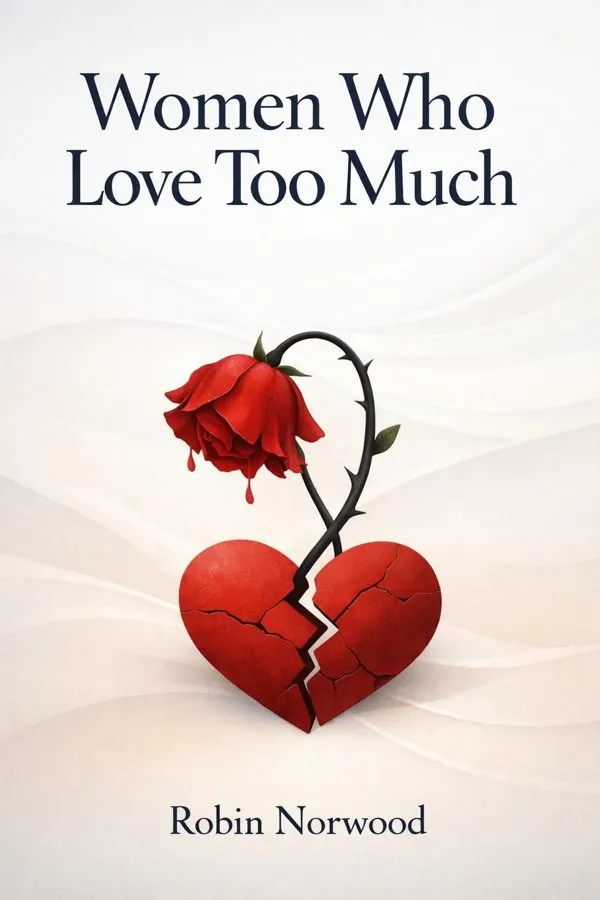
Women Who Love Too Much: Summary & Key Insights
 10 min9 chaptersAudio available
Key Takeaways from Women Who Love Too Much
One of the book’s most important insights is that loving too much is not about loving well—it is about loving compulsively.
The relationships we chase as adults often echo the emotional climate of our earliest home life.
A painful truth at the center of this book is that many women come to mistake suffering for love.
One of the most deceptive aspects of loving too much is that obsession often presents itself as concern.
Norwood shows that the rescuer role is not only about helping others—it is also a way of avoiding one’s own unmet needs, grief, and emptiness.
What Is Women Who Love Too Much About?
Women Who Love Too Much by Robin Norwood is a relationships book published in 1985 spanning 6 pages. Why do some women keep falling for partners who are distant, addicted, unreliable, or emotionally unavailable—and call it love? In Women Who Love Too Much, psychotherapist Robin Norwood explores this painful pattern with compassion and clarity. Drawing on her experience as a marriage and family therapist, she argues that many women are not simply unlucky in relationships; they are repeating emotional patterns rooted in childhood wounds, low self-worth, and a deep familiarity with chaos, longing, and caretaking. The book became a landmark in relationship self-help because it gives language to a form of attachment that often feels romantic from the inside but is actually compulsive, self-erasing, and destructive. Norwood shows how women can become addicted not just to a person, but to emotional struggle itself—to pursuing love, rescuing broken partners, and mistaking suffering for devotion. At the same time, she offers hope: awareness, responsibility, support, and healing can break the cycle. This book matters because it helps readers understand that healthier love begins not with fixing someone else, but with reclaiming themselves.
This FizzRead summary covers all 9 key chapters of Women Who Love Too Much in approximately 10 minutes, distilling the most important ideas, arguments, and takeaways from Robin Norwood's work. Also available as an audio summary and Key Quotes Podcast.
Women Who Love Too Much
Why do some women keep falling for partners who are distant, addicted, unreliable, or emotionally unavailable—and call it love? In Women Who Love Too Much, psychotherapist Robin Norwood explores this painful pattern with compassion and clarity. Drawing on her experience as a marriage and family therapist, she argues that many women are not simply unlucky in relationships; they are repeating emotional patterns rooted in childhood wounds, low self-worth, and a deep familiarity with chaos, longing, and caretaking. The book became a landmark in relationship self-help because it gives language to a form of attachment that often feels romantic from the inside but is actually compulsive, self-erasing, and destructive. Norwood shows how women can become addicted not just to a person, but to emotional struggle itself—to pursuing love, rescuing broken partners, and mistaking suffering for devotion. At the same time, she offers hope: awareness, responsibility, support, and healing can break the cycle. This book matters because it helps readers understand that healthier love begins not with fixing someone else, but with reclaiming themselves.
Who Should Read Women Who Love Too Much?
This book is perfect for anyone interested in relationships and looking to gain actionable insights in a short read. Whether you're a student, professional, or lifelong learner, the key ideas from Women Who Love Too Much by Robin Norwood will help you think differently.
- ✓Readers who enjoy relationships and want practical takeaways
- ✓Professionals looking to apply new ideas to their work and life
- ✓Anyone who wants the core insights of Women Who Love Too Much in just 10 minutes
Want the full summary?
Get instant access to this book summary and 100K+ more with Fizz Moment.
Get Free SummaryAvailable on App Store • Free to download
Key Chapters
One of the book’s most important insights is that loving too much is not about loving well—it is about loving compulsively. Norwood distinguishes healthy love from a form of attachment driven by obsession, anxiety, fear, and self-abandonment. A woman who loves too much may spend her emotional energy trying to win, keep, heal, or change a partner who gives little in return. Instead of asking whether the relationship is nourishing, she asks how she can work harder to make it succeed. Love becomes measured by pain, persistence, and sacrifice.
This pattern often looks socially admirable on the surface. She may seem loyal, generous, patient, and deeply committed. But underneath, she is trapped in emotional overinvestment. She may ignore lies, excuse neglect, minimize abuse, or organize her life around a partner’s moods and crises. The relationship becomes the center of her identity, while her own needs, ambitions, and well-being shrink.
For example, a woman may constantly check whether her partner is sober, employed, faithful, or emotionally stable. She calls this concern, but it slowly becomes vigilance and control. Another may stay with someone unavailable because occasional affection feels intensely rewarding after long stretches of pain. In both cases, what feels like love is often dependency.
Norwood’s key point is liberating: intensity does not equal intimacy. If a relationship consumes your peace, dignity, and self-respect, it is not proof of deep love. It is a sign that something painful is being repeated. Actionable takeaway: ask yourself whether your relationship is mutual and life-giving, or whether it survives mainly through your effort, worry, and sacrifice.
The relationships we chase as adults often echo the emotional climate of our earliest home life. Norwood argues that women who love too much frequently grew up in families marked by addiction, neglect, unpredictability, criticism, or emotional absence. As children, they learned to monitor others closely, to anticipate danger, to earn scraps of approval, and to become caretakers long before they were ready. Instead of receiving steady love, they adapted to instability.
This adaptation can look impressive. A girl may become competent, helpful, mature, and emotionally attuned. But her strength is built around survival. She learns that love means pleasing difficult people, calming chaos, and ignoring her own feelings. She may also absorb the belief that if she is good enough, patient enough, or selfless enough, she can finally be chosen and cherished.
As an adult, this conditioning creates powerful attraction to familiar emotional environments. A reliable, available partner may feel boring because stability is unfamiliar. A troubled or withholding partner, however, feels deeply compelling because the old childhood task returns: earn love, restore connection, rescue the wounded person. The adult relationship becomes an unconscious attempt to rewrite the past.
Consider someone raised by an alcoholic parent. She may later feel drawn to partners with addiction or erratic behavior, not because she wants suffering, but because she knows how to function in it. Chaos feels like home. Norwood shows that this pattern is not weakness; it is learned emotional training.
Actionable takeaway: reflect on what love looked like in your childhood. If love was linked to caretaking, fear, or earning approval, begin to question whether those same rules are shaping your adult relationships.
A painful truth at the center of this book is that many women come to mistake suffering for love. Norwood explains that when emotional deprivation begins early, longing itself can become eroticized and idealized. Waiting, worrying, hoping, forgiving, and trying harder all start to feel meaningful. The more difficult the relationship, the more valuable it may seem. This is why some women experience drama and heartbreak not as warning signs, but as evidence of depth.
The emotional logic is powerful: if love was scarce in childhood, then effort feels normal. If affection had to be earned, then struggle feels necessary. If tenderness came unpredictably, then intermittent rewards become intoxicating. A partner who is inconsistent can create a cycle of pain and relief that is psychologically gripping. Brief moments of closeness feel euphoric precisely because they are so rare.
This helps explain why friends and family may see a destructive relationship clearly while the woman inside it feels certain she has found something profound. She may say, “No one understands our connection,” when in fact the intensity comes from deprivation, not compatibility. She may also believe that her willingness to endure pain proves devotion and moral worth.
Norwood invites readers to challenge the cultural stories that glorify suffering in romance—the idea that true love means waiting endlessly, rescuing someone broken, or proving commitment through sacrifice. Real love does not require emotional starvation to feel meaningful.
Actionable takeaway: notice whether your strongest feelings in a relationship come from closeness and trust, or from longing, uncertainty, and relief after pain. If suffering is what makes the bond feel alive, it may be time to redefine what love should feel like.
One of the most deceptive aspects of loving too much is that obsession often presents itself as concern. Norwood describes how women caught in this pattern become consumed by another person’s problems, moods, habits, and choices. They analyze every conversation, anticipate every crisis, and monitor every sign of change. They may think they are being loving, supportive partners, but they are actually losing their own center.
This obsession often leads to controlling behavior. A woman may try to manage her partner’s drinking, job performance, finances, therapy, fidelity, or emotional stability. She pleads, advises, searches for solutions, covers up consequences, or makes threats she cannot sustain. The more she tries to control the relationship, the less agency she feels in her own life. Her attention goes outward, and her sense of self weakens.
The tragedy is that this pattern usually fails. The partner may resist, manipulate, or remain unchanged. Yet the woman often doubles down, believing she simply has not tried the right strategy yet. Her identity becomes tied to being the one who never gives up. Meanwhile, she may neglect sleep, work, friendships, parenting, health, and joy.
For example, someone may spend hours each day checking whether her partner has relapsed, reading his messages, calling his employer, and rehearsing interventions. She calls it love, but her life has become organized around his dysfunction. Norwood emphasizes that caring for someone is not the same as managing them.
Actionable takeaway: make a list of the time and energy you spend thinking about or trying to change your partner. Then ask what part of that effort would be better invested in your own healing, boundaries, and daily life.
Norwood shows that the rescuer role is not only about helping others—it is also a way of avoiding one’s own unmet needs, grief, and emptiness. If a woman focuses constantly on saving a troubled partner, she does not have to confront her own fear of abandonment, loneliness, low self-worth, or unresolved childhood pain. The relationship becomes a distraction with a noble disguise.
This dynamic can feel purposeful. Being needed creates identity. Solving crises creates urgency. Offering endless support can make a woman feel valuable and indispensable. But the cost is high: she becomes important through self-sacrifice rather than through authentic selfhood. She may not know what she wants, enjoys, believes, or needs outside the relationship because her energy is always directed toward someone else’s struggle.
This is why leaving a destructive relationship can feel terrifying even when it is clearly unhealthy. Without the project of rescuing someone, a woman may feel empty, guilty, restless, or directionless. The pain she was trying to outrun begins to surface. Norwood argues that real recovery begins when a woman stops defining herself by what she can endure or fix.
A practical example is someone who repeatedly chooses partners with severe problems because stability leaves her face-to-face with herself. She may say she wants peace, yet unconsciously recreate turmoil because chaos feels more familiar than inner stillness. Healing requires learning to tolerate that stillness and using it for self-discovery.
Actionable takeaway: ask yourself a difficult question—if your partner suddenly became healthy or disappeared from your life, who would you be then? Use the answer to identify the parts of yourself that need attention, compassion, and development.
A central turning point in Women Who Love Too Much is the shift from blame to responsibility. Norwood does not suggest that women are responsible for being mistreated. Rather, she argues that healing begins when they take responsibility for recognizing their patterns, making different choices, and stopping the cycle of self-abandonment. Waiting for a partner to change first keeps the woman trapped. Recovery starts when she turns toward her own life.
This is often a difficult message because it disrupts the fantasy that understanding, loving, or helping enough will finally transform the relationship. Norwood insists that no amount of devotion can heal another adult who does not want to change. The only person a woman can truly work on is herself. That means acknowledging denial, ending enabling behavior, accepting reality, and seeking support even when it feels uncomfortable.
Responsibility also means grieving illusions. It means admitting that the relationship one hoped for may never exist. It means seeing that repeated promises are not progress, and that love does not cancel harm. This honesty is painful, but it is also the beginning of freedom.
In practical terms, radical responsibility may involve attending therapy, joining a support group, stopping financial rescue, refusing to lie for a partner, moving out, or setting non-negotiable boundaries. It may also mean learning to sit with guilt without turning back toward dysfunction.
Actionable takeaway: identify one place where you are waiting for someone else to change before you reclaim your peace. Then choose one concrete action—however small—that places responsibility back in your own hands.
Another major contribution of the book is its insistence that recovery from compulsive relationship patterns requires structure and support. Norwood understands that women who love too much often promise themselves they will leave, detach, or stop obsessing—only to return again and again. This does not happen because they are weak. It happens because the pattern is deeply conditioned and emotionally addictive.
For that reason, insight by itself is rarely enough. A woman may fully understand that her relationship is unhealthy and still feel drawn back to it. The body, emotions, and nervous system remain attached to familiar cycles of pursuit, anxiety, and intermittent reward. Norwood recommends a recovery approach similar to addiction treatment: honesty, daily commitment, community, and ongoing self-examination.
Support can take many forms: psychotherapy, twelve-step groups, women’s groups, trusted friends, journaling, education, and routines that reduce isolation. These supports matter because they interrupt secrecy and provide reality when emotional thinking becomes distorted. Instead of relying on willpower in moments of craving or panic, the woman learns to reach outward for accountability and inward for self-awareness.
For example, someone tempted to call an ex every night might create a replacement ritual: attend a support meeting, write for twenty minutes, speak to a sponsor or friend, and go for a walk. Over time, these new practices weaken the old reflex of chasing relief through the relationship.
Actionable takeaway: build a recovery system before your next emotional crisis. Choose at least three supports—such as a therapist, a support group, and a daily writing practice—so you are not relying on insight alone when old patterns reappear.
Women who love too much often believe boundaries are selfish, cold, or unloving. Norwood challenges this belief directly. Without boundaries, love becomes enmeshment: one person’s needs dominate, while the other loses clarity about what she feels, allows, and deserves. Boundaries are not walls against love; they are the framework that makes mature love possible.
A boundary answers basic questions: What behavior will I accept? What is mine to manage, and what belongs to someone else? What will I do if my limit is crossed? These questions are especially important for women who are used to tolerating emotional volatility, dishonesty, addiction, neglect, or disrespect. When boundaries are absent, they keep adjusting themselves to avoid conflict and preserve connection. The result is resentment, confusion, and self-betrayal.
Healthy boundaries are behavioral, not just emotional wishes. Saying, “I need you to treat me better,” is vague. Saying, “If you continue to yell at me, I will end the conversation and leave,” is a boundary. Likewise, “I won’t lend money again,” “I will not cover for your drinking,” or “I’m ending this relationship if you continue to lie” are clear limits tied to action.
Norwood’s deeper point is that boundaries restore self-respect. They teach a woman that she does not have to disappear to maintain attachment. They also reveal the truth about a relationship: a healthy partner can respect limits, while a destructive one usually fights them.
Actionable takeaway: choose one recurring behavior that causes you pain and write a specific boundary around it, including the consequence you will follow through on if the behavior continues.
The end goal of recovery is not simply leaving a damaging relationship. It is becoming whole enough that different relationships begin to feel attractive. Norwood emphasizes that until a woman heals her underlying wounds, she may leave one unhealthy partner only to choose another with the same emotional profile. Real transformation happens when her sense of self no longer depends on being needed, chosen, or rescued by romantic love.
Wholeness means developing an identity outside relationship struggle. It includes emotional honesty, self-care, spiritual or psychological growth, supportive community, meaningful work, rest, and pleasure. It also involves learning to value calm, consistency, and reciprocity—even if those qualities once felt unfamiliar or underwhelming. The nervous system must be retrained to recognize peace as safe rather than dull.
This can be surprisingly challenging. A stable partner may initially seem less exciting than a troubled one. There is less drama, less pursuit, less fantasy. But over time, a healthier love offers something far more sustaining: trust, mutuality, and space for both people to remain fully themselves. Norwood wants readers to understand that genuine intimacy does not require emotional emergency.
In practice, wholeness might look like taking time off from dating, rebuilding friendships, pursuing creative interests, healing financially, practicing solitude, or learning to notice red flags early. As self-worth grows, tolerance for mistreatment shrinks.
Actionable takeaway: create a definition of love that does not include pain, chasing, fixing, or proving. Return to that definition whenever attraction pulls you back toward intensity disguised as intimacy.
All Chapters in Women Who Love Too Much
About the Author
Robin Norwood is an American psychotherapist and bestselling author known for her work on unhealthy relationship patterns, emotional dependency, and recovery. Trained as a marriage and family therapist, she spent years counseling individuals and couples, where she noticed a recurring pattern among women who were intensely drawn to troubled, distant, or addicted partners. That clinical experience led her to write Women Who Love Too Much, the book that made her internationally known. Her approach blends therapeutic insight with direct, compassionate guidance, helping readers understand how childhood conditioning can shape adult love. Norwood’s work has had a lasting influence on conversations about codependency, attachment wounds, and healing from compulsive relationships, and her ideas continue to resonate with readers seeking healthier forms of intimacy.
Get This Summary in Your Preferred Format
Read or listen to the Women Who Love Too Much summary by Robin Norwood anytime, anywhere. FizzRead offers multiple formats so you can learn on your terms — all free.
Available formats: App · Audio · PDF · EPUB — All included free with FizzRead
Download Women Who Love Too Much PDF and EPUB Summary
Key Quotes from Women Who Love Too Much
“One of the book’s most important insights is that loving too much is not about loving well—it is about loving compulsively.”
“The relationships we chase as adults often echo the emotional climate of our earliest home life.”
“A painful truth at the center of this book is that many women come to mistake suffering for love.”
“One of the most deceptive aspects of loving too much is that obsession often presents itself as concern.”
“Norwood shows that the rescuer role is not only about helping others—it is also a way of avoiding one’s own unmet needs, grief, and emptiness.”
Frequently Asked Questions about Women Who Love Too Much
Women Who Love Too Much by Robin Norwood is a relationships book that explores key ideas across 9 chapters. Why do some women keep falling for partners who are distant, addicted, unreliable, or emotionally unavailable—and call it love? In Women Who Love Too Much, psychotherapist Robin Norwood explores this painful pattern with compassion and clarity. Drawing on her experience as a marriage and family therapist, she argues that many women are not simply unlucky in relationships; they are repeating emotional patterns rooted in childhood wounds, low self-worth, and a deep familiarity with chaos, longing, and caretaking. The book became a landmark in relationship self-help because it gives language to a form of attachment that often feels romantic from the inside but is actually compulsive, self-erasing, and destructive. Norwood shows how women can become addicted not just to a person, but to emotional struggle itself—to pursuing love, rescuing broken partners, and mistaking suffering for devotion. At the same time, she offers hope: awareness, responsibility, support, and healing can break the cycle. This book matters because it helps readers understand that healthier love begins not with fixing someone else, but with reclaiming themselves.
You Might Also Like
The 5 Love Languages
Gary Chapman
10 min
Men Are from Mars, Women Are from Venus
John Gray
10 min
She Comes First
Ian Kerner
10 min
No More Mr Nice Guy
Robert Glover
10 min
Hold Me Tight
Sue Johnson
10 min
Mating in Captivity
Esther Perel
10 minFeatured In
Browse by Category
Ready to read Women Who Love Too Much?
Get the full summary and 100K+ more books with Fizz Moment.