
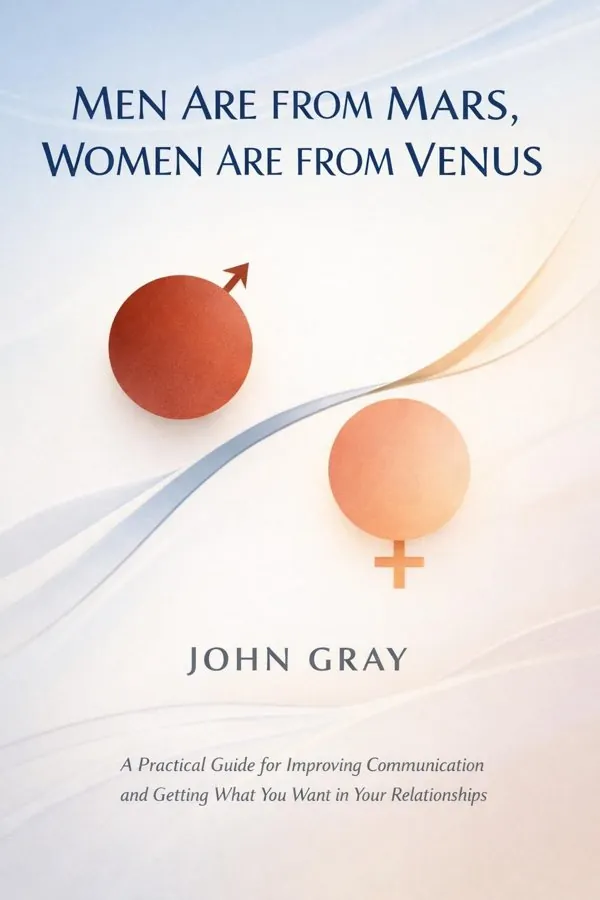
Men Are from Mars, Women Are from Venus: Summary & Key Insights
by John Gray
 10 min5 chaptersAudio available
Key Takeaways from Men Are from Mars, Women Are from Venus
One of the book’s most memorable ideas is that men and women often respond to stress in opposite ways.
This means two people can enter the same conversation with good intentions and still leave feeling frustrated.
A major theme in the book is that love is not only about intention; it is about whether each partner feels emotionally nourished in the way that matters most to them.
Gray emphasizes that many relationship arguments are not just about what is said, but when and how it is said.
Another important idea in the book is that closeness in relationships is not perfectly linear.
What Is Men Are from Mars, Women Are from Venus About?
Men Are from Mars, Women Are from Venus by John Gray is a relationships book published in 1992 spanning 5 pages. Why do loving couples so often end up feeling misunderstood? That question sits at the heart of Men Are from Mars, Women Are from Venus, one of the most widely recognized relationship books of the modern era. John Gray argues that many recurring conflicts in romance are not caused by bad intentions or lack of love, but by deep differences in how men and women often process stress, communicate needs, and interpret emotional signals. His famous metaphor—men as if from Mars and women as if from Venus—gives readers a simple way to understand why two caring people can experience the same moment so differently. What makes the book matter is its practicality. Rather than offering abstract theories, Gray focuses on everyday relationship pain points: one partner shuts down, the other wants to talk; one offers advice, the other feels unheard; one craves appreciation, the other needs reassurance. By naming these patterns, he helps couples replace blame with understanding. Gray, a relationship counselor, lecturer, and bestselling author of the Mars and Venus series, wrote this book as a guide for better communication and emotional connection. Whether you are dating, married, or trying to make sense of recurring tension, this book offers a vocabulary for turning frustration into empathy.
This FizzRead summary covers all 5 key chapters of Men Are from Mars, Women Are from Venus in approximately 10 minutes, distilling the most important ideas, arguments, and takeaways from John Gray's work. Also available as an audio summary and Key Quotes Podcast.
Men Are from Mars, Women Are from Venus: A Practical Guide for Improving Communication and Getting What You Want in Your Relationships
Why do loving couples so often end up feeling misunderstood? That question sits at the heart of Men Are from Mars, Women Are from Venus, one of the most widely recognized relationship books of the modern era. John Gray argues that many recurring conflicts in romance are not caused by bad intentions or lack of love, but by deep differences in how men and women often process stress, communicate needs, and interpret emotional signals. His famous metaphor—men as if from Mars and women as if from Venus—gives readers a simple way to understand why two caring people can experience the same moment so differently.
What makes the book matter is its practicality. Rather than offering abstract theories, Gray focuses on everyday relationship pain points: one partner shuts down, the other wants to talk; one offers advice, the other feels unheard; one craves appreciation, the other needs reassurance. By naming these patterns, he helps couples replace blame with understanding. Gray, a relationship counselor, lecturer, and bestselling author of the Mars and Venus series, wrote this book as a guide for better communication and emotional connection. Whether you are dating, married, or trying to make sense of recurring tension, this book offers a vocabulary for turning frustration into empathy.
Who Should Read Men Are from Mars, Women Are from Venus?
This book is perfect for anyone interested in relationships and looking to gain actionable insights in a short read. Whether you're a student, professional, or lifelong learner, the key ideas from Men Are from Mars, Women Are from Venus by John Gray will help you think differently.
- ✓Readers who enjoy relationships and want practical takeaways
- ✓Professionals looking to apply new ideas to their work and life
- ✓Anyone who wants the core insights of Men Are from Mars, Women Are from Venus in just 10 minutes
Want the full summary?
Get instant access to this book summary and 100K+ more with Fizz Moment.
Get Free SummaryAvailable on App Store • Free to download
Key Chapters
One of the book’s most memorable ideas is that men and women often respond to stress in opposite ways. Gray says men tend to “go to their caves.” In other words, when pressure builds, they pull back, become quiet, and try to solve things internally before re-engaging. A man might come home from a difficult day and sit silently, watch television, scroll on his phone, or immerse himself in a hobby. To him, this pause is restorative. It is not necessarily a rejection of his partner; it is often his way of regaining a sense of competence and calm.
Women, Gray argues, usually move in the other direction. When stressed, they often want to talk, connect, and feel emotionally understood. Sharing details is not pointless repetition; it is a way of processing emotion and easing tension. This creates a classic mismatch: the more she reaches for connection, the more he may retreat; the more he retreats, the more she may feel abandoned.
The practical lesson is to stop mislabeling each other’s coping style. If he needs a short period of quiet, agree on that space without assuming the relationship is in danger. If she needs to talk, respond first with warmth rather than solutions. A helpful script for men is: “I want to hear you. That sounds really hard.” A helpful script for women is: “Take a little time if you need it, but please come back and check in with me.” The goal is not to erase differences, but to create safety around them.
Gray’s central communication insight is simple but powerful: many men show love by trying to solve problems, while many women feel most loved when their emotions are heard and validated. This means two people can enter the same conversation with good intentions and still leave feeling frustrated. Imagine a woman says, “I’m overwhelmed. My boss ignored my work all day, and I feel terrible.” If her partner quickly replies, “You should confront your boss” or “Maybe you need better time management,” he may think he is being useful. She may hear something very different: “Your feelings are inconvenient, and I’d rather fix you than understand you.”
Gray argues that empathy must come before advice. For many women, emotional relief begins when someone says, “That sounds exhausting,” “I can see why you’d be upset,” or “Tell me more.” These responses communicate presence, not correction. Men often need to learn that listening itself is an act of love, not a passive substitute for action.
At the same time, Gray encourages women to recognize the positive intention behind problem-solving. Advice is often a sign of care, not domination. If a woman wants listening instead of solutions, she can ask clearly: “I don’t need you to fix this right now. I just want you to hear me.” That one sentence can prevent a familiar spiral.
Actionably, couples can create a rule for emotional conversations: first listen, then ask, “Do you want empathy, brainstorming, or both?” That small shift helps translate love into the form the other person can actually receive.
A major theme in the book is that love is not only about intention; it is about whether each partner feels emotionally nourished in the way that matters most to them. Gray suggests that men often feel deeply fulfilled when they feel needed, trusted, and appreciated. Women, by contrast, often feel most secure when they feel cherished, cared for, and emotionally prioritized. Problems begin when each partner gives love in the form they themselves naturally value, rather than in the form the other most easily recognizes.
For example, a woman may express love by offering attention, concern, and detailed emotional check-ins. She may assume this closeness will automatically make her partner feel loved. But if he rarely feels appreciated for his efforts, he may still feel unseen. Likewise, a man may work hard, solve practical problems, and assume his dedication is obvious proof of love. Yet if he rarely expresses tenderness, interest, or reassurance, his partner may feel emotionally neglected despite everything he does.
Gray’s advice is to become intentional about “translation.” Men can practice small but powerful gestures that help a woman feel cherished: remembering details, offering affection without being prompted, asking how she feels, or making time to listen without distraction. Women can help men feel needed and appreciated by acknowledging effort, expressing trust, and avoiding constant correction that may feel like disapproval.
A useful practice is daily appreciation. Each partner shares one thing they appreciated that day: “Thank you for taking care of that,” or “I loved how present you were with me tonight.” These moments may seem small, but they reinforce emotional security. In Gray’s framework, relationships improve when partners stop asking, “Am I loving?” and start asking, “Does my partner actually feel loved?”
Gray emphasizes that many relationship arguments are not just about what is said, but when and how it is said. Timing and tone often determine whether a conversation becomes constructive or explosive. A valid concern raised at the wrong moment—when one person is exhausted, rushed, defensive, or already overwhelmed—can quickly be heard as criticism. Likewise, a gentle request delivered with sarcasm, accumulated resentment, or a sharp tone can trigger conflict even if the underlying message is reasonable.
This is especially important in the Mars-Venus framework because men and women may react differently to perceived criticism. Gray suggests that men often become defensive or withdrawn when they feel they are failing, while women may become more emotionally expressive when they feel ignored or unsupported. This creates a cycle: the stronger her protest, the more he pulls away; the more he pulls away, the stronger her protest becomes.
The solution is to make difficult conversations safer. Instead of launching into a complaint the second irritation appears, choose a calmer moment and frame concerns as requests rather than accusations. For example, replace “You never listen to me” with “Can we set aside 15 minutes tonight to talk without distractions?” Replace “You don’t care” with “I feel more connected when you check in with me.” Gray’s approach encourages reducing blame and increasing clarity.
Couples can also benefit from a pause ritual. If emotions rise too quickly, agree to stop, cool down, and return at a specific time. The key is returning—space should support understanding, not become avoidance. In Gray’s view, respectful timing and a softer tone do not weaken honesty; they make honesty easier to hear.
Another important idea in the book is that closeness in relationships is not perfectly linear. Gray argues that intimacy naturally moves in cycles. There are periods of warmth, openness, and emotional closeness, followed by moments when one partner—often the man in Gray’s model—needs more independence, distance, or personal space. He compares this to a rubber band: a person may pull away temporarily, but if the relationship remains secure, they often return with renewed affection.
The problem is that many couples misinterpret this rhythm. When a partner becomes less expressive, less available, or more focused on solitary pursuits, the other may panic and assume love is fading. That anxiety can lead to clinging, criticism, repeated questioning, or demands for reassurance. Ironically, those reactions can intensify the distance. Gray’s key point is that temporary withdrawal does not always signal emotional danger; sometimes it is simply part of the relationship’s natural breathing pattern.
For women, this may mean learning not to interpret every dip in connection as abandonment. For men, it means recognizing that their need for space affects their partner emotionally and should be communicated with care. Rather than disappearing, a man might say, “I need a little time to reset, but I love you and I’ll reconnect later.” That reassurance changes everything.
A helpful practice is to normalize rhythm instead of fearing it. Couples can discuss their patterns openly: What does healthy space look like? How long is too long? What helps each person feel secure during periods of distance? By planning for these cycles instead of resisting them, partners can create a relationship that allows both autonomy and intimacy.
All Chapters in Men Are from Mars, Women Are from Venus
About the Author
John Gray, Ph.D., is an American relationship counselor, lecturer, and author best known for helping readers understand communication patterns between men and women. He rose to international prominence through his Mars and Venus series, which sold millions of copies worldwide and was translated into numerous languages. Gray holds a doctorate in psychology and has been a prominent voice in relationship counseling since the 1990s. His work focuses on practical strategies for reducing misunderstanding, improving emotional connection, and helping couples build more supportive, harmonious relationships through better communication.
Get This Summary in Your Preferred Format
Read or listen to the Men Are from Mars, Women Are from Venus summary by John Gray anytime, anywhere. FizzRead offers multiple formats so you can learn on your terms — all free.
Available formats: App · Audio · PDF · EPUB — All included free with FizzRead
Download Men Are from Mars, Women Are from Venus PDF and EPUB Summary
Key Quotes from Men Are from Mars, Women Are from Venus
“One of the book’s most memorable ideas is that men and women often respond to stress in opposite ways.”
“Gray’s central communication insight is simple but powerful: many men show love by trying to solve problems, while many women feel most loved when their emotions are heard and validated.”
“A major theme in the book is that love is not only about intention; it is about whether each partner feels emotionally nourished in the way that matters most to them.”
“Gray emphasizes that many relationship arguments are not just about what is said, but when and how it is said.”
“Another important idea in the book is that closeness in relationships is not perfectly linear.”
Frequently Asked Questions about Men Are from Mars, Women Are from Venus
Men Are from Mars, Women Are from Venus by John Gray is a relationships book that explores key ideas across 5 chapters. Why do loving couples so often end up feeling misunderstood? That question sits at the heart of Men Are from Mars, Women Are from Venus, one of the most widely recognized relationship books of the modern era. John Gray argues that many recurring conflicts in romance are not caused by bad intentions or lack of love, but by deep differences in how men and women often process stress, communicate needs, and interpret emotional signals. His famous metaphor—men as if from Mars and women as if from Venus—gives readers a simple way to understand why two caring people can experience the same moment so differently. What makes the book matter is its practicality. Rather than offering abstract theories, Gray focuses on everyday relationship pain points: one partner shuts down, the other wants to talk; one offers advice, the other feels unheard; one craves appreciation, the other needs reassurance. By naming these patterns, he helps couples replace blame with understanding. Gray, a relationship counselor, lecturer, and bestselling author of the Mars and Venus series, wrote this book as a guide for better communication and emotional connection. Whether you are dating, married, or trying to make sense of recurring tension, this book offers a vocabulary for turning frustration into empathy.
Compare Men Are from Mars, Women Are from Venus



You Might Also Like



Featured In
Browse by Category
Ready to read Men Are from Mars, Women Are from Venus?
Get the full summary and 100K+ more books with Fizz Moment.