
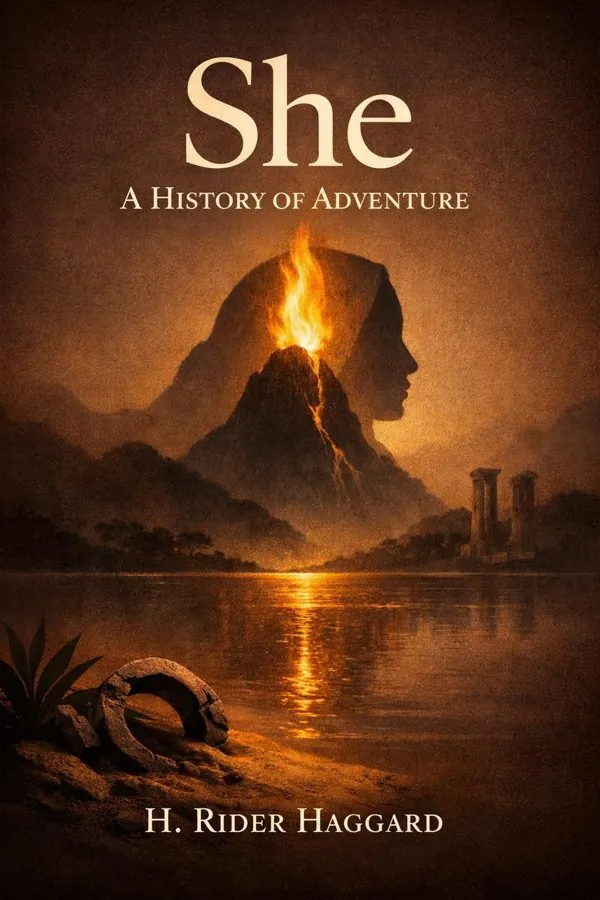
She Comes First: Summary & Key Insights
by Ian Kerner
 10 min4 chaptersAudio available
Key Takeaways from She Comes First
The story begins with a classic narrative device: a sealed inheritance that binds the present to an ancient past.
Once Holly, Leo, and Job leave England, the novel shifts from intellectual puzzle to ordeal.
At the heart of the novel lies Ayesha’s own account of who she is and how she came to endure across centuries.
The novel’s final movement turns its central fantasy inside out.
What Is She Comes First About?
She Comes First by Ian Kerner is a relationships book published in 1994 spanning 4 pages. If you came here looking for a summary of Ian Kerner’s *She Comes First*, the current material is actually about a very different book: *She: A History of Adventure* by Sir Henry Rider Haggard. That distinction matters, because this is not a modern relationships guide but a foundational adventure novel about obsession, fate, beauty, power, and the terrifying appeal of immortality. First published in 1887, *She* became one of the defining works of the “lost world” genre and helped shape later fantasy and adventure fiction. What makes the novel endure is not just its exotic setting or dramatic plot, but the psychological tension at its core. Through the scholarly Horace Holly and the charismatic Leo Vincey, Haggard leads readers from Victorian rationalism into a realm where myth feels more persuasive than logic. At the center stands Ayesha—“She-who-must-be-obeyed”—one of literature’s most unforgettable figures: alluring, intelligent, dangerous, and tragic. The novel asks timeless questions: What happens when love becomes possession? When knowledge becomes power? When the desire to defeat death costs us our humanity? For readers interested in classic literature, fantasy origins, and morally complex storytelling, *She* remains surprisingly compelling.
This FizzRead summary covers all 4 key chapters of She Comes First in approximately 10 minutes, distilling the most important ideas, arguments, and takeaways from Ian Kerner's work. Also available as an audio summary and Key Quotes Podcast.
She: A History of Adventure
If you came here looking for a summary of Ian Kerner’s *She Comes First*, the current material is actually about a very different book: *She: A History of Adventure* by Sir Henry Rider Haggard. That distinction matters, because this is not a modern relationships guide but a foundational adventure novel about obsession, fate, beauty, power, and the terrifying appeal of immortality. First published in 1887, *She* became one of the defining works of the “lost world” genre and helped shape later fantasy and adventure fiction.
What makes the novel endure is not just its exotic setting or dramatic plot, but the psychological tension at its core. Through the scholarly Horace Holly and the charismatic Leo Vincey, Haggard leads readers from Victorian rationalism into a realm where myth feels more persuasive than logic. At the center stands Ayesha—“She-who-must-be-obeyed”—one of literature’s most unforgettable figures: alluring, intelligent, dangerous, and tragic. The novel asks timeless questions: What happens when love becomes possession? When knowledge becomes power? When the desire to defeat death costs us our humanity? For readers interested in classic literature, fantasy origins, and morally complex storytelling, *She* remains surprisingly compelling.
Who Should Read She Comes First?
This book is perfect for anyone interested in relationships and looking to gain actionable insights in a short read. Whether you're a student, professional, or lifelong learner, the key ideas from She Comes First by Ian Kerner will help you think differently.
- ✓Readers who enjoy relationships and want practical takeaways
- ✓Professionals looking to apply new ideas to their work and life
- ✓Anyone who wants the core insights of She Comes First in just 10 minutes
Want the full summary?
Get instant access to this book summary and 100K+ more with Fizz Moment.
Get Free SummaryAvailable on App Store • Free to download
Key Chapters
The story begins with a classic narrative device: a sealed inheritance that binds the present to an ancient past. Horace Holly, a practical scholar who trusts evidence over superstition, is asked by his dying friend to safeguard an iron box until Leo Vincey turns twenty-five. That waiting period matters. It turns the box into more than a container of objects; it becomes a vessel of suspense, destiny, and intergenerational obligation. When Holly and Leo finally open it, they find relics and writings that suggest Leo’s lineage reaches back to a forgotten world of Egyptian ritual, forbidden love, and murder.
This opening works because it mixes the ordinary and the unbelievable. A legal duty becomes a mythic summons. The parchments do not simply provide exposition; they reframe Leo’s identity. He is no longer just a young Englishman but a possible continuation of Kallikrates, the man Ayesha loved and killed. Holly, though skeptical, recognizes that some mysteries exert power before they are proven. That tension between reason and fascination drives the entire novel.
A useful takeaway for readers is how powerfully stories shape action. Holly and Leo act not because they have certainty, but because the narrative they uncover feels meaningful enough to test. In modern terms, this is a reminder that the stories we inherit—family history, cultural myths, personal identity—often guide major choices long before facts are complete. Haggard shows that curiosity can be noble, but once a mystery starts to feel like destiny, it also becomes dangerous.
Once Holly, Leo, and Job leave England, the novel shifts from intellectual puzzle to ordeal. The journey into Africa is not simply travel; it is a stripping away of safety, status, and certainty. Shipwreck, exhaustion, hostile terrain, and dependence on strangers all force the characters beyond the protections of “civilized” life. Haggard uses this progression to make the entrance into Kôr feel earned. The hidden kingdom is not discovered casually—it is reached through suffering, persistence, and the gradual collapse of ordinary assumptions.
Kôr itself is one of the book’s great achievements: a city of ruin, grandeur, and eerie continuity, where the past has not fully died. Its architecture and ritual suggest a civilization suspended between decay and permanence, making it the perfect setting for Ayesha. When Holly and Leo finally meet her, the emotional center of the novel snaps into place. Ayesha is not merely beautiful; she is commanding in a way that unsettles judgment. Holly, the observer, becomes vulnerable to awe. Leo, the supposed reincarnation of Kallikrates, is drawn in by forces that feel both romantic and fatal.
The key insight here is that environments shape belief. Haggard carefully shows how fear, exhaustion, atmosphere, and repeated signs of legend make the impossible easier to accept. In everyday life, people are also influenced by context—charismatic leaders, emotionally charged spaces, and high-stakes situations can weaken skepticism. This chapter reminds readers to notice when intensity and mystery begin to override clear thinking. The road into Kôr is also the road into enchantment.
At the heart of the novel lies Ayesha’s own account of who she is and how she came to endure across centuries. Her story transforms her from an enigmatic ruler into a tragic, morally compromised figure. She presents herself as a woman of immense intelligence, desire, and will—someone who loved Kallikrates so absolutely that jealousy drove her to kill him. That confession is central. Ayesha is not simply waiting for lost love; she is trying to reverse the consequences of her own destructive passion. Her immortality, gained through the mysterious Flame of Life, is inseparable from guilt.
The Flame of Life functions as both plot device and symbol. On the surface, it offers what humans have always wanted: youth, renewal, and freedom from death. But Haggard uses it to ask whether limitless life actually deepens wisdom or merely preserves obsession. Ayesha has had centuries to reflect, yet she remains bound to the same unresolved desire. Time has not purified her longing; it has intensified it. In that sense, immortality does not heal character flaws—it magnifies them.
One practical lesson readers can draw is that power rarely solves emotional disorder. More time, more beauty, more status, or more control do not automatically produce peace. Ayesha embodies the fantasy that one extraordinary gift can compensate for moral failure and emotional fixation. It cannot. The Flame promises transcendence, but it reveals character instead. Haggard suggests that the real test is not whether we can extend life, but whether we can live wisely within our limits.
The novel’s final movement turns its central fantasy inside out. After all the buildup around Ayesha’s beauty, authority, and seeming invincibility, the idea of immortality is exposed as unstable and catastrophic. Believing she can safely reenter the Flame of Life and secure a renewed future with Leo, Ayesha instead undergoes a horrifying reversal. Her body collapses from supernatural magnificence into age and ruin, and the spectacle shatters the illusion that power can be possessed without consequence.
This ending matters because it rescues the book from being a simple romance of eternal life. Haggard makes clear that immortality is not a prize to be seized but a force beyond ordinary human mastery. Ayesha’s downfall is also moral. She has believed for too long that beauty guarantees authority, that longing justifies domination, and that destiny entitles her to reclaim love on her own terms. The destruction of her body reveals the fragility hidden beneath absolutism.
For Holly and Leo, the lesson is devastating but clarifying. They leave not with treasure or triumph, but with a deeper understanding of mortality. In modern language, the chapter warns against fantasies of total control—over aging, over other people, over fate itself. Many pursuits in life promise permanence: legacy, status, perfect love, invulnerability. Haggard’s insight is that these pursuits become dangerous when they deny human limits. Mortality, painful as it is, may be part of what keeps love humble, power accountable, and desire human.
All Chapters in She Comes First
About the Author
Sir Henry Rider Haggard (1856–1925) was an English writer best known for his adventure novels, especially *King Solomon’s Mines* and *She*. He became one of the defining voices of late 19th-century popular fiction and played a major role in shaping the “lost world” genre. His stories often combined exploration, ancient civilizations, supernatural mystery, and high-stakes moral conflict. Haggard’s influence can be seen in later adventure and fantasy writing, where hidden kingdoms, immortal rulers, and perilous quests became familiar motifs. Among his works, *She* remains one of his most famous and enduring novels, remembered for the haunting figure of Ayesha and its meditation on love, power, and mortality.
Get This Summary in Your Preferred Format
Read or listen to the She Comes First summary by Ian Kerner anytime, anywhere. FizzRead offers multiple formats so you can learn on your terms — all free.
Available formats: App · Audio · PDF · EPUB — All included free with FizzRead
Download She Comes First PDF and EPUB Summary
Key Quotes from She Comes First
“The story begins with a classic narrative device: a sealed inheritance that binds the present to an ancient past.”
“Once Holly, Leo, and Job leave England, the novel shifts from intellectual puzzle to ordeal.”
“At the heart of the novel lies Ayesha’s own account of who she is and how she came to endure across centuries.”
“The novel’s final movement turns its central fantasy inside out.”
Frequently Asked Questions about She Comes First
She Comes First by Ian Kerner is a relationships book that explores key ideas across 4 chapters. If you came here looking for a summary of Ian Kerner’s *She Comes First*, the current material is actually about a very different book: *She: A History of Adventure* by Sir Henry Rider Haggard. That distinction matters, because this is not a modern relationships guide but a foundational adventure novel about obsession, fate, beauty, power, and the terrifying appeal of immortality. First published in 1887, *She* became one of the defining works of the “lost world” genre and helped shape later fantasy and adventure fiction. What makes the novel endure is not just its exotic setting or dramatic plot, but the psychological tension at its core. Through the scholarly Horace Holly and the charismatic Leo Vincey, Haggard leads readers from Victorian rationalism into a realm where myth feels more persuasive than logic. At the center stands Ayesha—“She-who-must-be-obeyed”—one of literature’s most unforgettable figures: alluring, intelligent, dangerous, and tragic. The novel asks timeless questions: What happens when love becomes possession? When knowledge becomes power? When the desire to defeat death costs us our humanity? For readers interested in classic literature, fantasy origins, and morally complex storytelling, *She* remains surprisingly compelling.
Compare She Comes First
More by Ian Kerner
You Might Also Like

The 5 Love Languages
Gary Chapman
10 min
Men Are from Mars, Women Are from Venus
John Gray
10 min
No More Mr Nice Guy
Robert Glover
10 min
Hold Me Tight
Sue Johnson
10 min
Mating in Captivity
Esther Perel
10 min
Women Who Love Too Much
Robin Norwood
10 minFeatured In
Browse by Category
Ready to read She Comes First?
Get the full summary and 100K+ more books with Fizz Moment.