
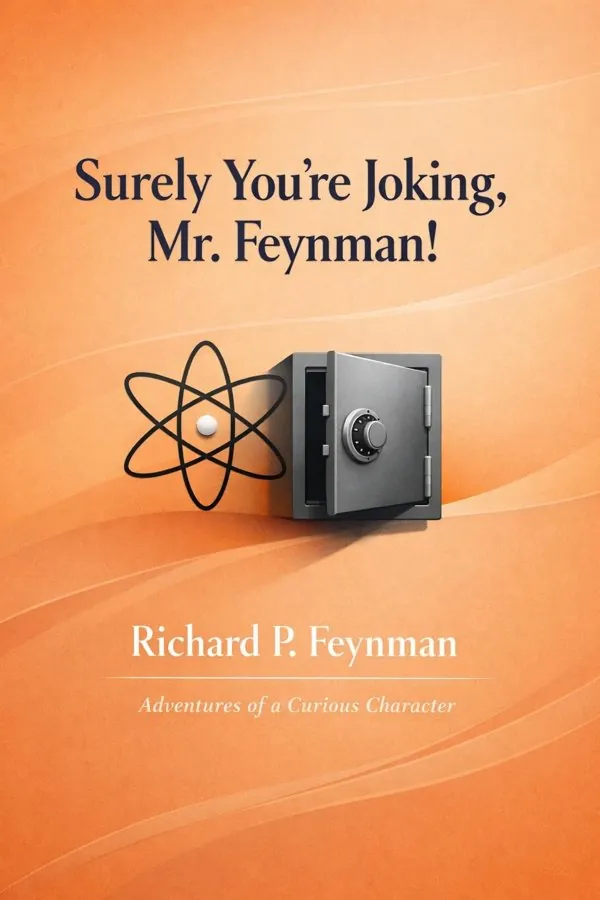
Surely You're Joking, Mr. Feynman!: Summary & Key Insights
 10 min10 chaptersAudio available
Key Takeaways from Surely You're Joking, Mr. Feynman!
A great mind is often shaped less by answers than by the habit of asking better questions.
The fastest route to mastery is often disguised as enjoyment.
Intelligence becomes far more useful when it is paired with the courage to doubt appearances.
Even world-changing work is still done by imperfect human beings in imperfect systems.
When meaning disappears, it is often renewed not by ambition but by playfully reengaging with the world.
What Is Surely You're Joking, Mr. Feynman! About?
Surely You're Joking, Mr. Feynman! by Richard P. Feynman is a biographies book published in 1985 spanning 10 pages. Surely You're Joking, Mr. Feynman! is not a conventional memoir, and that is exactly why it remains so memorable. Drawn from conversations between Nobel Prize–winning physicist Richard P. Feynman and Ralph Leighton, the book gathers a series of lively autobiographical stories that show Feynman at work, at play, and in constant pursuit of understanding. We meet him as a curious boy in Far Rockaway, a gifted student at MIT and Princeton, a young scientist at Los Alamos, and later a world-famous professor who still approached life with the enthusiasm of an amateur. What makes the book matter is that it is not really about fame or even physics. It is about a way of seeing: questioning assumptions, testing ideas firsthand, resisting pretension, and staying open to surprise. Feynman’s adventures with safecracking, teaching, drumming, drawing, and traveling reveal the same mindset that fueled his scientific breakthroughs. His authority comes not only from winning the 1965 Nobel Prize in Physics for work in quantum electrodynamics, but from his rare ability to connect rigorous thinking with playful curiosity. The result is a biography of a mind fully awake to the world.
This FizzRead summary covers all 10 key chapters of Surely You're Joking, Mr. Feynman! in approximately 10 minutes, distilling the most important ideas, arguments, and takeaways from Richard P. Feynman's work. Also available as an audio summary and Key Quotes Podcast.
Surely You're Joking, Mr. Feynman!
Surely You're Joking, Mr. Feynman! is not a conventional memoir, and that is exactly why it remains so memorable. Drawn from conversations between Nobel Prize–winning physicist Richard P. Feynman and Ralph Leighton, the book gathers a series of lively autobiographical stories that show Feynman at work, at play, and in constant pursuit of understanding. We meet him as a curious boy in Far Rockaway, a gifted student at MIT and Princeton, a young scientist at Los Alamos, and later a world-famous professor who still approached life with the enthusiasm of an amateur.
What makes the book matter is that it is not really about fame or even physics. It is about a way of seeing: questioning assumptions, testing ideas firsthand, resisting pretension, and staying open to surprise. Feynman’s adventures with safecracking, teaching, drumming, drawing, and traveling reveal the same mindset that fueled his scientific breakthroughs. His authority comes not only from winning the 1965 Nobel Prize in Physics for work in quantum electrodynamics, but from his rare ability to connect rigorous thinking with playful curiosity. The result is a biography of a mind fully awake to the world.
Who Should Read Surely You're Joking, Mr. Feynman!?
This book is perfect for anyone interested in biographies and looking to gain actionable insights in a short read. Whether you're a student, professional, or lifelong learner, the key ideas from Surely You're Joking, Mr. Feynman! by Richard P. Feynman will help you think differently.
- ✓Readers who enjoy biographies and want practical takeaways
- ✓Professionals looking to apply new ideas to their work and life
- ✓Anyone who wants the core insights of Surely You're Joking, Mr. Feynman! in just 10 minutes
Want the full summary?
Get instant access to this book summary and 100K+ more with Fizz Moment.
Get Free SummaryAvailable on App Store • Free to download
Key Chapters
A great mind is often shaped less by answers than by the habit of asking better questions. In the opening episodes of Feynman’s life, we see how his father, Melville, nurtured exactly that habit. Rather than stuffing his son with facts, he taught him to look closely, to compare, to wonder, and to distinguish between naming something and actually understanding it. If you know the name of a bird in multiple languages, Feynman’s father suggested, you still may know nothing about how it behaves. That lesson became foundational: words are not knowledge, and labels are not explanations.
This approach helps explain Feynman’s lifelong independence of mind. From childhood, he learned to inspect mechanisms, experiment with radios, and delight in figuring things out for himself. He was not content to repeat what adults said; he wanted to know why it worked. That orientation later became a scientific superpower, but it also applies to ordinary life. In school, at work, and in public debate, people often confuse familiarity with understanding. We hear jargon, absorb headlines, or repeat expert language without ever tracing cause and effect.
Feynman’s early experiences suggest a better model for learning. Instead of memorizing isolated facts, ask what phenomenon they explain. Instead of chasing credentials alone, build contact with reality through observation and experimentation. A student might test a concept with a homemade experiment. A manager might ask what evidence supports a decision. A parent might encourage children to explore how things function instead of rewarding rote recitation.
The practical takeaway is simple: when you encounter new information, do not stop at the name. Ask what it means, how it works, and what you can verify for yourself.
The fastest route to mastery is often disguised as enjoyment. Feynman’s years at MIT and Princeton show that his brilliance was not powered by grim discipline alone, but by fascination. He studied physics because it felt alive to him. He played with equations, challenged standard methods, and treated problems like puzzles rather than burdens. That playful attitude allowed him to persist where others became intimidated.
At MIT, Feynman developed a style of thinking that valued simplicity and directness. He did not want elegant words if a rough calculation could reveal the truth. At Princeton, surrounded by elite intellects, he remained irreverent and practical. He admired intelligence but refused to worship status. He was willing to make mistakes publicly if it helped him understand something deeply. This mattered because much of advanced learning is blocked by fear: fear of looking ignorant, fear of violating convention, fear of taking an unconventional path.
Feynman’s example is useful far beyond physics. In any demanding field, people improve faster when they engage actively instead of passively. A programmer who builds side projects often learns more than one who only reads manuals. A musician who experiments freely can discover style more quickly than one obsessed with perfection. A professional preparing for a new role may benefit from creating small “playground” projects where failure carries low cost and insight comes quickly.
The deeper lesson is that seriousness and play are not opposites. Play is often serious learning in its most effective form. Curiosity lowers resistance, invites persistence, and turns complexity into challenge rather than threat.
Actionable takeaway: choose one area you want to understand better and create a low-stakes way to play with it this week—solve a problem, build a tiny model, or test an idea instead of only reading about it.
Intelligence becomes far more useful when it is paired with the courage to doubt appearances. Throughout the book, Feynman repeatedly resists taking things at face value, whether he is dealing with professors, institutions, social customs, or supposedly settled knowledge. His skepticism is not cynicism for its own sake. It is a disciplined refusal to be impressed by prestige, empty ritual, or confident nonsense.
This trait was visible early in his education and remained central throughout his career. Feynman did not automatically accept that a complicated explanation was a good one, or that an established person must therefore be right. He wanted to see the logic, the evidence, and the mechanism. That is why he often cut through confusion with startling clarity. He looked for what could actually be tested. He also recognized how often people fool themselves—by using vague language, by hiding uncertainty, or by performing expertise instead of practicing it.
In modern life, this lesson is especially relevant. We are surrounded by polished presentations, ideological certainty, and professional jargon. Feynman reminds us that critical thinking means more than opposing others; it means examining our own assumptions with equal honesty. Before trusting a claim, ask what it predicts, how it was measured, and whether alternative explanations were considered. In the workplace, this might mean questioning metrics that look impressive but do not reflect reality. In personal decisions, it may mean separating emotional appeal from actual evidence.
Skepticism, properly used, is not negativity. It is intellectual hygiene. It protects curiosity from manipulation and keeps thought tied to reality.
Actionable takeaway: the next time you hear a confident claim—at work, online, or in conversation—pause and ask three questions: What is the evidence? What would disprove it? What assumptions am I making without noticing?
Even world-changing work is still done by imperfect human beings in imperfect systems. Feynman’s stories from Los Alamos, where he worked on the Manhattan Project during World War II, reveal a striking contrast: extraordinary scientific intensity coexisted with bureaucracy, secrecy theater, and ordinary human folly. The scientists were engaged in one of the most consequential technical efforts in history, yet daily life often involved logistical confusion, rigid security procedures, and endless opportunities for mischief.
Feynman became famous at Los Alamos not only for his physics but for his safecracking. By observing habits, understanding weak procedures, and noticing how people actually behaved, he was able to open filing cabinets and safes that supposedly protected serious secrets. The point of these episodes is larger than comic rebellion. Systems often fail not because rules are absent, but because people confuse rules with real security. Feynman exposed the gap between formal procedure and actual practice.
His Los Alamos stories also show another side of scientific life: collaboration under pressure. Great achievements are not produced by isolated genius alone. They require communication, adaptation, and a willingness to solve practical problems quickly. At the same time, the moral weight of the project lingers beneath the humor. Feynman does not preach, but the reader senses how science can become entangled with power and war.
Today, organizations still suffer from the same problems he noticed: checkbox compliance instead of real understanding, and confidence in systems that nobody has stress-tested. Cybersecurity, public policy, and corporate governance all face versions of this issue.
Actionable takeaway: identify one process you rely on—digital security, team communication, or a household system—and test whether it actually works in practice rather than assuming the procedure alone makes it effective.
When meaning disappears, it is often renewed not by ambition but by playfully reengaging with the world. After the death of his first wife, Arline, Feynman went through a period of emotional numbness and intellectual fatigue. Success no longer felt compelling. During his time at Cornell, however, he gradually rediscovered delight through small acts of curiosity rather than grand career planning.
One of the most famous examples is the wobbling plate story. Watching a student toss a plate in the cafeteria, Feynman became intrigued by the relation between its spin and wobble. The problem was not important in any formal sense. It would not win awards or solve a national crisis. But because it was fun, he pursued it. That playful line of thinking helped revive his scientific creativity and eventually fed into deeper work that contributed to his later achievements.
This episode offers a powerful counterpoint to productivity culture. People often assume that breakthrough work must start with strategic objectives and relentless focus. Feynman’s experience suggests that burnout and stagnation can sometimes be relieved by following what is intrinsically interesting, even if it appears trivial at first. Curiosity creates motion; motion reawakens energy; energy often leads somewhere valuable.
The idea applies to careers, learning, and personal recovery. A writer stuck on a major project may regain momentum by composing something light and experimental. A burned-out student may reconnect with a subject by exploring a narrow, strange question. A professional at a crossroads may find clarity by pursuing a side interest without demanding immediate usefulness.
Actionable takeaway: if you feel stalled, choose one small question or hobby that genuinely interests you and explore it with no pressure to monetize, optimize, or justify it.
A true teacher does not merely know a subject; he can re-create the excitement of discovering it. Feynman’s years in California, especially at Caltech, cemented his reputation as one of the greatest scientific communicators of the twentieth century. What made his teaching distinctive was not simplification for its own sake, but a relentless commitment to clarity, honesty, and intellectual contact with reality.
Feynman wanted students to understand ideas from the inside. He used vivid examples, direct language, and thought experiments that forced people to reason rather than recite. He distrusted educational performance—students passing exams without grasping principles, institutions rewarding symbols of learning more than learning itself. This critique appears in his stories about lectures, demonstrations, and educational experiences in different countries. For him, education failed whenever students learned to repeat formulas without understanding what the formulas described.
His teaching philosophy has practical implications for anyone who explains things: leaders, parents, managers, designers, and writers. If your audience cannot connect your explanation to something concrete, you probably do not understand it well enough yet. If they can repeat your words but cannot apply the idea, the teaching is incomplete. Good explanation respects the learner’s intelligence while removing unnecessary complexity.
In everyday settings, this may mean replacing abstract instructions with examples, asking others to explain a concept back in their own words, or using analogies tied to direct experience. It also means admitting what you do not know. Feynman’s authority came partly from his comfort with uncertainty.
Actionable takeaway: the next time you explain an idea, use one concrete example, avoid needless jargon, and ask the listener to apply the concept to a new situation to check for real understanding.
A rich life is built when interest spills beyond professional identity. One of the delights of Surely You're Joking, Mr. Feynman! is discovering how much of Feynman’s life unfolded outside formal physics. He learned to draw, played the bongos, explored sensory deprivation, visited bars and social scenes others in academia might avoid, and approached each unfamiliar domain with the same combination of innocence, experimentation, and persistence that he brought to science.
These episodes are not random eccentricities. They reveal a core principle: curiosity is transferable. The habits that make someone a good scientist—careful observation, willingness to be a beginner, tolerance for embarrassment, fascination with patterns—also make it possible to grow in art, music, conversation, or travel. Feynman did not protect a polished identity as “the great physicist.” He was willing to look clumsy while learning something new.
Many adults stop exploring because expertise becomes part of the ego. They would rather appear competent than risk novice status. Feynman offers the opposite model. By crossing domains, he kept perception fresh and prevented success in one area from making him mentally rigid. Cross-disciplinary curiosity can also improve work directly. An engineer can learn from drawing. A teacher can learn from theater. A manager can learn from improvisation. New forms of attention sharpen old ones.
The broader message is that specialization is useful, but overidentification with one role can shrink a life. You do not need a second career to benefit from expanding your curiosity; you only need permission to begin badly.
Actionable takeaway: pick one nonprofessional skill or art form you have been curious about and spend an hour trying it as a beginner, with no concern for talent, image, or outcome.
The most dangerous deception is the one we practice on ourselves. Few ideas are more associated with Feynman than intellectual honesty, and this book shows where that instinct came from. He had little patience for pseudoscience, empty ceremony, and claims dressed up to sound more rigorous than they were. Yet his target was not only fraudulent outsiders. He was equally alert to self-deception within respectable institutions, including academia.
This attitude later became famous in his discussions of “cargo cult science,” but the spirit is already present throughout these stories. Feynman insists that inquiry must stay anchored to evidence, transparency, and the willingness to admit error. If an experiment fails, that matters more than your theory. If a result cannot be replicated, confidence should drop. If a practice looks scientific but avoids real testing, skepticism is warranted.
The relevance goes far beyond laboratories. Businesses manipulate metrics. Influencers oversell expertise. Organizations create rituals of accountability that do not produce accountability. On a personal level, people create flattering stories about why they are stuck, why they are right, or why they do not need to change. Feynman’s standard is demanding but liberating: reality is the final judge.
Living this way requires humility. It means preferring an uncomfortable truth to a comfortable illusion. It means inviting critique, checking your biases, and separating what you wish were true from what evidence supports. That stance can feel harsh, but it ultimately builds trust and competence.
Actionable takeaway: choose one belief, project, or habit you care about and ask, “What evidence would show me I am wrong?” Then actively look for that evidence instead of avoiding it.
Wisdom is not the elimination of mystery but a more joyful relationship with it. By the end of Surely You're Joking, Mr. Feynman!, a pattern becomes unmistakable: Feynman’s deepest strength is not just intelligence, humor, or boldness, but his comfort with not knowing. He does not need every uncertainty resolved before he can act. He does not turn mystery into fear. Instead, he treats the unknown as an invitation.
This attitude appears in both his science and his stories. He delights in figuring things out, but he never suggests that life becomes meaningful only when everything is explained. Quite the opposite: wonder survives because there is always more to discover. His jokes, experiments, social adventures, and intellectual detours all reflect a mind that refuses premature closure. Certainty, for Feynman, is often the enemy of attention.
That perspective is profoundly useful in a culture obsessed with fixed identities, polished answers, and instant expertise. Many people delay action until they feel fully prepared. Others cling to ideology because ambiguity is uncomfortable. Feynman offers a more dynamic model. You can proceed experimentally. You can revise your views. You can enjoy learning without demanding final mastery.
In practical terms, this means seeing life less as a performance of competence and more as a continuing investigation. Careers change. Questions deepen. Interests evolve. The goal is not to become unshakably certain, but to become resilient, observant, and alive to complexity.
Actionable takeaway: identify one area of uncertainty in your life and replace the demand for a final answer with an experiment—one conversation, one test, or one small step that helps you learn what reality says next.
All Chapters in Surely You're Joking, Mr. Feynman!
About the Author
Richard Phillips Feynman (1918–1988) was an American theoretical physicist widely regarded as one of the most original scientific minds of the twentieth century. He made foundational contributions to quantum electrodynamics, sharing the 1965 Nobel Prize in Physics with Julian Schwinger and Shin'ichirō Tomonaga. During World War II, he worked on the Manhattan Project at Los Alamos, and later he taught for many years at the California Institute of Technology, where he became legendary for his brilliant lectures and unconventional teaching style. Feynman was also a gifted communicator who brought science to broad audiences through books, talks, and essays. Known for his humor, candor, and restless curiosity, he became as famous for his lively personality and intellectual honesty as for his achievements in physics.
Get This Summary in Your Preferred Format
Read or listen to the Surely You're Joking, Mr. Feynman! summary by Richard P. Feynman anytime, anywhere. FizzRead offers multiple formats so you can learn on your terms — all free.
Available formats: App · Audio · PDF · EPUB — All included free with FizzRead
Download Surely You're Joking, Mr. Feynman! PDF and EPUB Summary
Key Quotes from Surely You're Joking, Mr. Feynman!
“A great mind is often shaped less by answers than by the habit of asking better questions.”
“The fastest route to mastery is often disguised as enjoyment.”
“Intelligence becomes far more useful when it is paired with the courage to doubt appearances.”
“Even world-changing work is still done by imperfect human beings in imperfect systems.”
“When meaning disappears, it is often renewed not by ambition but by playfully reengaging with the world.”
Frequently Asked Questions about Surely You're Joking, Mr. Feynman!
Surely You're Joking, Mr. Feynman! by Richard P. Feynman is a biographies book that explores key ideas across 10 chapters. Surely You're Joking, Mr. Feynman! is not a conventional memoir, and that is exactly why it remains so memorable. Drawn from conversations between Nobel Prize–winning physicist Richard P. Feynman and Ralph Leighton, the book gathers a series of lively autobiographical stories that show Feynman at work, at play, and in constant pursuit of understanding. We meet him as a curious boy in Far Rockaway, a gifted student at MIT and Princeton, a young scientist at Los Alamos, and later a world-famous professor who still approached life with the enthusiasm of an amateur. What makes the book matter is that it is not really about fame or even physics. It is about a way of seeing: questioning assumptions, testing ideas firsthand, resisting pretension, and staying open to surprise. Feynman’s adventures with safecracking, teaching, drumming, drawing, and traveling reveal the same mindset that fueled his scientific breakthroughs. His authority comes not only from winning the 1965 Nobel Prize in Physics for work in quantum electrodynamics, but from his rare ability to connect rigorous thinking with playful curiosity. The result is a biography of a mind fully awake to the world.
More by Richard P. Feynman
The Feynman Lectures on Physics
Richard P. Feynman
10 min
The Character of Physical Law
Richard P. Feynman
10 min
Surely You’re Joking, Mr. Feynman!: Adventures of a Curious Character
Richard P. Feynman
10 min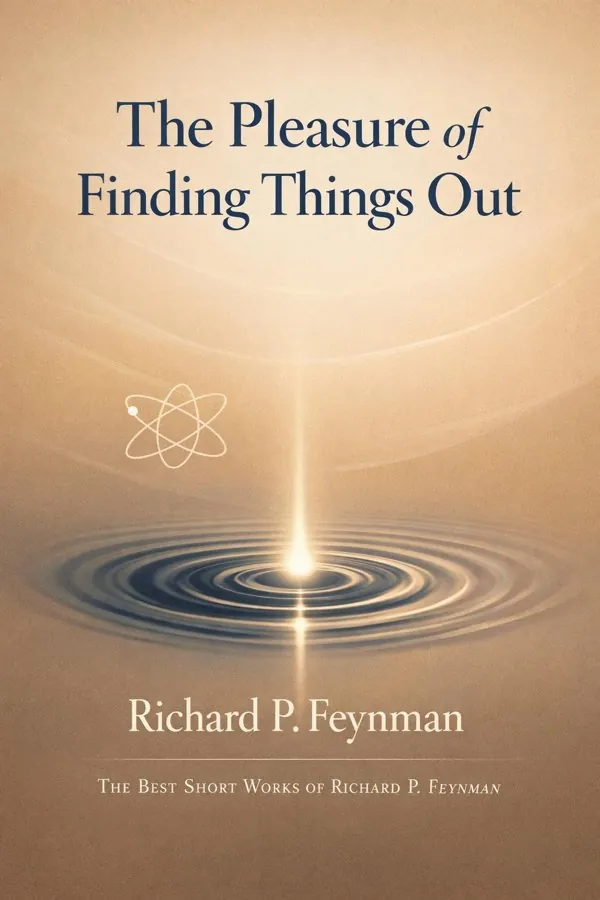
The Pleasure of Finding Things Out: The Best Short Works of Richard P. Feynman
Richard P. Feynman
10 minYou Might Also Like

An American Marriage
Tayari Jones
10 min
Benjamin Franklin: An American Life
Walter Isaacson
10 min
I Know Why The Caged Bird Sings
Maya Angelou
10 min
Long Walk to Freedom
Nelson Mandela
10 min
Persepolis
Marjane Satrapi
10 min
The Autobiography of Eleanor Roosevelt
Eleanor Roosevelt
10 minFeatured In
Browse by Category
Ready to read Surely You're Joking, Mr. Feynman!?
Get the full summary and 100K+ more books with Fizz Moment.