
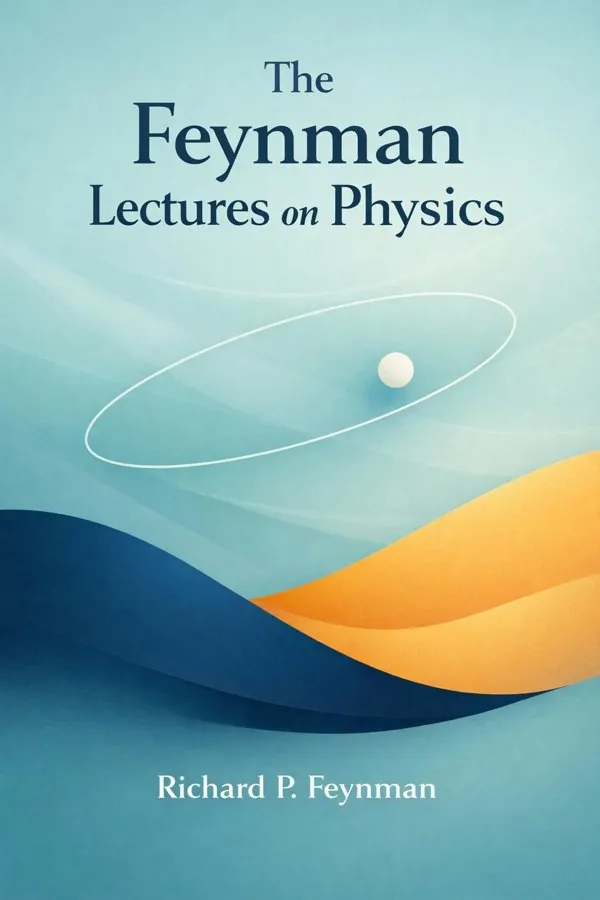
The Feynman Lectures on Physics: Summary & Key Insights
 10 min10 chaptersAudio available
Key Takeaways from The Feynman Lectures on Physics
Science begins with a simple but radical idea: nature, not authority, gets the final word.
You cannot hold energy in your hand, yet nearly everything in physics becomes clearer once you learn to track it.
The world feels messy, yet moving objects obey surprisingly clean rules.
One of the most beautiful achievements in science is the realization that the same force that pulls an apple downward also guides the moon and planets through space.
What seem like separate phenomena—static shocks, bar magnets, electric currents, radio waves, and visible light—are in fact aspects of a single electromagnetic reality.
What Is The Feynman Lectures on Physics About?
The Feynman Lectures on Physics by Richard P. Feynman is a popular_sci book spanning 13 pages. The Feynman Lectures on Physics is far more than an introductory physics course. Drawn from Richard P. Feynman’s legendary lectures at the California Institute of Technology in the early 1960s, this three-volume work is an invitation to see the universe with fresh eyes. Rather than presenting physics as a dry list of formulas, Feynman treats it as a living investigation into how nature really works. He moves from motion and gravitation to electricity, light, atoms, quantum mechanics, and relativity, always asking the deeper question: why do these ideas matter, and how do we know they are true? What makes the lectures enduring is the way they combine rigor with wonder. Feynman had a rare gift for explaining difficult concepts without flattening their mystery. He wanted students to feel both the power and the limits of scientific knowledge. As a Nobel Prize-winning physicist and one of the greatest science communicators of the twentieth century, he brings unmatched authority to the subject. This book matters because it does not simply teach physics. It teaches a way of thinking: skeptical, curious, imaginative, and grounded in evidence.
This FizzRead summary covers all 10 key chapters of The Feynman Lectures on Physics in approximately 10 minutes, distilling the most important ideas, arguments, and takeaways from Richard P. Feynman's work. Also available as an audio summary and Key Quotes Podcast.
The Feynman Lectures on Physics
The Feynman Lectures on Physics is far more than an introductory physics course. Drawn from Richard P. Feynman’s legendary lectures at the California Institute of Technology in the early 1960s, this three-volume work is an invitation to see the universe with fresh eyes. Rather than presenting physics as a dry list of formulas, Feynman treats it as a living investigation into how nature really works. He moves from motion and gravitation to electricity, light, atoms, quantum mechanics, and relativity, always asking the deeper question: why do these ideas matter, and how do we know they are true?
What makes the lectures enduring is the way they combine rigor with wonder. Feynman had a rare gift for explaining difficult concepts without flattening their mystery. He wanted students to feel both the power and the limits of scientific knowledge. As a Nobel Prize-winning physicist and one of the greatest science communicators of the twentieth century, he brings unmatched authority to the subject. This book matters because it does not simply teach physics. It teaches a way of thinking: skeptical, curious, imaginative, and grounded in evidence.
Who Should Read The Feynman Lectures on Physics?
This book is perfect for anyone interested in popular_sci and looking to gain actionable insights in a short read. Whether you're a student, professional, or lifelong learner, the key ideas from The Feynman Lectures on Physics by Richard P. Feynman will help you think differently.
- ✓Readers who enjoy popular_sci and want practical takeaways
- ✓Professionals looking to apply new ideas to their work and life
- ✓Anyone who wants the core insights of The Feynman Lectures on Physics in just 10 minutes
Want the full summary?
Get instant access to this book summary and 100K+ more with Fizz Moment.
Get Free SummaryAvailable on App Store • Free to download
Key Chapters
Science begins with a simple but radical idea: nature, not authority, gets the final word. One of Feynman’s central themes is that physical laws are discovered through observation, experiment, and continual testing. A law of physics is not sacred truth handed down once and for all. It is our best current description of patterns that hold up in the real world. That means every scientific law is powerful, but also provisional. If better evidence appears, the law must be revised or expanded.
Feynman uses this point to show why science is both humble and strong. It is humble because it accepts uncertainty and the possibility of error. It is strong because it relies on repeatable evidence rather than opinion. This mindset separates science from guesswork. When astronomers noticed that planets moved in regular ways, those observations eventually led to precise laws of motion and gravitation. When experiments with electricity and magnetism revealed deep connections, those findings led to Maxwell’s equations. In each case, reality was the judge.
This idea matters far beyond physics. In medicine, engineers test designs instead of trusting intuition alone. In daily life, we make better decisions when we ask what the evidence actually shows instead of what we wish were true. Feynman’s deeper lesson is that true understanding requires intellectual honesty: we must be willing to follow facts even when they surprise us.
Actionable takeaway: adopt the scientist’s habit of asking, “What is the evidence?” whenever you encounter a claim, whether in science, work, or everyday decision-making.
You cannot hold energy in your hand, yet nearly everything in physics becomes clearer once you learn to track it. Feynman presents energy as one of the deepest organizing ideas in science. Energy appears in many forms—kinetic, potential, thermal, electrical, chemical, radiant—but beneath these different names lies a unifying rule: in an isolated system, the total amount of energy remains constant. It changes form, but it does not vanish.
What makes this concept so striking is that energy is not a visible substance. We infer it through calculation and consistency. A falling object gains speed as gravitational potential energy becomes kinetic energy. A battery powers a flashlight by turning chemical energy into electrical energy, then into light and heat. A car engine transforms fuel into motion, sound, and waste heat. Even when energy seems “lost,” it has usually been dispersed into forms that are harder to use, not destroyed.
Feynman emphasizes that conservation laws are among the most powerful tools in physics because they let us solve problems without knowing every detail of the mechanism. Engineers rely on energy accounting to design power plants, buildings, electronics, and transportation systems. Athletes use it to understand motion and efficiency. Climate science depends on balancing incoming and outgoing energy on Earth.
The practical lesson is that hidden costs often show up when energy changes form. Friction, resistance, and inefficiency matter. Once you start thinking in terms of energy flows, many systems—from a swinging pendulum to a city’s electrical grid—become easier to analyze.
Actionable takeaway: when examining any machine, process, or problem, ask where the energy comes from, where it goes, and what is being wasted.
The world feels messy, yet moving objects obey surprisingly clean rules. In Feynman’s treatment of Newtonian mechanics, motion becomes understandable through a few foundational ideas: force changes motion, inertia resists change, and every interaction has consequences. Newton’s laws give a framework for predicting how objects behave, from a rolling ball to a rocket leaving Earth.
Feynman does not present mechanics as merely a set of equations to memorize. He shows that mechanics is a language for describing change. Velocity tells us how fast position changes. Acceleration tells us how fast velocity changes. Force connects the physical cause to that acceleration. This perspective makes mechanics dynamic rather than static. It explains why seatbelts matter, why a hammer hits hard, why satellites stay in orbit, and why a table can support a book despite gravity pulling downward.
Real-life applications are everywhere. Civil engineers calculate loads on bridges using mechanical principles. Automotive safety depends on understanding momentum, impact forces, and energy transfer. Sports training uses mechanics to improve throwing, jumping, and balance. Even walking is a mechanical process involving force, friction, and center of mass.
Feynman also reminds readers that idealized models—frictionless planes, point masses, perfect springs—are not fake; they are tools. By simplifying the world, physics reveals the underlying structure and then adds complexity step by step.
Actionable takeaway: when you see motion, do not just ask what is happening; ask what forces are acting, what is resisting change, and how momentum and energy are being transferred.
One of the most beautiful achievements in science is the realization that the same force that pulls an apple downward also guides the moon and planets through space. Feynman uses gravitation and planetary motion to demonstrate the explanatory power of physics: one simple law can unify phenomena that once seemed completely separate. Gravity is not just a local tug near Earth. It is a universal interaction between masses.
This insight transformed humanity’s picture of the cosmos. Before modern physics, heavenly motion and earthly motion were often treated as different realms. Newton’s law erased that divide. Planetary orbits, tides, falling objects, and projectiles all became parts of one coherent system. Feynman highlights the intellectual leap involved here: science advances not only by collecting facts, but by discovering deep unities.
The practical consequences are immense. Orbital mechanics makes satellites, GPS, telecommunications, and weather forecasting possible. Space agencies calculate trajectories using gravitational principles to send probes to other planets. Even everyday technologies—from navigation apps to satellite television—depend on a precise understanding of how objects move under gravity.
Feynman also points toward a broader lesson: scientific laws are judged by how much they explain with how little assumption. Gravity’s power lies in its reach and simplicity. It lets us connect the ordinary and the cosmic.
Actionable takeaway: look for unifying principles in complex problems. Often the best explanation is the one that reveals a common pattern behind events that first appear unrelated.
What seem like separate phenomena—static shocks, bar magnets, electric currents, radio waves, and visible light—are in fact aspects of a single electromagnetic reality. Feynman treats electromagnetism as one of physics’ grand unifications. Maxwell’s equations showed that changing electric fields create magnetic fields, and changing magnetic fields create electric fields. This self-sustaining interplay can travel through space as an electromagnetic wave. Light itself is one of those waves.
This is a profound conceptual shift. A lamp, a microwave oven, an X-ray machine, and a Wi-Fi router all operate within the same broad framework. The difference lies in wavelength, frequency, and how matter interacts with different parts of the spectrum. Once you understand that, the modern technological world starts to make sense. Power grids move electrical energy. Motors convert electromagnetic interactions into motion. Antennas send and receive signals. Medical imaging, communication networks, and countless electronic devices are built on these principles.
Feynman’s teaching here is notable because he combines mathematical elegance with physical intuition. He makes clear that fields are not just abstract bookkeeping tools; they are real features of how the world behaves. The electromagnetic field fills space and influences charged particles even when no direct contact occurs.
The broader lesson is that nature often hides simplicity beneath apparent variety. Mastering the core relationships unlocks an enormous range of applications.
Actionable takeaway: when confronting a complicated system, identify the underlying variables that interact repeatedly. Often a few core relationships generate the full richness you observe.
At the smallest scales, nature does not behave like a miniature version of everyday life. Feynman’s account of quantum mechanics shows that certainty gives way to probability, and that this is not a temporary gap in our knowledge but a basic feature of reality. Electrons, photons, and other particles do not always follow single, definite paths in the classical sense. Instead, quantum theory predicts the probabilities of different outcomes, and experiments confirm those predictions with extraordinary precision.
This can feel deeply counterintuitive. We are used to imagining objects as having exact positions and trajectories at all times. Quantum mechanics challenges that picture. Interference, superposition, and measurement effects suggest that the microscopic world follows rules unlike anything in common experience. Feynman was especially famous for stressing that no one should pretend quantum theory is emotionally easy. Its importance lies not in matching intuition but in matching experiment.
Yet quantum mechanics is not just philosophical strangeness. It underpins semiconductors, lasers, MRI machines, solar cells, LEDs, and modern computing. Chemistry depends on quantum behavior in atoms and molecules. Without quantum theory, much of contemporary technology would be impossible.
Feynman’s larger point is that reality is under no obligation to be simple to imagine. Good science requires us to accept well-tested truths even when they resist ordinary pictures. Intellectual maturity means learning to work with probabilities when probabilities are what nature provides.
Actionable takeaway: become comfortable reasoning under uncertainty. In science, business, and life, the best decisions often come from understanding probabilities rather than demanding impossible certainty.
If you had to compress modern science into one sentence, Feynman suggested, it might be this: everything is made of atoms. This idea, simple as it sounds, has enormous explanatory power. Atoms are tiny, restless units of matter that combine in different ways to produce the diversity of the material world. Their arrangement, motion, and interactions explain solids, liquids, gases, heat, pressure, and chemical reactions.
Feynman uses atomic theory to show how microscopic behavior creates macroscopic reality. Why does a metal conduct electricity? Why does ice float on water? Why do some substances react violently while others remain stable? These questions become manageable when we think in terms of atoms, electrons, and bonding. Chemical properties arise from electron arrangements. The structure of molecules shapes everything from the strength of materials to the behavior of living cells.
The practical implications are vast. Chemistry, materials science, medicine, and biology all depend on atomic thinking. Drug design targets molecular interactions. Semiconductor engineering manipulates electron behavior in solids. Food science, battery technology, and nanotechnology all rely on understanding matter at the atomic level.
What makes Feynman’s approach memorable is that he treats atomic theory not as an isolated chapter but as a bridge across disciplines. Physics explains chemistry; chemistry supports biology; and all of them connect through matter’s underlying structure. This is one reason the lectures feel so unified.
Actionable takeaway: whenever you encounter a material property or chemical process, ask what atomic or molecular structure might be producing the observed behavior.
Large systems become understandable not by tracking every particle individually, but by recognizing statistical patterns. In Feynman’s discussion of thermodynamics and statistical mechanics, heat, temperature, pressure, and entropy emerge from the collective behavior of countless atoms in motion. This is one of physics’ most powerful strategies: when microscopic detail is overwhelming, use probability to uncover reliable large-scale laws.
Temperature is not a substance; it reflects average molecular motion. Pressure comes from innumerable particle collisions. Heat flows from hotter objects to colder ones not because of a moral rule, but because overwhelmingly many microscopic arrangements favor that direction. Entropy measures, in a broad sense, how many ways a system can be arranged while still appearing the same macroscopically. Ordered states are possible, but disordered states are vastly more numerous.
This framework explains why ice melts, engines waste heat, perfumes diffuse through rooms, and perpetual motion machines cannot work. It also has practical relevance in engineering, computing, chemistry, and biology. Refrigerators, turbines, weather models, and even information theory are connected to thermodynamic reasoning. Data centers must manage heat. Industrial processes depend on efficiency limits. Living organisms survive by maintaining local order while increasing entropy elsewhere.
Feynman’s deeper insight is that probability is not a retreat from explanation. It is often the correct level of explanation for complex systems. We gain power not by knowing everything, but by knowing what details matter and what can be averaged out.
Actionable takeaway: when a system seems too complex to analyze in full, look for aggregate patterns—averages, distributions, constraints, and likely outcomes—rather than trying to follow every detail.
Some truths are so basic that changing them changes everything. Relativity is one of those truths. Feynman explains that space and time are not separate, fixed stages on which events unfold. They are woven together into space-time, and measurements of distance, duration, and simultaneity depend on the observer’s motion. The speed of light remains constant, and classical notions of absolute time must give way.
This shift is not just abstract philosophy. Time dilation affects fast-moving particles and must be accounted for in satellite systems such as GPS. Mass and energy are linked through one of physics’ most famous relations, making sense of nuclear processes and stellar energy production. Relativity also deepens our understanding of causality by showing how the structure of space-time constrains what can influence what.
Feynman ties relativity to a broader idea that runs through modern physics: symmetry. Conservation laws are not arbitrary facts; they are connected to underlying symmetries in nature. If the laws of physics do not change over time, energy is conserved. If they do not depend on position, momentum is conserved. These deep connections reveal that the universe is not merely a collection of events but a patterned, mathematically structured whole.
For readers, the lesson is both scientific and philosophical. Reality may be stranger than common sense suggests, but it is not chaotic. Beneath the strangeness lies remarkable order.
Actionable takeaway: challenge assumptions that feel “obvious.” In difficult problems, progress often begins when you question the hidden framework you have taken for granted.
The greatest scientific knowledge does not end mystery; it sharpens it. Across the lectures, Feynman returns to two linked themes: the unity of the sciences and the limits of what we know. Physics connects to chemistry, biology, astronomy, and engineering because the same underlying laws govern all material phenomena. Yet every answer opens new questions. This combination of coherence and incompleteness is not a weakness of science. It is its driving force.
Feynman resists the temptation to present knowledge as finished. He shows students where theories succeed brilliantly and where puzzles remain. That honesty is crucial. The aim of science is not to protect certainty but to improve understanding. Progress comes from admitting ignorance, testing ideas, and remaining open to correction. In this sense, skepticism is not cynicism. It is disciplined curiosity.
This mindset has practical power in any field. Innovative organizations improve by questioning assumptions. Researchers advance by treating anomalies as clues rather than annoyances. Individuals learn faster when they are willing to say, “I do not know yet.” Feynman’s example encourages intellectual courage: delight in discovery without pretending finality.
The unity of science also offers a hopeful message. Knowledge is not a pile of disconnected facts. It is an interconnected web in which concepts reinforce one another. Understanding energy helps with biology. Understanding probability helps with economics. Understanding symmetry can shape design and engineering.
Actionable takeaway: cultivate a learning style built on curiosity, cross-disciplinary thinking, and comfort with uncertainty. The best questions often matter more than quick answers.
All Chapters in The Feynman Lectures on Physics
About the Author
Richard Phillips Feynman (1918–1988) was an American theoretical physicist, educator, and one of the most celebrated scientific thinkers of the modern era. He made foundational contributions to quantum electrodynamics, particle physics, and quantum mechanics, and shared the 1965 Nobel Prize in Physics for his work on the behavior of subatomic particles. Feynman taught for many years at the California Institute of Technology, where his lectures became famous for their clarity, originality, and energy. Beyond academic physics, he was admired for his curiosity, humor, and ability to make difficult ideas accessible without losing their depth. His books, lectures, and public presence helped inspire generations of scientists and readers. Today, he remains a model of rigorous thinking, intellectual honesty, and joyful inquiry.
Get This Summary in Your Preferred Format
Read or listen to the The Feynman Lectures on Physics summary by Richard P. Feynman anytime, anywhere. FizzRead offers multiple formats so you can learn on your terms — all free.
Available formats: App · Audio · PDF · EPUB — All included free with FizzRead
Download The Feynman Lectures on Physics PDF and EPUB Summary
Key Quotes from The Feynman Lectures on Physics
“Science begins with a simple but radical idea: nature, not authority, gets the final word.”
“You cannot hold energy in your hand, yet nearly everything in physics becomes clearer once you learn to track it.”
“The world feels messy, yet moving objects obey surprisingly clean rules.”
“One of the most beautiful achievements in science is the realization that the same force that pulls an apple downward also guides the moon and planets through space.”
“What seem like separate phenomena—static shocks, bar magnets, electric currents, radio waves, and visible light—are in fact aspects of a single electromagnetic reality.”
Frequently Asked Questions about The Feynman Lectures on Physics
The Feynman Lectures on Physics by Richard P. Feynman is a popular_sci book that explores key ideas across 10 chapters. The Feynman Lectures on Physics is far more than an introductory physics course. Drawn from Richard P. Feynman’s legendary lectures at the California Institute of Technology in the early 1960s, this three-volume work is an invitation to see the universe with fresh eyes. Rather than presenting physics as a dry list of formulas, Feynman treats it as a living investigation into how nature really works. He moves from motion and gravitation to electricity, light, atoms, quantum mechanics, and relativity, always asking the deeper question: why do these ideas matter, and how do we know they are true? What makes the lectures enduring is the way they combine rigor with wonder. Feynman had a rare gift for explaining difficult concepts without flattening their mystery. He wanted students to feel both the power and the limits of scientific knowledge. As a Nobel Prize-winning physicist and one of the greatest science communicators of the twentieth century, he brings unmatched authority to the subject. This book matters because it does not simply teach physics. It teaches a way of thinking: skeptical, curious, imaginative, and grounded in evidence.
More by Richard P. Feynman
Surely You're Joking, Mr. Feynman!
Richard P. Feynman
10 min
The Character of Physical Law
Richard P. Feynman
10 min
Surely You’re Joking, Mr. Feynman!: Adventures of a Curious Character
Richard P. Feynman
10 min
The Pleasure of Finding Things Out: The Best Short Works of Richard P. Feynman
Richard P. Feynman
10 minYou Might Also Like

Structures: Or Why Things Don"t Fall Down
J.E. Gordon
10 min
The Road to Wigan Pier
George Orwell
10 min
Bonk: The Curious Coupling of Science and Sex
Mary Roach
10 min
First Bite: How We Learn to Eat
Bee Wilson
10 min
In Pursuit Of The Unknown: 17 Equations That Changed The World
Ian Stewart
10 min
Napoleon's Buttons: 17 Molecules That Changed History
Penny Le Couteur and Jay Burreson
10 minBrowse by Category
Ready to read The Feynman Lectures on Physics?
Get the full summary and 100K+ more books with Fizz Moment.