
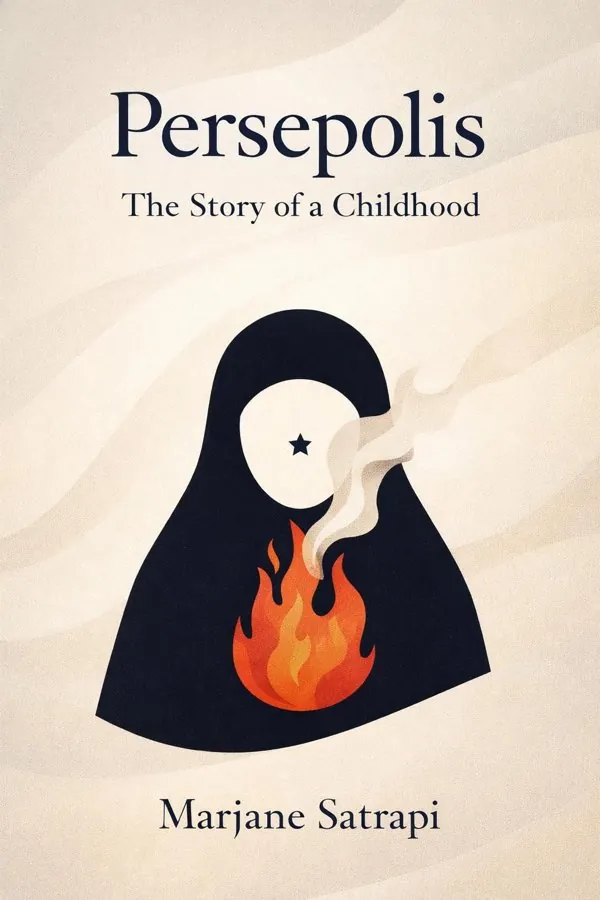
Persepolis: Summary & Key Insights
 10 min9 chaptersAudio available
Key Takeaways from Persepolis
Political upheaval becomes most revealing when seen by someone too young to fully explain it but old enough to feel its consequences.
The moment clothing becomes compulsory, identity becomes political.
Authoritarian regimes depend on controlling the story of the past, which is why family memory becomes a quiet form of resistance.
Childhood innocence is rarely lost all at once; more often, it disappears through repetition, fear, and normalization.
One of the most surprising truths in Persepolis is that laughter can coexist with oppression without diminishing its seriousness.
What Is Persepolis About?
Persepolis by Marjane Satrapi is a biographies book published in 2003 spanning 4 pages. Persepolis is Marjane Satrapi’s unforgettable graphic memoir about growing up in Iran during one of the most turbulent political transformations of the twentieth century. Told through the eyes of a sharp, rebellious, deeply observant child, the book traces the fall of the Shah, the rise of the Islamic Republic, and the devastating Iran-Iraq War. But Satrapi does far more than recount historical events. She shows how revolution enters kitchens, classrooms, friendships, clothing, and family life, changing not just governments but the texture of ordinary existence. Her stark black-and-white drawings give the story unusual clarity: they strip away distraction and make fear, humor, grief, and defiance feel immediate. What makes Persepolis so powerful is its balance of intimacy and scope. Satrapi is both witness and participant, offering the authority of lived experience while also reflecting on identity, ideology, exile, and freedom. The result is a memoir that challenges stereotypes about Iran and about women in Muslim societies, while speaking to universal questions about belonging, courage, and the cost of political upheaval.
This FizzRead summary covers all 9 key chapters of Persepolis in approximately 10 minutes, distilling the most important ideas, arguments, and takeaways from Marjane Satrapi's work. Also available as an audio summary and Key Quotes Podcast.
Persepolis
Persepolis is Marjane Satrapi’s unforgettable graphic memoir about growing up in Iran during one of the most turbulent political transformations of the twentieth century. Told through the eyes of a sharp, rebellious, deeply observant child, the book traces the fall of the Shah, the rise of the Islamic Republic, and the devastating Iran-Iraq War. But Satrapi does far more than recount historical events. She shows how revolution enters kitchens, classrooms, friendships, clothing, and family life, changing not just governments but the texture of ordinary existence. Her stark black-and-white drawings give the story unusual clarity: they strip away distraction and make fear, humor, grief, and defiance feel immediate. What makes Persepolis so powerful is its balance of intimacy and scope. Satrapi is both witness and participant, offering the authority of lived experience while also reflecting on identity, ideology, exile, and freedom. The result is a memoir that challenges stereotypes about Iran and about women in Muslim societies, while speaking to universal questions about belonging, courage, and the cost of political upheaval.
Who Should Read Persepolis?
This book is perfect for anyone interested in biographies and looking to gain actionable insights in a short read. Whether you're a student, professional, or lifelong learner, the key ideas from Persepolis by Marjane Satrapi will help you think differently.
- ✓Readers who enjoy biographies and want practical takeaways
- ✓Professionals looking to apply new ideas to their work and life
- ✓Anyone who wants the core insights of Persepolis in just 10 minutes
Want the full summary?
Get instant access to this book summary and 100K+ more with Fizz Moment.
Get Free SummaryAvailable on App Store • Free to download
Key Chapters
Political upheaval becomes most revealing when seen by someone too young to fully explain it but old enough to feel its consequences. In Persepolis, Marjane Satrapi begins as a curious, imaginative child in Tehran, growing up at the end of the Shah’s rule and the beginning of revolution. Her early perspective matters because children absorb contradictions with unusual honesty. She hears adults speak of justice, torture, class inequality, and imprisonment, then tries to fit those ideas into the moral universe she is still building. That tension gives the memoir much of its force.
Satrapi shows that revolutions are never abstract. They enter homes through whispered conversations, anxious relatives, political posters, and sudden changes in public life. Her family is educated, politically aware, and deeply engaged with events, which gives her a front-row seat to history. Yet she still responds as a child would: with excitement, idealism, confusion, and bursts of stubborn independence. She plays at being a prophet, imagines heroic sacrifice, and tries to make sense of stories about imprisoned family members.
This perspective helps readers understand how ideology shapes identity from an early age. Children learn what power looks like not through textbooks, but through adults’ fear, courage, and compromise. In modern life, the same lesson applies whenever children witness polarization, censorship, war, or social division. They may not grasp every policy, but they understand changes in tone, behavior, and freedom.
Actionable takeaway: Pay attention to how political and social change appears in everyday life, especially through the eyes of the young. If you want to understand a society, start with what children are being taught to fear, admire, obey, and question.
The moment clothing becomes compulsory, identity becomes political. One of Persepolis’s clearest insights is that authoritarian systems often begin by regulating visible, everyday behavior. After the Islamic Revolution, the new regime quickly transforms social life: the veil becomes mandatory, schools are segregated, Western cultural influences are condemned, and public behavior is increasingly monitored. For young Marjane, these changes are both immediate and bewildering. She is forced to wear the veil before she even understands what it signifies.
Satrapi is careful not to attack faith itself. Instead, she distinguishes between personal belief and political coercion. As a child, she is deeply spiritual and imagines conversations with God. That personal faith exists alongside her growing awareness that religion, when fused with state power, can become a tool of obedience. The memoir’s subtlety lies here: it resists simplistic binaries. It does not say religion is the problem; it shows how institutions manipulate religion to justify control.
This idea remains relevant far beyond Iran. Whenever governments or communities try to enforce virtue through dress, language, or ritual, they are often less interested in morality than in conformity. Dress codes, censorship campaigns, and symbolic loyalty tests can all serve the same purpose: making power visible on the body.
In everyday life, readers can apply this insight by asking whether a rule protects people or merely disciplines them. Does it invite thoughtful participation, or punish difference? Satrapi teaches us that freedom is often lost gradually, through rules that seem small until they accumulate.
Actionable takeaway: Learn to distinguish private conviction from public coercion. When a belief is no longer chosen but enforced, it has become a political instrument, and that is the moment to question it.
Authoritarian regimes depend on controlling the story of the past, which is why family memory becomes a quiet form of resistance. In Persepolis, Satrapi’s understanding of Iran does not come from state propaganda but from stories told at home. Her parents and grandmother explain the monarchy, the revolution, political repression, and the suffering of prisoners. Through these conversations, history becomes personal rather than abstract. She learns that public slogans rarely capture private truth.
One of the memoir’s strengths is how it links national history to family history. Marjane discovers that her own relatives were touched by political struggle, imprisonment, and class tensions. This connection breaks the illusion that history belongs only to leaders and headlines. Instead, Satrapi shows that ordinary families carry archives of pain, courage, compromise, and survival. Her grandmother, in particular, embodies moral clarity. She offers not ideology, but values: dignity, honesty, and self-respect.
This matters today because public discourse is still shaped by oversimplified narratives. Governments, media systems, and online communities often present history in ways that justify present power. Personal testimony, family stories, and lived experience can complicate those narratives in essential ways. That does not mean every memory is complete or unbiased, but it does mean that human detail can challenge official myth.
A practical application is to treat family history as a source of civic understanding. Ask older relatives what political changes felt like in daily life. What did they fear? What did they hope for? What did they stop saying in public? Such questions reveal how institutions affect real people.
Actionable takeaway: Preserve and listen to personal histories. When official narratives flatten the past, family memory can restore complexity, humanity, and moral perspective.
Childhood innocence is rarely lost all at once; more often, it disappears through repetition, fear, and normalization. In Persepolis, the Iran-Iraq War is not presented only as a geopolitical event but as a daily force that enters the home, the school, and the imagination. Air raids, sirens, rationing, bombings, and stories of martyrdom reshape how children think about safety and death. Marjane grows up in a world where violence is both terrifying and routine.
Satrapi captures a crucial truth about war: it reshapes not only bodies and borders, but emotional habits. Children learn to joke about danger, repeat propaganda they barely understand, and adapt to conditions that should never become normal. The state intensifies this process by glorifying sacrifice, especially among the poor. Plastic keys to paradise are handed to boys and sold as symbols of heavenly reward, exposing the cruelty of regimes that romanticize death for political ends.
The memoir also shows how class affects vulnerability. Some families have resources, education, or connections that soften hardship; others are sent directly toward the greatest risks. This observation deepens the book’s critique of war by linking violence to inequality.
Readers can apply this insight by noticing how repeated exposure to crisis dulls moral attention. Whether the issue is war, displacement, or domestic injustice, people can begin to treat the intolerable as ordinary. Satrapi reminds us to resist that drift.
Actionable takeaway: Refuse to normalize suffering. When crisis becomes familiar, make a deliberate effort to name what is unjust, protect the vulnerable, and remember that adaptation is not the same as acceptance.
One of the most surprising truths in Persepolis is that laughter can coexist with oppression without diminishing its seriousness. Satrapi’s memoir is full of wit, irony, and absurdity, even in dark moments. That tonal complexity is not decorative; it is central to the book’s meaning. Humor becomes a way of preserving perspective when public life is increasingly controlled. It allows characters to remain psychologically alive instead of becoming passive objects of history.
Satrapi often highlights the absurd gap between official morality and lived reality. The moral police, the arbitrary rules, the social performance of piety, and the private bending of those rules all create situations that are both comic and disturbing. Her family hosts parties despite bans, navigates black markets for music and clothing, and finds small ways to push back. These scenes reveal that resistance is not always dramatic. Sometimes it is hidden in jokes, smuggled pleasures, and the refusal to let power define one’s inner life.
This insight is widely applicable. In difficult workplaces, restrictive communities, or politically tense societies, humor can relieve fear, build solidarity, and expose hypocrisy. Of course, it can also be escapist if it avoids action. But in Persepolis, humor sharpens awareness rather than dulling it. It helps people endure without surrendering their ability to judge.
For readers, the practical lesson is to respect emotional complexity. Serious times do not require constant solemnity. In fact, moments of shared laughter often protect courage and connection. They remind people that they are more than victims of circumstance.
Actionable takeaway: Use humor to maintain clarity and solidarity, not denial. When power becomes absurd, naming that absurdity can be a quiet but meaningful form of resistance.
Identity becomes most visible when a person is pulled between conflicting expectations. Throughout Persepolis, Marjane grows up between worlds: tradition and modernity, Iran and the West, family values and state ideology, private freedom and public conformity. She loves pop culture, denim jackets, posters, and rebellious style, yet she is also shaped by Persian history, family loyalty, and the realities of Iranian life. The memoir refuses the false choice between these influences.
What makes Satrapi’s account so compelling is that identity is not presented as a finished essence but as an ongoing negotiation. Marjane experiments, performs, resists, and sometimes misjudges. Her attempts to appear grown-up, politically aware, or culturally sophisticated reveal how identity is often built through trial and error. She wants authenticity, but she is still discovering what that means.
This struggle is familiar to many readers, especially immigrants, children of diaspora, or anyone balancing community expectations with personal conviction. The pressure to be legible to others can be intense. You may be told you are too traditional for one group and too Western for another, too rebellious at home and too foreign outside it. Satrapi captures that tension without sentimentalizing it.
A practical application is to reject simplistic labels. Instead of asking which side of yourself is the “real” one, ask which values remain consistent across settings. For Satrapi, dignity, honesty, independence, and love of truth matter more than cultural performance.
Actionable takeaway: Build identity around chosen values rather than imposed categories. You do not need to fit neatly into one narrative to live with integrity.
Leaving an oppressive environment can save a person, but it can also fracture the self. A major turning point in Persepolis comes when Marjane is sent away from Iran for her safety and future. This decision reflects love, sacrifice, and necessity, yet it also reveals the painful cost of freedom. Exile is not simply escape; it is dislocation. To survive in a new country, one must not only adapt externally but reorganize memory, identity, and belonging.
Satrapi shows that distance changes perception. From abroad, Iran becomes at once more precious and more painful. Home is no longer just a place of repression; it is also family, language, humor, and emotional familiarity. Meanwhile, the outside world that promises liberty can also bring loneliness, misunderstanding, and cultural isolation. Exile therefore creates a double consciousness: the exiled person sees both the limits of home and the limits of the new society.
This theme resonates strongly today, when migration, forced displacement, and transnational identity shape millions of lives. Freedom of movement does not erase grief. Safety does not automatically produce belonging. Many people who leave difficult environments discover that reinvention has emotional costs, including guilt, fragmentation, and the pressure to explain oneself constantly.
Readers can apply this insight by approaching stories of migration with greater nuance. Rather than assuming departure solves everything, ask what must be surrendered in exchange. If you are navigating your own transition, recognize that mixed feelings are not failure; they are evidence of attachment.
Actionable takeaway: Treat freedom and belonging as separate needs. When entering a new environment, make intentional space to preserve memory, language, and relationships rather than expecting adaptation alone to heal displacement.
Resistance is often imagined as dramatic confrontation, but Persepolis shows that for women under restrictive systems, defiance frequently lives in daily choices. Marjane, her mother, her grandmother, and the women around them negotiate a world where behavior, dress, speech, and mobility are constantly scrutinized. Yet they do not disappear into silence. They argue, remember, criticize, educate, and persist. Their resistance is moral before it is theatrical.
Satrapi’s memoir is especially powerful because it rejects both victim stereotypes and simplistic empowerment slogans. The women in Persepolis are neither passive nor invincible. They are intelligent, frightened, proud, inconsistent, and brave. Marjane’s mother protests publicly. Her grandmother guards ethical standards at home. Marjane herself experiments with rebellion through style, speech, and refusal to internalize shame. These acts may seem small, but in a tightly controlled society, small acts can carry great risk.
The broader lesson is that gendered oppression often operates through accumulation: countless rules, warnings, expectations, and humiliations designed to narrow a woman’s sense of what is possible. The answer is therefore often cumulative too: small refusals, mutual support, truthful speech, and preservation of self-respect. Contemporary readers can recognize similar dynamics in settings ranging from authoritarian states to conservative institutions or coercive relationships.
A useful application is to notice the everyday arenas where dignity is defended: what people wear, what they say no to, whom they trust, and how they protect one another. Change often begins there, before it becomes visible on a larger scale.
Actionable takeaway: Do not underestimate daily acts of self-definition. In restrictive environments, maintaining dignity, solidarity, and independent judgment is already a meaningful form of resistance.
Statistics can inform us, but stories make us care. One of Persepolis’s greatest achievements is its ability to turn a widely misunderstood period of history into a human experience. Rather than teaching the Iranian Revolution and the Iran-Iraq War as distant events, Satrapi places readers inside a family trying to live through them. The graphic memoir form intensifies this effect. Simple black-and-white images make emotion legible, while the child’s viewpoint prevents abstraction.
This humanization matters because global audiences often encounter countries like Iran through headlines, slogans, and stereotypes. Satrapi complicates those narratives by showing a society full of intellectual debate, humor, affection, contradiction, and pain. She invites readers to see Iranians not as symbols of a geopolitical crisis but as people making difficult choices under pressure. That shift has ethical importance. It becomes harder to accept caricatures once you have encountered individual lives.
The book also demonstrates how memoir can serve as historical intervention. Personal stories do not replace formal history, but they can expose what official summaries miss: emotional texture, domestic consequence, and moral ambiguity. In workplaces, classrooms, and public conversations, this lesson encourages a more humane approach to political discussion. Before reducing a nation or movement to a label, ask whose experience is being erased.
Practically, readers can seek out memoirs, oral histories, and first-person accounts when trying to understand political events. These sources cultivate empathy without abandoning complexity.
Actionable takeaway: Whenever history feels distant or simplified, look for an individual story inside it. Personal testimony is often the bridge between information and genuine understanding.
All Chapters in Persepolis
About the Author
Marjane Satrapi is an Iranian-born French graphic novelist, illustrator, writer, and filmmaker best known for Persepolis, her autobiographical graphic memoir about growing up during the Islamic Revolution in Iran. Born in Rasht and raised in Tehran, she later moved to Europe, where questions of exile, identity, and cultural belonging became central to her work. Satrapi’s storytelling is distinguished by its stark visual style, emotional precision, and ability to connect personal memory with political history. In addition to Persepolis, she has created acclaimed works such as Embroideries and Chicken with Plums, and she co-directed the award-winning animated film adaptation of Persepolis. Across books and films alike, Satrapi has built an international reputation for transforming complex historical and emotional realities into art that is direct, humane, and unforgettable.
Get This Summary in Your Preferred Format
Read or listen to the Persepolis summary by Marjane Satrapi anytime, anywhere. FizzRead offers multiple formats so you can learn on your terms — all free.
Available formats: App · Audio · PDF · EPUB — All included free with FizzRead
Download Persepolis PDF and EPUB Summary
Key Quotes from Persepolis
“Political upheaval becomes most revealing when seen by someone too young to fully explain it but old enough to feel its consequences.”
“The moment clothing becomes compulsory, identity becomes political.”
“Authoritarian regimes depend on controlling the story of the past, which is why family memory becomes a quiet form of resistance.”
“Childhood innocence is rarely lost all at once; more often, it disappears through repetition, fear, and normalization.”
“One of the most surprising truths in Persepolis is that laughter can coexist with oppression without diminishing its seriousness.”
Frequently Asked Questions about Persepolis
Persepolis by Marjane Satrapi is a biographies book that explores key ideas across 9 chapters. Persepolis is Marjane Satrapi’s unforgettable graphic memoir about growing up in Iran during one of the most turbulent political transformations of the twentieth century. Told through the eyes of a sharp, rebellious, deeply observant child, the book traces the fall of the Shah, the rise of the Islamic Republic, and the devastating Iran-Iraq War. But Satrapi does far more than recount historical events. She shows how revolution enters kitchens, classrooms, friendships, clothing, and family life, changing not just governments but the texture of ordinary existence. Her stark black-and-white drawings give the story unusual clarity: they strip away distraction and make fear, humor, grief, and defiance feel immediate. What makes Persepolis so powerful is its balance of intimacy and scope. Satrapi is both witness and participant, offering the authority of lived experience while also reflecting on identity, ideology, exile, and freedom. The result is a memoir that challenges stereotypes about Iran and about women in Muslim societies, while speaking to universal questions about belonging, courage, and the cost of political upheaval.
You Might Also Like

An American Marriage
Tayari Jones
10 min
Benjamin Franklin: An American Life
Walter Isaacson
10 min
I Know Why The Caged Bird Sings
Maya Angelou
10 min
Long Walk to Freedom
Nelson Mandela
10 min
Surely You're Joking, Mr. Feynman!
Richard P. Feynman
10 min
The Autobiography of Eleanor Roosevelt
Eleanor Roosevelt
10 minFeatured In
Browse by Category
Ready to read Persepolis?
Get the full summary and 100K+ more books with Fizz Moment.