
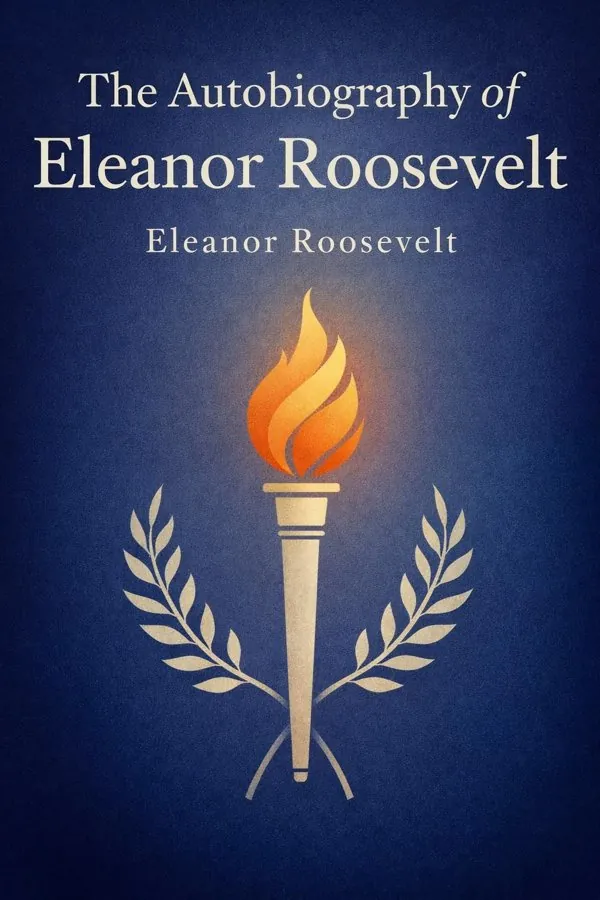
The Autobiography of Eleanor Roosevelt: Summary & Key Insights
 10 min8 chaptersAudio available
Key Takeaways from The Autobiography of Eleanor Roosevelt
Confidence rarely begins as confidence.
Social conscience becomes meaningful only when it leaves the realm of sentiment and encounters real lives.
Relationships are tested most severely when private hopes collide with public ambition.
Public leadership loses its moral force when it becomes insulated from ordinary life.
Crises do not create values from nothing; they expose which values people are prepared to live by.
What Is The Autobiography of Eleanor Roosevelt About?
The Autobiography of Eleanor Roosevelt by Eleanor Roosevelt is a biographies book published in 1992 spanning 7 pages. The Autobiography of Eleanor Roosevelt is far more than the life story of a former First Lady. It is a record of personal transformation, public service, and moral growth told by one of the most influential women of the twentieth century. In these pages, Eleanor Roosevelt traces her journey from a lonely and insecure childhood into a life of political engagement, social advocacy, and international leadership. She reflects on family wounds, marriage, motherhood, public controversy, and the responsibilities that come with visibility and power. What makes this autobiography especially compelling is its unusual combination of humility and authority. Roosevelt does not present herself as flawless or heroic from the beginning. Instead, she shows how conviction is built gradually through experience, observation, and action. Her voice is thoughtful, candid, and deeply practical, always returning to the question of how an individual can be useful in a troubled world. The book matters because it turns history into lived experience. Through Eleanor Roosevelt’s eyes, readers witness the evolution of modern citizenship, women’s public leadership, and human rights advocacy. Few memoirs offer such intimate access to both a private conscience and a public era.
This FizzRead summary covers all 8 key chapters of The Autobiography of Eleanor Roosevelt in approximately 10 minutes, distilling the most important ideas, arguments, and takeaways from Eleanor Roosevelt's work. Also available as an audio summary and Key Quotes Podcast.
The Autobiography of Eleanor Roosevelt
The Autobiography of Eleanor Roosevelt is far more than the life story of a former First Lady. It is a record of personal transformation, public service, and moral growth told by one of the most influential women of the twentieth century. In these pages, Eleanor Roosevelt traces her journey from a lonely and insecure childhood into a life of political engagement, social advocacy, and international leadership. She reflects on family wounds, marriage, motherhood, public controversy, and the responsibilities that come with visibility and power.
What makes this autobiography especially compelling is its unusual combination of humility and authority. Roosevelt does not present herself as flawless or heroic from the beginning. Instead, she shows how conviction is built gradually through experience, observation, and action. Her voice is thoughtful, candid, and deeply practical, always returning to the question of how an individual can be useful in a troubled world.
The book matters because it turns history into lived experience. Through Eleanor Roosevelt’s eyes, readers witness the evolution of modern citizenship, women’s public leadership, and human rights advocacy. Few memoirs offer such intimate access to both a private conscience and a public era.
Who Should Read The Autobiography of Eleanor Roosevelt?
This book is perfect for anyone interested in biographies and looking to gain actionable insights in a short read. Whether you're a student, professional, or lifelong learner, the key ideas from The Autobiography of Eleanor Roosevelt by Eleanor Roosevelt will help you think differently.
- ✓Readers who enjoy biographies and want practical takeaways
- ✓Professionals looking to apply new ideas to their work and life
- ✓Anyone who wants the core insights of The Autobiography of Eleanor Roosevelt in just 10 minutes
Want the full summary?
Get instant access to this book summary and 100K+ more with Fizz Moment.
Get Free SummaryAvailable on App Store • Free to download
Key Chapters
Confidence rarely begins as confidence. More often, it begins as loneliness, uncertainty, and the slow decision not to be defeated by either. In recounting her early life, Eleanor Roosevelt shows how a childhood marked by emotional loss and insecurity shaped her character. Born into privilege, she nevertheless felt unloved and awkward, especially after the deaths of her parents left her emotionally adrift. Rather than romanticizing her upbringing, she reveals how deeply isolation affected her sense of self.
A turning point came through education, particularly at Allenswood Academy in England, where the headmistress Marie Souvestre challenged her to think independently and engage seriously with the world. This experience did more than refine her intellect. It gave her a framework for dignity. She began to see that self-worth could be cultivated through curiosity, discipline, and usefulness rather than inherited status or social approval.
The deeper lesson is that identity is not fixed by early pain. Roosevelt’s story demonstrates that difficult beginnings can sharpen one’s moral imagination. Someone who has known fear or exclusion may become more capable of recognizing suffering in others. In practical terms, this means adversity can be transformed into empathy, and insecurity into steady purpose.
For modern readers, her example is especially relevant. Many people assume that impactful lives begin with natural self-assurance. Roosevelt suggests the opposite: growth often starts when someone feels inadequate but keeps moving toward responsibility anyway. Teachers, mentors, and environments that encourage independent thought can alter an entire life trajectory.
Actionable takeaway: Examine one early hardship in your life and ask how it might be converted into a source of empathy, resilience, or service rather than a permanent limitation.
Social conscience becomes meaningful only when it leaves the realm of sentiment and encounters real lives. Eleanor Roosevelt’s early work at the Rivington Street Settlement on the Lower East Side marked a decisive awakening. There she encountered crowded housing, labor exploitation, illness, and the daily humiliations of poverty. These experiences did not produce abstract pity; they produced informed commitment.
What changed Roosevelt was proximity. She did not rely on secondhand descriptions of inequality. She entered neighborhoods, listened to immigrant families, taught classes, and observed conditions directly. This mattered because it stripped away the comforting illusions that privilege can sustain. Poverty was not a sign of personal failure. It was tied to systems: wages, housing, education, health, and the unequal distribution of opportunity.
Her account reminds readers that service is not about feeling noble. It is about learning enough to be useful. Roosevelt’s compassion became effective because she paired feeling with observation. She saw that real help requires understanding context. A child struggling in school may also be dealing with hunger. A worker in distress may be trapped by poor policy, not poor character. In this way, service becomes a form of civic intelligence.
This insight remains practical today. Whether volunteering, donating, managing a team, or shaping policy, people make better decisions when they first understand lived conditions. Visiting communities, listening without defensiveness, and resisting stereotypes are all forms of responsible action. Good intentions are a beginning, not a solution.
Actionable takeaway: Before trying to solve a problem you care about, spend time learning from the people closest to it and let firsthand understanding reshape your assumptions.
Relationships are tested most severely when private hopes collide with public ambition. Eleanor Roosevelt’s marriage to Franklin D. Roosevelt was deeply important, often painful, and politically formative. She writes not as someone living inside a fairy tale, but as someone who gradually learned how to build purpose amid disappointment. Their partnership endured emotional strains, including betrayal, yet it evolved into a collaboration that influenced American public life.
One of the autobiography’s most striking themes is that Eleanor did not remain defined by the conventional role expected of political wives. As Franklin’s career expanded, especially after his battle with polio, she became increasingly active in political organizing, speechmaking, travel, and advocacy. She did not merely support his public identity; she developed her own. In time, they became partners whose strengths were different but mutually reinforcing. He operated through formal political power; she through social contact, observation, and moral pressure.
This chapter of her life illustrates a broader truth: mature partnership does not require sameness. It requires adaptation, honesty about limits, and a willingness to grow beyond assigned roles. Roosevelt found that personal disillusionment could either lead to bitterness or to a broader life of usefulness. She chose the latter. That choice did not erase hurt, but it gave her pain a direction.
Modern readers can apply this insight in many contexts. In marriages, friendships, and professional alliances, people often begin with assumptions about who each person will be. Strong partnerships survive when both individuals are allowed to evolve. Shared purpose matters more than rigid scripts.
Actionable takeaway: Reassess one important partnership in your life by asking not only what you expect from it, but how both people might grow into a more honest and purposeful collaboration.
Public leadership loses its moral force when it becomes insulated from ordinary life. During the White House years, Eleanor Roosevelt transformed the role of First Lady by refusing ceremonial confinement. She traveled widely, visited mining towns and relief programs, met workers and soldiers, held press conferences, wrote a newspaper column, and made herself accessible to people far beyond elite political circles.
Her approach was radical not simply because she was active, but because she treated visibility as responsibility. She understood that access to power should widen one’s field of concern, not narrow it. By seeing conditions firsthand during the Great Depression, she became both witness and messenger. She reported suffering to those in authority and used her public standing to draw attention to neglected communities, women’s employment, youth programs, and racial injustice.
Roosevelt also expanded what female political leadership could look like. She showed that influence need not depend on formal office alone. It can emerge through listening, convening, writing, questioning, and insisting that the vulnerable be included in national conversations. Her example challenges the assumption that leadership is mainly about control. For her, it was about contact and conscience.
This idea remains relevant in institutions of every kind. Executives who never leave headquarters, public officials who ignore local realities, or community leaders who speak without listening all risk detachment. Leadership becomes stronger when it is informed by direct encounters with the people most affected by decisions.
Actionable takeaway: If you hold any position of responsibility, spend time regularly with those least heard by your organization and let their reality influence your priorities.
Crises do not create values from nothing; they expose which values people are prepared to live by. During World War II, Eleanor Roosevelt’s public role took on even greater urgency. She visited troops, encouraged civilians, advocated for refugees, and remained attentive to the social consequences of war at home and abroad. In her telling, wartime service was not only patriotic ceremony. It was a test of endurance, compassion, and moral steadiness.
Roosevelt understood that war compresses human choices. Governments make rapid decisions, fear spreads easily, and people become vulnerable to propaganda, cruelty, and indifference. Her response was to widen rather than narrow her concern. She focused not just on victory, but on the human beings caught in conflict: soldiers facing loneliness, families enduring separation, and displaced people struggling for safety. She believed that democratic values must be defended in method as well as in rhetoric.
A key contribution of this section is her insistence that civic duty includes emotional labor. Encouragement, presence, and public honesty matter during periods of upheaval. She did not pretend that reassurance alone could solve wartime suffering, but she recognized that morale and dignity are part of national resilience. Her wartime experiences also deepened her postwar commitment to international cooperation and human rights.
For readers today, the lesson extends beyond military conflict. Economic shocks, pandemics, social unrest, and institutional crises all reveal whether communities act with courage or retreat into selfishness. Character becomes visible under pressure.
Actionable takeaway: In times of crisis, ask not only what protects your own interests, but what concrete act of steadiness, care, or truth-telling you can offer to others.
The end of one identity can become the beginning of a larger vocation. After Franklin Roosevelt’s death, Eleanor Roosevelt faced a profound personal and public turning point. She was no longer First Lady, no longer part of the daily machinery of the White House, and no longer anchored by the partnership that had defined much of her adult life. Yet instead of retreating from public life, she entered one of her most consequential phases.
Her appointment as a United States delegate to the United Nations gave shape to this next chapter. Roosevelt brought to the international stage the same habits that had defined her domestic work: listening, persistence, moral seriousness, and a belief that human dignity should not depend on nationality, race, or class. She became a central figure in the work that led to the Universal Declaration of Human Rights, helping articulate principles that still shape global moral language.
What makes this transformation so powerful is that it was not a denial of grief. Rather, it shows how grief can be integrated into purpose. Roosevelt did not erase loss by staying busy. She accepted that sorrow changes a person, then allowed that change to deepen her commitments. She moved from symbolic national motherhood to active global citizenship.
Many readers will recognize this pattern in their own lives. Career endings, bereavement, divorce, illness, or retirement can feel like reductions of self. Roosevelt’s example suggests another possibility: when one role falls away, a more essential mission may emerge. Reinvention is not always glamorous, but it can be meaningful.
Actionable takeaway: If a major loss has altered your life, ask which values remain most alive in you and how they might guide the next chapter rather than merely remind you of what is gone.
Democracy weakens when people imagine that public life belongs to someone else. One of the recurring convictions in Eleanor Roosevelt’s autobiography is that citizenship is an active responsibility. She believed individuals should not remain passive consumers of politics, waiting for leaders to solve every problem. Instead, they must think, participate, question, and contribute to the common good.
Her understanding of citizenship was broad. Voting mattered, but so did staying informed, joining civic organizations, volunteering, speaking up about injustice, and caring about the welfare of people outside one’s immediate circle. She saw democracy as a living habit rather than a periodic event. That habit requires discipline: listening to opposing views, resisting cynicism, and accepting that social progress is often slow and incomplete.
Roosevelt also linked citizenship to moral imagination. A healthy society depends on whether its members can recognize one another as fully human, even across lines of class, race, religion, and nationality. This is why she repeatedly returned to education, public discussion, and contact across difference. Ignorance breeds fear; fear invites division; division threatens democratic life.
This idea is strikingly practical today. Many people feel overwhelmed by politics and retreat into private concerns. Roosevelt would likely argue that withdrawal is understandable but dangerous. Communities improve when ordinary people attend meetings, mentor youth, support honest journalism, help neighbors, and remain engaged even when results are imperfect.
Actionable takeaway: Choose one form of civic participation you can practice consistently this month—such as attending a local meeting, volunteering, contacting a representative, or supporting a community initiative—and treat it as part of your duty, not an optional extra.
Conscience often begins where conformity ends. Throughout her life, Eleanor Roosevelt had to develop the courage to think and speak independently, even when doing so invited criticism. Whether addressing racial discrimination, labor conditions, women’s rights, or international cooperation, she repeatedly faced resistance from those who believed she had overstepped the proper boundaries of her role.
What makes her independence notable is that it was not impulsive rebellion. She did not oppose convention merely to appear bold. Instead, she learned to test inherited assumptions against lived experience. If social custom contradicted human dignity, she became willing to challenge it. This habit of mind was nurtured early through education and strengthened over time through travel, reading, and direct contact with people unlike herself.
Her example offers a useful model for modern life. Independent thinking is not the same as reflexive contrarianism. It requires humility, evidence, and moral clarity. It means being willing to revise one’s views when new realities appear, but also being willing to stand firm when convenience pressures one to stay silent. In workplaces, families, and public discourse, many harmful patterns continue because people fear social cost more than ethical failure.
Roosevelt’s life shows that courage is often cumulative. Each time a person speaks honestly, asks a harder question, or refuses an easy prejudice, character grows stronger. Over time, that inner freedom becomes one of the most valuable forms of leadership.
Actionable takeaway: Identify one belief you hold mainly because it is socially expected, then examine whether it withstands evidence, experience, and your own deepest values.
All Chapters in The Autobiography of Eleanor Roosevelt
About the Author
Eleanor Roosevelt (1884–1962) was an American diplomat, author, activist, and one of the most influential public figures of the twentieth century. As First Lady of the United States from 1933 to 1945, she reshaped the role into one of direct social and political engagement. She championed workers’ rights, women’s participation in public life, youth programs, and civil rights, while maintaining a strong public voice through speeches, journalism, and extensive travel. After President Franklin D. Roosevelt’s death, she remained a major force in international affairs as a U.S. delegate to the United Nations. She was instrumental in advancing the Universal Declaration of Human Rights, helping to define a new moral language for the postwar world. Her legacy endures as a model of civic responsibility, empathy, and principled leadership.
Get This Summary in Your Preferred Format
Read or listen to the The Autobiography of Eleanor Roosevelt summary by Eleanor Roosevelt anytime, anywhere. FizzRead offers multiple formats so you can learn on your terms — all free.
Available formats: App · Audio · PDF · EPUB — All included free with FizzRead
Download The Autobiography of Eleanor Roosevelt PDF and EPUB Summary
Key Quotes from The Autobiography of Eleanor Roosevelt
“More often, it begins as loneliness, uncertainty, and the slow decision not to be defeated by either.”
“Social conscience becomes meaningful only when it leaves the realm of sentiment and encounters real lives.”
“Relationships are tested most severely when private hopes collide with public ambition.”
“Public leadership loses its moral force when it becomes insulated from ordinary life.”
“Crises do not create values from nothing; they expose which values people are prepared to live by.”
Frequently Asked Questions about The Autobiography of Eleanor Roosevelt
The Autobiography of Eleanor Roosevelt by Eleanor Roosevelt is a biographies book that explores key ideas across 8 chapters. The Autobiography of Eleanor Roosevelt is far more than the life story of a former First Lady. It is a record of personal transformation, public service, and moral growth told by one of the most influential women of the twentieth century. In these pages, Eleanor Roosevelt traces her journey from a lonely and insecure childhood into a life of political engagement, social advocacy, and international leadership. She reflects on family wounds, marriage, motherhood, public controversy, and the responsibilities that come with visibility and power. What makes this autobiography especially compelling is its unusual combination of humility and authority. Roosevelt does not present herself as flawless or heroic from the beginning. Instead, she shows how conviction is built gradually through experience, observation, and action. Her voice is thoughtful, candid, and deeply practical, always returning to the question of how an individual can be useful in a troubled world. The book matters because it turns history into lived experience. Through Eleanor Roosevelt’s eyes, readers witness the evolution of modern citizenship, women’s public leadership, and human rights advocacy. Few memoirs offer such intimate access to both a private conscience and a public era.
You Might Also Like

An American Marriage
Tayari Jones
10 min
Benjamin Franklin: An American Life
Walter Isaacson
10 min
I Know Why The Caged Bird Sings
Maya Angelou
10 min
Long Walk to Freedom
Nelson Mandela
10 min
Persepolis
Marjane Satrapi
10 min
Surely You're Joking, Mr. Feynman!
Richard P. Feynman
10 minFeatured In
Browse by Category
Ready to read The Autobiography of Eleanor Roosevelt?
Get the full summary and 100K+ more books with Fizz Moment.