
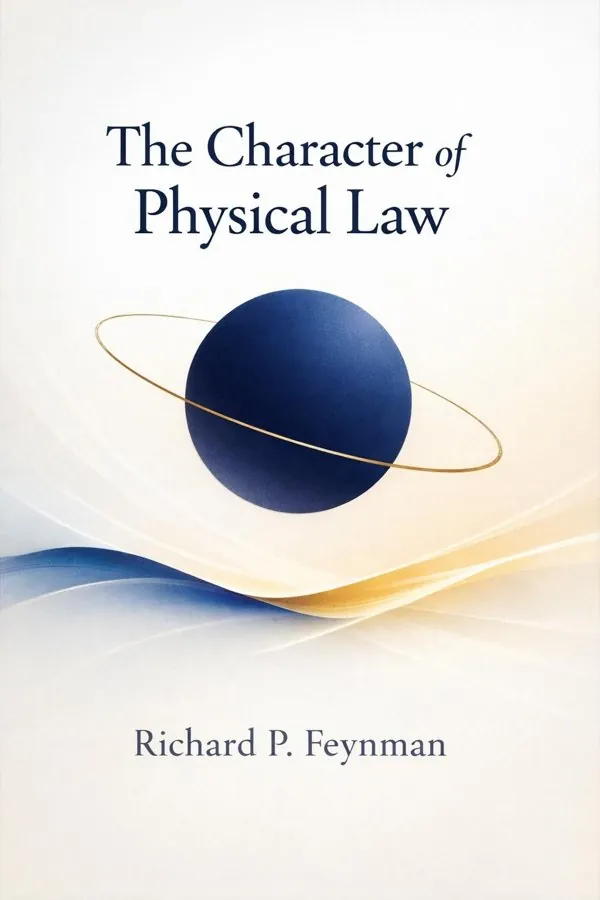
The Character of Physical Law: Summary & Key Insights
 10 min9 chaptersAudio available
Key Takeaways from The Character of Physical Law
A single law can illuminate an entire worldview.
Reality often becomes clearest when words fail.
Some of the deepest truths in physics are not about what changes, but about what stays the same.
Beauty in physics is not decoration; it is often a clue.
Most fundamental equations do not care whether time moves forward or backward, yet human experience is saturated with irreversibility.
What Is The Character of Physical Law About?
The Character of Physical Law by Richard P. Feynman is a popular_sci book spanning 9 pages. Based on a celebrated series of Messenger Lectures delivered at Cornell University in 1964, The Character of Physical Law is Richard P. Feynman’s brilliant exploration of what scientific laws are, how physicists discover them, and why they possess such astonishing beauty. Rather than presenting physics as a dry collection of formulas, Feynman reveals it as a disciplined yet imaginative search for patterns hidden beneath the chaos of everyday experience. He moves from Newton’s law of gravitation to symmetry, conservation, probability, time, and the role of experiment, showing how a few abstract principles can explain an immense range of phenomena. What makes this book enduring is its combination of intellectual rigor and philosophical depth. Feynman does not merely explain results; he examines the very logic of science—why mathematics is so effective, why uncertainty is built into nature, and why every law remains open to revision if experiment disagrees. As one of the twentieth century’s greatest physicists and teachers, Feynman writes with unmatched authority, clarity, and wit. This book matters because it teaches readers not only something about physics, but something profound about reality, knowledge, and the humility required to understand the universe.
This FizzRead summary covers all 9 key chapters of The Character of Physical Law in approximately 10 minutes, distilling the most important ideas, arguments, and takeaways from Richard P. Feynman's work. Also available as an audio summary and Key Quotes Podcast.
The Character of Physical Law
Based on a celebrated series of Messenger Lectures delivered at Cornell University in 1964, The Character of Physical Law is Richard P. Feynman’s brilliant exploration of what scientific laws are, how physicists discover them, and why they possess such astonishing beauty. Rather than presenting physics as a dry collection of formulas, Feynman reveals it as a disciplined yet imaginative search for patterns hidden beneath the chaos of everyday experience. He moves from Newton’s law of gravitation to symmetry, conservation, probability, time, and the role of experiment, showing how a few abstract principles can explain an immense range of phenomena.
What makes this book enduring is its combination of intellectual rigor and philosophical depth. Feynman does not merely explain results; he examines the very logic of science—why mathematics is so effective, why uncertainty is built into nature, and why every law remains open to revision if experiment disagrees. As one of the twentieth century’s greatest physicists and teachers, Feynman writes with unmatched authority, clarity, and wit. This book matters because it teaches readers not only something about physics, but something profound about reality, knowledge, and the humility required to understand the universe.
Who Should Read The Character of Physical Law?
This book is perfect for anyone interested in popular_sci and looking to gain actionable insights in a short read. Whether you're a student, professional, or lifelong learner, the key ideas from The Character of Physical Law by Richard P. Feynman will help you think differently.
- ✓Readers who enjoy popular_sci and want practical takeaways
- ✓Professionals looking to apply new ideas to their work and life
- ✓Anyone who wants the core insights of The Character of Physical Law in just 10 minutes
Want the full summary?
Get instant access to this book summary and 100K+ more with Fizz Moment.
Get Free SummaryAvailable on App Store • Free to download
Key Chapters
A single law can illuminate an entire worldview. Feynman uses Newton’s law of gravitation as his model example because it shows what makes a physical law remarkable: simplicity in expression, enormous explanatory power, and precise agreement with observation. With one mathematical relationship, Newton explained falling apples, the motion of the Moon, the orbits of planets, and the tides. That kind of unification is the hallmark of great science.
But Feynman’s deeper point is not merely that gravity is important. It is that physical laws often connect things that seem completely unrelated to ordinary intuition. The same rule governing an object dropped from a tower also governs the paths of celestial bodies across immense distances. This teaches us that nature is not organized around human-scale categories. It is organized around hidden regularities that mathematics can reveal.
Feynman also emphasizes that laws are judged not by how obvious they sound, but by how accurately they predict reality. Newton’s law was powerful not because it was philosophically pleasing, but because it worked. Later, Einstein refined our understanding of gravity, showing that even magnificent laws may be approximations within a deeper framework. Science advances by preserving what works while extending its range.
In practical terms, this idea shapes everything from satellite navigation to space travel. GPS technology, orbital mechanics, and astrophysics all depend on gravitational laws, even when corrected by relativity. The lesson reaches beyond physics: in any field, the best explanations are often those that unify many cases under one elegant principle.
Actionable takeaway: When trying to understand a complex problem, look for a simple rule that explains many different outcomes at once.
Reality often becomes clearest when words fail. Feynman argues that mathematics is not just a convenient tool for physicists; it is the only language precise enough to express physical law fully. Everyday language is flexible, emotional, and rich in nuance, but physical laws demand exact relationships. Mathematics allows us to state those relationships without ambiguity.
This does not mean equations are magical symbols detached from reality. Rather, they encode patterns that experiments reveal. A formula is valuable because it compresses an enormous amount of observed truth into a compact form. For example, the equations of motion do not merely describe a thrown ball; they also apply to projectiles, satellites, and countless mechanical systems. Mathematics makes such generality possible.
Feynman is also struck by a mystery: why should mathematics, a product of human thought, fit the structure of the universe so well? He does not offer a final answer, but he treats the question with wonder. The success of mathematics suggests that nature has an underlying order that can be grasped abstractly, even when it cannot be visualized directly.
This insight matters in modern life far beyond theoretical physics. Engineers use mathematical models to design bridges and airplanes. Epidemiologists model disease spread. Economists and data scientists use equations to identify patterns in markets and behavior. In each case, mathematics enables clearer thinking by forcing assumptions into explicit form.
Still, Feynman warns against confusing mathematical elegance with truth. A beautiful equation must still face experiment. Mathematics can guide us, but nature has the final say.
Actionable takeaway: Whenever you face a complicated issue, try to express it quantitatively; clear measurement often reveals patterns that vague language hides.
Some of the deepest truths in physics are not about what changes, but about what stays the same. Feynman highlights the great conservation principles—such as conservation of energy, momentum, and angular momentum—as central pillars of physical law. These principles tell us that although systems may transform dramatically, certain quantities remain constant throughout the process.
Conservation of energy is especially striking because energy itself can take many forms: motion, heat, electricity, chemical potential, radiation. A moving car brakes and its kinetic energy becomes heat. A battery powers a device by converting stored chemical energy into electrical work. A star radiates energy into space while transforming matter in its core. The forms shift, yet the total accounting remains consistent.
Feynman’s treatment makes conservation laws feel less like bookkeeping tricks and more like windows into the architecture of reality. They reveal that beneath apparent disorder lies a hidden order. Even when events look messy, there are invariant quantities that allow us to understand what is possible and what is not.
These principles are immensely practical. Engineers rely on conservation laws in every design, from roller coasters and engines to power grids and spacecraft. Athletes intuit momentum and balance. Even household decisions involve energy efficiency, whether in insulation, fuel use, or appliances.
The broader lesson is intellectual discipline. Conservation laws teach us to ask: what remains unchanged beneath the surface? In business, biology, and social systems, identifying constraints and invariant factors often leads to better decisions than focusing only on visible events.
Actionable takeaway: In any changing situation, identify what must be conserved or constrained; that often reveals the true structure of the problem.
Beauty in physics is not decoration; it is often a clue. Feynman shows that symmetry is one of the most powerful guides in discovering physical laws. A symmetry exists when a system can undergo some transformation—such as shifting in space, moving in time, or rotating in direction—without changing its essential behavior. These invariances are not superficial patterns; they point to deep regularities in nature.
One of the most profound ideas in modern physics is that symmetry and conservation are linked. If the laws of physics do not change from one moment to the next, energy is conserved. If they do not depend on location, momentum is conserved. If they do not depend on orientation, angular momentum is conserved. This connection reveals that nature’s order is not random but structured through hidden consistency.
Feynman also reminds us that symmetries can be subtle. Nature may appear uneven at first glance, yet obey beautiful invariances at a deeper level. Conversely, some symmetries can be broken, and those breakings can be just as revealing. Much of modern particle physics depends on understanding which symmetries hold exactly, which are approximate, and what their limits imply.
Everyday life offers simple examples. A perfectly balanced wheel behaves the same no matter how you rotate it. A recipe that works in one kitchen should work in another because the underlying chemistry does not depend on place. Designers, architects, and coders also use symmetry because it creates stability, efficiency, and predictability.
Feynman’s larger message is that when a pattern persists across transformations, we should pay attention. Symmetry often signals that we are touching something fundamental.
Actionable takeaway: Look for what stays the same when perspective changes; recurring invariances often reveal the deepest principles at work.
Most fundamental equations do not care whether time moves forward or backward, yet human experience is saturated with irreversibility. Feynman explores this tension through the distinction between past and future. Why does a glass shatter but never spontaneously reassemble? Why do we remember the past and not the future? Why does heat flow from hot to cold and not the reverse? These questions reveal one of the most profound puzzles in physics.
At the microscopic level, many laws are nearly time-symmetric. If we filmed atoms colliding and played the motion backward, the equations might still make sense. But at the macroscopic level, the world has a clear arrow of time, largely because of probability and entropy. There are vastly more disordered arrangements than ordered ones, so systems naturally evolve toward states that can occur in more ways. That statistical tendency gives rise to the practical irreversibility we observe.
Feynman’s discussion shows how our common-sense picture of time is both valid and incomplete. We live in a world where causes precede effects and history accumulates. Yet the fundamental laws beneath that experience may be far less directional than intuition suggests. Physics therefore asks us to distinguish between what feels obvious and what is actually basic.
This idea matters in fields ranging from thermodynamics and computing to cosmology. Refrigerators, engines, data storage, and climate systems all depend on understanding irreversible processes. Even personal productivity echoes the principle: some actions are easier to undo than others because systems drift toward complexity and disorder unless energy is invested.
Actionable takeaway: Respect irreversibility—whether in machines, decisions, or habits—because returning to order usually requires far more effort than losing it.
Uncertainty is not always a sign of ignorance; sometimes it is part of nature itself. Feynman explains that modern physics, especially quantum mechanics, forces us to give up the classical dream of perfect prediction. At very small scales, events are often described not by definite outcomes in advance, but by probabilities. Physics can tell us the likelihood of where a particle will be found or how a process may unfold, but not always a single guaranteed result.
This was a radical shift in scientific thought. In older mechanics, if we knew all the initial conditions, we imagined we could in principle predict everything. Quantum theory shattered that confidence. The world is not merely difficult to know; in some cases it is fundamentally indeterminate until measured. Feynman does not present this as a failure of science but as a triumph of honesty. A good theory describes nature as it is, not as we wish it to be.
Probability also governs many large-scale systems, even outside quantum physics. Weather forecasting, insurance models, genetics, traffic analysis, and financial risk all depend on statistical reasoning. We may not predict one exact event, but we can still understand patterns across many events. This is one of science’s most powerful methods.
Feynman encourages readers to become comfortable with uncertainty without sinking into confusion. Probability does not mean “anything goes.” It means reality has structure that is statistical rather than deterministic in certain domains. Wise thinking therefore requires reasoning in likelihoods, not just certainties.
In everyday life, this mindset improves judgment. Medical tests, investments, and policy decisions all involve probabilistic trade-offs. People often make poor choices because they demand absolute guarantees where only weighted possibilities exist.
Actionable takeaway: Learn to think in probabilities rather than absolutes; better decisions come from weighing likelihoods, not clinging to certainty.
Science does not advance by defending old ideas; it advances by exposing them to risk. Feynman’s account of seeking new laws is one of the book’s most inspiring themes. He describes discovery as a process of imagination disciplined by evidence. A scientist proposes a pattern, frames it mathematically, and then compares its predictions with experiment. If the predictions fail, the theory must be abandoned or revised, no matter how elegant it seemed.
This process requires both creativity and humility. New laws are not found by mechanically collecting facts alone. They often begin as daring guesses—leaps that connect known results in unfamiliar ways. But unlike in philosophy or speculation, these guesses must survive contact with reality. Nature is the judge, and she is unimpressed by status, confidence, or beauty.
Feynman is especially sharp on the danger of self-deception. Scientists naturally become attached to their ideas, yet progress depends on being willing to let them go. This makes science not only a body of knowledge but a moral practice of intellectual honesty. The best scientist is not the one who is never wrong, but the one who is quickest to recognize when nature says no.
This method applies widely. Entrepreneurs test products with customers. Doctors compare treatments through trials. Software teams run experiments before scaling features. In each case, progress depends on replacing assumptions with feedback.
The search for new laws therefore models a powerful way of thinking: imagine boldly, test rigorously, revise quickly. It is a formula for learning in any uncertain environment.
Actionable takeaway: Treat your ideas as hypotheses, not identities—test them against reality early, and change course when the evidence demands it.
The history of physics is, in part, the story of finding that many things are secretly one. Feynman emphasizes the unification of physical laws as a guiding ambition of science. Great advances occur when phenomena once treated separately turn out to be different expressions of a deeper principle. Newton united celestial and terrestrial motion. Maxwell united electricity, magnetism, and light. Later physics pursued still deeper connections among forces and particles.
This drive toward unity reflects more than aesthetic preference. Unified theories are powerful because they reduce complexity. Instead of memorizing separate rules for many cases, we discover a smaller number of principles from which those cases follow. Such compression is one of the signatures of understanding. To know more with fewer assumptions is the essence of explanatory progress.
Feynman does not claim that unification is complete. On the contrary, he presents it as an unfinished journey. Some parts of physics fit together beautifully; others remain stubbornly separate. The dream of combining quantum mechanics and gravitation, for example, was unresolved in his time and remains one of the great challenges of modern science. That incompleteness is not discouraging—it is what keeps science alive.
The value of unification extends beyond physics. In medicine, a common biological mechanism can explain many symptoms. In management, one incentive structure may account for diverse behaviors. In personal learning, a few fundamental concepts often unlock many skills.
Feynman teaches readers to prefer explanations that connect rather than merely catalog. When different facts start to align under one framework, understanding deepens and prediction improves.
Actionable takeaway: Seek the principle that links seemingly separate problems; unified understanding is more powerful than isolated facts.
All Chapters in The Character of Physical Law
About the Author
Richard Phillips Feynman (1918–1988) was an American theoretical physicist renowned for both his scientific brilliance and his extraordinary gift for explanation. He made foundational contributions to quantum electrodynamics, helping reshape modern physics, and received the Nobel Prize in Physics in 1965. Feynman also worked on particle physics, quantum mechanics, and the physics of superfluidity, and he played a role in the Manhattan Project during World War II. Beyond research, he became famous as a teacher at Cornell and the California Institute of Technology, where his lectures inspired generations of students. His writing and public speaking combined rigor, wit, curiosity, and skepticism, making complex ideas accessible without sacrificing depth. Today, he remains one of the most beloved scientific voices of the twentieth century.
Get This Summary in Your Preferred Format
Read or listen to the The Character of Physical Law summary by Richard P. Feynman anytime, anywhere. FizzRead offers multiple formats so you can learn on your terms — all free.
Available formats: App · Audio · PDF · EPUB — All included free with FizzRead
Download The Character of Physical Law PDF and EPUB Summary
Key Quotes from The Character of Physical Law
“A single law can illuminate an entire worldview.”
“Reality often becomes clearest when words fail.”
“Some of the deepest truths in physics are not about what changes, but about what stays the same.”
“Beauty in physics is not decoration; it is often a clue.”
“Most fundamental equations do not care whether time moves forward or backward, yet human experience is saturated with irreversibility.”
Frequently Asked Questions about The Character of Physical Law
The Character of Physical Law by Richard P. Feynman is a popular_sci book that explores key ideas across 9 chapters. Based on a celebrated series of Messenger Lectures delivered at Cornell University in 1964, The Character of Physical Law is Richard P. Feynman’s brilliant exploration of what scientific laws are, how physicists discover them, and why they possess such astonishing beauty. Rather than presenting physics as a dry collection of formulas, Feynman reveals it as a disciplined yet imaginative search for patterns hidden beneath the chaos of everyday experience. He moves from Newton’s law of gravitation to symmetry, conservation, probability, time, and the role of experiment, showing how a few abstract principles can explain an immense range of phenomena. What makes this book enduring is its combination of intellectual rigor and philosophical depth. Feynman does not merely explain results; he examines the very logic of science—why mathematics is so effective, why uncertainty is built into nature, and why every law remains open to revision if experiment disagrees. As one of the twentieth century’s greatest physicists and teachers, Feynman writes with unmatched authority, clarity, and wit. This book matters because it teaches readers not only something about physics, but something profound about reality, knowledge, and the humility required to understand the universe.
More by Richard P. Feynman
Surely You're Joking, Mr. Feynman!
Richard P. Feynman
10 min
The Feynman Lectures on Physics
Richard P. Feynman
10 min
Surely You’re Joking, Mr. Feynman!: Adventures of a Curious Character
Richard P. Feynman
10 min
The Pleasure of Finding Things Out: The Best Short Works of Richard P. Feynman
Richard P. Feynman
10 minYou Might Also Like

Structures: Or Why Things Don"t Fall Down
J.E. Gordon
10 min
The Road to Wigan Pier
George Orwell
10 min
Bonk: The Curious Coupling of Science and Sex
Mary Roach
10 min
First Bite: How We Learn to Eat
Bee Wilson
10 min
In Pursuit Of The Unknown: 17 Equations That Changed The World
Ian Stewart
10 min
Napoleon's Buttons: 17 Molecules That Changed History
Penny Le Couteur and Jay Burreson
10 minBrowse by Category
Ready to read The Character of Physical Law?
Get the full summary and 100K+ more books with Fizz Moment.