
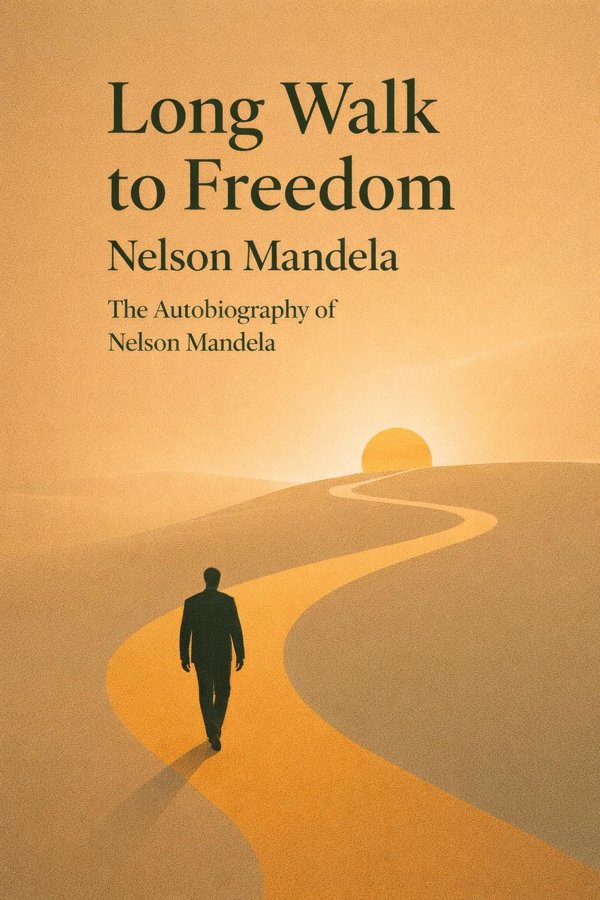
Long Walk to Freedom: Summary & Key Insights
 10 min10 chaptersAudio available
Key Takeaways from Long Walk to Freedom
A leader’s public convictions are often rooted in private beginnings.
Education does more than prepare a person for work; it can awaken a person to injustice.
Sometimes freedom begins when comfort ends.
No lasting movement is built by one person alone.
A movement’s strategy must respond to the world as it is, not only as it should be.
What Is Long Walk to Freedom About?
Long Walk to Freedom by Nelson Mandela is a biographies book published in 1994 spanning 10 pages. Long Walk to Freedom is far more than the life story of Nelson Mandela. It is a firsthand account of one of the twentieth century’s most significant moral and political struggles: the fight against apartheid in South Africa. In this autobiography, Mandela traces his path from a rural childhood in the Transkei to his emergence as a lawyer, activist, political prisoner, negotiator, and ultimately the first democratically elected president of South Africa. Along the way, he reveals not only the public milestones of history, but also the private costs of commitment, leadership, and sacrifice. What makes this book so powerful is its combination of intimacy and historical weight. Mandela does not present himself as a flawless hero. Instead, he writes with humility about fear, error, discipline, grief, and endurance. His authority comes not from theory, but from lived experience: decades spent resisting racial oppression, including 27 years in prison. The result is a memoir that illuminates how courage is built, how dignity survives under pressure, and how reconciliation can become a political force. Long Walk to Freedom matters because it shows that freedom is never simply won once; it must be continually defended, shared, and deepened.
This FizzRead summary covers all 10 key chapters of Long Walk to Freedom in approximately 10 minutes, distilling the most important ideas, arguments, and takeaways from Nelson Mandela's work. Also available as an audio summary and Key Quotes Podcast.
Long Walk to Freedom
Long Walk to Freedom is far more than the life story of Nelson Mandela. It is a firsthand account of one of the twentieth century’s most significant moral and political struggles: the fight against apartheid in South Africa. In this autobiography, Mandela traces his path from a rural childhood in the Transkei to his emergence as a lawyer, activist, political prisoner, negotiator, and ultimately the first democratically elected president of South Africa. Along the way, he reveals not only the public milestones of history, but also the private costs of commitment, leadership, and sacrifice.
What makes this book so powerful is its combination of intimacy and historical weight. Mandela does not present himself as a flawless hero. Instead, he writes with humility about fear, error, discipline, grief, and endurance. His authority comes not from theory, but from lived experience: decades spent resisting racial oppression, including 27 years in prison. The result is a memoir that illuminates how courage is built, how dignity survives under pressure, and how reconciliation can become a political force. Long Walk to Freedom matters because it shows that freedom is never simply won once; it must be continually defended, shared, and deepened.
Who Should Read Long Walk to Freedom?
This book is perfect for anyone interested in biographies and looking to gain actionable insights in a short read. Whether you're a student, professional, or lifelong learner, the key ideas from Long Walk to Freedom by Nelson Mandela will help you think differently.
- ✓Readers who enjoy biographies and want practical takeaways
- ✓Professionals looking to apply new ideas to their work and life
- ✓Anyone who wants the core insights of Long Walk to Freedom in just 10 minutes
Want the full summary?
Get instant access to this book summary and 100K+ more with Fizz Moment.
Get Free SummaryAvailable on App Store • Free to download
Key Chapters
A leader’s public convictions are often rooted in private beginnings. Mandela’s early life in Mvezo and Qunu, in the Transkei, shaped the values that would later guide his political life. Born into the Thembu royal family, he grew up in a world structured by kinship, oral tradition, customary law, and communal responsibility. His father, a counselor to the king, embodied pride and independence, while the elders around Mandela modeled forms of leadership based on consultation rather than domination.
This upbringing matters because it gave Mandela an early understanding of dignity. Even before he encountered formal politics, he saw that authority carried obligations. Leadership, in his experience, was not simply command; it was listening, weighing different voices, and preserving the community’s well-being. At the same time, his rural childhood exposed him to simplicity, discipline, and belonging. These were not abstract ideals but lived realities that later gave him psychological strength in prison and moral clarity in politics.
Mandela’s recollections also show how identity develops in layers. He was shaped by family, clan, language, and custom long before he became an activist. That grounding helped him endure the upheavals of urban life and political struggle without losing his sense of self. Modern readers can draw a practical lesson here: resilience often begins with knowing where you come from and what values formed you.
In daily life, this may mean reflecting on the people, traditions, or experiences that taught you dignity, fairness, and courage. Those foundations become especially important under pressure, when borrowed beliefs often collapse. Mandela’s childhood reminds us that strong principles usually begin in small, local worlds.
Actionable takeaway: Identify three values from your upbringing or community that still guide you, and write down how you can apply one of them to a current challenge.
Education does more than prepare a person for work; it can awaken a person to injustice. Mandela’s schooling, especially at Clarkebury, Healdtown, and Fort Hare, expanded his world far beyond the boundaries of rural life. He encountered Western ideas, Christian moral teaching, formal discipline, and ambitious peers who expected to lead. Education offered him prestige and opportunity, but it also forced him to confront contradictions between the ideals he was taught and the racial realities of South Africa.
At Fort Hare, one of the few institutions for Black Africans to receive higher education, Mandela began to develop both intellectual confidence and political awareness. He saw students debating governance, rights, and responsibility. He also learned that institutions could demand obedience while withholding justice. His participation in a student protest led to his departure, an early sign that he would not easily accept illegitimate authority.
Mandela’s educational journey reveals a crucial insight: learning is transformative when it teaches people not only how systems work, but also when those systems are wrong. Credentials alone do not produce moral courage. What mattered was the combination of exposure, reflection, and the willingness to act on conscience.
For readers today, this idea remains deeply practical. Whether in school, at work, or through independent study, true education involves asking difficult questions. Does the environment reward integrity or conformity? Are rules serving fairness, or protecting power? Mandela’s experience suggests that education is most valuable when it sharpens judgment and enlarges one’s responsibility to others.
This does not require dramatic acts. It may begin with speaking up in a meeting, challenging a harmful norm, or mentoring someone excluded from opportunity. Knowledge becomes meaningful when paired with ethical purpose.
Actionable takeaway: Choose one institution in your life—school, workplace, or community—and ask yourself where its stated values differ from its actual behavior, then decide on one constructive step to address that gap.
Sometimes freedom begins when comfort ends. Mandela’s move to Johannesburg transformed him from a sheltered young man into someone forced to confront the machinery of racial oppression directly. In the city, he experienced modern South Africa in its harshest form: pass laws, economic inequality, racial humiliation, and the constant policing of Black life. Johannesburg was not only a geographic shift; it was an education in power.
He worked a series of jobs, studied law, and met people who broadened his political horizons. Most important, he encountered activists, intellectuals, and ordinary workers who understood apartheid not as isolated unfairness, but as a systematic structure designed to control every aspect of life. He also formed relationships that would shape history, including ties with Walter Sisulu and others in the African National Congress. These connections helped him move from private ambition toward public commitment.
Mandela’s urban awakening demonstrates how environment can clarify reality. In rural life, injustice may appear distant or diffuse. In Johannesburg, it was immediate and visible. He saw that talent and effort alone could not overcome a political system built to deny Black South Africans full humanity. This realization shifted his goals. Personal advancement no longer seemed sufficient if the broader system remained unchanged.
There is a practical lesson here for modern readers. Many people discover their deepest convictions not in comfort, but in exposure to inequality, conflict, or contradiction. Rather than turning away from what disturbs us, Mandela’s example encourages us to study it, understand its causes, and connect with others already doing the work of change.
That can look like engaging with a local issue, listening to those most affected, or moving beyond complaint toward organized action. Awareness becomes powerful when it leads to disciplined participation.
Actionable takeaway: Identify one social problem you regularly notice but rarely study, and spend one hour this week learning from credible sources or people directly affected by it.
No lasting movement is built by one person alone. Mandela’s involvement with the African National Congress taught him that political change depends on collective organization, disciplined strategy, and a shared sense of purpose. Through the ANC and especially the Youth League, he helped push for a more assertive form of resistance against apartheid. This was a turning point in his development from concerned observer to movement leader.
The ANC gave Mandela more than a platform. It gave him a framework for understanding how oppressed people could turn anger into coordinated action. The movement emphasized mass mobilization, political education, protest, and unity across differences. Mandela learned that leadership was not simply charisma or bravery. It required structure, planning, debate, and the ability to align personal ambition with a common cause.
One of the most important lessons in this period is that effective activism requires institutions. Spontaneous outrage can bring attention to injustice, but enduring progress depends on organization. Campaigns must be designed, roles assigned, risks managed, and sacrifices shared. Mandela’s work in the Defiance Campaign and related efforts reflected this disciplined approach.
For readers today, this idea applies well beyond politics. Any meaningful effort—community reform, workplace change, educational improvement, or nonprofit work—benefits from collective leadership. People often overestimate the power of individual passion and underestimate the importance of systems, teams, and continuity.
Mandela’s experience also reminds us that movements grow stronger when they are willing to debate strategy without abandoning shared principles. Internal disagreement is not always weakness; it can be part of refining purpose.
Actionable takeaway: If you care about a cause, do not stop at personal opinion—join, support, or help build an organized group working toward that goal, and contribute in one concrete role.
A movement’s strategy must respond to the world as it is, not only as it should be. One of the most morally complex sections of Long Walk to Freedom is Mandela’s account of the shift from exclusively nonviolent resistance to armed struggle. For years, he and many others in the ANC believed deeply in nonviolent protest. But repeated repression, bans, arrests, and massacres convinced them that peaceful dissent alone was being met with relentless state violence.
Mandela does not present this transition lightly or triumphantly. Instead, he frames it as a painful decision shaped by circumstance. The creation of Umkhonto we Sizwe, the armed wing associated with the movement, emerged from the belief that sabotage against infrastructure could resist apartheid while minimizing loss of life. The goal was not revenge, but pressure. He wanted to show that the government could not expect obedience forever while closing every peaceful avenue for change.
This part of the book is important because it resists easy moral simplification. Mandela invites readers to consider how oppressed people make choices under extreme conditions. He neither glorifies violence nor ignores the reality that political options narrow when a state criminalizes peaceful opposition.
For modern readers, the broader lesson is about strategic adaptation under pressure. Principles matter, but so does sober assessment of reality. Whether in activism, leadership, or conflict resolution, methods must be chosen with care, proportionality, and a clear understanding of consequences.
At a personal level, this means recognizing when a familiar approach is no longer effective. It does not mean abandoning ethics; it means reassessing strategy while staying anchored in values.
Actionable takeaway: Examine one ongoing conflict or challenge in your life and ask whether your current approach is still working; if not, adjust your method without compromising your core principles.
There are moments when a courtroom becomes a stage for truth. Mandela’s arrest, prosecution, and eventual conviction—especially during the Rivonia Trial—transformed legal proceedings into a moral confrontation with apartheid itself. Facing the possibility of death, he used his defense statement not merely to argue for acquittal, but to explain the justice of the struggle against racial domination. His words made clear that obedience to an unjust system is not neutrality; it is submission.
What stands out here is Mandela’s composure. He understood that the state could imprison his body, but it could not fully control the meaning of his actions. By speaking clearly and without self-pity, he turned vulnerability into authority. His famous declaration that he was prepared to die for the ideal of a democratic and free society became one of the defining statements of the twentieth century.
This episode illustrates the power of reframing. Mandela refused to let the state define him as a criminal. Instead, he recast the real crime as apartheid itself. That shift in narrative mattered not only for South Africans, but for the international audience watching the trial. Leadership often involves naming reality more truthfully than those in power do.
The practical application is broader than politics. In any setting where people are unfairly judged, the ability to articulate one’s principles with calm clarity can reshape how others understand the issue. This does not guarantee immediate victory, but it can preserve dignity and influence history.
Mandela’s conduct also reminds us that courage is often verbal before it becomes victorious. Speaking truth under pressure is itself a form of action.
Actionable takeaway: Prepare a clear statement of your core values so that when you face criticism or pressure, you can respond from principle rather than fear.
A prison can confine a body without fully mastering a mind. Mandela’s years on Robben Island reveal one of the book’s deepest insights: freedom is both political and interior. The prison was designed to humiliate, isolate, and break resistance. Inmates endured hard labor, poor food, censorship, physical hardship, and degrading treatment. Yet Mandela and his fellow prisoners slowly turned survival into discipline, and discipline into a quiet form of defiance.
Robben Island became, in Mandela’s telling, a place of suffering but also of education and solidarity. Prisoners studied, debated, taught one another, and protected each other’s morale. They learned Afrikaans to understand their jailers, negotiated for better conditions, and refused to surrender their sense of worth. Mandela developed patience, emotional restraint, and strategic thinking. He came to see that anger, unless governed, could become another prison.
This section matters because it challenges the idea that power always belongs to those with weapons and walls. Even under extreme confinement, people can preserve dignity through routine, self-command, mutual support, and meaning. Mandela did not romanticize prison; he described its cruelty plainly. But he also showed how character is strengthened when people decide that humiliation will not define them.
For readers, the practical lesson is enduring. Many forms of confinement exist outside literal prison: illness, grief, bureaucracy, debt, or a demeaning workplace. In such conditions, inner freedom may begin with what remains under your control—your habits, your standards, your treatment of others, and your interpretation of events.
Actionable takeaway: In a situation where you feel trapped, list what is still within your control and build one daily discipline around it, however small.
Peace is rarely achieved by wishful thinking; it is built by people strong enough to negotiate without surrendering principle. As apartheid weakened and political conditions changed, Mandela emerged from prison not as a symbol frozen in suffering, but as an active negotiator shaping South Africa’s future. His willingness to talk with the government surprised some allies, yet for him negotiation was not compromise with injustice. It was the next strategic phase of the struggle.
What made Mandela effective was his ability to combine firmness with empathy. He understood his opponents well enough to negotiate with them seriously, but not so sympathetically that he forgot what they had defended. He recognized that a stable democratic future required more than victory; it required a political settlement that could prevent civil war and allow former enemies to coexist. This was not softness. It was disciplined realism.
Mandela’s example offers a practical framework for difficult negotiations of any kind. First, know your non-negotiables. Second, understand the fears and interests of the other side. Third, separate humiliation from justice. If the goal is durable peace, the losing side must still have a place in the future. This principle applies in organizations, families, communities, and politics.
He also showed that timing matters. Negotiation works best when paired with leverage, credibility, and preparation. Mandela could negotiate effectively because he had earned trust, maintained principle, and understood power.
In everyday life, this means entering difficult conversations with clarity rather than aggression. Listening is not capitulation, and firmness need not become cruelty.
Actionable takeaway: Before your next difficult conversation, write down your core objective, your non-negotiables, and one sincere attempt to understand the other person’s perspective.
Winning power is easier than using it wisely. Mandela’s presidency and role in the democratic transition show that liberation movements face their greatest test after triumph. Once apartheid formally ended and South Africa held democratic elections, the challenge shifted from resistance to governance. The country needed institutions, legitimacy, reconciliation, and a vision broad enough to include those who had once upheld oppression.
Mandela understood that symbolic leadership could stabilize a fragile nation. His gestures mattered: reaching out to former adversaries, supporting national unity, and encouraging institutions rather than personal rule. He recognized that revenge might feel emotionally satisfying but would likely destroy the possibility of a shared future. This is why reconciliation became central to his political style. He did not deny the crimes of apartheid, but he insisted that justice should help build a country, not merely settle scores.
This phase of the memoir highlights an often ignored truth: moral authority must be translated into administrative responsibility. It is one thing to inspire people; it is another to govern fairly, restrain one’s supporters, and make peace practical. Mandela’s presidency was not presented as perfection, but as an effort to move a wounded society toward democratic normalcy.
For readers, the broader lesson is that success changes obligations. After you achieve a goal—promotion, influence, recognition, or authority—you are responsible for what happens next. Character is tested not only in adversity, but in victory.
In practical terms, this could mean using power to widen opportunity, calming division rather than exploiting it, and building systems that outlast your own presence.
Actionable takeaway: If you hold any leadership role, ask not only how to succeed, but how to leave the people or institution stronger, fairer, and more stable than before.
The deepest message of Long Walk to Freedom is that liberation is never merely individual. Mandela repeatedly reflects on sacrifice, family loss, comradeship, and the unfinished nature of justice. He achieved global recognition, but the memoir resists treating freedom as a personal triumph story. Again and again, he returns to the idea that his life only makes sense within the larger struggle of millions denied dignity, land, rights, mobility, and voice.
This insight is essential because modern culture often frames freedom as private independence: the right to choose, achieve, or escape constraint. Mandela broadens the concept. A person is not fully free while living in a society structured by domination, fear, and exclusion. Likewise, political freedom without economic opportunity, human dignity, and social belonging remains incomplete. His reflections after prison and presidency make clear that the walk to freedom does not end with a single election or a single leader.
He also acknowledges the cost of commitment. His devotion to the struggle affected his marriage, his children, and his private life. This honesty gives the book moral complexity. It reminds readers that noble causes do not erase painful consequences. Yet Mandela still argues that a meaningful life requires service beyond the self.
For readers today, this means reconsidering what freedom demands. It may include defending your own rights, but it also means caring whether others can live with dignity. A healthy society depends on shared freedom, not isolated advantage.
Actionable takeaway: Define freedom in one sentence for yourself, then revise that sentence to include not only your own well-being but the dignity and opportunity of others.
All Chapters in Long Walk to Freedom
About the Author
Nelson Rolihlahla Mandela was a South African lawyer, anti-apartheid activist, and statesman born in 1918 in Mvezo, in the Transkei. A leading figure in the African National Congress, he became one of the most prominent opponents of apartheid, South Africa’s system of institutionalized racial segregation. Arrested for his political activities, Mandela spent 27 years in prison, much of it on Robben Island. After his release in 1990, he played a central role in negotiations that ended white minority rule and established multiracial democracy. In 1994, he became South Africa’s first democratically elected president, serving until 1999. Mandela is remembered worldwide for his moral courage, commitment to justice, and extraordinary emphasis on reconciliation over revenge. He died in 2013, leaving a legacy that continues to inspire movements for freedom and human dignity.
Get This Summary in Your Preferred Format
Read or listen to the Long Walk to Freedom summary by Nelson Mandela anytime, anywhere. FizzRead offers multiple formats so you can learn on your terms — all free.
Available formats: App · Audio · PDF · EPUB — All included free with FizzRead
Download Long Walk to Freedom PDF and EPUB Summary
Key Quotes from Long Walk to Freedom
“A leader’s public convictions are often rooted in private beginnings.”
“Education does more than prepare a person for work; it can awaken a person to injustice.”
“Sometimes freedom begins when comfort ends.”
“No lasting movement is built by one person alone.”
“A movement’s strategy must respond to the world as it is, not only as it should be.”
Frequently Asked Questions about Long Walk to Freedom
Long Walk to Freedom by Nelson Mandela is a biographies book that explores key ideas across 10 chapters. Long Walk to Freedom is far more than the life story of Nelson Mandela. It is a firsthand account of one of the twentieth century’s most significant moral and political struggles: the fight against apartheid in South Africa. In this autobiography, Mandela traces his path from a rural childhood in the Transkei to his emergence as a lawyer, activist, political prisoner, negotiator, and ultimately the first democratically elected president of South Africa. Along the way, he reveals not only the public milestones of history, but also the private costs of commitment, leadership, and sacrifice. What makes this book so powerful is its combination of intimacy and historical weight. Mandela does not present himself as a flawless hero. Instead, he writes with humility about fear, error, discipline, grief, and endurance. His authority comes not from theory, but from lived experience: decades spent resisting racial oppression, including 27 years in prison. The result is a memoir that illuminates how courage is built, how dignity survives under pressure, and how reconciliation can become a political force. Long Walk to Freedom matters because it shows that freedom is never simply won once; it must be continually defended, shared, and deepened.
You Might Also Like

An American Marriage
Tayari Jones
10 min
Benjamin Franklin: An American Life
Walter Isaacson
10 min
I Know Why The Caged Bird Sings
Maya Angelou
10 min
Persepolis
Marjane Satrapi
10 min
Surely You're Joking, Mr. Feynman!
Richard P. Feynman
10 min
The Autobiography of Eleanor Roosevelt
Eleanor Roosevelt
10 minFeatured In
Browse by Category
Ready to read Long Walk to Freedom?
Get the full summary and 100K+ more books with Fizz Moment.