
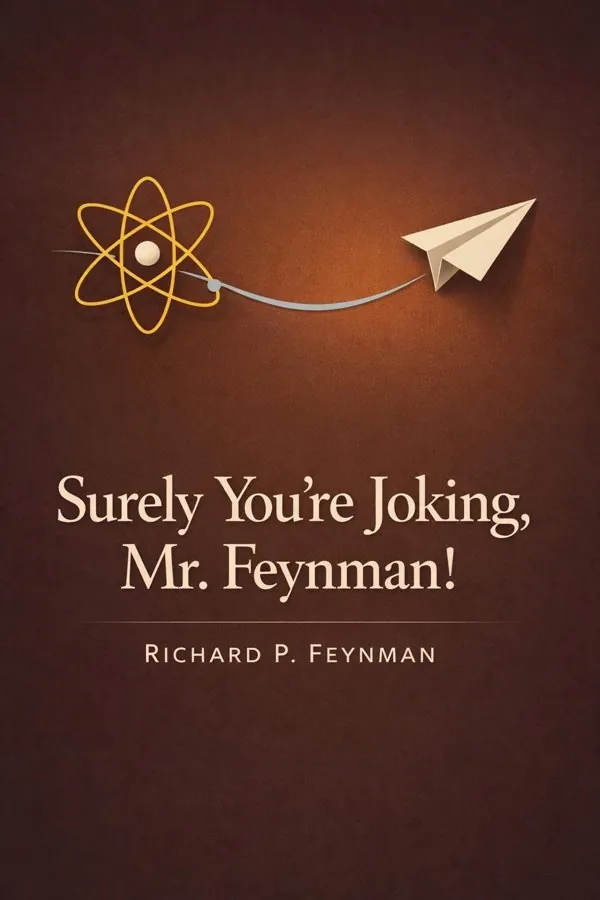
Surely You’re Joking, Mr. Feynman!: Adventures of a Curious Character: Summary & Key Insights
 10 min9 chaptersAudio available
Key Takeaways from Surely You’re Joking, Mr. Feynman!: Adventures of a Curious Character
Real understanding starts when you stop being impressed by mystery and begin investigating it.
The best education does not fill your head with answers; it trains you to ask better questions.
Great mentors expand your horizon, but they cannot do your thinking for you.
Pressure can sharpen performance, but joy is what sustains creativity.
Burnout often lifts not when you force productivity, but when you rediscover what first made the work beautiful.
What Is Surely You’re Joking, Mr. Feynman!: Adventures of a Curious Character About?
Surely You’re Joking, Mr. Feynman!: Adventures of a Curious Character by Richard P. Feynman is a biographies book spanning 11 pages. Surely You’re Joking, Mr. Feynman! is not a conventional autobiography, and that is exactly why it remains so memorable. Rather than presenting a neat, chronological account of his life, Richard P. Feynman offers a lively collection of stories about childhood experiments, college life, wartime research, scientific discovery, travel, art, music, and countless playful encounters with the world. The result is a portrait of a mind that refused to accept dull explanations, empty status, or intellectual pretense. At the center of every anecdote is the same driving force: curiosity. The book matters because it shows science not as a cold body of facts, but as a way of seeing. Feynman demonstrates that careful observation, irreverent questioning, and hands-on experimentation can illuminate everything from radios and safes to academic culture and human behavior. His authority comes not only from being a Nobel Prize–winning physicist, but from being one of the twentieth century’s most gifted teachers and most original thinkers. This book is entertaining first, but it also offers something deeper: a model for living with skepticism, joy, and a relentless desire to understand how things really work.
This FizzRead summary covers all 9 key chapters of Surely You’re Joking, Mr. Feynman!: Adventures of a Curious Character in approximately 10 minutes, distilling the most important ideas, arguments, and takeaways from Richard P. Feynman's work. Also available as an audio summary and Key Quotes Podcast.
Surely You’re Joking, Mr. Feynman!: Adventures of a Curious Character
Surely You’re Joking, Mr. Feynman! is not a conventional autobiography, and that is exactly why it remains so memorable. Rather than presenting a neat, chronological account of his life, Richard P. Feynman offers a lively collection of stories about childhood experiments, college life, wartime research, scientific discovery, travel, art, music, and countless playful encounters with the world. The result is a portrait of a mind that refused to accept dull explanations, empty status, or intellectual pretense. At the center of every anecdote is the same driving force: curiosity.
The book matters because it shows science not as a cold body of facts, but as a way of seeing. Feynman demonstrates that careful observation, irreverent questioning, and hands-on experimentation can illuminate everything from radios and safes to academic culture and human behavior. His authority comes not only from being a Nobel Prize–winning physicist, but from being one of the twentieth century’s most gifted teachers and most original thinkers. This book is entertaining first, but it also offers something deeper: a model for living with skepticism, joy, and a relentless desire to understand how things really work.
Who Should Read Surely You’re Joking, Mr. Feynman!: Adventures of a Curious Character?
This book is perfect for anyone interested in biographies and looking to gain actionable insights in a short read. Whether you're a student, professional, or lifelong learner, the key ideas from Surely You’re Joking, Mr. Feynman!: Adventures of a Curious Character by Richard P. Feynman will help you think differently.
- ✓Readers who enjoy biographies and want practical takeaways
- ✓Professionals looking to apply new ideas to their work and life
- ✓Anyone who wants the core insights of Surely You’re Joking, Mr. Feynman!: Adventures of a Curious Character in just 10 minutes
Want the full summary?
Get instant access to this book summary and 100K+ more with Fizz Moment.
Get Free SummaryAvailable on App Store • Free to download
Key Chapters
Real understanding starts when you stop being impressed by mystery and begin investigating it. In the opening stories of his life, Feynman describes a childhood shaped by playful inquiry. Radios, gadgets, puzzles, and small mechanical systems became opportunities to discover how the world worked. He did not merely want to know that something functioned; he wanted to know why. His father reinforced this habit by teaching him that naming a bird is not the same as understanding it. Labels can create the illusion of knowledge, but genuine insight comes from observing behavior, patterns, causes, and consequences.
This early approach shaped Feynman’s entire intellectual life. He learned to trust direct reasoning over secondhand authority. If a radio broke, he listened carefully, tested possibilities, and reasoned backward from the symptoms. That mindset later became the foundation of his scientific method. The same principle applies far beyond physics. A manager can ask why a process fails instead of blaming people. A student can test concepts by building examples rather than memorizing definitions. A parent can encourage children to ask what makes something happen instead of rewarding only correct answers.
Feynman’s childhood also shows that expertise often grows from play. His experiments were not always formal or efficient, but they trained his attention. By treating the ordinary world as a puzzle, he developed confidence in his ability to figure things out.
Actionable takeaway: Choose one everyday object or process this week and study how it actually works. Replace passive familiarity with active investigation.
The best education does not fill your head with answers; it trains you to ask better questions. During his undergraduate years at MIT, Feynman found an environment rich with ambition and intelligence, but he also noticed a danger familiar in elite institutions: students often confuse solving assigned problems with truly understanding the subject. He excelled academically, yet his advantage came less from brilliance alone than from refusing to be satisfied with formalism he could not personally make sense of.
Feynman developed his own style of learning. If a method felt mechanical, he searched for a more intuitive route. If a theorem was presented elegantly but abstractly, he tried to re-derive it from first principles. This habit helped him avoid intellectual dependence on authority. He was not disrespecting teachers; he was making knowledge his own. That distinction is central to the book. Real learning is active, not ceremonial.
The lesson extends to modern education and professional life. A programmer who memorizes syntax without building projects remains fragile. A medical student who recalls terminology without understanding mechanisms struggles in practice. A business leader who repeats management frameworks without testing them against reality lacks judgment. Feynman reminds us that personal comprehension is more durable than borrowed sophistication.
He also demonstrates the value of intellectual honesty. If he did not understand something, he admitted it to himself immediately. That prevented the accumulation of fake knowledge.
Actionable takeaway: The next time you learn a new concept, explain it in plain language without notes. If you cannot do that, go back until the idea becomes genuinely yours.
Great mentors expand your horizon, but they cannot do your thinking for you. In graduate school at Princeton, Feynman encountered powerful scientific minds, especially the physicist John Wheeler. These relationships mattered enormously. They exposed him to difficult questions, serious standards, and a wider scientific community. Yet what made Feynman distinctive was not obedience to his mentors, but his willingness to approach problems in his own unconventional way.
At Princeton, he wrestled with advanced physics while also learning the social world of elite academia. He discovered that prestige can intimidate young thinkers into silence. Feynman pushed against that pressure by treating even famous scientists as people rather than untouchable authorities. This attitude gave him intellectual freedom. He could admire expertise without surrendering his independence.
His graduate years reveal an important balance. On one hand, learning accelerates when you place yourself near excellence. On the other hand, progress stalls if you become overly concerned with appearing clever, fitting in, or pleasing gatekeepers. Feynman’s breakthrough mindset came from daring to ask simple questions others might consider naive. Those simple questions often exposed hidden confusion or opened new lines of thought.
This is deeply practical. In any field, mentorship is valuable when it strengthens your judgment rather than replacing it. A young lawyer, designer, scientist, or entrepreneur should absorb lessons from experienced people while preserving the right to test assumptions and reframe problems.
Actionable takeaway: Seek out one person whose expertise you respect, learn from them closely, and then deliberately restate the problem in your own words before accepting their framework.
Pressure can sharpen performance, but joy is what sustains creativity. Feynman’s stories from the Manhattan Project at Los Alamos combine scientific urgency, wartime tension, and mischievous problem-solving. Surrounded by secrecy and monumental stakes, he did groundbreaking work with other brilliant physicists. Yet some of his most memorable anecdotes involve opening locked filing cabinets, testing security systems, and exposing how easily people mistake procedure for safety.
These stories are funny, but they reveal something serious about institutions. Rules often create a comforting illusion of control. Feynman showed that systems must be understood in practice, not merely respected in theory. If a safe can be opened because people choose predictable combinations or leave clues around, then “security” exists only on paper. His prankster behavior was really a form of applied skepticism: test the real system, not the official story.
At a deeper level, the Los Alamos years show how playfulness can coexist with intense responsibility. Feynman did not become effective by acting solemn all the time. He stayed mentally agile by treating problems as things to explore, not just burdens to endure. In modern workplaces, this matters enormously. Teams that permit experimentation, challenge assumptions, and run small tests often outperform teams that cling to rigid routines.
Feynman also reveals the social side of science. Discovery is collaborative, messy, and human. Even among geniuses, confusion, shortcuts, pride, and humor are everywhere.
Actionable takeaway: In any system you rely on, test one assumption directly this week. Do not trust a process just because it looks official; verify how it works in reality.
Burnout often lifts not when you force productivity, but when you rediscover what first made the work beautiful. After the war, Feynman went through a period of emotional exhaustion and intellectual stagnation at Cornell. Prestige had not disappeared, and his technical ability remained intact, but the joy had drained away. Instead of solving this by doubling down on pressure, he let himself play with problems that interested him for no practical reason.
One famous example involved watching a plate wobble in the air and becoming fascinated by its motion. That small, seemingly trivial curiosity helped reawaken his delight in physics. By studying something unnecessary, he loosened the grip of expectation. Eventually, that return to playful exploration fed into deeper scientific work.
This is one of the book’s most useful insights because it reverses common advice. When people feel stuck, they often respond with more discipline, more comparison, and more anxiety. Feynman’s experience suggests that creative recovery may require a return to intrinsic motivation. Whether you are writing, teaching, coding, researching, or leading, your best work may come after you reconnect with the questions that naturally pull your attention.
That does not mean avoiding hard work. It means recognizing that sustainable excellence depends on fascination, not just obligation. Curiosity restores energy because it gives effort meaning.
In practical terms, professionals can use “low-stakes inquiry” to rekindle momentum: explore a side problem, sketch an idea, tinker without immediate payoff, or revisit what once excited you.
Actionable takeaway: Set aside one hour for a problem that interests you but does not advance any urgent goal. Use that time to reawaken enjoyment, not to prove your worth.
A curious mind weakens when it is forced into a single role. Feynman did not confine himself to physics. He learned to draw, played the bongo drums, engaged with artists, explored performance, and entered unfamiliar cultural spaces with the same appetite for understanding that he brought to science. These adventures were not distractions from his intellect; they were expressions of it.
The book makes clear that creativity grows through cross-pollination. When Feynman studied art, he had to train perception differently. When he played music, he developed rhythm, listening, and responsiveness. When he interacted with people outside academic science, he confronted assumptions embedded in his own world. Each new domain challenged him to become a beginner again, and that beginner’s mind protected him from intellectual rigidity.
This matters because modern life often rewards narrow specialization. Expertise is important, but over-identification with a single label can make people defensive, predictable, and less imaginative. Feynman’s example suggests that broad curiosity strengthens, rather than dilutes, core competence. An engineer who studies design may build more human-centered products. A scientist who learns storytelling may communicate more effectively. An executive who practices music may sharpen discipline and presence.
There is also a philosophical point here. Feynman lived as though the world were richer than any résumé. He resisted the idea that achievement should trap a person inside one socially approved identity.
Actionable takeaway: Start one serious beginner activity outside your main field this month. Choose something that requires observation, practice, and humility, and let it refresh the way you think in your primary work.
The deepest lesson in Feynman’s stories is that science is not just a profession; it is a disciplined form of honesty. Across his reflections on education, research, and everyday reasoning, he returns to one core principle: never fool yourself, and remember that you are the easiest person to fool. This standard explains both his brilliance and his irreverence. He was less interested in sounding intelligent than in finding out what was true.
For Feynman, scientific thinking meant confronting uncertainty directly. It meant distinguishing between names and explanations, theories and evidence, confidence and proof. It also meant accepting that not knowing is not a failure. In fact, pretending to know is often far more damaging than genuine ignorance, because false certainty blocks inquiry.
This principle is useful in every domain. Leaders make better decisions when they distinguish assumptions from data. Students learn faster when they admit confusion early. Citizens think more clearly when they separate evidence from rhetoric. Relationships improve when people stop defending appearances and start investigating causes.
The closing spirit of the book, often captured in Feynman’s phrase about the pleasure of finding things out, is both intellectual and existential. Life becomes more vivid when approached with open-eyed curiosity. Wonder and rigor are not opposites. They belong together.
Feynman’s example does not ask readers to become physicists. It asks them to become more awake: more willing to observe, question, test, revise, and delight in discovery.
Actionable takeaway: At the end of each day, write down one belief, assumption, or explanation you relied on. Then ask: How do I know this is true, and what evidence would change my mind?
All Chapters in Surely You’re Joking, Mr. Feynman!: Adventures of a Curious Character
About the Author
Richard Phillips Feynman (1918–1988) was an American theoretical physicist, educator, and writer celebrated for both his scientific achievements and his extraordinary gift for explanation. He played a major role in the development of quantum electrodynamics, work that earned him the Nobel Prize in Physics in 1965 alongside Julian Schwinger and Sin-Itiro Tomonaga. Feynman contributed to the Manhattan Project during World War II, later taught at Cornell University, and became a legendary professor at the California Institute of Technology. Beyond research, he was known for his humor, independence, and wide-ranging interests, including music, drawing, and puzzle-solving. His books and lectures introduced millions of readers to the pleasures of scientific thinking, making him one of the twentieth century’s most beloved public intellectuals.
Get This Summary in Your Preferred Format
Read or listen to the Surely You’re Joking, Mr. Feynman!: Adventures of a Curious Character summary by Richard P. Feynman anytime, anywhere. FizzRead offers multiple formats so you can learn on your terms — all free.
Available formats: App · Audio · PDF · EPUB — All included free with FizzRead
Download Surely You’re Joking, Mr. Feynman!: Adventures of a Curious Character PDF and EPUB Summary
Key Quotes from Surely You’re Joking, Mr. Feynman!: Adventures of a Curious Character
“Real understanding starts when you stop being impressed by mystery and begin investigating it.”
“The best education does not fill your head with answers; it trains you to ask better questions.”
“Great mentors expand your horizon, but they cannot do your thinking for you.”
“Pressure can sharpen performance, but joy is what sustains creativity.”
“Burnout often lifts not when you force productivity, but when you rediscover what first made the work beautiful.”
Frequently Asked Questions about Surely You’re Joking, Mr. Feynman!: Adventures of a Curious Character
Surely You’re Joking, Mr. Feynman!: Adventures of a Curious Character by Richard P. Feynman is a biographies book that explores key ideas across 9 chapters. Surely You’re Joking, Mr. Feynman! is not a conventional autobiography, and that is exactly why it remains so memorable. Rather than presenting a neat, chronological account of his life, Richard P. Feynman offers a lively collection of stories about childhood experiments, college life, wartime research, scientific discovery, travel, art, music, and countless playful encounters with the world. The result is a portrait of a mind that refused to accept dull explanations, empty status, or intellectual pretense. At the center of every anecdote is the same driving force: curiosity. The book matters because it shows science not as a cold body of facts, but as a way of seeing. Feynman demonstrates that careful observation, irreverent questioning, and hands-on experimentation can illuminate everything from radios and safes to academic culture and human behavior. His authority comes not only from being a Nobel Prize–winning physicist, but from being one of the twentieth century’s most gifted teachers and most original thinkers. This book is entertaining first, but it also offers something deeper: a model for living with skepticism, joy, and a relentless desire to understand how things really work.
More by Richard P. Feynman
Surely You're Joking, Mr. Feynman!
Richard P. Feynman
10 min
The Feynman Lectures on Physics
Richard P. Feynman
10 min
The Character of Physical Law
Richard P. Feynman
10 min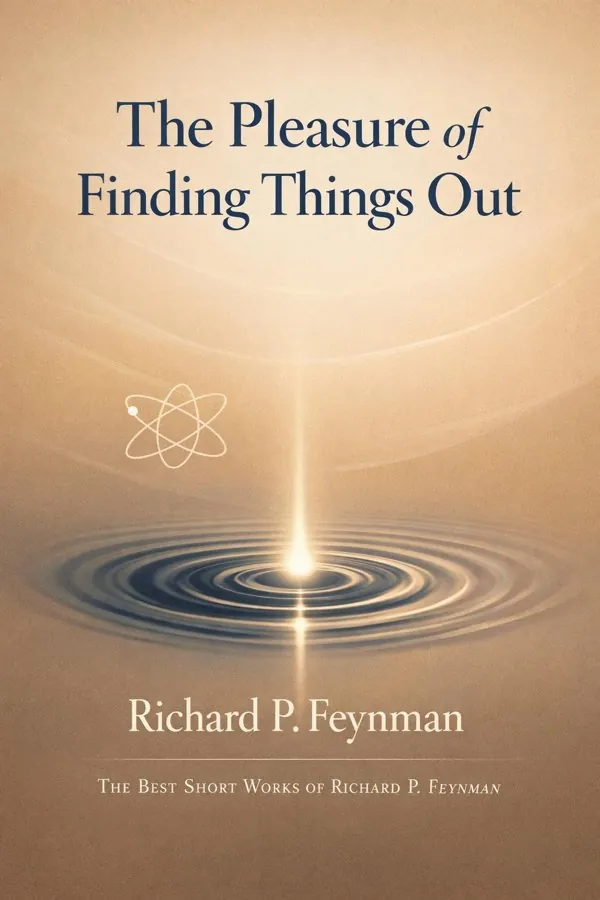
The Pleasure of Finding Things Out: The Best Short Works of Richard P. Feynman
Richard P. Feynman
10 minYou Might Also Like

An American Marriage
Tayari Jones
10 min
Benjamin Franklin: An American Life
Walter Isaacson
10 min
I Know Why The Caged Bird Sings
Maya Angelou
10 min
Long Walk to Freedom
Nelson Mandela
10 min
Persepolis
Marjane Satrapi
10 minSurely You're Joking, Mr. Feynman!
Richard P. Feynman
10 minBrowse by Category
Ready to read Surely You’re Joking, Mr. Feynman!: Adventures of a Curious Character?
Get the full summary and 100K+ more books with Fizz Moment.