
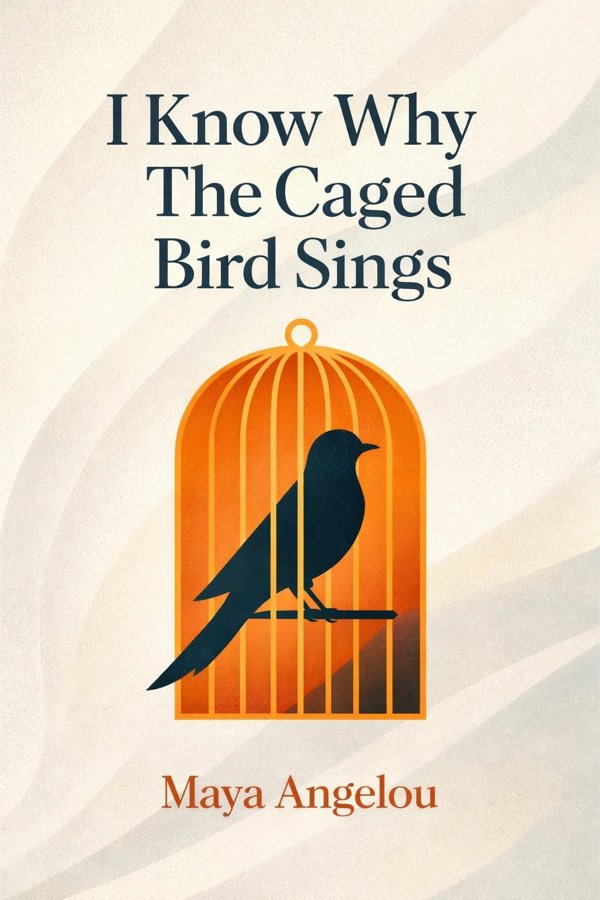
I Know Why The Caged Bird Sings: Summary & Key Insights
by Maya Angelou
 10 min9 chaptersAudio available
Key Takeaways from I Know Why The Caged Bird Sings
Oppression often works best when it makes injustice feel ordinary.
Children do not experience abandonment as an abstract fact; they experience it as a question about their own worth.
Trauma does not only wound the body; it can break the relationship between a person and language.
A person can be rescued not only by affection, but by being invited back into expression.
When the world becomes hostile, imagination can become a form of survival.
What Is I Know Why The Caged Bird Sings About?
I Know Why The Caged Bird Sings by Maya Angelou is a biographies book published in 1969 spanning 4 pages. I Know Why The Caged Bird Sings is Maya Angelou’s groundbreaking first autobiography, originally published in 1969. It traces her early years from a bewildered childhood in the segregated South to the beginnings of adult independence, revealing how racism, sexual violence, shame, and displacement shape a young Black girl’s sense of self. Yet this is not only a story of suffering. It is also a story of language, courage, community, and the slow recovery of a voice once driven into silence. What makes the book so enduring is the way Angelou transforms personal memory into universal insight. She writes with poetic precision about family, class, religion, education, and the emotional costs of living in a society built on humiliation and exclusion. Her experiences in Stamps, St. Louis, and California illuminate larger truths about America while remaining deeply intimate. Angelou’s authority comes not just from having lived these events, but from her remarkable ability to interpret them with honesty and artistry. The result is a modern classic: a memoir that speaks powerfully about resilience, dignity, and the lifelong work of becoming fully oneself.
This FizzRead summary covers all 9 key chapters of I Know Why The Caged Bird Sings in approximately 10 minutes, distilling the most important ideas, arguments, and takeaways from Maya Angelou's work. Also available as an audio summary and Key Quotes Podcast.
I Know Why The Caged Bird Sings
I Know Why The Caged Bird Sings is Maya Angelou’s groundbreaking first autobiography, originally published in 1969. It traces her early years from a bewildered childhood in the segregated South to the beginnings of adult independence, revealing how racism, sexual violence, shame, and displacement shape a young Black girl’s sense of self. Yet this is not only a story of suffering. It is also a story of language, courage, community, and the slow recovery of a voice once driven into silence.
What makes the book so enduring is the way Angelou transforms personal memory into universal insight. She writes with poetic precision about family, class, religion, education, and the emotional costs of living in a society built on humiliation and exclusion. Her experiences in Stamps, St. Louis, and California illuminate larger truths about America while remaining deeply intimate.
Angelou’s authority comes not just from having lived these events, but from her remarkable ability to interpret them with honesty and artistry. The result is a modern classic: a memoir that speaks powerfully about resilience, dignity, and the lifelong work of becoming fully oneself.
Who Should Read I Know Why The Caged Bird Sings?
This book is perfect for anyone interested in biographies and looking to gain actionable insights in a short read. Whether you're a student, professional, or lifelong learner, the key ideas from I Know Why The Caged Bird Sings by Maya Angelou will help you think differently.
- ✓Readers who enjoy biographies and want practical takeaways
- ✓Professionals looking to apply new ideas to their work and life
- ✓Anyone who wants the core insights of I Know Why The Caged Bird Sings in just 10 minutes
Want the full summary?
Get instant access to this book summary and 100K+ more with Fizz Moment.
Get Free SummaryAvailable on App Store • Free to download
Key Chapters
Oppression often works best when it makes injustice feel ordinary. In the small town of Stamps, Arkansas, Maya and her brother Bailey grow up inside a rigid racial order that structures every detail of life: where Black people can shop, how they must speak, what dangers they must quietly anticipate, and how little protection they can expect from public institutions. Their grandmother, Momma, runs the family store with discipline, faith, and self-command, teaching the children that dignity is not given by society but guarded from within.
Angelou shows that segregation is not only a legal system; it is a psychological atmosphere. White supremacy in Stamps appears in public insults, economic inequality, and the constant expectation that Black people absorb humiliation without visible anger. Yet the Black community also creates spaces of strength: the store, the church, shared rituals, and collective endurance. Maya learns both the brutality of prejudice and the survival skills needed to live within it.
This part of the memoir matters because it reveals how children absorb social hierarchies long before they can fully name them. Modern readers can see parallels in schools, workplaces, or neighborhoods where unfair treatment becomes normalized through repetition. The lesson is not merely historical. It asks us to notice the systems we treat as “just the way things are.”
Actionable takeaway: pay attention to the everyday habits, jokes, rules, and assumptions that make inequality seem natural, and consciously practice dignity in the face of environments designed to deny it.
Children do not experience abandonment as an abstract fact; they experience it as a question about their own worth. Maya and Bailey are sent away by their parents as if they were freight, traveling alone to live with their grandmother. That early rupture creates one of the memoir’s deepest emotional currents: the longing to belong somewhere fully, safely, and without condition.
Angelou captures the confusion of being loved inconsistently. Her parents are vivid, charismatic, and sometimes generous, but they are also unstable presences in her life. This inconsistency leaves Maya trying to understand where she fits and who can be trusted. Bailey becomes her closest emotional anchor, a sibling bond that provides loyalty and mutual recognition when the adult world feels unpredictable.
The memoir suggests that identity is often formed in the tension between chosen and inherited family. Momma offers structure. Bailey offers intimacy. Later, Maya’s mother offers glamour, complexity, and a different kind of strength. No single relationship resolves her hunger for belonging, but together they teach her that family can be fragmented and still deeply formative.
Readers today may recognize similar emotional patterns in divorce, migration, foster care, or households marked by instability. The book offers a powerful reminder that children need more than food and shelter; they need continuity, reassurance, and honest love. Adults cannot always prevent hardship, but they can reduce its confusion by making children feel wanted and seen.
Actionable takeaway: if you care for a child, do not assume love is understood; communicate it clearly, repeatedly, and through dependable presence.
Trauma does not only wound the body; it can break the relationship between a person and language. In St. Louis, Maya is sexually abused by Mr. Freeman, her mother’s boyfriend. The assault is devastating not only because of the violence itself, but because it collapses the safety of the domestic world. What should have been ordinary closeness becomes danger, and the child is left to carry fear, confusion, and guilt she cannot yet process.
After Mr. Freeman is killed, Maya comes to believe that her words caused his death. This belief leads her into prolonged silence. Angelou’s treatment of this period is one of the memoir’s most profound achievements. She shows how a child can internalize responsibility for adult wrongdoing and how silence can become both punishment and protection. Maya withdraws from spoken language, but her inner life deepens. She listens, reads, and observes with painful intensity.
This section remains deeply relevant because many survivors of trauma struggle with self-blame, muteness, or emotional dissociation. Angelou does not offer a simplistic recovery narrative. Instead, she reveals how healing begins slowly, often indirectly, through safety, patience, and the restoration of trust.
In practical terms, the memoir teaches readers to take children seriously, to avoid pressuring survivors into neat explanations, and to understand that silence may be a sign of injury rather than defiance. Compassion must precede interpretation.
Actionable takeaway: when someone withdraws after harm, respond first with protection and patient listening rather than demands for immediate clarity or performance.
A person can be rescued not only by affection, but by being invited back into expression. Mrs. Bertha Flowers, an elegant and compassionate woman in Stamps, becomes a turning point in Maya’s life. She recognizes that Maya’s silence is not emptiness but a wounded intelligence waiting to reemerge. Through literature, conversation, and personal attention, Mrs. Flowers helps her rediscover the beauty and power of the spoken word.
What makes this episode so memorable is its understanding of mentorship. Mrs. Flowers does not lecture Maya about recovery. She models refinement, curiosity, and respect. She gives her books, reads with emotional richness, and explains that language on the page comes alive only when spoken. In doing so, she restores not just Maya’s voice but her sense that voice can be a source of pleasure, connection, and self-possession.
This idea extends far beyond the memoir. Many people recover confidence because one teacher, coach, librarian, or elder sees a possibility they cannot yet see in themselves. A well-timed act of faith can interrupt a cycle of shame. In classrooms and homes, this means valuing not only performance but potential, especially in quiet or struggling children.
For adult readers, Mrs. Flowers also represents the civilizing force of art. Books do not erase suffering, but they give form to feelings that might otherwise remain chaotic and mute. Literature becomes a bridge between isolation and shared humanity.
Actionable takeaway: become the person who notices hidden potential in someone else, and use books, conversation, or example to help them reclaim confidence.
When the world becomes hostile, imagination can become a form of survival. Throughout the memoir, reading offers Maya more than entertainment. Books provide refuge from racial humiliation, emotional confusion, and loneliness. Through literature, she enters larger worlds, encounters language equal to her feelings, and discovers identities beyond the narrow social roles assigned to her.
Angelou’s relationship to books is especially powerful because it is not escapist in a shallow sense. Reading does not make racism disappear. Instead, it strengthens her inward life so that external degradation does not fully define her. Literature becomes a private territory where thought remains free. Authors give her models of beauty, intelligence, irony, and complexity that the segregated world around her often denies Black girlhood.
This insight remains practical today. In a culture saturated with speed and distraction, reading still offers a rare combination of solitude and enlargement. It helps people name experiences they could not previously articulate. It expands empathy by allowing readers to inhabit minds unlike their own. For marginalized readers in particular, books can affirm humanity in spaces where recognition is scarce.
Parents, teachers, and communities can apply this lesson by making books accessible, discussing them seriously, and treating reading as an essential resource rather than a luxury. A child given stories is also being given psychological tools.
Actionable takeaway: build a deliberate reading habit around books that challenge, comfort, and clarify your inner life, especially during periods of confusion or hardship.
One of the most painful cages in childhood is the belief that one’s body is inherently wrong. Angelou writes candidly about her appearance, awkwardness, and longing to match white standards of beauty. As a dark-skinned Black girl growing up in a racist society, she absorbs messages that suggest femininity, attractiveness, and worth belong more naturally to others. This produces deep insecurity and estrangement from her own body.
What makes the memoir so important is that it records this struggle without vanity or simplification. Maya does not present self-acceptance as immediate or easy. She shows how beauty standards, racial hierarchy, and gender expectations interact to shape self-perception. To feel unattractive in such a system is not merely a private sadness; it is the emotional effect of a culture that ranks bodies and identities.
This idea remains strikingly current. Social media, advertising, and colorism continue to teach young people to evaluate themselves through external approval. Angelou’s honesty helps readers see that shame often masquerades as personal failure when it is actually socially produced. Recognizing that distinction is liberating.
Practically, this section challenges adults to be careful about how they speak around children regarding skin tone, hair texture, weight, and desirability. It also invites readers to notice whose features are celebrated and whose are ignored. Self-worth grows more easily in environments where difference is not treated as deficiency.
Actionable takeaway: question the beauty standards you have inherited, and actively affirm forms of beauty and worth that dominant culture has taught you to overlook.
People survive degradation not only through individual toughness, but through collective rituals of meaning. In Stamps, the Black community creates a social and spiritual world capable of holding suffering without surrendering entirely to it. Church services, shared stories, neighborhood codes, humor, and the rhythms of the store all function as structures of resilience. They do not eliminate injustice, but they make endurance communal rather than solitary.
Angelou is attentive to both the strengths and limitations of this community. It can be nurturing, morally serious, and protective. It can also be strict, judgmental, and shaped by the same fears produced by white supremacy. This complexity is part of the book’s power. It does not romanticize communal life, yet it honors the essential role it plays in preserving dignity under pressure.
Modern readers can apply this insight in many settings. People facing discrimination, grief, migration, or instability often need more than private willpower. They need spaces where they are understood without translation. Communities—whether cultural, religious, educational, artistic, or chosen—can provide language, memory, and support when dominant institutions fail.
At the same time, Angelou reminds us that community is something people build through attention and participation. Shared meals, recurring gatherings, storytelling traditions, and mutual aid are not minor extras; they are protective social fabric.
Actionable takeaway: invest intentionally in communities that reinforce dignity, and contribute to the rituals and relationships that help others feel less alone.
Maturity often begins when a person decides not to accept the limits others have assigned. As Maya grows older, her world expands geographically and psychologically. Moves to California expose her to new environments and possibilities, while adolescence forces her to confront sexuality, work, responsibility, and independence. She begins testing herself against rules that previously seemed fixed.
One of the memoir’s most memorable examples is her determination to become a streetcar conductor, a position denied to Black girls. The effort matters not only because of the job itself, but because it reveals a shift in posture. Maya stops seeing barriers as permanent facts and starts treating them as obstacles that can be challenged. Persistence, self-presentation, and courage become tools of self-definition.
The memoir also explores confusion about sexuality and womanhood. Maya’s decisions are not always polished or idealized. She experiments, worries, and learns through imperfect experience. That honesty makes her journey convincing. Growth here is not graceful certainty; it is the messy process of trying to inhabit one’s life without a reliable script.
For readers, this section offers a practical model of boundary-crossing. Structural inequalities are real, but initiative still matters. Progress often begins with a specific refusal: refusing to be excluded, underestimated, or spoken for. Even small acts of self-assertion can alter identity.
Actionable takeaway: choose one limitation you have accepted too passively, and take a concrete step—however modest—toward challenging it.
Sometimes responsibility does not end freedom; it clarifies it. The memoir closes with Maya becoming a mother while still very young, an event that could be read only as burden if described superficially. Angelou presents it more subtly. The birth of her son marks not a tidy resolution, but a profound transition from wounded girlhood toward a more grounded sense of self.
This ending matters because it resists both despair and false triumph. Maya has not escaped history, pain, or uncertainty. Yet she has survived enough to meet a new life with tenderness and seriousness. Motherhood becomes a threshold: evidence that she can protect, nurture, and continue despite what she has endured. The caged bird still sings not because the cage has vanished, but because voice, love, and agency remain possible within and against constraint.
Readers can apply this idea beyond parenthood. Major responsibilities—caring for a child, supporting family, committing to work, or rebuilding after crisis—can reveal strengths we did not know we possessed. Identity often stabilizes when we stop waiting to feel fully prepared and begin acting with care amid imperfection.
Angelou’s achievement is to show that survival alone is not the final goal. The deeper task is to create meaning from survival, to become capable of giving rather than merely enduring.
Actionable takeaway: treat your next serious responsibility not only as pressure, but as an opportunity to step into a fuller and more deliberate version of yourself.
All Chapters in I Know Why The Caged Bird Sings
About the Author
Maya Angelou (1928–2014) was an American poet, memoirist, essayist, performer, and civil rights activist whose work reshaped modern autobiographical writing. Born Marguerite Annie Johnson, she rose to international prominence with I Know Why The Caged Bird Sings, the first of several autobiographies that chronicle her life with lyrical power and moral clarity. Her writing explored race, gender, identity, trauma, love, and freedom, always grounded in a distinctive voice that combined elegance with emotional directness. Beyond literature, Angelou worked as a singer, actress, editor, journalist, and educator, and she was involved in the civil rights movement alongside figures such as Martin Luther King Jr. and Malcolm X. She remains one of the most widely read and respected voices in American literature.
Get This Summary in Your Preferred Format
Read or listen to the I Know Why The Caged Bird Sings summary by Maya Angelou anytime, anywhere. FizzRead offers multiple formats so you can learn on your terms — all free.
Available formats: App · Audio · PDF · EPUB — All included free with FizzRead
Download I Know Why The Caged Bird Sings PDF and EPUB Summary
Key Quotes from I Know Why The Caged Bird Sings
“Oppression often works best when it makes injustice feel ordinary.”
“Children do not experience abandonment as an abstract fact; they experience it as a question about their own worth.”
“Trauma does not only wound the body; it can break the relationship between a person and language.”
“A person can be rescued not only by affection, but by being invited back into expression.”
“When the world becomes hostile, imagination can become a form of survival.”
Frequently Asked Questions about I Know Why The Caged Bird Sings
I Know Why The Caged Bird Sings by Maya Angelou is a biographies book that explores key ideas across 9 chapters. I Know Why The Caged Bird Sings is Maya Angelou’s groundbreaking first autobiography, originally published in 1969. It traces her early years from a bewildered childhood in the segregated South to the beginnings of adult independence, revealing how racism, sexual violence, shame, and displacement shape a young Black girl’s sense of self. Yet this is not only a story of suffering. It is also a story of language, courage, community, and the slow recovery of a voice once driven into silence. What makes the book so enduring is the way Angelou transforms personal memory into universal insight. She writes with poetic precision about family, class, religion, education, and the emotional costs of living in a society built on humiliation and exclusion. Her experiences in Stamps, St. Louis, and California illuminate larger truths about America while remaining deeply intimate. Angelou’s authority comes not just from having lived these events, but from her remarkable ability to interpret them with honesty and artistry. The result is a modern classic: a memoir that speaks powerfully about resilience, dignity, and the lifelong work of becoming fully oneself.
More by Maya Angelou
You Might Also Like

An American Marriage
Tayari Jones
10 min
Benjamin Franklin: An American Life
Walter Isaacson
10 min
Long Walk to Freedom
Nelson Mandela
10 min
Persepolis
Marjane Satrapi
10 min
Surely You're Joking, Mr. Feynman!
Richard P. Feynman
10 min
The Autobiography of Eleanor Roosevelt
Eleanor Roosevelt
10 minFeatured In
Browse by Category
Ready to read I Know Why The Caged Bird Sings?
Get the full summary and 100K+ more books with Fizz Moment.