
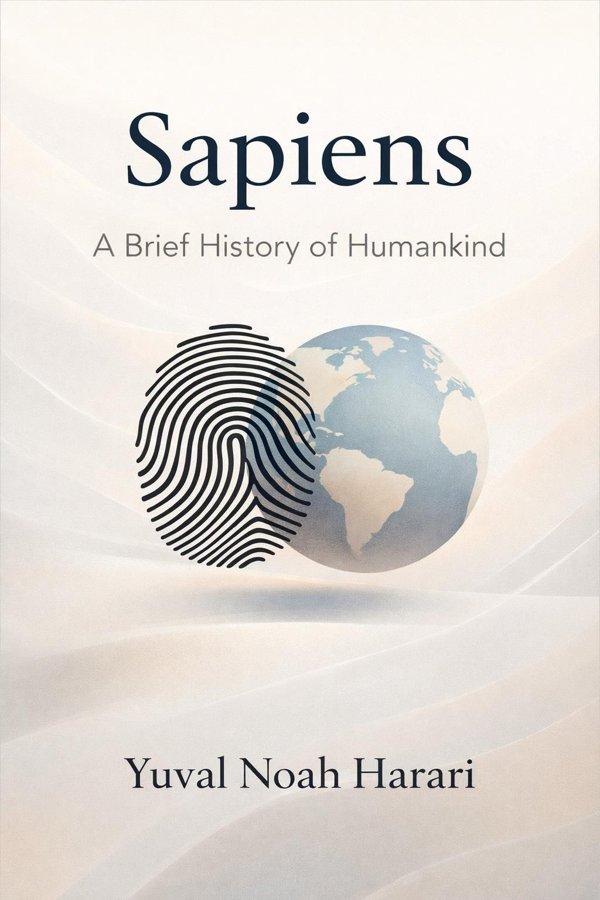
Sapiens: Summary & Key Insights
 10 min9 chaptersAudio available
Key Takeaways from Sapiens
Human dominance did not begin with stronger bodies, sharper teeth, or faster legs; it began with a new kind of mind.
What if one of history’s greatest achievements was also one of its greatest mistakes?
Civilization runs not only on roads, crops, and armies, but on ideas that exist because people collectively agree they do.
Few inventions have united strangers more effectively than money.
It is tempting to see empires only as engines of conquest and exploitation.
What Is Sapiens About?
Sapiens by Yuval Noah Harari is a history book. Sapiens: A Brief History of Humankind is an ambitious, big-picture history of our species, tracing how Homo sapiens rose from an unremarkable African ape to the dominant force on Earth. Yuval Noah Harari combines history, biology, anthropology, economics, and philosophy to explain the turning points that transformed human life: the Cognitive Revolution, the Agricultural Revolution, and the Scientific Revolution. Rather than offering a narrow chronological account, he asks a deeper question: what made humans uniquely capable of building empires, religions, markets, and nations? Harari’s answer is both provocative and memorable: our greatest power lies in our ability to create and believe shared stories. These collective fictions—such as money, laws, gods, and states—allow strangers to cooperate on a massive scale. The book matters because it challenges comforting assumptions about progress, happiness, and civilization. It invites readers to see modern society not as inevitable, but as the result of historical choices, accidents, and myths. As a historian and public intellectual, Harari brings scholarly range and narrative clarity to one of the most compelling questions in human history: how did we become who we are?
This FizzRead summary covers all 9 key chapters of Sapiens in approximately 10 minutes, distilling the most important ideas, arguments, and takeaways from Yuval Noah Harari's work. Also available as an audio summary and Key Quotes Podcast.
Sapiens
Sapiens: A Brief History of Humankind is an ambitious, big-picture history of our species, tracing how Homo sapiens rose from an unremarkable African ape to the dominant force on Earth. Yuval Noah Harari combines history, biology, anthropology, economics, and philosophy to explain the turning points that transformed human life: the Cognitive Revolution, the Agricultural Revolution, and the Scientific Revolution. Rather than offering a narrow chronological account, he asks a deeper question: what made humans uniquely capable of building empires, religions, markets, and nations? Harari’s answer is both provocative and memorable: our greatest power lies in our ability to create and believe shared stories. These collective fictions—such as money, laws, gods, and states—allow strangers to cooperate on a massive scale. The book matters because it challenges comforting assumptions about progress, happiness, and civilization. It invites readers to see modern society not as inevitable, but as the result of historical choices, accidents, and myths. As a historian and public intellectual, Harari brings scholarly range and narrative clarity to one of the most compelling questions in human history: how did we become who we are?
Who Should Read Sapiens?
This book is perfect for anyone interested in history and looking to gain actionable insights in a short read. Whether you're a student, professional, or lifelong learner, the key ideas from Sapiens by Yuval Noah Harari will help you think differently.
- ✓Readers who enjoy history and want practical takeaways
- ✓Professionals looking to apply new ideas to their work and life
- ✓Anyone who wants the core insights of Sapiens in just 10 minutes
Want the full summary?
Get instant access to this book summary and 100K+ more with Fizz Moment.
Get Free SummaryAvailable on App Store • Free to download
Key Chapters
What if one of history’s greatest achievements was also one of its greatest mistakes? Harari provocatively argues that the Agricultural Revolution, beginning around ten thousand years ago, was not a clear improvement in human well-being. When humans shifted from foraging to farming, they gained more food overall, but often at the cost of harder labor, poorer diets, denser settlements, and greater social inequality.
Foragers typically enjoyed varied diets and flexible lifestyles. Early farmers, by contrast, depended heavily on a few crops such as wheat, rice, or maize. This made them vulnerable to drought, disease, and famine. Farming also required constant effort: planting, weeding, harvesting, storing, defending land, and raising more children to work it. In Harari’s memorable formulation, humans did not domesticate wheat; wheat domesticated humans.
Agriculture did, however, support population growth. More calories meant more people, and more people meant larger villages, cities, states, and armies. In that sense, farming enabled civilization, bureaucracy, and empire. But what benefited the species did not always benefit the individual. A peasant bent over a field may have lived a worse daily life than a hunter-gatherer, even if his society became more complex.
This idea helps modern readers question the assumption that more productivity always equals a better life. Many people today work longer hours to sustain systems that are materially richer but emotionally exhausting. Actionable takeaway: when evaluating progress—personally or socially—measure not only output and growth, but also health, freedom, resilience, and quality of life.
Civilization runs not only on roads, crops, and armies, but on ideas that exist because people collectively agree they do. Harari’s central argument is that large human societies are built on intersubjective realities: myths, institutions, and rules that are real in their effects even though they are not natural facts. Religion, money, human rights, citizenship, and corporations all belong to this category.
A mountain exists whether or not anyone believes in it. A company exists only because legal systems, employees, investors, and customers all act as if it does. The same applies to nations and currencies. These shared beliefs allow millions of strangers to coordinate behavior, trade peacefully, and submit to common institutions. Without them, human cooperation would collapse back into small tribal units.
This explains why history often turns on storytelling as much as on military force. Revolutions succeed when new narratives displace old ones. Religions spread when they offer compelling moral and social frameworks. Businesses grow when they persuade people to trust an intangible promise. Even personal identity is shaped by stories inherited from family, school, and culture.
In practical terms, understanding social myths can make you a better citizen, thinker, and professional. It becomes easier to see why markets fluctuate, why political debates become emotional, and why institutions can seem both powerful and fragile. Actionable takeaway: whenever you encounter a major social system, ask three questions—what story supports it, who benefits from that story, and what happens if people stop believing it?
Few inventions have united strangers more effectively than money. Harari describes money not simply as coins or paper, but as a system of mutual trust that allows people who share neither language nor culture to cooperate. Money is perhaps the most successful story humans have ever told, because almost everyone believes in it enough to exchange real labor, goods, and time for it.
This made economic networks far more expansive than kinship or religion alone could manage. A merchant in one civilization could trade with a merchant in another because both trusted the value represented by silver, gold, or later fiat currency. Money does not require affection, shared morals, or deep understanding. It requires only confidence that others will also accept it.
Harari’s point is not that money is fake in a trivial sense, but that its power depends on collective belief. This is why economic crises often stem from shattered trust. If people lose faith in banks, currencies, or institutions, entire systems seize up. The same principle applies today to stock markets, digital payments, and even cryptocurrencies.
For individuals, this idea sharpens financial awareness. Wealth is not just about possession; it is about participating in networks of trust. Your salary, savings, investments, and debts all exist within shared systems of belief and enforcement. Actionable takeaway: treat money as a tool built on trust—learn how financial institutions work, diversify your risks, and avoid confusing symbolic wealth with actual security, freedom, or fulfillment.
It is tempting to see empires only as engines of conquest and exploitation. Harari acknowledges their violence, but he also argues that empires helped unify the world by spreading languages, laws, technologies, religions, and cultural standards across vast territories. In this sense, empires were among history’s most powerful agents of integration.
An empire brings diverse peoples under a single political framework. This often happens brutally, but over time it can create shared institutions that outlast the empire itself. Roman law influenced Europe long after Rome fell. Islamic caliphates connected trade and scholarship across continents. Colonial empires imposed destructive hierarchies, yet they also accelerated global exchanges of crops, ideas, and administrative systems.
Harari’s broader point is that history is not neatly divided into good and bad civilizations. Most large-scale human orders are morally mixed. They produce suffering and creativity, domination and synthesis. The modern world—with its common legal concepts, global trade routes, and transnational norms—owes much to imperial legacies.
This lens helps readers approach current globalization with more nuance. International institutions, shared business practices, and global culture often emerge from unequal histories. Understanding that complexity can prevent simplistic judgments.
Actionable takeaway: when studying any powerful institution or country, look beyond slogans. Ask not only what harms it caused, but also what structures, values, and connections it left behind. Mature historical thinking begins when we can hold moral criticism and analytical clarity at the same time.
For most of history, humans explained the world by appealing to tradition, scripture, or inherited certainty. The Scientific Revolution transformed that mindset by elevating ignorance into a virtue. Harari argues that modern science began when people admitted they did not know and developed methods to discover more. This was not just a new body of knowledge; it was a new attitude toward reality.
Science gave humanity extraordinary power because it linked observation, mathematics, experiment, and institutional support. States and empires funded exploration, medicine, engineering, and military technology. In return, science expanded political and economic power. This alliance between knowledge and power fueled modernity.
The result was not only better tools, but larger ambition. Humans stopped merely adapting to nature and began trying to control it. We learned to cure diseases, cross oceans, fly through the air, and reshape ecosystems. The modern belief that tomorrow can be better than today depends heavily on this scientific mindset.
Yet Harari also warns that greater power does not guarantee greater wisdom. Nuclear weapons, industrial farming, surveillance systems, and ecological destruction are products of the same knowledge systems that produced vaccines and clean water.
For modern readers, the lesson is clear: science is indispensable, but it cannot decide what goals are worth pursuing. Actionable takeaway: cultivate scientific thinking in your own life—question assumptions, seek evidence, revise beliefs when facts change—but pair that mindset with ethical reflection about how power should be used.
One of Harari’s most unsettling questions is also one of the most important: are humans actually happier now than they were in the past? We have more technology, medicine, safety, and comfort than earlier generations, yet happiness does not appear to rise in direct proportion to material progress. History has clearly increased human power, but whether it has increased human well-being is much harder to answer.
Harari explores several reasons. First, people adapt quickly. What once felt like luxury soon becomes normal, and expectations rise. Second, many historical changes improve collective capacity while burdening individuals, as with agriculture or modern bureaucratic work. Third, happiness may depend less on external conditions than on biochemistry, social bonds, and the stories people tell about their lives.
He also points to the suffering imposed on domesticated animals and colonized peoples as hidden costs of human progress. A civilization may become wealthier while spreading misery unevenly. This forces readers to ask whose happiness counts and how it should be measured.
This idea has practical relevance in an age obsessed with optimization. Better careers, more consumption, and constant productivity do not automatically produce meaningful lives. The gap between progress and fulfillment remains real.
Actionable takeaway: define success more carefully. Instead of assuming that more income, convenience, or status will make life better, track what genuinely improves your well-being—relationships, purpose, health, autonomy, and peace of mind.
The most startling part of Harari’s story is that it may no longer be about history alone, but about the end of history as we know it. After mastering the planet, Homo sapiens is beginning to manipulate life itself through biotechnology, genetic engineering, artificial intelligence, and data systems. The species that once evolved through natural selection may soon be redesigned through human intention.
Harari suggests that the old questions of survival and expansion are giving way to new goals: immortality, enhanced intelligence, emotional engineering, and non-human forms of consciousness. This could produce unprecedented breakthroughs in medicine and quality of life. It could also deepen inequality, concentrate power, and blur the meaning of being human.
If some people can enhance their bodies or minds while others cannot, the future may create biological as well as economic class divisions. Meanwhile, algorithms may know our preferences better than we do, challenging humanist ideas about free will and personal authority. The myths that built civilization may be replaced by new systems grounded in data rather than gods or nations.
This final theme makes Sapiens more than a history book. It is also a warning and a prompt. Our species has gained immense power without resolving ancient moral problems.
Actionable takeaway: stay informed about emerging technologies and engage with their ethical implications now. The future of humanity should not be decided only by engineers, governments, or corporations, but by thoughtful public debate.
All Chapters in Sapiens
About the Author
Yuval Noah Harari is an Israeli historian, philosopher, and public intellectual best known for making large-scale human history accessible to a global audience. He studied history at the University of Oxford and later became a professor at the Hebrew University of Jerusalem. Harari’s work focuses on broad historical processes, the relationship between biology and culture, and the future implications of science and technology. He rose to international prominence with Sapiens, followed by other bestselling books such as Homo Deus and 21 Lessons for the 21st Century. Known for his clear style and provocative arguments, Harari blends academic research with philosophical inquiry, encouraging readers to question familiar assumptions about progress, identity, power, and what it means to be human.
Get This Summary in Your Preferred Format
Read or listen to the Sapiens summary by Yuval Noah Harari anytime, anywhere. FizzRead offers multiple formats so you can learn on your terms — all free.
Available formats: App · Audio · PDF · EPUB — All included free with FizzRead
Download Sapiens PDF and EPUB Summary
Key Quotes from Sapiens
“Human dominance did not begin with stronger bodies, sharper teeth, or faster legs; it began with a new kind of mind.”
“What if one of history’s greatest achievements was also one of its greatest mistakes?”
“Civilization runs not only on roads, crops, and armies, but on ideas that exist because people collectively agree they do.”
“Few inventions have united strangers more effectively than money.”
“It is tempting to see empires only as engines of conquest and exploitation.”
Frequently Asked Questions about Sapiens
Sapiens by Yuval Noah Harari is a history book that explores key ideas across 9 chapters. Sapiens: A Brief History of Humankind is an ambitious, big-picture history of our species, tracing how Homo sapiens rose from an unremarkable African ape to the dominant force on Earth. Yuval Noah Harari combines history, biology, anthropology, economics, and philosophy to explain the turning points that transformed human life: the Cognitive Revolution, the Agricultural Revolution, and the Scientific Revolution. Rather than offering a narrow chronological account, he asks a deeper question: what made humans uniquely capable of building empires, religions, markets, and nations? Harari’s answer is both provocative and memorable: our greatest power lies in our ability to create and believe shared stories. These collective fictions—such as money, laws, gods, and states—allow strangers to cooperate on a massive scale. The book matters because it challenges comforting assumptions about progress, happiness, and civilization. It invites readers to see modern society not as inevitable, but as the result of historical choices, accidents, and myths. As a historian and public intellectual, Harari brings scholarly range and narrative clarity to one of the most compelling questions in human history: how did we become who we are?
Compare Sapiens




More by Yuval Noah Harari

You Might Also Like



Featured In
Bill Gates's Book Picks
Bill Gates' Reading List: The Books That Shaped a Visionary
Mark Zuckerberg's Book Picks
Mark Zuckerberg's Year of Books: His Top Picks
Naval Ravikant's Book Picks
Naval Ravikant on Wealth and Wisdom: Essential Reads
Tim Ferriss's Book Picks
Tim Ferriss's Toolkit: Books for Peak Performance
Barack Obama's Book Picks
Barack Obama's Reading List: Books That Shaped a President
Joe Rogan's Book Picks
Joe Rogan's Go-To Books: What He Can't Stop Recommending
Richard Branson's Book Picks
Richard Branson's Lifetime Reading List: Adventure in Every Page
James Clear's Book Picks
James Clear's Reading List: Books That Build Better Habits
Malcolm Gladwell's Book Picks
Malcolm Gladwell's Picks: Books That Make You See the World Differently
Sam Altman's Book Picks
Sam Altman's Reading List: Books Behind the AI Revolution
Trevor Noah's Book Picks
Trevor Noah's Thought-Provoking Reads
Neil deGrasse Tyson's Book Picks
Neil deGrasse Tyson's Science Bookshelf
Yuval Noah Harari's Book Picks
Yuval Noah Harari's History & Future Reading
Morgan Housel's Book Picks
Morgan Housel's Financial Wisdom Reads
Psychology's Book Picks
Inside Your Mind: Psychology Books That Change Everything
Browse by Category
Ready to read Sapiens?
Get the full summary and 100K+ more books with Fizz Moment.