
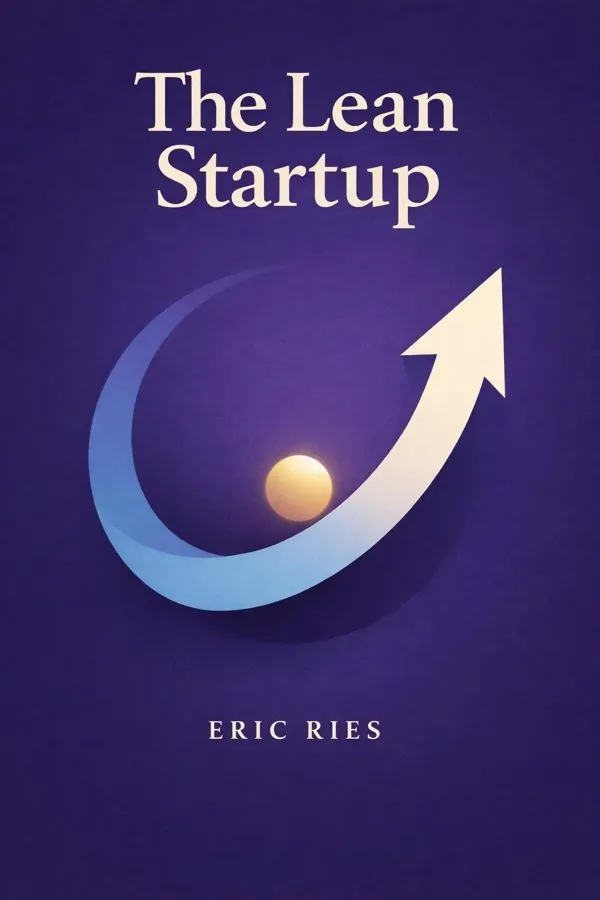
The Lean Startup: Summary & Key Insights
by Eric Ries
 10 min9 chaptersAudio available
Key Takeaways from The Lean Startup
The most dangerous myth about entrepreneurship is that it belongs only to hoodie-wearing founders in garages.
Waste in a startup is rarely obvious at first because it often looks like progress.
Speed alone does not create successful startups; learning speed does.
Startups often celebrate activity because true progress is hard to see.
Perfection is often the most expensive form of procrastination.
What Is The Lean Startup About?
The Lean Startup by Eric Ries is a business book. Most new ventures do not fail because their founders lack ambition, intelligence, or effort. They fail because they spend too long building products, features, and business plans based on assumptions instead of evidence. In The Lean Startup, Eric Ries offers a different path: treat entrepreneurship as a disciplined process of experimentation, learning, and adaptation. Rather than betting everything on a grand launch, Ries argues that successful innovators test ideas early, gather real customer feedback, and improve continuously. The book introduces a practical framework built around validated learning, minimum viable products, and the build-measure-learn loop, helping teams reduce waste and discover what customers actually value. Its relevance extends far beyond Silicon Valley. Whether you are launching a startup, leading innovation inside a large company, or developing a new service in a nonprofit, the principles apply wherever uncertainty is high. Ries writes with unusual authority because his ideas grew from hard experience as a founder and advisor. He combines startup scars, management thinking, and systems discipline into a methodology that has reshaped how modern businesses approach innovation.
This FizzRead summary covers all 9 key chapters of The Lean Startup in approximately 10 minutes, distilling the most important ideas, arguments, and takeaways from Eric Ries's work. Also available as an audio summary and Key Quotes Podcast.
The Lean Startup
Most new ventures do not fail because their founders lack ambition, intelligence, or effort. They fail because they spend too long building products, features, and business plans based on assumptions instead of evidence. In The Lean Startup, Eric Ries offers a different path: treat entrepreneurship as a disciplined process of experimentation, learning, and adaptation. Rather than betting everything on a grand launch, Ries argues that successful innovators test ideas early, gather real customer feedback, and improve continuously. The book introduces a practical framework built around validated learning, minimum viable products, and the build-measure-learn loop, helping teams reduce waste and discover what customers actually value. Its relevance extends far beyond Silicon Valley. Whether you are launching a startup, leading innovation inside a large company, or developing a new service in a nonprofit, the principles apply wherever uncertainty is high. Ries writes with unusual authority because his ideas grew from hard experience as a founder and advisor. He combines startup scars, management thinking, and systems discipline into a methodology that has reshaped how modern businesses approach innovation.
Who Should Read The Lean Startup?
This book is perfect for anyone interested in business and looking to gain actionable insights in a short read. Whether you're a student, professional, or lifelong learner, the key ideas from The Lean Startup by Eric Ries will help you think differently.
- ✓Readers who enjoy business and want practical takeaways
- ✓Professionals looking to apply new ideas to their work and life
- ✓Anyone who wants the core insights of The Lean Startup in just 10 minutes
Want the full summary?
Get instant access to this book summary and 100K+ more with Fizz Moment.
Get Free SummaryAvailable on App Store • Free to download
Key Chapters
The most dangerous myth about entrepreneurship is that it belongs only to hoodie-wearing founders in garages. Eric Ries challenges that stereotype from the start: an entrepreneur is anyone creating something new under conditions of extreme uncertainty. That definition immediately widens the field. A product manager launching a new app feature, a school leader redesigning a learning model, or a corporate team building a new line of business can all be acting entrepreneurially. What matters is not the job title or the company size, but the presence of innovation and uncertainty.
This broader definition matters because it changes how organizations should manage innovation. Startups are not merely small versions of large companies. They face a different problem: they are searching for a sustainable business model, not executing a known one. That means they need different tools, metrics, and expectations. A large company may optimize efficiency in its mature divisions, but when it launches something new, it must give that effort room to experiment. Otherwise, it applies the logic of predictability to a situation defined by unknowns.
Consider a bank testing a new digital savings tool. If leadership evaluates the team only on immediate profit, it may kill the project before learning whether customers even want it. But if it treats the effort like a startup, the team can test assumptions, interview users, and iterate toward a useful solution. The same principle applies to nonprofits, hospitals, and government agencies.
Actionable takeaway: Identify one project in your organization that operates under uncertainty, and manage it like a startup by focusing first on learning what works before demanding full-scale efficiency.
Waste in a startup is rarely obvious at first because it often looks like progress. Teams spend months refining business plans, building elaborate features, or polishing branding, assuming that effort equals value. Ries borrows from lean manufacturing to argue the opposite: anything that does not directly help you learn how to create value for customers is waste. In manufacturing, waste may be excess inventory or unnecessary motion. In startups, waste often takes the form of untested assumptions turned into expensive work.
Applying lean thinking to entrepreneurship means stripping away activities that feel productive but do not generate real insight. A startup does not need a perfect product before meeting customers. It needs the fastest possible way to test whether a problem matters, whether the proposed solution resonates, and whether customers will change behavior. This shift is profound because it redefines efficiency. The efficient startup is not the one that builds the most. It is the one that learns the fastest with the fewest resources.
Imagine a team building a meal-planning app. Instead of spending six months coding every possible feature, they might first create a landing page, run ads, and invite users to join a beta. They may even manually send meal plans before automating anything. If few people sign up or engage, they have saved months of waste. If interest is strong, they know where to invest.
Actionable takeaway: Review your current project and ask of every task, "Will this directly help us learn what customers value?" If not, delay, simplify, or remove it.
Speed alone does not create successful startups; learning speed does. The core engine of The Lean Startup is the build-measure-learn feedback loop. The idea is simple but powerful: build a small experiment, measure how customers respond, and learn whether your assumptions were right. Then use that learning to decide what to do next. The goal is not to move fast in random directions, but to move fast in a disciplined loop that steadily reduces uncertainty.
Many teams get stuck because they overinvest in the first step. They build too much before measuring anything. Ries argues that the loop should be as short as possible. Every extra week spent developing untested features delays learning and increases the risk of building the wrong thing. Measurement also matters. It must go beyond vague impressions like "users seemed interested." Teams need data tied to behavior: sign-ups, retention, conversion, referrals, usage frequency, or willingness to pay.
For example, a SaaS startup might believe that small businesses want automated invoicing. Instead of building a full accounting platform, it could release a basic tool with one core function and track whether users create invoices repeatedly, invite teammates, or upgrade for advanced options. Those signals provide much stronger learning than compliments in a demo.
The final step, learning, is where strategic decisions happen. Did the experiment support the hypothesis? Should the team improve the current direction or change course? The build-measure-learn loop turns entrepreneurship into a continuous process of testing reality.
Actionable takeaway: Design your next product step as an experiment with a clear hypothesis, one measurable behavior, and a deadline for deciding what you learned.
Startups often celebrate activity because true progress is hard to see. More features, more meetings, more downloads, and more press coverage can create the comforting illusion that the business is advancing. Ries introduces validated learning as the antidote. Validated learning is evidence that a team has discovered something true and useful about customers, the product, or the business model. It is not just doing work; it is proving that the work matters.
This concept changes the purpose of a startup. A startup exists not only to build products, but to learn how to build a sustainable business. Every feature, campaign, and experiment should contribute to that learning. The question is not "What did we finish this week?" but "What did we prove or disprove?" That subtle shift can save companies from years of misguided effort.
Ries warns against vanity metrics, numbers that look impressive but hide reality. Total downloads, page views, or registered users may rise even if customers quickly abandon the product. Actionable metrics, by contrast, connect behavior to hypotheses. If a new onboarding flow improves week-one retention from 20 percent to 35 percent, that is useful learning. If a pricing experiment increases paid conversion, that teaches something about value perception.
Suppose an education platform adds gamification and sees a surge in app opens, but course completion remains flat. Vanity metrics say the feature worked; validated learning says it did not solve the real problem. The startup must dig deeper.
Actionable takeaway: Replace at least one status-report metric with a learning metric tied to customer behavior, and ask your team to explain what decision that metric helps you make.
Perfection is often the most expensive form of procrastination. Ries’s concept of the minimum viable product, or MVP, is one of the book’s most influential ideas. An MVP is the simplest version of a product that allows a team to begin the learning process with real customers. It is not about releasing something careless or low quality for its own sake. It is about avoiding unnecessary work until the team has evidence about what users actually need.
Founders often resist MVPs because they fear looking unprofessional or damaging the brand. But Ries argues that most startups fail from building too much, not too little. The MVP helps reveal whether customers care enough to engage, return, recommend, or pay. It turns assumptions into testable hypotheses.
MVPs can take many forms. A video can test demand before a product exists. A concierge MVP can deliver the service manually behind the scenes. A landing page can test messaging and sign-up interest. A basic feature set can test product usage. Dropbox famously used a demo video to validate interest before building the full system. That simple experiment generated strong demand and justified deeper investment.
The key is matching the MVP to the riskiest assumption. If the biggest uncertainty is whether people want the product at all, a prototype may be enough. If the biggest uncertainty is whether users will pay, a pricing test may matter more than additional features.
Actionable takeaway: Identify your single riskiest assumption and create the smallest possible version of your idea that can test it with real users within days, not months.
Stubbornness is often praised in entrepreneurship, but persistence without learning can become self-destruction. One of Ries’s most important contributions is the concept of the pivot: a structured course correction designed to test a new fundamental hypothesis about the product, strategy, or engine of growth. A pivot is not random change or panic. It is a deliberate response to evidence that the current path is not working.
Many founders either pivot too late or too often. Pivot too late, and you waste precious time, money, and morale on a flawed direction. Pivot too often, and you never learn enough from any one approach. Ries suggests using data and clear milestones to recognize when perseverance no longer makes sense. If core assumptions repeatedly fail despite thoughtful iteration, it may be time to change.
There are many kinds of pivots: a zoom-in pivot focuses on one feature that proves more valuable than the full product; a customer segment pivot discovers that a different audience cares more; a channel pivot changes how the product reaches users; a value capture pivot rethinks monetization. The point is not to abandon the vision, but to find a better route toward it.
For example, a fitness startup may begin by serving consumers directly, then learn that employers are more willing to pay for wellness tools. The mission of improving health remains, but the customer and business model shift.
Actionable takeaway: Set explicit review points for your venture and ask, "What evidence would tell us to persist, and what evidence would tell us to pivot?" Write those triggers down before emotion clouds judgment.
If you measure the wrong things, you can run a company straight into failure while feeling informed. Ries argues that startups need accounting too, but not the traditional kind alone. They need innovation accounting: a way to measure progress in environments where the business model is still being discovered. This approach helps teams understand whether they are truly moving toward product-market fit or merely generating noise.
Innovation accounting begins with establishing a baseline. Before making improvements, a startup must know how the current product performs on key behaviors such as acquisition, activation, retention, referral, and revenue. Then it tunes the engine by running experiments designed to improve those metrics. Finally, it decides whether the rate of progress is strong enough to justify continued investment or whether a pivot is needed.
This system is especially valuable because it creates accountability without punishing experimentation. A team can say, "Our onboarding conversion is 12 percent today. We believe simplifying sign-up will raise it to 18 percent. We will test this in two weeks." That is much more useful than reporting that "engagement is improving" with no context.
Cohort analysis is one practical tool Ries favors. Instead of looking at aggregate numbers, teams compare groups of users based on when or how they joined. This reveals whether product changes actually improve behavior for new users, rather than being hidden by overall growth.
Actionable takeaway: Choose three metrics that reflect real customer behavior, establish a current baseline for each, and review experimental changes through cohorts instead of broad totals.
Many startups talk about growth as if it were magic: launch, go viral, scale. Ries brings discipline to this conversation by explaining that sustainable growth usually comes from identifiable engines. A startup grows because existing customers drive new customer acquisition in repeatable ways. Understanding which engine powers the business helps teams focus resources instead of chasing every channel at once.
Ries describes three primary engines of growth. The sticky engine depends on retention: if customers stay and use the product consistently, growth compounds over time. Subscription businesses, productivity tools, and enterprise software often rely on this engine. The viral engine depends on customers naturally bringing in other users as part of product usage, as with messaging apps or collaboration tools. The paid engine depends on acquiring customers profitably through marketing or sales, as long as customer lifetime value exceeds acquisition cost.
Each engine demands different metrics and tactics. A company using the sticky engine should obsess over churn reduction and product value. A company using the viral engine should improve invitation rates and sharing loops. A company using the paid engine must master conversion, pricing, and unit economics. Problems arise when teams try to optimize all three at once without knowing which one truly matters.
Take a project management tool for teams. If the product spreads because users invite coworkers, improving collaboration features may matter more than buying ads. But if most customers come through content marketing and convert to paid plans, the economics of acquisition become central.
Actionable takeaway: Determine your primary engine of growth and align your experiments, budget, and success metrics around strengthening that one engine first.
A startup’s greatest long-term challenge is not just inventing a product, but building an organization that can keep learning as it grows. Ries argues that management is not the enemy of entrepreneurship; bad management is. Startups need systems, priorities, and processes, but those systems must support adaptation rather than bureaucracy. The goal is to create an organization that can innovate repeatedly, not just get lucky once.
As companies scale, they often become slower, more political, and more attached to existing assumptions. Ries warns that success can harden habits. Teams begin optimizing what once worked instead of questioning whether it still does. That is why entrepreneurship must become a managerial discipline. Leaders must create structures that preserve experimentation, such as small autonomous teams, fast feedback cycles, clear hypotheses, and milestone reviews based on learning.
This is especially relevant inside established companies. Corporate innovators often face approval layers, rigid budgeting, and performance systems designed for mature business units. If leaders want innovation, they must protect exploratory efforts from processes built for efficiency. That might mean separate metrics, limited funding tranches tied to learning goals, and permission to release early versions to small customer groups.
Ries also emphasizes the human side of adaptive organizations. Teams need psychological permission to admit uncertainty and confront evidence. A culture that punishes failed experiments will produce hidden failure and shallow learning.
Actionable takeaway: Audit one process in your team, such as approvals, budgeting, or reporting, and redesign it to reward experimentation speed and evidence-based decisions rather than mere output.
All Chapters in The Lean Startup
About the Author
Eric Ries is an American entrepreneur, author, and influential voice in modern startup thinking. He is best known for creating the Lean Startup methodology, a framework that helps organizations build new products and businesses through rapid experimentation, customer feedback, and validated learning. Ries drew many of his ideas from his own startup experiences, especially his work as a co-founder and CTO of IMVU, where he confronted the costly consequences of building on assumptions rather than evidence. He later expanded those lessons through writing, speaking, and advising startups, venture capital firms, and large companies seeking to innovate more effectively. His work blends insights from entrepreneurship, lean manufacturing, agile development, and management theory, making him one of the most widely cited thinkers on innovation in uncertain environments.
Get This Summary in Your Preferred Format
Read or listen to the The Lean Startup summary by Eric Ries anytime, anywhere. FizzRead offers multiple formats so you can learn on your terms — all free.
Available formats: App · Audio · PDF · EPUB — All included free with FizzRead
Download The Lean Startup PDF and EPUB Summary
Key Quotes from The Lean Startup
“The most dangerous myth about entrepreneurship is that it belongs only to hoodie-wearing founders in garages.”
“Waste in a startup is rarely obvious at first because it often looks like progress.”
“Speed alone does not create successful startups; learning speed does.”
“Startups often celebrate activity because true progress is hard to see.”
“Perfection is often the most expensive form of procrastination.”
Frequently Asked Questions about The Lean Startup
The Lean Startup by Eric Ries is a business book that explores key ideas across 9 chapters. Most new ventures do not fail because their founders lack ambition, intelligence, or effort. They fail because they spend too long building products, features, and business plans based on assumptions instead of evidence. In The Lean Startup, Eric Ries offers a different path: treat entrepreneurship as a disciplined process of experimentation, learning, and adaptation. Rather than betting everything on a grand launch, Ries argues that successful innovators test ideas early, gather real customer feedback, and improve continuously. The book introduces a practical framework built around validated learning, minimum viable products, and the build-measure-learn loop, helping teams reduce waste and discover what customers actually value. Its relevance extends far beyond Silicon Valley. Whether you are launching a startup, leading innovation inside a large company, or developing a new service in a nonprofit, the principles apply wherever uncertainty is high. Ries writes with unusual authority because his ideas grew from hard experience as a founder and advisor. He combines startup scars, management thinking, and systems discipline into a methodology that has reshaped how modern businesses approach innovation.
Compare The Lean Startup

You Might Also Like




Featured In
Browse by Category
Ready to read The Lean Startup?
Get the full summary and 100K+ more books with Fizz Moment.