
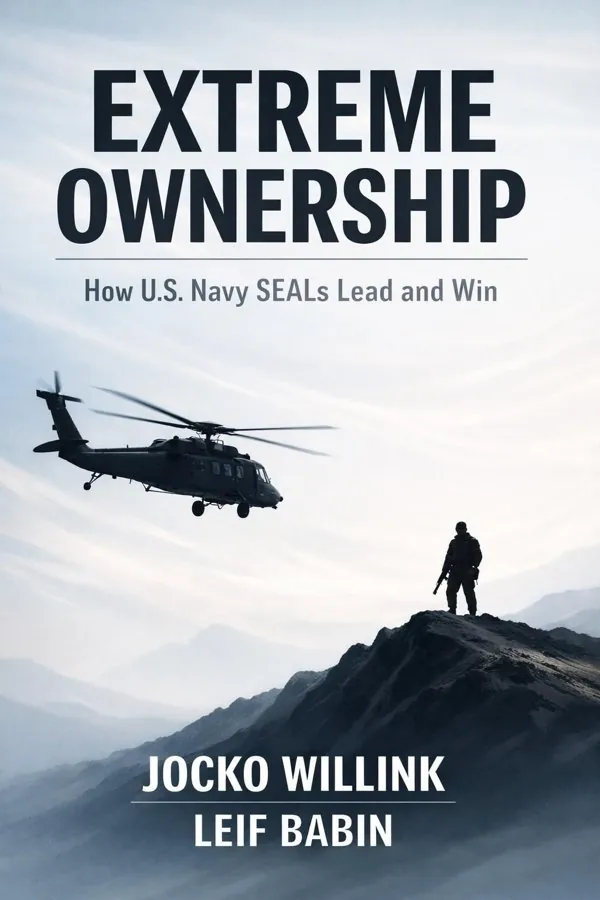
Extreme Ownership: Summary & Key Insights
 10 min13 chaptersAudio available
Key Takeaways from Extreme Ownership
The leadership principles in *Extreme Ownership* were not developed in a classroom or corporate workshop.
Extreme Ownership is the book’s core idea: leaders must take full responsibility for everything within their sphere of influence.
One of the book’s most memorable and uncomfortable ideas is that team performance reflects leadership quality.
Leaders cannot expect teams to commit to a mission they do not understand or believe in.
Ego is one of the most dangerous threats to effective leadership because it distorts judgment, blocks learning, and turns collaboration into competition.
What Is Extreme Ownership About?
Extreme Ownership by Jocko Willink is a leadership book published in 2015 spanning 13 pages. What if the biggest obstacle to better leadership wasn’t your team, your market, or your circumstances—but your willingness to take responsibility? That is the central challenge of *Extreme Ownership*, a leadership classic by former U.S. Navy SEAL officers Jocko Willink and Leif Babin. Drawing on hard-won lessons from their deployment in Ramadi, Iraq, the authors argue that leadership is the decisive factor in whether teams succeed or fail. Their message is direct: leaders must own everything in their world, from communication breakdowns and unclear priorities to poor execution and weak morale. What makes this book so powerful is that it doesn’t stay on the battlefield. Willink and Babin show how the same principles apply in companies, startups, sports teams, and everyday life. The stakes may be different, but the patterns are the same: confusion spreads when leaders are unclear, trust collapses when ego takes over, and performance improves when accountability starts at the top. As ex-Navy SEAL officers who later co-founded the leadership consulting firm Echelon Front, the authors bring both combat experience and real-world business application. *Extreme Ownership* matters because it turns leadership from a vague ideal into a practical discipline anyone can apply.
This FizzRead summary covers all 13 key chapters of Extreme Ownership in approximately 10 minutes, distilling the most important ideas, arguments, and takeaways from Jocko Willink's work. Also available as an audio summary and Key Quotes Podcast.
Extreme Ownership: How U.S. Navy SEALs Lead and Win
What if the biggest obstacle to better leadership wasn’t your team, your market, or your circumstances—but your willingness to take responsibility? That is the central challenge of *Extreme Ownership*, a leadership classic by former U.S. Navy SEAL officers Jocko Willink and Leif Babin. Drawing on hard-won lessons from their deployment in Ramadi, Iraq, the authors argue that leadership is the decisive factor in whether teams succeed or fail. Their message is direct: leaders must own everything in their world, from communication breakdowns and unclear priorities to poor execution and weak morale.
What makes this book so powerful is that it doesn’t stay on the battlefield. Willink and Babin show how the same principles apply in companies, startups, sports teams, and everyday life. The stakes may be different, but the patterns are the same: confusion spreads when leaders are unclear, trust collapses when ego takes over, and performance improves when accountability starts at the top. As ex-Navy SEAL officers who later co-founded the leadership consulting firm Echelon Front, the authors bring both combat experience and real-world business application. *Extreme Ownership* matters because it turns leadership from a vague ideal into a practical discipline anyone can apply.
Who Should Read Extreme Ownership?
This book is perfect for anyone interested in leadership and looking to gain actionable insights in a short read. Whether you're a student, professional, or lifelong learner, the key ideas from Extreme Ownership by Jocko Willink will help you think differently.
- ✓Readers who enjoy leadership and want practical takeaways
- ✓Professionals looking to apply new ideas to their work and life
- ✓Anyone who wants the core insights of Extreme Ownership in just 10 minutes
Want the full summary?
Get instant access to this book summary and 100K+ more with Fizz Moment.
Get Free SummaryAvailable on App Store • Free to download
Key Chapters
The leadership principles in *Extreme Ownership* were not developed in a classroom or corporate workshop. They were forged in Ramadi, Iraq, in 2006, one of the most dangerous combat zones in the world. In that environment, leadership failures had immediate and devastating consequences. Teams had to make decisions quickly, communicate clearly, and trust one another completely. There was no room for confusion, ego, or hesitation.
One of the book’s defining moments is a friendly fire incident caused by confusion across multiple units operating in the same battlespace. Instead of blaming the chaos, the conditions, or another team, the lesson was clear: the leader in charge had to own the failure. That moment became the foundation for the entire book. The point is not that leaders control every variable, but that they are responsible for building systems, clarity, and coordination that reduce avoidable mistakes.
This idea translates directly to business. A missed product launch, a customer service breakdown, or a failed strategy meeting may not involve bullets, but the root causes are often the same: poor communication, unclear roles, and weak alignment. The actionable takeaway is simple: when something goes wrong, first ask, “What did I fail to explain, prioritize, or prepare?” That question creates learning instead of blame.
Extreme Ownership is the book’s core idea: leaders must take full responsibility for everything within their sphere of influence. That means no excuses, no finger-pointing, and no hiding behind difficult circumstances. If a team underperforms, the leader must ask whether expectations were clear, whether training was sufficient, and whether the mission was properly communicated. This mindset shifts leadership from complaint to control.
A key insight here is that ownership is not the same as self-punishment. Willink and Babin present it as a form of empowerment. The moment a leader says, “This is on me,” they also gain the power to improve it. By contrast, blaming employees, market conditions, or senior leadership may feel justified, but it leaves the leader passive. Ownership creates agency.
In practical terms, this means replacing statements like “My team just doesn’t get it” with “I haven’t explained it clearly enough.” In a workplace example, if a project repeatedly misses deadlines, an extreme ownership response would include reviewing priorities, clarifying accountability, simplifying communication, and ensuring the team has the resources to execute. A useful habit is to conduct an “ownership audit” after every setback: What happened? What was my role? What can I change immediately? Leaders who do this consistently create stronger teams and better results.
One of the book’s most memorable and uncomfortable ideas is that team performance reflects leadership quality. “No bad teams, only bad leaders” does not mean every employee is equally skilled or motivated. It means the leader is responsible for setting standards, building culture, correcting problems, and creating an environment where people can perform. When a weak team improves under new leadership, it becomes clear that leadership—not raw talent alone—often drives outcomes.
The deeper lesson is that morale, discipline, and accountability are contagious from the top. If leaders tolerate excuses, the team learns excuses. If leaders model focus and ownership, the team follows. In business, this shows up when one department consistently misses goals while another thrives with similar resources. Often the difference is not luck, but leadership clarity, follow-through, and standards.
Actionably, this principle encourages leaders to stop labeling teams as hopeless. Instead, diagnose the leadership inputs: Are expectations measurable? Are consequences and feedback consistent? Are top performers recognized? Is underperformance addressed quickly? For example, a sales manager facing poor results should examine coaching quality, meeting structure, and lead prioritization before blaming the market. This principle is demanding, but it is also liberating because it reminds leaders that culture is not random. It can be shaped.
Leaders cannot expect teams to commit to a mission they do not understand or believe in. In *Extreme Ownership*, the principle of “Believe” means leaders must fully buy into the mission before they can convincingly communicate it to others. If they are confused, skeptical, or half-hearted, their teams will sense it immediately. Commitment is difficult to fake.
This is especially important when decisions come from higher up in the organization. A middle manager may not have created the strategy, but if they are responsible for executing it, they must understand why it matters. If they disagree or lack clarity, their job is to ask questions, challenge respectfully, and get aligned before briefing the team. Passing down orders you don’t believe in leads to weak execution and resentment.
In practice, this principle matters during change initiatives, restructures, product pivots, or difficult cost decisions. Imagine a manager rolling out a new workflow they secretly think is pointless. Their explanation will be vague, their tone uncertain, and the team’s resistance will grow. A stronger approach is to clarify the rationale, connect the mission to broader goals, and explain what success looks like. People are more willing to endure friction when they understand the purpose. Belief creates conviction, and conviction creates clarity.
Ego is one of the most dangerous threats to effective leadership because it distorts judgment, blocks learning, and turns collaboration into competition. In the book, Willink and Babin show that ego can appear as arrogance, defensiveness, the need to be right, or the refusal to admit mistakes. On the battlefield, that mindset can get people killed. In business, it can derail teams, poison culture, and cause leaders to ignore useful feedback until problems become crises.
Checking the ego does not mean becoming passive or lacking confidence. It means putting the mission and the team above personal pride. A leader with controlled ego can admit when someone else has a better idea, ask for help, and change course without feeling diminished. This makes teams faster, safer, and more adaptable.
A practical example: a senior leader launches a strategy that is clearly underperforming, but refuses to revise it because doing so would look like weakness. That is ego in action. A better leader would review the data, invite candid feedback, and adjust quickly. To apply this principle, build habits that make humility operational: ask, “What am I missing?” in meetings, reward dissent delivered respectfully, and treat criticism as information rather than insult. Teams trust leaders more when they see them prioritize truth over status.
“Cover and Move” comes from a basic combat truth: no team succeeds alone. Units support one another so each can advance without being exposed. In organizational life, the same principle means departments, functions, and individuals must work together rather than compete internally. Sales cannot blame operations, marketing cannot operate in isolation from product, and senior leaders cannot expect alignment if teams are fighting turf wars.
This principle highlights interdependence. Every team contributes to the larger mission, and when one group focuses only on its own metrics or status, the whole organization suffers. Silos create friction, duplication, delays, and mistrust. Strong leaders break those silos by reinforcing shared goals and reminding people that internal conflict weakens everyone.
A common business example is when customer success and sales blame each other for churn. Cover and Move would require both teams to coordinate around a shared outcome: customer retention and long-term value. That may involve better handoffs, shared dashboards, and regular communication loops. Actionably, leaders can ask: Where are teams competing when they should be collaborating? What incentives are creating conflict? How can we define success in a way that benefits the whole organization? Teamwork is not a slogan here—it is a strategic necessity.
In high-pressure environments, complexity is the enemy of execution. The principle of “Simple” teaches that plans, instructions, and priorities must be easy to understand. When people are stressed, overloaded, or moving fast, they do not rise to the level of sophisticated strategy documents—they fall to the level of what they can clearly remember and act on. If a plan is too complicated, it will break down in real conditions.
This applies directly to leadership communication. Leaders often think they are being thorough when they are actually creating confusion. Long explanations, vague language, and too many moving parts reduce clarity and increase errors. Simplicity, by contrast, does not mean being simplistic. It means distilling the mission to its essential elements so everyone knows what to do.
For example, a product launch plan that spans dozens of loosely defined tasks across multiple teams is vulnerable to failure. A simpler plan would identify the top priorities, assign clear owners, define milestones, and make escalation paths obvious. A useful test is this: can every person involved explain the plan in plain language? If not, it is not simple enough. Leaders should aim to communicate in a way that reduces cognitive load. Simple plans are easier to execute, adapt, and repeat.
When chaos hits, leaders can easily become overwhelmed by the number of urgent problems demanding attention. The principle of “Prioritize and Execute” teaches that leaders must detach emotionally, identify the highest-priority issue, address it, and then move to the next. Trying to solve everything at once often results in solving nothing effectively.
This mindset is especially powerful in crises. Whether on the battlefield or in a company facing missed targets, customer complaints, and staffing issues at the same time, the leader’s role is to create order from disorder. That begins with deciding what matters most right now. Not everything is equally urgent, and leaders must resist the temptation to bounce between problems reactively.
Consider a startup experiencing server outages, investor pressure, and internal conflict. Prioritize and Execute would mean stabilizing the service first if customer trust is at immediate risk, then addressing communication and stakeholder updates in sequence. Teams gain confidence when leaders remain calm and focused instead of panicked and scattered. A practical tool is to ask three questions: What is the most critical problem? What immediate action will reduce risk? Who owns the next step? This principle helps leaders avoid paralysis and maintain momentum under pressure.
No leader can control every detail, especially in fast-moving, complex environments. Decentralized Command means authority must be pushed down to frontline leaders who understand the mission and can make decisions quickly. But this only works when everyone clearly understands the broader objective, their specific role, and the limits of their decision-making authority.
The point is not to create independence without oversight. It is to build a structure where people can act without waiting for constant permission. In combat, that speed can save lives. In business, it helps teams respond faster to customers, solve problems in real time, and avoid bottlenecks caused by overcentralized leadership.
For example, if every customer complaint escalation requires executive approval, response times slow and frustration rises. A decentralized system would empower team leads with defined authority to resolve common issues within agreed parameters. To make this work, leaders must brief clearly, train thoroughly, and verify understanding. They also need to avoid micromanagement, which sends the message that ownership is fake. A simple rule is this: leaders should hold the line on standards and strategy, while giving teams enough freedom to execute intelligently. Decentralized command creates agility, accountability, and stronger future leaders.
Plan
A good plan aligns people, clarifies intent, and prepares teams for uncertainty. In *Extreme Ownership*, planning is not portrayed as bureaucracy or paperwork for its own sake. It is a disciplined process of thinking ahead, identifying risks, assigning responsibilities, and ensuring everyone understands the mission. A plan gives teams a starting structure, but it must also remain flexible enough to adapt when reality changes.
Effective planning requires broad input but clear ownership. Leaders should gather information from those closest to the work, because they often see risks that senior decision-makers miss. At the same time, someone must ultimately make decisions and communicate the plan in a way the team can understand. The best plans are collaborative in development and simple in execution.
A business example might be a major product rollout. A weak plan focuses only on launch day. A strong plan includes customer support readiness, contingency scenarios, stakeholder communication, technical fallback options, and clear criteria for success. One practical takeaway from this principle is to use briefings that answer a few essential questions: What is the mission? Why does it matter? Who is responsible for what? What are the likely obstacles? What is the backup plan? Planning reduces avoidable friction and increases confidence before execution begins.
Leadership does not only flow downward. One of the book’s most useful insights is that leaders must also know how to lead upward and across the organization. If senior leaders do not understand what is happening on the ground, frontline leaders must communicate clearly and proactively. Complaining that “management doesn’t get it” is not enough. Extreme ownership requires translating reality upward in a way that drives action.
Leading down the chain means making sure teams understand the mission, priorities, and standards. Leading up the chain means giving bosses the information they need, in a concise and useful format, so they can support the mission. This may involve clarifying risks, requesting resources, or reframing a problem in strategic terms.
For example, if a department is missing targets because of outdated tools, an effective leader does not simply grumble to peers. They present the issue to senior leadership with context, impact, and a proposed solution. They make it easy for decision-makers to understand the problem and act on it. This principle is particularly valuable for middle managers, who often feel squeezed from both directions. The key lesson is that leadership is not limited by formal authority. Influence comes from ownership, clarity, and initiative.
Leaders rarely have perfect information. Waiting until every variable is known can be more dangerous than making a reasonably informed decision quickly. “Decisiveness amid Uncertainty” teaches that leaders must assess what they know, weigh the risks, and act—while remaining ready to adjust as new information emerges. Indecision creates drift, and drift often makes situations worse.
This principle does not endorse recklessness. It emphasizes disciplined action in the face of ambiguity. Strong leaders gather enough information to move, communicate the decision clearly, and maintain the flexibility to pivot if needed. Their calm decisiveness helps teams stay focused instead of freezing in uncertainty.
Think about a company facing a sudden competitive threat. If leadership spends months debating every possible scenario, the opportunity to respond may disappear. A decisive leader might launch a controlled response, monitor feedback, and refine the strategy in real time. Teams generally prefer a clear direction—even if imperfect—to prolonged uncertainty. An actionable habit here is to define decision thresholds in advance: What information is essential? What risk is acceptable? What signals would trigger a course correction? This helps leaders move with confidence without pretending certainty they do not have.
The phrase “Discipline Equals Freedom” may sound paradoxical, but it captures one of the book’s most practical leadership truths. Discipline creates freedom by reducing chaos, increasing reliability, and making good performance repeatable. Teams that are disciplined in planning, communication, training, and execution have more freedom to adapt because they are not constantly dealing with preventable mistakes.
At a personal level, discipline means doing what is required before circumstances force your hand. A disciplined leader prepares early, communicates consistently, follows through, and maintains standards even when it would be easier not to. That creates freedom from crisis mode, last-minute scrambling, and emotional reactivity.
In organizational terms, disciplined operating rhythms—clear meetings, documented processes, regular feedback, and after-action reviews—free teams to focus on meaningful work instead of confusion. For example, a team that consistently updates project status and flags risks early has more freedom than one that avoids structure and then panics near deadlines. The takeaway is that discipline is not restriction for its own sake. It is the system that creates trust, speed, and resilience. Freedom is earned through preparation and consistency, not through avoiding structure.
All Chapters in Extreme Ownership
About the Author
Jocko Willink and Leif Babin are former U.S. Navy SEAL officers who served in Task Unit Bruiser during the Iraq War, where they led operations in Ramadi. Their combat leadership experience became the foundation for *Extreme Ownership*, which translates battlefield lessons into practical leadership principles for business and life. After leaving active duty, they co-founded Echelon Front, a leadership consulting company that advises organizations around the world. Through their writing, training, and consulting, they have become widely known for teaching accountability, discipline, teamwork, and high-performance leadership.
Get This Summary in Your Preferred Format
Read or listen to the Extreme Ownership summary by Jocko Willink anytime, anywhere. FizzRead offers multiple formats so you can learn on your terms — all free.
Available formats: App · Audio · PDF · EPUB — All included free with FizzRead
Download Extreme Ownership PDF and EPUB Summary
Key Quotes from Extreme Ownership
“The leadership principles in *Extreme Ownership* were not developed in a classroom or corporate workshop.”
“Extreme Ownership is the book’s core idea: leaders must take full responsibility for everything within their sphere of influence.”
“One of the book’s most memorable and uncomfortable ideas is that team performance reflects leadership quality.”
“Leaders cannot expect teams to commit to a mission they do not understand or believe in.”
“Ego is one of the most dangerous threats to effective leadership because it distorts judgment, blocks learning, and turns collaboration into competition.”
Frequently Asked Questions about Extreme Ownership
Extreme Ownership by Jocko Willink is a leadership book that explores key ideas across 13 chapters. What if the biggest obstacle to better leadership wasn’t your team, your market, or your circumstances—but your willingness to take responsibility? That is the central challenge of *Extreme Ownership*, a leadership classic by former U.S. Navy SEAL officers Jocko Willink and Leif Babin. Drawing on hard-won lessons from their deployment in Ramadi, Iraq, the authors argue that leadership is the decisive factor in whether teams succeed or fail. Their message is direct: leaders must own everything in their world, from communication breakdowns and unclear priorities to poor execution and weak morale. What makes this book so powerful is that it doesn’t stay on the battlefield. Willink and Babin show how the same principles apply in companies, startups, sports teams, and everyday life. The stakes may be different, but the patterns are the same: confusion spreads when leaders are unclear, trust collapses when ego takes over, and performance improves when accountability starts at the top. As ex-Navy SEAL officers who later co-founded the leadership consulting firm Echelon Front, the authors bring both combat experience and real-world business application. *Extreme Ownership* matters because it turns leadership from a vague ideal into a practical discipline anyone can apply.
Compare Extreme Ownership



More by Jocko Willink
Discipline Equals Freedom
Jocko Willink
10 min
Discipline Equals Freedom: Field Manual
Jocko Willink
10 min
The Dichotomy of Leadership: Balancing the Challenges of Extreme Ownership to Lead and Win
Jocko Willink, Leif Babin
10 min
Leadership Strategy and Tactics: Field Manual
Jocko Willink
10 minYou Might Also Like


Featured In
Browse by Category
Ready to read Extreme Ownership?
Get the full summary and 100K+ more books with Fizz Moment.