
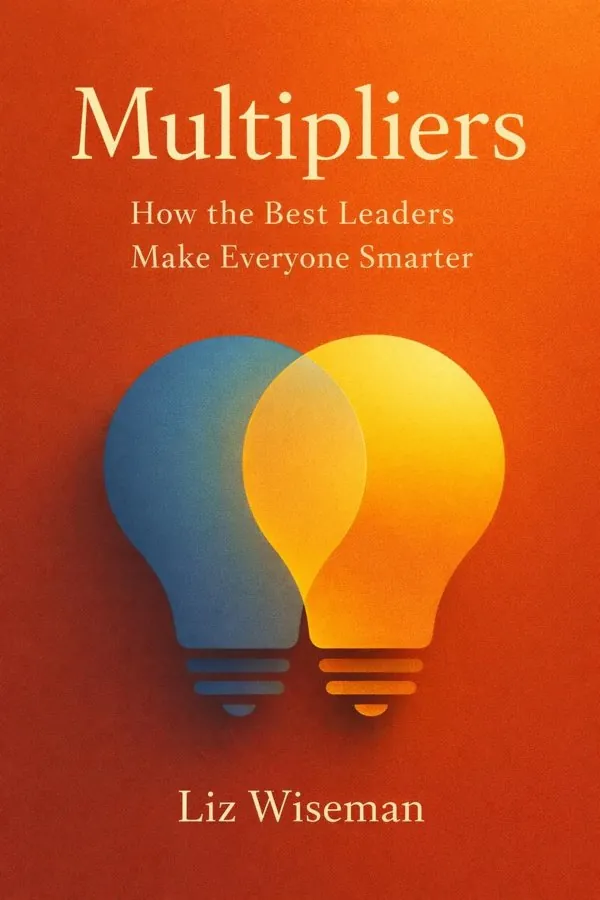
Multipliers: Summary & Key Insights
by Liz Wiseman
 10 min9 chaptersAudio available
Key Takeaways from Multipliers
A leader can be brilliant and still make everyone around them less effective.
Great leadership often looks mysterious from a distance, but Wiseman shows that it can be broken into repeatable disciplines.
Many leaders do not diminish others because they are arrogant or controlling; they do it because they are capable, committed, and trying to help.
Leadership is never just personal; it becomes cultural.
People often do their best work not when they are managed more tightly, but when their native strengths are recognized and put to use.
What Is Multipliers About?
Multipliers by Liz Wiseman is a leadership book published in 2010 spanning 4 pages. What if the most important measure of leadership is not how smart you are, but how much intelligence you can draw out of others? In Multipliers, leadership researcher and executive advisor Liz Wiseman argues that the strongest leaders are not the ones with all the answers. They are the ones who create the conditions for other people to think boldly, contribute fully, and grow beyond what they thought possible. Based on extensive research across industries and supported by vivid case studies, Wiseman contrasts two leadership styles: Multipliers, who amplify capability and ownership, and Diminishers, who drain energy, suppress initiative, and accidentally leave talent underused. The book matters because most organizations do not suffer from a lack of intelligence; they suffer from a failure to access the intelligence they already have. Wiseman, founder of the Wiseman Group and a widely respected thinker on leadership and talent development, brings practical credibility to this insight. Multipliers is both a diagnosis and a playbook, showing leaders how to shift from controlling and rescuing to challenging, trusting, and unlocking the full power of their teams.
This FizzRead summary covers all 9 key chapters of Multipliers in approximately 10 minutes, distilling the most important ideas, arguments, and takeaways from Liz Wiseman's work. Also available as an audio summary and Key Quotes Podcast.
Multipliers
What if the most important measure of leadership is not how smart you are, but how much intelligence you can draw out of others? In Multipliers, leadership researcher and executive advisor Liz Wiseman argues that the strongest leaders are not the ones with all the answers. They are the ones who create the conditions for other people to think boldly, contribute fully, and grow beyond what they thought possible. Based on extensive research across industries and supported by vivid case studies, Wiseman contrasts two leadership styles: Multipliers, who amplify capability and ownership, and Diminishers, who drain energy, suppress initiative, and accidentally leave talent underused. The book matters because most organizations do not suffer from a lack of intelligence; they suffer from a failure to access the intelligence they already have. Wiseman, founder of the Wiseman Group and a widely respected thinker on leadership and talent development, brings practical credibility to this insight. Multipliers is both a diagnosis and a playbook, showing leaders how to shift from controlling and rescuing to challenging, trusting, and unlocking the full power of their teams.
Who Should Read Multipliers?
This book is perfect for anyone interested in leadership and looking to gain actionable insights in a short read. Whether you're a student, professional, or lifelong learner, the key ideas from Multipliers by Liz Wiseman will help you think differently.
- ✓Readers who enjoy leadership and want practical takeaways
- ✓Professionals looking to apply new ideas to their work and life
- ✓Anyone who wants the core insights of Multipliers in just 10 minutes
Want the full summary?
Get instant access to this book summary and 100K+ more with Fizz Moment.
Get Free SummaryAvailable on App Store • Free to download
Key Chapters
A leader can be brilliant and still make everyone around them less effective. That is the unsettling insight at the heart of Multipliers. Liz Wiseman observed that some leaders create an environment where people’s ideas sharpen, confidence rises, and initiative expands. Others, often with good intentions, dominate discussions, give too much direction, and end up shrinking the capability of the very people they lead. She calls the first group Multipliers and the second Diminishers.
The difference is not simply personality or charisma. It is about how leaders use their intelligence. Diminishers tend to believe they need to be the smartest person in the room, the central decision-maker, and the rescuer when problems appear. This creates dependency. Team members wait for approval, stop taking risks, and conserve their thinking because they assume the boss will ultimately decide. Multipliers do the opposite. They assume people are capable and that their role is to provoke, stretch, and channel that capability. As a result, more minds engage and better outcomes emerge.
Imagine two department heads facing the same challenge. One responds by giving detailed instructions, correcting every draft, and stepping into every meeting. The team may comply, but they learn to defer. The other frames the problem, asks for competing solutions, and pushes people to defend their reasoning. The team works harder intellectually because they are truly responsible.
The practical lesson is to watch for dependency signals: silence in meetings, constant upward escalation, and people waiting to be told what to do. If you see those patterns, ask yourself whether your leadership is multiplying intelligence or diminishing it. Your takeaway: measure your effectiveness not by how often you provide answers, but by how often others around you generate them.
Great leadership often looks mysterious from a distance, but Wiseman shows that it can be broken into repeatable disciplines. Multipliers, despite different temperaments and backgrounds, tend to lead in five consistent ways: they are Talent Magnets, Liberators, Challengers, Debate Makers, and Investors. Together, these disciplines create an environment where people think more deeply and contribute more fully.
As Talent Magnets, they attract and deploy people’s strengths instead of hoarding top performers or narrowly defining roles. As Liberators, they create psychological safety combined with high standards, so people can think and act without fear. As Challengers, they frame opportunities that stretch people and force growth. As Debate Makers, they invite rigorous discussion before decisions, ensuring that ideas are tested rather than accepted by hierarchy. And as Investors, they give ownership rather than micromanagement, placing real responsibility in others’ hands.
These are not abstract ideals. A Multiplier might hire someone for an unusual skill set and then position them where that strength matters most. In meetings, they may insist that junior voices speak before senior ones to avoid conformity. When launching a new initiative, they ask, “What is the hardest problem worth solving here?” rather than dictating a plan.
The power of the five disciplines is that they work together. A challenge without safety becomes intimidation. Debate without ownership becomes endless talk. Talent attraction without stretch leads to stagnation. The Multiplier model is effective because it is systemic.
Your takeaway: choose one of the five disciplines where you are weakest and practice it deliberately for the next month. Leadership multiplication begins not with a personality transplant, but with a disciplined shift in behavior.
Many leaders do not diminish others because they are arrogant or controlling; they do it because they are capable, committed, and trying to help. Wiseman’s most useful insight is that diminishing behavior is often accidental. The fast-thinking expert who jumps in with answers, the supportive manager who rescues struggling employees, and the perfectionist who rewrites everyone’s work may all believe they are adding value. In reality, they can quietly undermine ownership and growth.
This makes the transition to becoming a Multiplier both more difficult and more hopeful. Difficult, because leaders must confront the gap between intention and impact. Hopeful, because once the pattern is visible, it can be changed. Wiseman encourages leaders to identify their accidental diminisher tendencies. Some are idea guys who overwhelm the room with their own thoughts. Others are pace setters who move so fast that no one else can keep up. Some are protectors who shield teams from consequences so thoroughly that learning never happens.
A manager might think, “I am being efficient by making the call myself.” But if that happens every time, the team never develops judgment. Another leader may pride themselves on being available for every problem, only to discover that their staff has stopped solving problems independently. Becoming an intentional Multiplier requires restraint: asking before telling, waiting before stepping in, and giving room for struggle.
One practical method is to conduct a simple review of your habits. Ask trusted colleagues: When do I unintentionally shut people down? When do I take over too quickly? What do you need more of from me to think and lead more independently?
Your takeaway: identify one accidental diminisher habit this week and replace it with a multiplier behavior, such as asking a coaching question instead of offering a solution.
Leadership is never just personal; it becomes cultural. When multiplier behavior is practiced consistently, it reshapes how an entire organization thinks, decides, and performs. Wiseman argues that a culture of multiplication emerges when people expect to contribute, expect to be challenged, and expect ownership rather than dependency. In such environments, intelligence is not concentrated at the top. It circulates.
This matters because culture often overrides individual talent. A company can hire exceptional people and still waste them if decisions are centralized, debate is discouraged, or mistakes are punished harshly. By contrast, an average team can outperform expectations when people are trusted to think, speak, and act. Multiplication becomes visible in meeting dynamics, decision-making processes, talent mobility, and how leaders respond to uncertainty.
For example, a multiplying culture does not treat meetings as stages for executive performance. It uses them as forums for problem-solving. It does not reward people solely for pleasing powerful leaders; it rewards insight, initiative, and accountability. It also normalizes stretch assignments. Instead of saying, “You are not ready yet,” multiplying organizations often say, “You are capable of more than you think, and we will support you as you grow.”
Building this kind of culture requires systems as well as intentions. Leaders can redesign staff meetings to surface diverse viewpoints, create talent reviews focused on underused strengths, and establish clear decision rights so ownership is real. Recognition systems can highlight not only results but also how leaders develop others.
Your takeaway: examine one team ritual, such as meetings, performance reviews, or project launches, and redesign it to increase voice, challenge, and ownership. Culture changes when repeated practices change.
People often do their best work not when they are managed more tightly, but when their native strengths are recognized and put to use. Wiseman’s Talent Magnet discipline begins with a simple but demanding belief: every person has some form of intelligence that can be better utilized. Multipliers are skilled at spotting this capability, attracting talented people, and placing them where their strengths matter most.
Diminishers tend to overlook or misapply talent. They may rely on a few trusted stars, keep top performers close to protect their own power, or define people too narrowly based on past roles. Talent Magnets behave differently. They look for hidden capability, ask what each person does naturally well, and make sure the team is not wasting expertise. They create an environment where strong people want to stay because they know they will be challenged and seen.
A practical example is a leader who notices that a quiet analyst has exceptional pattern-recognition skills. Instead of leaving that person in a back-office support role, the leader brings them into strategic discussions where those strengths improve decisions. Another example is assigning projects based not only on availability but on developmental stretch and demonstrated genius.
This discipline also requires resisting the urge to be the talent center yourself. If people only shine in your presence or only contribute when directly called upon, talent is still bottlenecked. Talent Magnets build a team that can operate intelligently across situations, not just around one strong leader.
A useful practice is to create a "genius inventory" for your team. List each person’s obvious skills, hidden strengths, and underused capabilities. Then ask where those strengths are currently being wasted.
Your takeaway: identify one underutilized strength in each team member and redesign responsibilities so more of their best thinking is brought into the work.
People do not think well under fear, but they also do not grow in comfort that asks little of them. One of Wiseman’s most powerful ideas is that the best leaders combine emotional safety with intellectual challenge. She calls these leaders Liberators. They remove the fear that keeps people silent, while maintaining standards that push people to perform at a high level.
This balance is rare. Some managers create tension through blame, unpredictability, or public criticism. Their teams become cautious and politically aware rather than creative. Other managers are kind but overly protective. Their teams feel safe, yet underchallenged. Liberators strike the middle ground. They give people room to speak candidly, take smart risks, and recover from mistakes, but they also insist on rigor, accountability, and excellence.
In practice, a Liberator runs meetings where people can disagree openly without personal fallout. They avoid humiliating corrections and instead ask clarifying questions that elevate thinking. At the same time, they do not lower expectations. If work is weak, they address it directly and expect improvement. This creates what might be called productive pressure: people know they are trusted, but they also know quality matters.
Consider a team preparing a major client proposal. A diminishing leader may tear apart draft ideas in a way that shuts everyone down. A Liberator would encourage multiple concepts, invite honest critique, and then push the team to refine until the result meets a demanding standard. The team feels stretched, not crushed.
To apply this, pay attention to your emotional footprint. Do people become more open and more capable after interacting with you, or more guarded and dependent? Then examine your standards: are you asking enough of them?
Your takeaway: create one explicit norm for candor and one explicit norm for excellence on your team so people know they are both safe to contribute and expected to deliver.
Most people are capable of far more than their job descriptions require. Wiseman shows that Multipliers unlock this surplus by challenging people with opportunities that stretch their thinking and demand growth. Challengers do not pile on random pressure. They define a meaningful opportunity, frame a difficult question, and invite people into work that matters enough to call forth their full capacity.
Diminishers often underchallenge. They assume others cannot handle complexity, so they simplify decisions, prescribe methods, and keep important work to themselves. This may feel efficient, but it leaves talent underdeveloped. Challengers assume people can rise. They hand out problems worth solving, not just tasks to complete.
For example, instead of telling a product team exactly what features to build, a Challenger might say, “How might we reduce customer friction by half in the next quarter?” That framing opens space for ownership and innovation. Or a senior leader might give an emerging manager responsibility for a cross-functional initiative that is slightly beyond their current comfort zone, while offering support without taking over.
The discipline here is not merely setting ambitious goals. It is making the challenge clear, compelling, and bounded enough that people can engage. A challenge that is vague becomes anxiety. A challenge that is meaningful becomes energy. Wiseman emphasizes that people often perform best when they are asked to tackle something difficult and trusted to figure it out.
A useful application is to review your delegation. Are you handing out pieces of work, or real problems? Are you assigning tasks people can already do, or opportunities that stretch them into new capability?
Your takeaway: this week, replace one instruction-based assignment with a challenge-based brief that defines the outcome, the constraints, and the significance, then let the person design the path.
A team does not become intelligent because everyone agrees quickly. It becomes intelligent when important ideas are examined from multiple angles before a decision is made. Wiseman describes Multipliers as Debate Makers because they create disciplined forums where people can think aloud, disagree constructively, and test assumptions without fear. This is how collective intelligence becomes sharper than any one person’s opinion.
Diminishers often shut down debate in subtle ways. They state their view too early, reward agreement, or let hierarchy decide what evidence should matter. Even when others are invited to speak, the conversation is often performative because the answer is already known. Debate Makers do something different. They frame the issue clearly, invite contrasting views, and manage the discussion so conflict stays productive rather than personal.
Imagine a leadership team deciding whether to enter a new market. A diminishing leader presents a preferred strategy and asks for comments, which predictably produces mild refinements and quiet compliance. A Debate Maker begins by assigning people to explore distinct perspectives: financial risk, operational feasibility, customer demand, and strategic fit. They ask participants to argue with evidence, not status. Once the debate has surfaced the strongest thinking, the leader makes a decision and the team aligns.
This discipline matters because debate and decision are different stages. Endless discussion creates paralysis, but no discussion creates weak decisions and low commitment. Multipliers separate the two: broad debate first, clear decision second.
To apply this, improve one recurring decision process. Ask: Are dissenting views surfaced early? Do junior people speak before senior people? Is the problem framed in a way that invites analysis rather than opinion?
Your takeaway: before your next major decision, design the debate intentionally by defining the question, inviting multiple viewpoints, and making clear when discussion ends and commitment begins.
People become more capable when they are given responsibility they truly own. Wiseman’s Investor discipline captures a leader’s ability to put resources, trust, and accountability into others’ hands without hovering over every move. Investors do not abandon people; they back them. They create ownership strong enough that employees think like leaders rather than assistants.
Diminishers often believe close supervision ensures quality. They review every detail, stay involved in every decision, and hold the final authority on matters others should be managing. The result is dependency. Team members may execute diligently, but they do not develop judgment because the real ownership never left the boss. Investors reverse this dynamic. They define the outcome, clarify support, and then let people carry the weight of decisions.
Consider a director assigning a major client relationship to a rising account manager. A diminisher would insist on approving each communication, joining every call, and correcting every move in real time. The account manager learns caution, not leadership. An Investor would outline expectations, discuss risks, provide coaching checkpoints, and make clear that the relationship is now that manager’s responsibility. The learning curve may be steeper, but growth is real.
Ownership also means consequences. Investors do not step in at the first sign of discomfort. They allow people to wrestle with ambiguity and, when mistakes occur, use them as material for learning rather than excuses to reclaim control. This creates confidence grounded in experience.
A practical way to lead this way is to ask, when delegating: What decisions am I truly transferring? What support will I offer? Under what conditions should the person escalate back to me?
Your takeaway: choose one area where you are overmanaging and transfer genuine decision authority, along with clear expectations and support, so someone else can build capability through ownership.
All Chapters in Multipliers
About the Author
Liz Wiseman is a researcher, executive advisor, speaker, and bestselling author focused on leadership and talent development. She is the founder and CEO of the Wiseman Group, a firm that helps organizations strengthen leadership capability and make better use of their people’s intelligence. Before launching her firm, she spent years at Oracle, where she held senior leadership roles, including vice president of Oracle University. Wiseman’s work has earned broad recognition, and she has been named by Thinkers50 as one of the world’s top management thinkers. Her writing explores how leaders can create environments where people contribute more, think more independently, and grow faster. Multipliers remains her signature work, widely read by managers, executives, and teams seeking to lead with greater impact.
Get This Summary in Your Preferred Format
Read or listen to the Multipliers summary by Liz Wiseman anytime, anywhere. FizzRead offers multiple formats so you can learn on your terms — all free.
Available formats: App · Audio · PDF · EPUB — All included free with FizzRead
Download Multipliers PDF and EPUB Summary
Key Quotes from Multipliers
“A leader can be brilliant and still make everyone around them less effective.”
“Great leadership often looks mysterious from a distance, but Wiseman shows that it can be broken into repeatable disciplines.”
“Many leaders do not diminish others because they are arrogant or controlling; they do it because they are capable, committed, and trying to help.”
“Leadership is never just personal; it becomes cultural.”
“People often do their best work not when they are managed more tightly, but when their native strengths are recognized and put to use.”
Frequently Asked Questions about Multipliers
Multipliers by Liz Wiseman is a leadership book that explores key ideas across 9 chapters. What if the most important measure of leadership is not how smart you are, but how much intelligence you can draw out of others? In Multipliers, leadership researcher and executive advisor Liz Wiseman argues that the strongest leaders are not the ones with all the answers. They are the ones who create the conditions for other people to think boldly, contribute fully, and grow beyond what they thought possible. Based on extensive research across industries and supported by vivid case studies, Wiseman contrasts two leadership styles: Multipliers, who amplify capability and ownership, and Diminishers, who drain energy, suppress initiative, and accidentally leave talent underused. The book matters because most organizations do not suffer from a lack of intelligence; they suffer from a failure to access the intelligence they already have. Wiseman, founder of the Wiseman Group and a widely respected thinker on leadership and talent development, brings practical credibility to this insight. Multipliers is both a diagnosis and a playbook, showing leaders how to shift from controlling and rescuing to challenging, trusting, and unlocking the full power of their teams.
Compare Multipliers

More by Liz Wiseman

You Might Also Like

Extreme Ownership
Jocko Willink
10 min
Dare to Lead
Brene Brown
10 min
Leaders Eat Last
Simon Sinek
10 min
The 21 Irrefutable Laws of Leadership
John Maxwell
10 min
Start With Why
Simon Sinek
10 min
How to Lead When You're Not in Charge
Clay Scroggins
10 minFeatured In
Browse by Category
Ready to read Multipliers?
Get the full summary and 100K+ more books with Fizz Moment.