
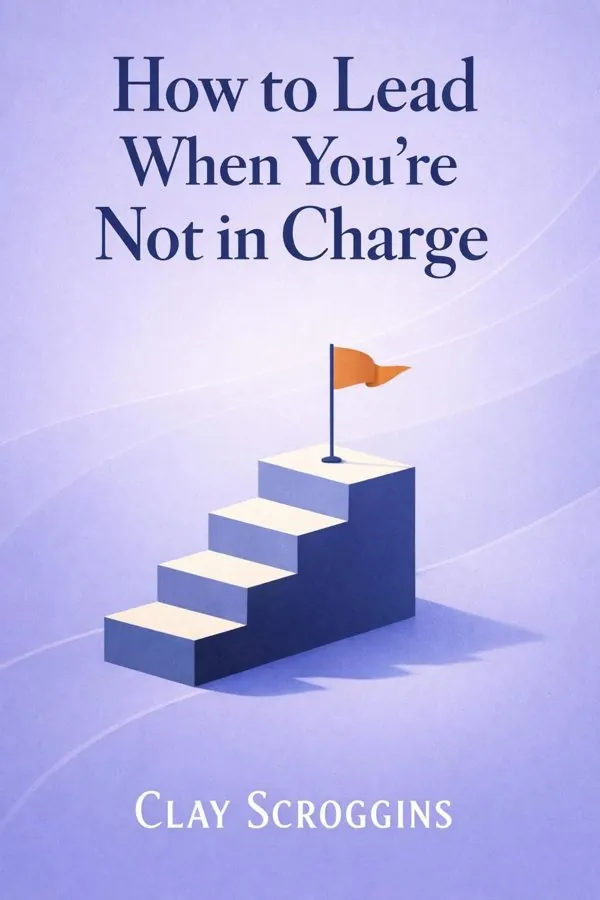
How to Lead When You're Not in Charge: Summary & Key Insights
 10 min10 chaptersAudio available
Key Takeaways from How to Lead When You're Not in Charge
One of the most freeing truths in leadership is that a title may grant power, but it does not guarantee impact.
The hardest person you will ever lead is yourself.
Positivity is often misunderstood as personality, but Scroggins presents it as a leadership choice.
Leadership without thoughtful judgment becomes noise.
Passivity is one of the quietest ways people surrender their leadership.
What Is How to Lead When You're Not in Charge About?
How to Lead When You're Not in Charge by Clay Scroggins is a leadership book published in 2017 spanning 10 pages. How to Lead When You're Not in Charge is a practical leadership book for anyone who wants to make a meaningful difference without waiting for a promotion, title, or corner office. Clay Scroggins argues that leadership is not reserved for the person at the top of the org chart. Instead, it is expressed through influence, initiative, mindset, and the daily choices people make in the middle, bottom, or edges of an organization. That idea matters because many professionals feel stuck: they see problems, have ideas, and want to contribute, but assume they must first gain formal authority. Scroggins challenges that assumption directly. Drawing from his work as a pastor and organizational leader at North Point Ministries, Scroggins combines real-world leadership lessons with humor, honesty, and strong practical advice. His core framework centers on four repeatable behaviors: lead yourself, choose positivity, think critically, and reject passivity. Around those principles, he shows readers how to handle conflict, navigate complex workplace dynamics, communicate vision, and build long-term trust. The result is an accessible and encouraging guide for emerging leaders, team members, managers, and anyone determined to lead well before they are officially in charge.
This FizzRead summary covers all 10 key chapters of How to Lead When You're Not in Charge in approximately 10 minutes, distilling the most important ideas, arguments, and takeaways from Clay Scroggins's work. Also available as an audio summary and Key Quotes Podcast.
How to Lead When You're Not in Charge
How to Lead When You're Not in Charge is a practical leadership book for anyone who wants to make a meaningful difference without waiting for a promotion, title, or corner office. Clay Scroggins argues that leadership is not reserved for the person at the top of the org chart. Instead, it is expressed through influence, initiative, mindset, and the daily choices people make in the middle, bottom, or edges of an organization. That idea matters because many professionals feel stuck: they see problems, have ideas, and want to contribute, but assume they must first gain formal authority. Scroggins challenges that assumption directly.
Drawing from his work as a pastor and organizational leader at North Point Ministries, Scroggins combines real-world leadership lessons with humor, honesty, and strong practical advice. His core framework centers on four repeatable behaviors: lead yourself, choose positivity, think critically, and reject passivity. Around those principles, he shows readers how to handle conflict, navigate complex workplace dynamics, communicate vision, and build long-term trust. The result is an accessible and encouraging guide for emerging leaders, team members, managers, and anyone determined to lead well before they are officially in charge.
Who Should Read How to Lead When You're Not in Charge?
This book is perfect for anyone interested in leadership and looking to gain actionable insights in a short read. Whether you're a student, professional, or lifelong learner, the key ideas from How to Lead When You're Not in Charge by Clay Scroggins will help you think differently.
- ✓Readers who enjoy leadership and want practical takeaways
- ✓Professionals looking to apply new ideas to their work and life
- ✓Anyone who wants the core insights of How to Lead When You're Not in Charge in just 10 minutes
Want the full summary?
Get instant access to this book summary and 100K+ more with Fizz Moment.
Get Free SummaryAvailable on App Store • Free to download
Key Chapters
The hardest person you will ever lead is yourself. That idea sits at the heart of Scroggins’s message. Before you can guide a team, shape culture, or influence a boss, you must learn to manage your own emotions, habits, ego, and reactions. Self-leadership is not glamorous, but it is foundational. Without it, ambition turns into frustration, giftedness turns into inconsistency, and potential never becomes dependable leadership.
Leading yourself well begins with self-awareness. You need to know your strengths, blind spots, emotional triggers, motivations, and patterns under stress. A person who says they want more responsibility but constantly misses deadlines, blames others, or avoids hard conversations is not being overlooked; they are revealing a self-leadership gap. Scroggins challenges readers to take responsibility for their inner world rather than assuming external circumstances are the main obstacle.
Self-leadership also involves discipline. This includes keeping commitments, regulating your mood, preparing thoroughly, and refusing to let insecurity dominate your behavior. For example, if feedback makes you defensive, your influence will shrink. If pressure causes you to become disorganized or reactive, others will hesitate to trust your judgment. But if you respond with humility, steadiness, and growth, your credibility rises.
A practical way to apply this idea is to build rhythms of reflection. Ask yourself: What do I do when I feel overlooked? How do I behave when I disagree with leadership? What habits are strengthening or weakening my influence? Journaling, seeking feedback, and reviewing your own behavior after difficult moments can reveal patterns you would otherwise miss.
Actionable takeaway: choose one self-leadership habit to improve over the next 30 days, such as emotional control, punctuality, preparation, or receptiveness to feedback, and track your progress consistently.
Positivity is often misunderstood as personality, but Scroggins presents it as a leadership choice. You do not need to be naturally cheerful to choose a positive posture. In his framework, positivity means refusing cynicism, complaint, and defeatism, especially when circumstances are imperfect. This matters because culture is contagious. A negative person can drain momentum from an entire team, while a hopeful and constructive person can stabilize and energize everyone around them.
Choosing positivity does not mean denying problems or pretending everything is fine. Instead, it means facing reality without surrendering to bitterness. In organizations, people who are not in charge often feel especially tempted toward cynicism. They see flaws in leadership, communication breakdowns, and inefficient decisions. The temptation is to become the smart critic in the hallway. Scroggins argues that this posture feels powerful for a moment but ultimately erodes influence. Chronic negativity may make you sound insightful, but it rarely makes you trustworthy.
A positive leader helps others move forward. In practice, that might mean reframing a setback as a learning opportunity, bringing solutions instead of only objections, or maintaining encouragement during a stressful project. Imagine a team whose launch is delayed. One person says, “This place is a mess.” Another says, “This is frustrating, but let’s identify what we can improve before the next deadline.” Both see the same reality; only one strengthens the team.
Positivity also signals emotional maturity. It shows that your outlook is not controlled by mood, ego, or disappointment. This makes people more likely to listen when you do raise concerns because they know you are not driven by resentment.
Actionable takeaway: for one week, replace every workplace complaint with either a constructive suggestion, a clarifying question, or a word of encouragement.
Leadership without thoughtful judgment becomes noise. Scroggins emphasizes that people who are not in charge must learn to think critically if they want to contribute meaningfully. Critical thinking is more than intelligence or skepticism. It is the disciplined ability to evaluate situations clearly, ask better questions, understand context, and make wise recommendations rather than impulsive reactions.
This skill matters because organizations are complex. Decisions that look foolish from one angle may make sense when you understand constraints, competing priorities, budget realities, timing issues, or information that leaders have and you do not. People with growing influence resist the temptation to oversimplify. Instead of saying, “Leadership never listens,” they ask, “What pressures might leadership be balancing that I do not see?” This shift creates humility and better analysis.
Critical thinking also means identifying root causes instead of treating symptoms. If morale is dropping, the issue may not simply be workload. It may involve unclear expectations, weak communication, or lack of recognition. A critical thinker does not jump to the easiest explanation; they observe patterns, gather information, and think systemically. That makes their input more valuable.
In practical terms, this could mean preparing for meetings with data, anticipating objections before presenting an idea, or distinguishing between personal preferences and organizational priorities. If you want your boss to support your proposal, do the work of showing how it aligns with team goals, what trade-offs it requires, and how success can be measured. Thoughtful preparation builds influence.
Actionable takeaway: before raising your next concern or idea, write down three possible causes of the issue, two organizational constraints that may matter, and one solution that serves the broader mission rather than just your preference.
Passivity is one of the quietest ways people surrender their leadership. Scroggins argues that many talented individuals stay stuck not because they lack ability, but because they wait. They wait to be noticed, invited, promoted, trained, or perfectly prepared. Meanwhile, influence often grows through initiative. Leaders step toward responsibility before they possess full control.
Rejecting passivity does not mean becoming reckless or disrespectful. It means refusing to hide behind excuses like “That’s not my job” or “No one asked me.” In any organization, there are constant opportunities to improve communication, solve small problems, support a teammate, strengthen a process, or volunteer for a difficult task. Initiative shows that you are invested in the mission, not merely your role description.
This principle is especially powerful for people who feel overlooked. The natural reaction to being underutilized is withdrawal. Scroggins offers a better response: become useful in visible, humble, consistent ways. For example, if a recurring meeting is chaotic, offer to organize notes and action items. If new hires struggle to adapt, create a simple onboarding checklist. If your manager is overloaded, proactively prepare options instead of just delivering problems. None of these actions require formal authority, but each expands trust.
Passivity often disguises fear: fear of failure, criticism, or overstepping. Yet leadership always involves risk. Not every initiative will be embraced, but inactivity guarantees stagnation. The key is to act with wisdom, alignment, and respect while still moving forward.
Actionable takeaway: identify one recurring problem within your team that frustrates everyone, and take one small, practical step this week to help solve it without waiting to be asked.
People often assume vision only belongs to top leadership, but Scroggins shows that clarity is a form of leadership available at every level. While senior leaders may set the broad direction, anyone can help translate that direction into meaningful, actionable understanding for the people around them. In fact, teams often suffer not from lack of effort but from lack of clarity. The person who helps others see what matters, what success looks like, and what to do next becomes deeply influential.
Clarity matters because confusion drains energy. When expectations are fuzzy, priorities compete, and people pull in different directions. A leader without formal authority can add enormous value by simplifying complexity. This might mean summarizing a strategy after a meeting, restating goals in plain language, defining next steps for a project, or helping teammates understand why a task matters.
Vision at this level is not about grand speeches. It is about connecting daily work to a larger purpose. For example, an operations employee can remind the team that accuracy is not just about process compliance but about customer trust. A school administrator can connect scheduling improvements to a better student experience. When people see how their work contributes to something bigger, motivation increases.
Scroggins’s larger point is that influence grows when you reduce ambiguity. People are drawn to those who bring focus instead of confusion. If you can clarify priorities, communicate meaning, and align action, you are leading.
Actionable takeaway: in your next project or meeting, identify one point of confusion and take responsibility for creating clarity by summarizing the goal, naming priorities, and proposing the next three practical steps.
Conflict is unavoidable wherever people work closely together, but the way you handle it determines whether your influence grows or shrinks. Scroggins encourages readers to see conflict not as proof that leadership is failing, but as an opportunity to demonstrate maturity. People who are not in charge often feel they have two bad options: stay silent or become combative. The book offers a better path rooted in courage, humility, and clarity.
Healthy conflict starts with motives. Are you trying to serve the mission, or defend your ego? Are you seeking understanding, or trying to prove someone wrong? If your goal is personal victory, even a valid point can damage trust. But if your goal is organizational health, people are more likely to hear you. This requires emotional restraint, especially when you feel ignored or misunderstood.
Practically, handling conflict well means addressing issues directly, privately when appropriate, and with specific examples rather than vague frustration. Instead of saying, “You never communicate,” say, “When project updates are shared at the last minute, it creates confusion for the team. Can we try a weekly update rhythm?” That approach is clearer, less accusatory, and more solution-oriented.
Scroggins also highlights the importance of absorbing some friction without dramatizing everything. Not every annoyance deserves escalation. Mature leaders know the difference between a true issue and a personal irritation. They also know when to let go, when to speak up, and when to ask questions before assuming intent.
Actionable takeaway: think of one unresolved tension in your work environment and plan a calm, direct conversation focused on observable facts, shared goals, and one constructive solution rather than blame.
Real leadership is never only about personal advancement. Scroggins argues that if you are growing in influence, one of the clearest signs is that you help others lead too. This is how leadership culture forms: not through slogans, but through everyday behaviors that multiply ownership, responsibility, and trust throughout a team.
A leadership culture emerges when people stop acting like mere task executors and begin thinking like stewards of the mission. Even if you are not running the department, you can encourage this shift by modeling accountability, inviting ideas from others, sharing credit, and helping teammates grow. For instance, instead of hoarding knowledge to make yourself indispensable, you can mentor a newer colleague, document a useful process, or ask quieter teammates for input in meetings. These small actions communicate that leadership is shared, not scarce.
This matters because organizations become fragile when leadership is concentrated in only a few visible people. Teams become stronger when initiative, responsibility, and problem-solving spread across the group. People feel more engaged when they know their voice matters and their contribution can shape outcomes.
Scroggins’s perspective is especially valuable for emerging leaders who want influence without appearing self-promotional. One of the best ways to gain trust is to make others better. When your presence increases ownership, confidence, and clarity in the people around you, leadership becomes undeniable.
Actionable takeaway: choose one person on your team this week to encourage, coach, or empower in a specific way, such as delegating meaningful ownership, sharing helpful feedback, or publicly recognizing their contribution.
Influence is easier to gain than to sustain. Scroggins closes the leadership gap by emphasizing that long-term credibility depends less on charisma than on character and consistency. A person may impress others briefly with talent, energy, or confidence, but enduring influence is built through repeated trustworthiness over time. People watch what you do after disappointment, success, boredom, and pressure. Those patterns define your leadership far more than isolated moments.
Sustained influence requires patience. Many aspiring leaders expect rapid recognition and become discouraged when advancement is slow. Scroggins urges readers to play the long game. Keep showing up prepared. Keep serving well. Keep managing your attitude. Keep telling the truth. Over time, these habits create a reputation no title can manufacture.
Character is central here. If you manipulate, gossip, chase visibility, or treat people as stepping stones, your influence may increase temporarily but it will eventually weaken. By contrast, honesty, humility, dependability, and generosity make people feel safe with you. Safety is a hidden currency of leadership. People trust those whose behavior is stable and whose motives are clean.
Consistency is what transforms values into reputation. It is easy to be positive on a good day or humble when things are going your way. The test is whether you remain grounded when recognition goes elsewhere, plans change, or criticism arrives. Long-term leaders do not need constant spotlight to stay engaged.
Actionable takeaway: identify the two or three character traits you want to be known for professionally, then choose one daily practice for each trait so your reputation is built intentionally rather than accidentally.
All Chapters in How to Lead When You're Not in Charge
About the Author
Clay Scroggins is an American pastor, speaker, and leadership writer known for making leadership ideas practical, relatable, and easy to apply. He served for many years at North Point Ministries in Atlanta, where he gained extensive experience leading teams within a large and influential church organization. Through his speaking and writing, Scroggins has focused on topics such as influence, personal growth, organizational culture, and leading without relying on formal authority. His style blends humor, honesty, and actionable insight, which has helped his work resonate with both faith-based and general leadership audiences. In How to Lead When You're Not in Charge, he draws on years of firsthand leadership experience to encourage readers to stop waiting for position and start developing influence through character, initiative, and everyday responsibility.
Get This Summary in Your Preferred Format
Read or listen to the How to Lead When You're Not in Charge summary by Clay Scroggins anytime, anywhere. FizzRead offers multiple formats so you can learn on your terms — all free.
Available formats: App · Audio · PDF · EPUB — All included free with FizzRead
Download How to Lead When You're Not in Charge PDF and EPUB Summary
Key Quotes from How to Lead When You're Not in Charge
“One of the most freeing truths in leadership is that a title may grant power, but it does not guarantee impact.”
“The hardest person you will ever lead is yourself.”
“Positivity is often misunderstood as personality, but Scroggins presents it as a leadership choice.”
“Leadership without thoughtful judgment becomes noise.”
“Passivity is one of the quietest ways people surrender their leadership.”
Frequently Asked Questions about How to Lead When You're Not in Charge
How to Lead When You're Not in Charge by Clay Scroggins is a leadership book that explores key ideas across 10 chapters. How to Lead When You're Not in Charge is a practical leadership book for anyone who wants to make a meaningful difference without waiting for a promotion, title, or corner office. Clay Scroggins argues that leadership is not reserved for the person at the top of the org chart. Instead, it is expressed through influence, initiative, mindset, and the daily choices people make in the middle, bottom, or edges of an organization. That idea matters because many professionals feel stuck: they see problems, have ideas, and want to contribute, but assume they must first gain formal authority. Scroggins challenges that assumption directly. Drawing from his work as a pastor and organizational leader at North Point Ministries, Scroggins combines real-world leadership lessons with humor, honesty, and strong practical advice. His core framework centers on four repeatable behaviors: lead yourself, choose positivity, think critically, and reject passivity. Around those principles, he shows readers how to handle conflict, navigate complex workplace dynamics, communicate vision, and build long-term trust. The result is an accessible and encouraging guide for emerging leaders, team members, managers, and anyone determined to lead well before they are officially in charge.
You Might Also Like



Featured In
Browse by Category
Ready to read How to Lead When You're Not in Charge?
Get the full summary and 100K+ more books with Fizz Moment.