
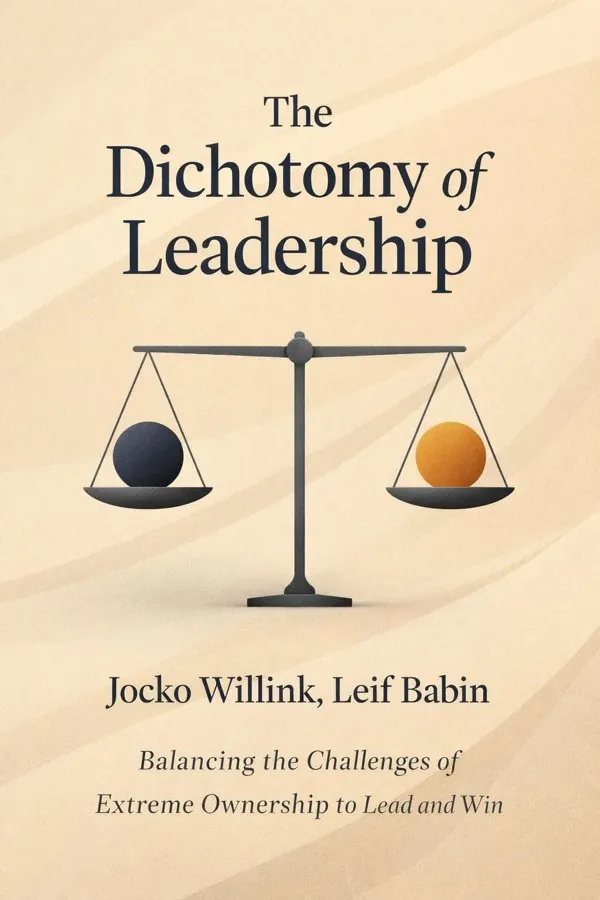
The Dichotomy of Leadership: Balancing the Challenges of Extreme Ownership to Lead and Win: Summary & Key Insights
 10 min10 chaptersAudio available
Key Takeaways from The Dichotomy of Leadership: Balancing the Challenges of Extreme Ownership to Lead and Win
One of the most dangerous myths in leadership is that success comes from applying a principle more aggressively than everyone else.
A team that feels cared for can still fail, and a team that hits numbers while burning out its people will eventually collapse.
Extreme ownership can be misunderstood as doing everything yourself.
Teams need leaders who can make calls under uncertainty.
Leadership is not about always being in front.
What Is The Dichotomy of Leadership: Balancing the Challenges of Extreme Ownership to Lead and Win About?
The Dichotomy of Leadership: Balancing the Challenges of Extreme Ownership to Lead and Win by Jocko Willink, Leif Babin is a leadership book spanning 11 pages. Leadership rarely fails because people do not care enough. More often, it fails because they push a strength too far and turn it into a weakness. In The Dichotomy of Leadership, Jocko Willink and Leif Babin argue that the hardest part of leading is not learning a set of rules, but balancing competing demands that are both necessary at the same time. A leader must be confident, but never arrogant; disciplined, but never rigid; close to the team, but not so close that standards slip. This book is a practical guide to that tension. Building on the ideas of Extreme Ownership, the authors show that leadership is not about choosing one side of an equation. It is about finding the right equilibrium for the mission, the team, and the moment. Their authority comes from two worlds with high stakes: combat in Iraq as Navy SEAL officers and years of advising businesses through their consulting firm, Echelon Front. The result is a sharp, field-tested framework for anyone who wants to lead more effectively under pressure.
This FizzRead summary covers all 10 key chapters of The Dichotomy of Leadership: Balancing the Challenges of Extreme Ownership to Lead and Win in approximately 10 minutes, distilling the most important ideas, arguments, and takeaways from Jocko Willink, Leif Babin's work. Also available as an audio summary and Key Quotes Podcast.
The Dichotomy of Leadership: Balancing the Challenges of Extreme Ownership to Lead and Win
Leadership rarely fails because people do not care enough. More often, it fails because they push a strength too far and turn it into a weakness. In The Dichotomy of Leadership, Jocko Willink and Leif Babin argue that the hardest part of leading is not learning a set of rules, but balancing competing demands that are both necessary at the same time. A leader must be confident, but never arrogant; disciplined, but never rigid; close to the team, but not so close that standards slip. This book is a practical guide to that tension. Building on the ideas of Extreme Ownership, the authors show that leadership is not about choosing one side of an equation. It is about finding the right equilibrium for the mission, the team, and the moment. Their authority comes from two worlds with high stakes: combat in Iraq as Navy SEAL officers and years of advising businesses through their consulting firm, Echelon Front. The result is a sharp, field-tested framework for anyone who wants to lead more effectively under pressure.
Who Should Read The Dichotomy of Leadership: Balancing the Challenges of Extreme Ownership to Lead and Win?
This book is perfect for anyone interested in leadership and looking to gain actionable insights in a short read. Whether you're a student, professional, or lifelong learner, the key ideas from The Dichotomy of Leadership: Balancing the Challenges of Extreme Ownership to Lead and Win by Jocko Willink, Leif Babin will help you think differently.
- ✓Readers who enjoy leadership and want practical takeaways
- ✓Professionals looking to apply new ideas to their work and life
- ✓Anyone who wants the core insights of The Dichotomy of Leadership: Balancing the Challenges of Extreme Ownership to Lead and Win in just 10 minutes
Want the full summary?
Get instant access to this book summary and 100K+ more with Fizz Moment.
Get Free SummaryAvailable on App Store • Free to download
Key Chapters
One of the most dangerous myths in leadership is that success comes from applying a principle more aggressively than everyone else. The truth, Willink and Babin argue, is that nearly every leadership virtue has an opposite that is also necessary. That is the central dichotomy of leadership: leaders must embrace both sides of competing demands and know when to lean into one without neglecting the other. Confidence is essential, but humility keeps confidence from becoming arrogance. Decisiveness matters, but patience prevents rash mistakes. Control is necessary, but empowerment is what allows a team to scale.
This idea matters because many leadership failures do not come from bad intentions. They come from overcorrection. A leader who wants accountability becomes a micromanager. A leader who wants trust becomes too hands-off. A leader who cares deeply about morale avoids hard conversations until performance erodes. In each case, the problem is not the value itself, but the lack of balance.
The authors draw on combat and business examples to show that leadership is situational. There is no formula that works in every environment. Instead, leaders must read the context, understand the mission, assess the team, and adjust. This requires self-awareness. It also requires the humility to admit that your natural style may not be what the situation needs.
In practical terms, this means leaders should regularly ask: where am I overcompensating? Am I too controlling, too distant, too soft, too forceful, too optimistic, too cautious? The best leaders stay alert to these shifts and recalibrate before strengths become liabilities.
Actionable takeaway: identify one of your strongest leadership traits this week and ask how it might be creating problems when pushed too far.
A team that feels cared for can still fail, and a team that hits numbers while burning out its people will eventually collapse. That is why the book insists on a hard truth: leaders must prioritize the mission without losing the trust and commitment of the people who execute it. These two responsibilities are not in conflict, but they can feel that way in difficult moments.
The mission has to come first because without a clear objective, teams drift. Resources are wasted, confusion spreads, and standards fall. In combat, that can cost lives. In business, it can cost customers, cash, and credibility. But a leader who pursues the mission without regard for the team creates resentment, fear, and disengagement. People may comply temporarily, but they will stop bringing initiative, honesty, and energy to the work.
The balance comes from recognizing that caring about people does not mean lowering standards. It means giving people clarity, support, training, and honest feedback so they can meet the standard. It means making difficult decisions in a way that preserves dignity. It means explaining why the mission matters and how each person contributes to it.
Consider a manager facing a demanding deadline. Leaning too far toward the mission may mean excessive pressure, chaotic communication, and ignored warning signs. Leaning too far toward comfort may mean missed milestones and vague expectations. Balanced leadership would break down priorities, remove obstacles, redistribute workload, and communicate openly about what success requires.
Actionable takeaway: in your next high-pressure project, define the mission in one sentence and pair it with one concrete action that demonstrates commitment to your team’s well-being.
Extreme ownership can be misunderstood as doing everything yourself. The authors reject that interpretation. A leader must take full responsibility for outcomes while simultaneously building a team that can operate independently. If ownership turns into personal control over every decision, the leader becomes the bottleneck. If empowerment turns into detachment, the team loses direction. The challenge is to do both.
Owning everything means the leader cannot blame the team, the market, unclear instructions, or bad luck. If the team underperforms, the leader must ask what was not explained, trained, reinforced, or monitored. That mindset is powerful because it keeps leaders focused on what they can improve. But ownership is not an excuse to centralize authority. In fact, the more responsibility a leader accepts, the more important it becomes to decentralize execution.
Empowered teams move faster, solve local problems, and adapt under pressure. This only works, however, when leaders provide clear intent. People do not need endless instructions; they need to understand the mission, priorities, constraints, and desired end state. Once they have that, they can make smart decisions without waiting for permission.
A common workplace example is a founder who approves every customer proposal, every hire, and every expense. That may feel responsible, but it limits growth. A better approach is to establish standards, train decision-makers, review outcomes, and intervene only when needed. That preserves accountability while increasing capacity.
Actionable takeaway: choose one decision you currently control too tightly, clarify the intent and boundaries, and delegate it fully to a capable team member.
Teams need leaders who can make calls under uncertainty. Yet decisiveness becomes destructive when it turns into domination. The book emphasizes that strong leadership is not loud, theatrical, or constant. A resolute leader provides direction, makes the hard call when necessary, and creates confidence. An overbearing leader smothers initiative, discourages dissent, and makes people dependent instead of capable.
This distinction matters because many leaders equate authority with visible control. They interrupt, override, and issue orders on every detail in the name of urgency. In the short term, this can create movement. In the long term, it weakens the team. People stop speaking up. Problems are hidden. Creativity disappears. Eventually the leader is surrounded by passive executors who wait to be told what to do.
Being resolute starts with clarity. What must happen? What standards are nonnegotiable? What risks are acceptable? Once those are clear, a leader can listen, gather input, and then decide. Overbearing leaders often skip the listening part. Balanced leaders encourage candid feedback before the decision and unified execution after it.
In practical settings, this means running meetings where disagreement is invited early but not endlessly. It means telling a struggling employee exactly what must improve, without humiliating them. It means stepping in during a crisis, but stepping back once the team regains footing.
Actionable takeaway: at your next decision point, ask for opposing views before making the call, then communicate the final direction with confidence and brevity.
Leadership is not about always being in front. Sometimes the most effective leader steps back and follows the expertise of someone else. Willink and Babin stress that ego is often the hidden obstacle here. Leaders may believe they must dominate every conversation, own every plan, and appear to have all the answers. But real leadership includes the humility to let others lead when they are better positioned.
Following does not mean abdication. It means recognizing who has the best information, the strongest expertise, or the clearest view of a particular problem. In combat, rank matters, but so does situational awareness. In business, titles matter, but so do technical skill and frontline knowledge. A senior leader who ignores a specialist’s expertise out of pride puts the mission at risk.
This balance creates stronger teams because it shows that authority is in service of results, not ego. It also develops future leaders. When people are trusted to lead parts of the mission, they gain confidence and judgment. The overall organization becomes more resilient.
A practical example is a department head in a product meeting. If engineering understands the technical tradeoffs better, the leader should let engineering drive that decision while keeping the broader mission in view. If a customer success manager sees a retention risk before executives do, that voice should carry weight.
Actionable takeaway: in your next team discussion, deliberately identify who has the best knowledge on the issue and give that person space to lead the conversation.
Passivity rarely wins in competitive environments, but unchecked aggression can be just as damaging. The authors show that leaders must cultivate a proactive, offensive mindset while avoiding recklessness. Aggression, in their framing, means taking initiative, moving with purpose, and confronting problems early. It does not mean acting impulsively, escalating unnecessarily, or confusing intensity with effectiveness.
This distinction is vital in both crisis and routine operations. Teams often admire aggressive leaders because they seem energetic and fearless. But if that energy is not grounded in judgment, it produces chaos. Resources get wasted, communication breaks down, and preventable mistakes multiply. A reckless leader may seem bold, but they are actually exposing the team to avoidable risk.
Disciplined aggression starts with preparation. Leaders gather enough information to act intelligently, establish contingencies, and communicate intent clearly. Then they move. They do not freeze in analysis, but neither do they rush blindly. In business, this might look like entering a new market only after testing assumptions, defining metrics, and identifying failure points. In personnel issues, it means addressing poor performance directly, but with facts and a plan rather than emotion.
The key is to ask not only, should we act, but how do we act in a way that increases the odds of success? Aggressive leaders solve problems. Reckless leaders create new ones.
Actionable takeaway: before taking bold action, write down the objective, top two risks, and one fallback option so your initiative is guided by discipline.
Standards create excellence, but inflexible adherence to rules can undermine the very outcomes those rules were meant to protect. The book argues that disciplined teams outperform chaotic ones because discipline builds consistency, trust, and speed. People know what is expected. Processes reduce confusion. Repetition creates competence. Yet discipline becomes rigidity when leaders treat procedure as more important than purpose.
Rigid leaders often believe they are preserving quality. In reality, they can be slowing adaptation. When conditions change, teams need enough structure to stay aligned and enough flexibility to respond to reality. This is especially important in fast-moving environments where yesterday’s plan may not survive today’s facts.
The authors make clear that disciplined leadership is not about blind obedience. It is about mastering fundamentals so thoroughly that teams can adjust intelligently when necessary. In a business setting, this could mean using a standard sales process but adapting the conversation to different customer needs. It could mean maintaining reporting routines while revising metrics when strategy changes.
Leaders must constantly distinguish between principles and preferences. Principles are essential and should be protected. Preferences may feel familiar but are often negotiable. Teams become rigid when leaders cannot tell the difference.
A balanced approach trains people in core standards, explains why they matter, and empowers them to deviate thoughtfully when the mission demands it. That creates disciplined initiative rather than robotic compliance.
Actionable takeaway: review one team rule or process this month and ask whether it serves the mission now or merely reflects habit.
Many leaders swing between two ineffective extremes: they either let people operate with too little oversight or they hover so closely that ownership disappears. Willink and Babin argue that accountability works only when leaders hold standards firmly while avoiding the temptation to manage every step. People need responsibility, but they also need to know that results matter.
Micromanagement usually comes from fear. A leader worries that mistakes will happen, so they over-control tasks, require constant updates, and correct minor details. This may reduce short-term uncertainty, but it teaches dependence. Team members stop thinking ahead because they know the leader will step in. At the other extreme, a leader who avoids follow-up in the name of trust often discovers too late that priorities were misunderstood or ignored.
Balanced accountability means setting clear expectations upfront: what success looks like, when progress will be reviewed, what constraints exist, and what support is available. Then the leader lets the person execute. Follow-up is intentional, not intrusive. Questions focus on outcomes and obstacles, not on proving who has power.
For example, instead of asking for hourly updates on a project, a leader might agree on milestones, define metrics, and schedule review points. If performance slips, the leader does not rescue the person immediately or lash out emotionally. They diagnose the issue, coach where needed, and reset expectations.
Actionable takeaway: the next time you delegate, define the desired outcome, deadline, and check-in cadence in advance, then resist the urge to interfere between those agreed moments.
Training is where confidence is built, weaknesses are exposed, and future crises are won before they happen. But the book warns that more training is not always better training. Leaders must push teams hard enough to prepare them for reality, while also ensuring that training is relevant, sustainable, and aligned with actual mission demands.
Hard training matters because pressure reveals gaps. Under stress, people do not rise to their ideals; they fall back on their habits. If habits have not been built deliberately, performance collapses when stakes rise. That is why elite teams rehearse fundamentals repeatedly and under demanding conditions. Yet training can become wasteful when leaders chase intensity for its own sake. Exhausting people with exercises that do not match real needs may create the illusion of toughness without improving capability.
Smart training starts with clarity about the mission. What scenarios are most likely? What decisions are most critical? What failures would be most costly? From there, leaders design practice that is challenging but targeted. They also debrief honestly, capturing lessons while memory is fresh. Mistakes in training are valuable only if they are analyzed and corrected.
In business, this might mean role-playing difficult customer conversations, rehearsing incident-response procedures, or simulating product launches. It also means not overloading teams with endless workshops that disconnect from daily work.
Actionable takeaway: identify one high-stakes situation your team may face soon and run a focused practice session that mirrors real conditions, followed by a short debrief on lessons learned.
Confidence inspires trust, but confidence without humility quickly becomes blindness. One of the most important balances in the book is the need to project belief in the mission and the team while remaining open to correction, learning, and hard truths. Leaders who lack confidence create hesitation. Leaders who lack humility create preventable failure.
Humility is often misunderstood as weakness or self-doubt. The authors present it differently. Humility is the willingness to see reality as it is, not as you want it to be. It means recognizing that your rank, experience, or past success does not make you infallible. It means listening when someone closer to the problem sees something you missed. It means owning mistakes quickly instead of protecting your ego.
At the same time, leaders cannot lead well if they appear uncertain about everything. Teams under pressure want to know that someone believes success is possible. Confidence provides that stabilizing force. The challenge is to hold confidence in the mission and humility about your own limitations.
In practice, a humble and confident leader says, This is the direction we are taking, and I want to hear any risks or concerns now. They do not pretend to know every detail. They invite input, then commit to a course of action. This combination builds trust because it feels both strong and honest.
Actionable takeaway: in your next team meeting, state your decision clearly, then explicitly invite one piece of dissenting feedback before execution begins.
All Chapters in The Dichotomy of Leadership: Balancing the Challenges of Extreme Ownership to Lead and Win
About the Authors
Jocko Willink and Leif Babin are former U.S. Navy SEAL officers best known for translating battlefield leadership into practical lessons for organizations. They served together in SEAL Team Three’s Task Unit Bruiser during the Battle of Ramadi in Iraq, where they led troops in one of the conflict’s most intense combat environments. After their military service, they co-founded Echelon Front, a leadership consulting firm that works with companies, teams, and executives to improve performance, accountability, and execution. They first gained widespread attention with their bestselling book Extreme Ownership, which introduced a clear, uncompromising philosophy of responsibility in leadership. Their work stands out for combining real combat experience with hands-on business consulting, making their advice both credible and highly practical for leaders in many fields.
Get This Summary in Your Preferred Format
Read or listen to the The Dichotomy of Leadership: Balancing the Challenges of Extreme Ownership to Lead and Win summary by Jocko Willink, Leif Babin anytime, anywhere. FizzRead offers multiple formats so you can learn on your terms — all free.
Available formats: App · Audio · PDF · EPUB — All included free with FizzRead
Download The Dichotomy of Leadership: Balancing the Challenges of Extreme Ownership to Lead and Win PDF and EPUB Summary
Key Quotes from The Dichotomy of Leadership: Balancing the Challenges of Extreme Ownership to Lead and Win
“One of the most dangerous myths in leadership is that success comes from applying a principle more aggressively than everyone else.”
“A team that feels cared for can still fail, and a team that hits numbers while burning out its people will eventually collapse.”
“Extreme ownership can be misunderstood as doing everything yourself.”
“Teams need leaders who can make calls under uncertainty.”
“Leadership is not about always being in front.”
Frequently Asked Questions about The Dichotomy of Leadership: Balancing the Challenges of Extreme Ownership to Lead and Win
The Dichotomy of Leadership: Balancing the Challenges of Extreme Ownership to Lead and Win by Jocko Willink, Leif Babin is a leadership book that explores key ideas across 10 chapters. Leadership rarely fails because people do not care enough. More often, it fails because they push a strength too far and turn it into a weakness. In The Dichotomy of Leadership, Jocko Willink and Leif Babin argue that the hardest part of leading is not learning a set of rules, but balancing competing demands that are both necessary at the same time. A leader must be confident, but never arrogant; disciplined, but never rigid; close to the team, but not so close that standards slip. This book is a practical guide to that tension. Building on the ideas of Extreme Ownership, the authors show that leadership is not about choosing one side of an equation. It is about finding the right equilibrium for the mission, the team, and the moment. Their authority comes from two worlds with high stakes: combat in Iraq as Navy SEAL officers and years of advising businesses through their consulting firm, Echelon Front. The result is a sharp, field-tested framework for anyone who wants to lead more effectively under pressure.
More by Jocko Willink, Leif Babin

You Might Also Like

Extreme Ownership
Jocko Willink
10 min
Dare to Lead
Brene Brown
10 min
Leaders Eat Last
Simon Sinek
10 min
The 21 Irrefutable Laws of Leadership
John Maxwell
10 min
Start With Why
Simon Sinek
10 min
How to Lead When You're Not in Charge
Clay Scroggins
10 minBrowse by Category
Ready to read The Dichotomy of Leadership: Balancing the Challenges of Extreme Ownership to Lead and Win?
Get the full summary and 100K+ more books with Fizz Moment.