
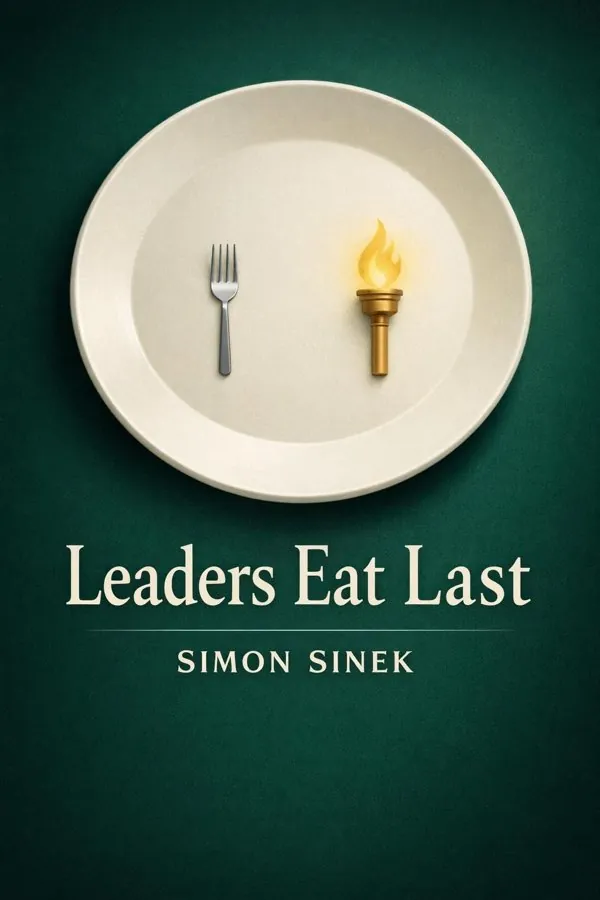
Leaders Eat Last: Summary & Key Insights
by Simon Sinek
 10 min10 chaptersAudio available
Key Takeaways from Leaders Eat Last
People perform at their best when they do not feel they are constantly defending themselves.
Leadership is not just a philosophy; it is also chemistry.
A workplace ruled by fear does not create excellence; it creates self-protection.
Authority can be granted by a title, but leadership must be earned through sacrifice.
The military may seem far removed from corporate life, yet Sinek draws heavily from it because it reveals leadership principles in their purest form.
What Is Leaders Eat Last About?
Leaders Eat Last by Simon Sinek is a leadership book published in 2014 spanning 11 pages. In Leaders Eat Last, Simon Sinek argues that the best leaders do not lead by exerting power, demanding loyalty, or chasing short-term results. They lead by creating conditions in which people feel safe, trusted, and valued. When that happens, teams cooperate more freely, take smarter risks, and stay committed even under pressure. Drawing from military traditions, neuroscience, anthropology, and business case studies, Sinek shows that leadership is less about status and more about responsibility. His central metaphor comes from the U.S. Marine Corps practice in which officers eat after their troops, signaling that leaders place the needs of their people above their own comfort. What makes the book matter is its relevance to modern workplaces, where anxiety, isolation, and performance pressure often weaken trust from within. Sinek explains how human biology shapes behavior at work, why some cultures inspire devotion while others breed fear, and how leaders can strengthen belonging in a distracted, metrics-driven age. As a bestselling author, speaker, and leadership thinker known for Start With Why, Sinek brings together research and memorable stories to make a powerful case: when leaders protect people first, performance follows.
This FizzRead summary covers all 10 key chapters of Leaders Eat Last in approximately 10 minutes, distilling the most important ideas, arguments, and takeaways from Simon Sinek's work. Also available as an audio summary and Key Quotes Podcast.
Leaders Eat Last
In Leaders Eat Last, Simon Sinek argues that the best leaders do not lead by exerting power, demanding loyalty, or chasing short-term results. They lead by creating conditions in which people feel safe, trusted, and valued. When that happens, teams cooperate more freely, take smarter risks, and stay committed even under pressure. Drawing from military traditions, neuroscience, anthropology, and business case studies, Sinek shows that leadership is less about status and more about responsibility. His central metaphor comes from the U.S. Marine Corps practice in which officers eat after their troops, signaling that leaders place the needs of their people above their own comfort.
What makes the book matter is its relevance to modern workplaces, where anxiety, isolation, and performance pressure often weaken trust from within. Sinek explains how human biology shapes behavior at work, why some cultures inspire devotion while others breed fear, and how leaders can strengthen belonging in a distracted, metrics-driven age. As a bestselling author, speaker, and leadership thinker known for Start With Why, Sinek brings together research and memorable stories to make a powerful case: when leaders protect people first, performance follows.
Who Should Read Leaders Eat Last?
This book is perfect for anyone interested in leadership and looking to gain actionable insights in a short read. Whether you're a student, professional, or lifelong learner, the key ideas from Leaders Eat Last by Simon Sinek will help you think differently.
- ✓Readers who enjoy leadership and want practical takeaways
- ✓Professionals looking to apply new ideas to their work and life
- ✓Anyone who wants the core insights of Leaders Eat Last in just 10 minutes
Want the full summary?
Get instant access to this book summary and 100K+ more with Fizz Moment.
Get Free SummaryAvailable on App Store • Free to download
Key Chapters
People perform at their best when they do not feel they are constantly defending themselves. One of Simon Sinek’s most powerful ideas is the Circle of Safety: a culture in which employees feel protected from internal politics, humiliation, and unnecessary fear. Human beings evolved in groups where survival depended on mutual protection. In modern organizations, the same instinct remains. If people believe their leaders and colleagues have their backs, they spend less energy on self-preservation and more on creativity, cooperation, and problem-solving.
A strong Circle of Safety does not mean low standards or endless comfort. It means that the threats people face come from outside the group—competition, market shifts, uncertainty—not from one another. In weak cultures, employees hoard information, blame peers, and hide mistakes because they fear punishment. In healthy cultures, people speak honestly, admit problems early, and help one another succeed. That shift changes everything. Trust reduces friction, improves decision-making, and strengthens resilience under pressure.
Sinek uses the military as a vivid model. Soldiers can take extraordinary risks for one another because they trust the people beside and above them. Businesses may not face literal life-and-death stakes, but the emotional dynamics are surprisingly similar. A manager who defends their team, shares credit, and takes responsibility builds loyalty. A leader who creates competition inside the team weakens it.
The practical lesson is clear: if you want better performance, start by making people feel safe enough to tell the truth, ask for help, and focus on the mission. Audit your environment for internal threats, and remove one this week.
Leadership is not just a philosophy; it is also chemistry. Sinek explains that human behavior at work is deeply shaped by four key chemicals: endorphins, dopamine, serotonin, and oxytocin. Endorphins help us push through physical strain and discomfort. Dopamine rewards progress and achievement, which is why goals, checklists, and bonuses can feel motivating. Serotonin is linked to feelings of pride and status, especially when we feel respected by others. Oxytocin strengthens trust, bonding, generosity, and connection.
This biological lens matters because many organizations over-rely on dopamine-driven systems. Sales targets, dashboards, incentives, and rapid-fire rewards can create bursts of productivity, but they can also become addictive. People start chasing numbers instead of meaning. They may hit short-term goals while undermining relationships, ethics, or long-term health. By contrast, cultures rich in serotonin and oxytocin encourage cooperation, belonging, and mutual support. These are the chemicals that sustain teams over time.
Think about two workplaces. In one, employees are constantly pushed with targets and public rankings. In the other, leaders still expect results, but they also recognize effort, build trust, and foster human connection. The first may produce intensity; the second produces endurance. Sinek’s point is not to reject ambition, but to understand that high performance is strongest when achievement is balanced by belonging.
Leaders influence biology through behavior. A sincere thank-you, fair recognition, mentoring, and consistent support all shape how people feel and respond. If your culture runs on pressure alone, it will eventually exhaust people. Build systems that reward progress without sacrificing trust. Actionable takeaway: pair every performance metric with a relationship-building practice, such as regular recognition, coaching, or peer support.
A workplace ruled by fear does not create excellence; it creates self-protection. Sinek highlights cortisol, the stress chemical released when we sense danger. In small doses, cortisol is useful. It heightens alertness and prepares us to respond to threats. But when stress becomes chronic—because of layoffs, toxic managers, humiliation, or constant uncertainty—people begin operating in survival mode. They stop collaborating openly and start prioritizing personal security over collective success.
This is why fear-based leadership is so damaging even when it appears to “work” in the short run. A team under pressure may move quickly for a while, but high cortisol narrows thinking. It reduces empathy, weakens trust, and makes people more reactive. In that state, employees are less likely to share bad news early, challenge flawed assumptions, or take thoughtful risks. They may comply outwardly while disengaging inwardly.
You can see this in organizations where people dread meetings, avoid speaking honestly, or treat every mistake as a threat to their reputation. Information gets distorted because honesty feels unsafe. Innovation drops because experimentation feels dangerous. People burn out not only from workload, but from vigilance.
Sinek’s argument is especially important in a world where uncertainty is common. Leaders cannot remove all stress, but they can prevent unnecessary internal danger. They can communicate clearly during hard times, avoid surprise decisions, explain context, and respond to mistakes with curiosity before blame. That does not mean avoiding accountability; it means delivering accountability in a way that preserves dignity and learning.
Actionable takeaway: identify one source of chronic fear on your team—unclear expectations, inconsistent feedback, public criticism, or job insecurity—and address it directly. Lowering internal stress frees people to focus on meaningful work.
Authority can be granted by a title, but leadership must be earned through sacrifice. The phrase “leaders eat last” captures a deeper principle: true leaders choose responsibility over privilege. In the Marine Corps tradition that inspired Sinek, senior people step back so others can be served first. The symbolism matters because it signals that rank exists to protect the group, not to extract benefits from it.
This idea cuts against many modern assumptions. In some organizations, leadership is treated as a reward: a bigger office, more control, more status, more access. Sinek argues that this mindset misses the point. Leadership means accepting the burden of looking after others, especially when conditions are difficult. The best leaders absorb pressure rather than pass it downward. They shield teams from chaos, take blame when necessary, and give credit generously.
This principle shows up in everyday behavior. A responsible leader does not disappear when a project fails. They ask what support was missing. They do not use fear to secure obedience. They model calm, fairness, and consistency. They do not demand commitment they have not earned. Over time, these actions create loyalty that no incentive program can buy.
Importantly, sacrifice is not performative martyrdom. It is not about leaders exhausting themselves to seem noble. It is about making decisions that prioritize the long-term well-being of people and the mission. Sometimes that means protecting team members from unrealistic demands. Sometimes it means having hard conversations with honesty and care.
Actionable takeaway: in your next decision, ask a simple question—does this mainly protect my comfort, or does it strengthen my people? Choose the option that expands trust, even if it costs you convenience or status.
The military may seem far removed from corporate life, yet Sinek draws heavily from it because it reveals leadership principles in their purest form. In dangerous environments, trust is not a soft idea. It is operationally essential. Units function only when people know that others will support them, share risk, and act with integrity. That same logic applies in business, even if the stakes are different.
What organizations can learn from military culture is not aggression or rigid hierarchy, but the clarity of commitment. Strong military teams are built around shared purpose, discipline, and mutual protection. Leaders are expected to serve those in their charge. Training reinforces standards, but belonging reinforces courage. People endure hardship because they believe they are part of something larger than themselves.
In business, leaders often try to create commitment through perks, slogans, or incentive plans. These can help at the margins, but they are weak substitutes for shared mission and earned trust. Consider two teams facing a major setback. The first is fragmented and politically charged. The second has clear purpose and strong internal bonds. The second team is far more likely to adapt quickly and stay united under pressure.
Military case studies also remind readers that culture is forged in repeated actions, not statements. Rituals matter. Standards matter. Shared hardship can matter. So does the visible conduct of senior leaders. If the people at the top act entitled, everyone notices. If they act accountable and service-minded, that example spreads.
Actionable takeaway: borrow one military-style discipline for your team—clear mission language, after-action reviews, or visible leader accountability—to strengthen trust and collective ownership in everyday work.
When leaders become too distant from the people affected by their decisions, those people turn into numbers. Sinek warns against abstraction: the habit of viewing employees, customers, or communities as metrics instead of human beings. Spreadsheets are necessary, but they can also create moral distance. It is easier to cut jobs, overload teams, or ignore suffering when the impact is hidden behind percentages and reports.
Abstraction is one reason large organizations can behave in ways that individuals within them would never justify face to face. A leader may tell themselves they are simply improving efficiency, yet the people experiencing the decision may feel disposable. Sinek does not deny the need for tough choices. His point is that leaders should remain close enough to the human consequences that they do not lose empathy.
This idea has practical implications. Leaders should spend time with frontline employees, listen directly to customers, and understand the lived reality behind performance data. A declining metric may represent exhaustion, frustration, or confusion. A financial win may have been achieved through unsustainable pressure. Without human context, leaders can optimize the wrong things.
Abstraction also damages culture internally. Employees quickly sense when they are seen mainly as labor inputs. That perception erodes trust and commitment. People are more willing to give discretionary effort when they believe they matter as individuals, not just as resources.
Sinek’s argument is especially relevant in digital and scaled environments, where dashboards dominate attention. Metrics are useful servants but dangerous masters. Actionable takeaway: before making a major people-related decision, speak directly with those affected or review real stories from the frontline. Replace at least one abstract metric with a human conversation.
An organization’s culture is not its mission statement; it is what people feel safe doing every day. Sinek emphasizes that leadership shapes culture through repeated signals: how promotions happen, how mistakes are handled, who gets recognized, how conflict is resolved, and whether people are treated with dignity when pressure rises. Employees watch behavior more closely than they listen to values language.
This explains why culture can be strong or weak regardless of branding. A company may speak about teamwork while rewarding internal rivalry. It may celebrate innovation while punishing failure. It may claim to value people while sacrificing them for short-term optics. These contradictions teach employees what is really true. Over time, the gap between stated values and lived experience becomes either a source of trust or cynicism.
Sinek argues that leaders cannot outsource culture to HR slogans or occasional workshops. Culture is the cumulative effect of leadership behavior. If leaders are patient, fair, and service-oriented, those norms spread. If they are political, inconsistent, or self-protective, those habits spread too. The emotional tone at the top ripples throughout the organization.
A practical application is to examine moments of stress. Pressure reveals culture faster than prosperity. How does your team behave when deadlines tighten or results slip? Do people become defensive and territorial, or do they pull together? Whatever happens under stress reflects what the culture has actually been training people to do.
Actionable takeaway: choose one repeated leadership signal to improve—such as how you give feedback, run meetings, or recognize effort. Consistency in small moments is one of the fastest ways to reshape culture for the better.
Many leaders fear that empathy will make them soft. Sinek argues the opposite: empathy is a strategic advantage because it allows leaders to understand what people need in order to perform well, grow, and stay committed. Service-oriented leadership does not lower expectations. It creates the conditions in which high expectations become sustainable.
Empathy begins with attention. Leaders who know their people as human beings—what motivates them, what pressures they face, where they struggle—can respond more intelligently. A blanket management style often fails because different people need different kinds of support. One team member may need autonomy; another may need clarity; another may need encouragement after a setback. Empathy helps leaders distinguish between laziness, confusion, overload, and fear.
Service also changes the moral direction of leadership. Instead of asking, “How do I get more out of people?” the better question becomes, “How do I help people do their best work?” That shift often improves results. Employees are more likely to commit when they feel respected, seen, and supported. They are also more likely to stay, reducing turnover and preserving knowledge.
This principle can be applied in simple ways: regular one-on-ones, thoughtful listening, mentoring, fair boundaries, and visible advocacy when teams face unreasonable demands. Service may also mean confronting poor behavior quickly so that one person does not damage the safety of many.
Sinek’s message is not sentimental. Caring for people is not separate from performance; it is part of the engine of performance. Actionable takeaway: in your next conversation with a direct report, spend more time understanding their reality than delivering instructions. Useful support begins with genuine listening.
The modern workplace offers extraordinary tools, but it also carries hidden dangers. Sinek warns that technology, metrics, and short-term incentives can push people toward distraction, comparison, and transactional behavior. When every action is measured and every result is instantly visible, leaders may be tempted to manage only what can be counted. Yet many of the most important drivers of strong organizations—trust, loyalty, courage, belonging—are harder to quantify.
Technology can also amplify dopamine dependence. Notifications, rankings, dashboards, and constant updates create a rhythm of small rewards that feels productive but can become compulsive. Teams may start chasing visible activity instead of meaningful progress. Communication becomes faster but not necessarily deeper. People may appear connected while feeling increasingly isolated.
Sinek is especially critical of leadership systems built around short-term wins at the expense of long-term health. Quarterly targets, shareholder pressure, and incentive bonuses can encourage decisions that look efficient today while weakening the culture tomorrow. If leaders reward outcomes without examining how those outcomes were achieved, they may inadvertently train selfishness, burnout, or corner-cutting.
The answer is not to reject technology or measurement. It is to put them in their proper place. Tools should support human relationships, not replace them. Metrics should inform judgment, not dominate it. Leaders must deliberately create moments of real connection, reflection, and perspective.
Actionable takeaway: review one system your team relies on—performance dashboards, messaging tools, incentive plans—and ask whether it is strengthening trust or merely increasing pressure. Adjust it so that human judgment and human connection remain central.
The strongest organizations are not built by squeezing maximum output from people as quickly as possible. They are built by leaders who think in human time, not just reporting cycles. Sinek’s broader argument points toward sustainable leadership: protecting culture, trust, and meaning so that performance can endure rather than spike and collapse.
Sustainable leadership recognizes that people are not machines. They need recovery, clarity, purpose, and social connection. When leaders ignore these realities, they may achieve short-term gains but often at a hidden cost: burnout, turnover, distrust, and weakened innovation. By the time those costs appear on a spreadsheet, the cultural damage is already significant.
Long-term leadership also requires moral patience. It takes time to build trust, mentor talent, and establish a culture where people feel safe to contribute fully. There are no shortcuts. A leader who invests in people may not always get immediate applause, but they create the kind of environment where strong teams can adapt repeatedly over years.
This idea is especially valuable during uncertainty. Under pressure, many organizations cut development, neglect communication, and centralize control. Sinek would argue that these are the very moments when leaders must deepen trust and preserve human dignity. People remember how they were treated during difficult times.
Sustainable leadership is not passive. It still demands standards, accountability, and ambition. But it refuses to sacrifice the social fabric that makes future success possible. Actionable takeaway: make one decision this month that favors long-term trust over short-term optics—whether that means more honest communication, better workload balance, or deeper investment in team development.
All Chapters in Leaders Eat Last
About the Author
Simon Sinek is a British-American author, speaker, and organizational consultant best known for his work on leadership, purpose, and trust. He rose to international prominence through his TED Talk “How Great Leaders Inspire Action,” which introduced millions of people to his concept of the Golden Circle and the importance of starting with “why.” Sinek has written several influential books, including Start With Why, Leaders Eat Last, Together Is Better, and The Infinite Game. His work blends storytelling, behavioral science, and practical leadership insights to help individuals and organizations build more inspired, human-centered cultures. Widely sought after by businesses, nonprofits, and military audiences, Sinek is known for arguing that lasting success comes from service, clarity of purpose, and the ability to create environments where people feel safe and motivated.
Get This Summary in Your Preferred Format
Read or listen to the Leaders Eat Last summary by Simon Sinek anytime, anywhere. FizzRead offers multiple formats so you can learn on your terms — all free.
Available formats: App · Audio · PDF · EPUB — All included free with FizzRead
Download Leaders Eat Last PDF and EPUB Summary
Key Quotes from Leaders Eat Last
“People perform at their best when they do not feel they are constantly defending themselves.”
“Leadership is not just a philosophy; it is also chemistry.”
“A workplace ruled by fear does not create excellence; it creates self-protection.”
“Authority can be granted by a title, but leadership must be earned through sacrifice.”
“The military may seem far removed from corporate life, yet Sinek draws heavily from it because it reveals leadership principles in their purest form.”
Frequently Asked Questions about Leaders Eat Last
Leaders Eat Last by Simon Sinek is a leadership book that explores key ideas across 10 chapters. In Leaders Eat Last, Simon Sinek argues that the best leaders do not lead by exerting power, demanding loyalty, or chasing short-term results. They lead by creating conditions in which people feel safe, trusted, and valued. When that happens, teams cooperate more freely, take smarter risks, and stay committed even under pressure. Drawing from military traditions, neuroscience, anthropology, and business case studies, Sinek shows that leadership is less about status and more about responsibility. His central metaphor comes from the U.S. Marine Corps practice in which officers eat after their troops, signaling that leaders place the needs of their people above their own comfort. What makes the book matter is its relevance to modern workplaces, where anxiety, isolation, and performance pressure often weaken trust from within. Sinek explains how human biology shapes behavior at work, why some cultures inspire devotion while others breed fear, and how leaders can strengthen belonging in a distracted, metrics-driven age. As a bestselling author, speaker, and leadership thinker known for Start With Why, Sinek brings together research and memorable stories to make a powerful case: when leaders protect people first, performance follows.
Compare Leaders Eat Last

More by Simon Sinek

You Might Also Like
Featured In
Browse by Category
Ready to read Leaders Eat Last?
Get the full summary and 100K+ more books with Fizz Moment.