
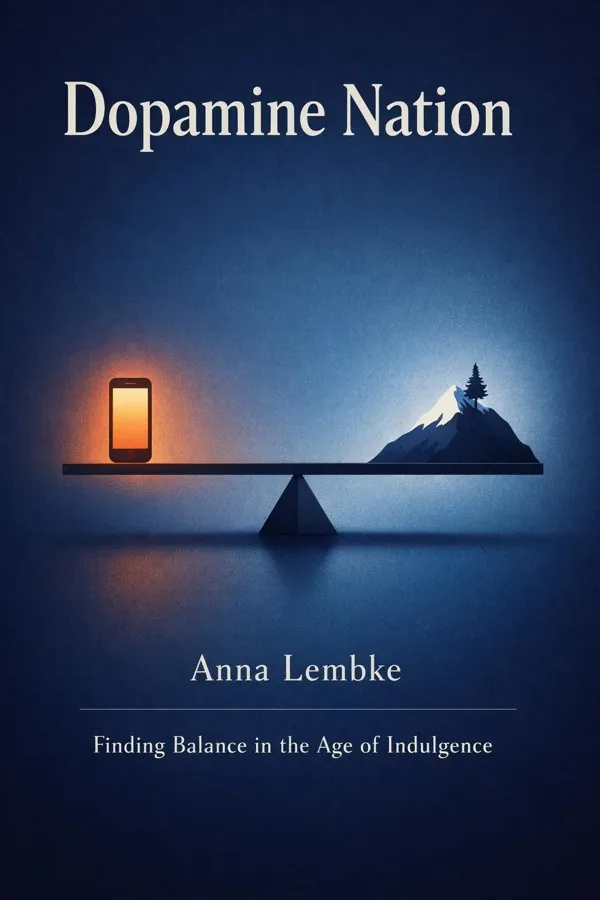
Dopamine Nation: Summary & Key Insights
by Anna Lembke
 10 min8 chaptersAudio available
Key Takeaways from Dopamine Nation
One of the book’s most memorable ideas is that pleasure and pain are processed in the brain like opposite sides of a balance.
Lembke shows that addiction is not just a failure of willpower; it is a learned pattern embedded in the brain’s reward circuitry.
A major strength of *Dopamine Nation* is that it does not stay at the level of abstract neuroscience.
In a culture that celebrates moderation slogans but profits from excess, abstinence can sound old-fashioned or extreme.
One of the book’s most counterintuitive insights is that certain forms of pain can be healing.
What Is Dopamine Nation About?
Dopamine Nation by Anna Lembke is a psychology book published in 2021 spanning 8 pages. Why do so many people feel overstimulated, exhausted, and strangely empty in a world designed to entertain us? That question sits at the heart of *Dopamine Nation*, a timely and deeply practical book by psychiatrist Anna Lembke. In an age of endless scrolling, on-demand streaming, online shopping, ultra-processed food, and increasingly potent drugs, pleasure is no longer scarce. It is constant, convenient, and aggressively optimized to capture our attention. Yet instead of making us happier, this abundance often leaves us more anxious, numb, and compulsive. Lembke explains why through the lens of dopamine, the brain chemical that shapes motivation, reward, and craving. Drawing on her work as a professor of psychiatry at Stanford University School of Medicine and chief of the Stanford Addiction Medicine Dual Diagnosis Clinic, she shows how the same brain systems that help us survive can be pushed into imbalance by modern life. The result is a book that is both scientifically illuminating and personally useful. If you have ever wondered why “more” so often feels like less, *Dopamine Nation* offers a clear, compassionate answer—and a path back to balance.
This FizzRead summary covers all 8 key chapters of Dopamine Nation in approximately 10 minutes, distilling the most important ideas, arguments, and takeaways from Anna Lembke's work. Also available as an audio summary and Key Quotes Podcast.
Dopamine Nation: Finding Balance in the Age of Indulgence
Why do so many people feel overstimulated, exhausted, and strangely empty in a world designed to entertain us? That question sits at the heart of *Dopamine Nation*, a timely and deeply practical book by psychiatrist Anna Lembke. In an age of endless scrolling, on-demand streaming, online shopping, ultra-processed food, and increasingly potent drugs, pleasure is no longer scarce. It is constant, convenient, and aggressively optimized to capture our attention. Yet instead of making us happier, this abundance often leaves us more anxious, numb, and compulsive. Lembke explains why through the lens of dopamine, the brain chemical that shapes motivation, reward, and craving. Drawing on her work as a professor of psychiatry at Stanford University School of Medicine and chief of the Stanford Addiction Medicine Dual Diagnosis Clinic, she shows how the same brain systems that help us survive can be pushed into imbalance by modern life. The result is a book that is both scientifically illuminating and personally useful. If you have ever wondered why “more” so often feels like less, *Dopamine Nation* offers a clear, compassionate answer—and a path back to balance.
Who Should Read Dopamine Nation?
This book is perfect for anyone interested in psychology and looking to gain actionable insights in a short read. Whether you're a student, professional, or lifelong learner, the key ideas from Dopamine Nation by Anna Lembke will help you think differently.
- ✓Readers who enjoy psychology and want practical takeaways
- ✓Professionals looking to apply new ideas to their work and life
- ✓Anyone who wants the core insights of Dopamine Nation in just 10 minutes
Want the full summary?
Get instant access to this book summary and 100K+ more with Fizz Moment.
Get Free SummaryAvailable on App Store • Free to download
Key Chapters
One of the book’s most memorable ideas is that pleasure and pain are processed in the brain like opposite sides of a balance. When something feels good—checking your phone, eating dessert, gambling, taking a drug, receiving praise—dopamine rises and the balance tips toward pleasure. But the brain does not like being out of equilibrium for long. It responds by activating counterforces, tipping the balance back toward pain. That is why a burst of pleasure is often followed by irritability, dissatisfaction, or a craving for more. As Lembke explains, “the more pleasure we feel, the more our brain compensates with pain.”
This matters because repeated overstimulation changes the baseline. A person who binges social media every idle moment may start to find silence unbearable. Someone who constantly snacks on highly rewarding food may lose interest in ordinary meals. What once felt exciting becomes merely normal, and normal starts to feel dull. That shift helps explain why people can be surrounded by comforts and still feel restless. A practical takeaway is to notice your own “mini reward loops.” What do you reach for automatically when you feel bored, lonely, or stressed? By reducing constant high-dopamine inputs and allowing periods of boredom, you give your brain a chance to reset and rediscover simpler pleasures.
Lembke shows that addiction is not just a failure of willpower; it is a learned pattern embedded in the brain’s reward circuitry. Dopamine plays a central role because it helps the brain register reward prediction error—the gap between what we expect and what we receive. When a reward exceeds expectations, dopamine spikes and says, in effect, “Remember this. Do it again.” Over time, the brain begins to release dopamine not only during the rewarding experience itself but also in response to cues: a liquor store sign, a betting app icon, the vibration of a phone, the time of day you usually use.
That anticipatory dopamine is what craving feels like. It can make a person feel compelled long before the behavior starts. With repeated use, however, the brain adapts. Dopamine receptors become less responsive, so people need more of the same stimulus to get the same effect. This is tolerance: more use, less pleasure. Eventually, the person may not be chasing a high at all, but trying to escape the low that follows not using. This framework is powerful because it applies beyond drugs—to gaming, porn, shopping, and even productivity compulsions. The actionable lesson is to interrupt cue-behavior patterns. Remove easy triggers, create friction, delay the behavior by ten minutes, and name the craving when it appears. Awareness weakens automaticity, and repeated interruption helps the brain build new pathways.
A major strength of *Dopamine Nation* is that it does not stay at the level of abstract neuroscience. Lembke uses clinical stories to show how addiction can take many forms and affect people who seem outwardly successful, disciplined, or ordinary. These case studies help readers see that addiction is rarely just about the substance or behavior itself. It is often tied to loneliness, trauma, shame, emotional avoidance, or a desperate attempt to regulate inner pain. A person may drink to quiet social anxiety, overwork to escape feelings of inadequacy, or compulsively consume pornography to avoid vulnerability in real relationships.
What makes these stories effective is their honesty. They reveal how rationalization works: “I deserve this,” “It’s not that bad,” “Everyone does it,” or “I can stop whenever I want.” They also show how addiction narrows life. As the habit takes over, time, attention, and identity become organized around obtaining relief. The lesson for readers is to look beyond the surface behavior and ask better questions. What problem is this habit solving for me? What feeling am I trying not to feel? What costs am I ignoring? Keeping a simple log of triggers, emotions, and consequences can be eye-opening. Lembke’s clinical lens encourages compassion without denial: understand the pain underneath the compulsion, but be honest about the damage the behavior is causing.
In a culture that celebrates moderation slogans but profits from excess, abstinence can sound old-fashioned or extreme. Lembke argues that in many cases it is simply practical. If the brain’s reward system has been overloaded, the fastest way to begin restoring sensitivity is to stop feeding the cycle for a meaningful period of time. This pause allows the pleasure-pain balance to recalibrate. Instead of constantly spiking dopamine and crashing into discomfort, the brain gradually moves closer to baseline.
Abstinence is not presented as punishment. It is an experiment in freedom. What happens when you stop the behavior for long enough to experience the craving, the restlessness, and the emotional static underneath it? You learn what the habit has been masking. For some people, a clear time-bound reset—such as thirty days without alcohol, gaming, or social media—reveals how dependent they had become on stimulation just to feel okay. Lembke’s approach suggests making the rules explicit rather than vague. Decide what counts, for how long, and how you will handle predictable weak moments. Remove apps, avoid high-risk environments, tell someone supportive, and expect discomfort rather than treating it as failure. The key insight is that the pain of abstinence is often the doorway to recovery, not evidence that recovery is impossible.
One of the book’s most counterintuitive insights is that certain forms of pain can be healing. Modern life encourages us to eliminate discomfort whenever possible, but Lembke argues that this instinct can backfire. If we constantly medicate boredom, sadness, loneliness, stress, or uncertainty with quick hits of pleasure, we make ourselves more fragile. We lose the ability to tolerate ordinary emotional pain, and our threshold for distress drops. Ironically, avoiding pain too aggressively creates more suffering.
The paradox is that chosen, manageable discomfort can help restore resilience and even increase well-being. This does not mean glorifying suffering or ignoring serious mental health needs. It means recognizing that effort, restraint, and even temporary deprivation can strengthen the mind’s capacity to handle life. Think of examples like vigorous exercise, cold-water immersion, difficult conversations, or sitting with a craving instead of instantly acting on it. These experiences are uncomfortable in the short term but can produce clarity, pride, calm, and renewed sensitivity to everyday pleasure afterward. Lembke’s broader point is that pleasure and pain are intertwined, not separate. The actionable takeaway is to intentionally reintroduce small, healthy challenges into daily life. Walk without headphones. Delay a craving. Finish a hard workout. Let boredom exist. In doing so, you train your brain not to panic at discomfort and you reclaim a deeper, steadier kind of reward.
Although dopamine and addiction are central themes, Lembke also emphasizes that lasting recovery is deeply relational. Addiction thrives in secrecy, isolation, and shame. The more a person hides a behavior, lies about it, or uses it to avoid real intimacy, the more powerful the cycle can become. Genuine human connection interrupts that cycle by making honesty possible. Being known by another person reduces shame, and reduced shame makes change more sustainable.
Connection matters in practical ways too. A trusted friend, therapist, support group, or recovery community can provide accountability during cravings and perspective during relapse-risk moments. Just as important, healthy relationships offer rewards that are slower, richer, and less destabilizing than artificial dopamine spikes. Shared meals, conversation, service, laughter, affection, and belonging do not usually produce the same intense highs as addictive stimuli, but they nourish rather than deplete. That distinction is crucial. Lembke suggests that healing often involves replacing compulsive consumption with truthful connection—to others, to one’s own values, and to meaningful routines. A useful practice is “radical honesty”: choosing one safe person and telling the truth about the habit, including when, why, and how it happens. That step can feel terrifying, but it often marks the beginning of real change because it breaks the private world in which addiction survives.
The book ultimately aims to help readers build a sustainable relationship with pleasure rather than simply fear it. Balance comes from awareness, boundaries, and deliberate recovery practices. Lembke encourages readers to start by identifying their most problematic dopamine sources. Not every pleasure is equally risky for every person, so the first step is honest inventory. What behavior leaves you feeling depleted, secretive, distracted, or unable to stop? Once identified, create specific rules around it instead of relying on vague intentions. “Only on weekends,” “never alone,” “not in the bedroom,” or “thirty-day reset” are clearer than “I’ll try to cut back.”
She also points toward daily habits that stabilize the nervous system: sleep, exercise, time outdoors, purposeful work, and connection with others. These are less dramatic than instant rewards, but they help repair the brain’s ability to find satisfaction in ordinary life. Mindfulness can also help by increasing the gap between urge and action. When a craving appears, notice where it shows up in the body, label it, and let it rise and pass without immediately obeying it. Another useful strategy is adding friction—deleting apps, using website blockers, carrying less cash, or avoiding high-risk situations. The larger message is hopeful: balance is not about becoming joyless. It is about training your brain so that joy becomes available again in healthier, more durable forms.
All Chapters in Dopamine Nation
About the Author
Anna Lembke, M.D., is a professor of psychiatry at Stanford University School of Medicine and chief of the Stanford Addiction Medicine Dual Diagnosis Clinic. She is widely recognized for her research and clinical work on addiction, particularly the ways modern environments intensify compulsive behavior and reshape the brain’s reward system. Her writing brings together neuroscience, patient stories, and practical guidance in a clear, accessible way for general readers. Beyond her academic and clinical roles, she has also appeared in documentaries such as *The Social Dilemma*, helping bring conversations about addiction, technology, and mental health to a broader public audience.
Get This Summary in Your Preferred Format
Read or listen to the Dopamine Nation summary by Anna Lembke anytime, anywhere. FizzRead offers multiple formats so you can learn on your terms — all free.
Available formats: App · Audio · PDF · EPUB — All included free with FizzRead
Download Dopamine Nation PDF and EPUB Summary
Key Quotes from Dopamine Nation
“One of the book’s most memorable ideas is that pleasure and pain are processed in the brain like opposite sides of a balance.”
“Lembke shows that addiction is not just a failure of willpower; it is a learned pattern embedded in the brain’s reward circuitry.”
“A major strength of *Dopamine Nation* is that it does not stay at the level of abstract neuroscience.”
“In a culture that celebrates moderation slogans but profits from excess, abstinence can sound old-fashioned or extreme.”
“One of the book’s most counterintuitive insights is that certain forms of pain can be healing.”
Frequently Asked Questions about Dopamine Nation
Dopamine Nation by Anna Lembke is a psychology book that explores key ideas across 8 chapters. Why do so many people feel overstimulated, exhausted, and strangely empty in a world designed to entertain us? That question sits at the heart of *Dopamine Nation*, a timely and deeply practical book by psychiatrist Anna Lembke. In an age of endless scrolling, on-demand streaming, online shopping, ultra-processed food, and increasingly potent drugs, pleasure is no longer scarce. It is constant, convenient, and aggressively optimized to capture our attention. Yet instead of making us happier, this abundance often leaves us more anxious, numb, and compulsive. Lembke explains why through the lens of dopamine, the brain chemical that shapes motivation, reward, and craving. Drawing on her work as a professor of psychiatry at Stanford University School of Medicine and chief of the Stanford Addiction Medicine Dual Diagnosis Clinic, she shows how the same brain systems that help us survive can be pushed into imbalance by modern life. The result is a book that is both scientifically illuminating and personally useful. If you have ever wondered why “more” so often feels like less, *Dopamine Nation* offers a clear, compassionate answer—and a path back to balance.
Compare Dopamine Nation
More by Anna Lembke
You Might Also Like
The Body Keeps the Score
Bessel van der Kolk
10 min
Surrounded by Idiots
Thomas Erikson
10 min
Emotional Intelligence
Daniel Goleman
10 min
Attached
Amir Levine
10 min
Why Does He Do That
Lundy Bancroft
10 min
Women Who Run with the Wolves
Clarissa Pinkola Estés
10 minFeatured In
Browse by Category
Ready to read Dopamine Nation?
Get the full summary and 100K+ more books with Fizz Moment.