
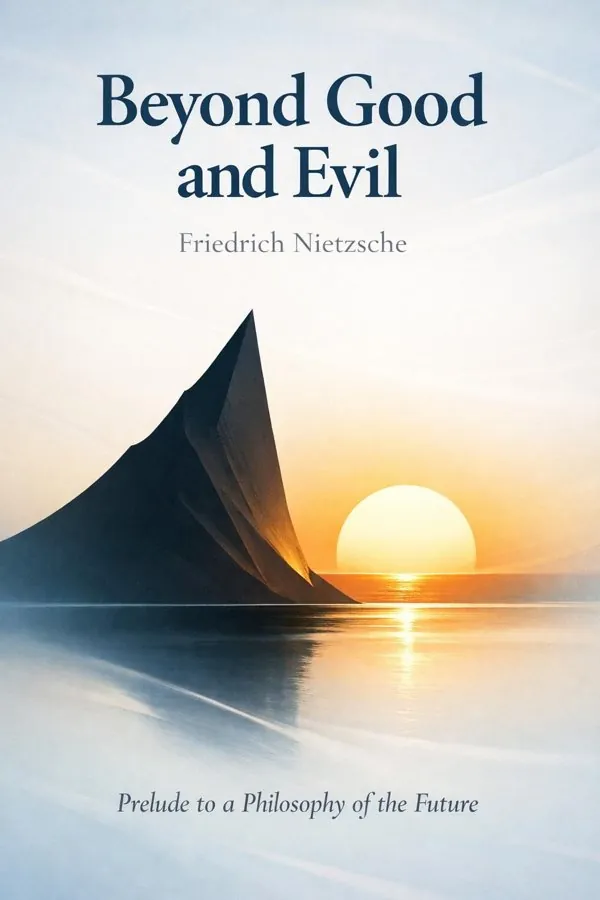
Beyond Good and Evil: Summary & Key Insights
 10 min9 chaptersAudio available
Key Takeaways from Beyond Good and Evil
Every philosophy begins with a confession, even when it pretends to be pure reason.
Freedom begins when a person can live without the shelter of comforting illusions.
Religious belief is never just a doctrine; it is also a training of the human soul.
Some truths cannot be delivered as a system; they must strike like lightning.
What if morality is not eternal law but a historical product?
What Is Beyond Good and Evil About?
Beyond Good and Evil by Friedrich Nietzsche is a philosophy book published in 2003 spanning 9 pages. Beyond Good and Evil is Friedrich Nietzsche’s bold attack on the moral certainties, philosophical habits, and spiritual comforts that have shaped Western thought for centuries. First published in 1886, the book asks a disturbing question: what if our highest ideals—truth, humility, equality, selflessness, even morality itself—are not eternal facts but human inventions shaped by fear, instinct, and the struggle for power? Rather than offering a tidy system, Nietzsche tests inherited beliefs and exposes the motives hidden beneath them. He challenges philosophers for pretending to be objective while smuggling in their own values, and he calls for a new kind of thinker strong enough to create values instead of merely obeying them. The book matters because it pushes readers to examine not only what they believe, but why they believe it. Nietzsche wrote as a trained classical scholar, brilliant stylist, and fearless critic of culture. His influence extends across philosophy, psychology, literature, politics, and modern self-understanding. Beyond Good and Evil remains one of his sharpest and most provocative works.
This FizzRead summary covers all 9 key chapters of Beyond Good and Evil in approximately 10 minutes, distilling the most important ideas, arguments, and takeaways from Friedrich Nietzsche's work. Also available as an audio summary and Key Quotes Podcast.
Beyond Good and Evil
Beyond Good and Evil is Friedrich Nietzsche’s bold attack on the moral certainties, philosophical habits, and spiritual comforts that have shaped Western thought for centuries. First published in 1886, the book asks a disturbing question: what if our highest ideals—truth, humility, equality, selflessness, even morality itself—are not eternal facts but human inventions shaped by fear, instinct, and the struggle for power? Rather than offering a tidy system, Nietzsche tests inherited beliefs and exposes the motives hidden beneath them. He challenges philosophers for pretending to be objective while smuggling in their own values, and he calls for a new kind of thinker strong enough to create values instead of merely obeying them. The book matters because it pushes readers to examine not only what they believe, but why they believe it. Nietzsche wrote as a trained classical scholar, brilliant stylist, and fearless critic of culture. His influence extends across philosophy, psychology, literature, politics, and modern self-understanding. Beyond Good and Evil remains one of his sharpest and most provocative works.
Who Should Read Beyond Good and Evil?
This book is perfect for anyone interested in philosophy and looking to gain actionable insights in a short read. Whether you're a student, professional, or lifelong learner, the key ideas from Beyond Good and Evil by Friedrich Nietzsche will help you think differently.
- ✓Readers who enjoy philosophy and want practical takeaways
- ✓Professionals looking to apply new ideas to their work and life
- ✓Anyone who wants the core insights of Beyond Good and Evil in just 10 minutes
Want the full summary?
Get instant access to this book summary and 100K+ more with Fizz Moment.
Get Free SummaryAvailable on App Store • Free to download
Key Chapters
Freedom begins when a person can live without the shelter of comforting illusions. Nietzsche’s “free spirit” is not simply an independent thinker or a rebel for its own sake. It is someone who has developed the strength to question inherited truths without collapsing into despair. Most people depend on fixed beliefs to preserve psychological stability. The free spirit, by contrast, is willing to risk uncertainty in order to think more honestly.
Nietzsche does not portray this freedom as easy or pleasant. It requires discipline, resilience, and a willingness to stand apart from the crowd. The free spirit does not cling to moral slogans, party identities, or fashionable opinions. Instead, this person experiments with ideas, tests values, and remains suspicious of any system that promises final answers. Such freedom is demanding because certainty is emotionally comforting, while honest inquiry can be isolating.
This idea has powerful modern relevance. In an age of online tribes, ideological branding, and instant judgment, the pressure to conform is intense. Nietzsche would say that many people mistake group approval for truth. A free spirit resists this temptation. For example, in work life, it may mean refusing to repeat accepted corporate language when it hides real problems. In personal life, it may mean rethinking goals that were inherited from family or society rather than genuinely chosen.
Actionable takeaway: Practice intellectual independence by choosing one deeply held assumption each week and examining it without defensiveness. Ask whether you believe it because it is true, or because it is safe.
Religious belief is never just a doctrine; it is also a training of the human soul. In his reflections on religion, Nietzsche does not merely reject faith in a simple, dismissive way. He treats religion as a powerful historical force that shapes character, obedience, guilt, hope, and social order. Christianity in particular, for Nietzsche, expresses a morality that elevates humility, pity, and self-denial—but these values also reveal psychological tendencies. They can arise from weakness, resentment, or the desire to make suffering meaningful.
Yet Nietzsche’s treatment is more layered than a simple attack. He recognizes that religion has often disciplined human beings, refined feeling, and created structures through which people endured hardship. The problem, in his view, is that religious morality often turns life against itself. It teaches suspicion of strength, pride, sensuality, and worldly excellence. It glorifies meekness in a way that can restrain human flourishing.
Applied today, Nietzsche’s argument encourages readers to examine moral language that appears noble on the surface. When people praise sacrifice, innocence, or compassion, what else may be happening? Are these values empowering growth, or are they protecting dependency and fear? This question applies not only to religion, but also to secular moral cultures that adopt similar emotional patterns.
Actionable takeaway: Reflect on one moral ideal you admire—such as humility, service, or compassion—and ask whether, in practice, it strengthens vitality and honesty or quietly rewards passivity and self-erasure.
Some truths cannot be delivered as a system; they must strike like lightning. In the section of aphorisms and interludes, Nietzsche uses short, cutting observations to disrupt habitual thinking. These compact statements are not decorative interruptions. They are exercises in mental agility. By refusing long, orderly argument, Nietzsche forces readers to become active interpreters rather than passive recipients.
Aphorisms work by compression. A few words can expose vanity, hypocrisy, self-deception, or social convention more effectively than a polished essay. Nietzsche understood that human beings often hide behind elaborate explanations. A sharp sentence can puncture that defense. His style mirrors his philosophy: truth is often uncomfortable, indirect, and destabilizing.
This method is useful beyond literature. In daily life, we often understand ourselves through narratives that are too neat. Short, honest observations can reveal more. For example: “I say I am busy, but I may be avoiding what matters.” Or: “I call it principle, but perhaps it is pride.” Nietzsche’s aphoristic style teaches us to condense, sharpen, and test our judgments. It also reminds us that intelligence includes style, timing, and courage—not just information.
For readers and thinkers, this section offers a practical model: insight does not always arrive in complete theories. Sometimes growth begins with one sentence that cannot be ignored. Aphorisms invite rereading because they unfold over time.
Actionable takeaway: Start a notebook of brief, honest observations about your motives, habits, and values. Revisit them weekly and ask which ones still disturb you, because those may contain your deepest truths.
What if morality is not eternal law but a historical product? Nietzsche’s “natural history of morals” is one of the book’s most important contributions. He argues that moral systems do not descend from heaven or arise from pure reason. They develop through social conditions, power relations, customs, fears, and psychological needs. Morality, then, must be studied like a living phenomenon—with origins, functions, and consequences.
This approach changes the entire conversation. Instead of asking only whether a moral rule is right, Nietzsche asks: who benefits from it, what instincts does it express, and what kind of human being does it cultivate? For instance, rules praising obedience may stabilize communities, but they may also suppress initiative. Ideals of equality may protect the vulnerable, but they may also reflect hostility toward excellence. Nietzsche is not giving easy answers; he is asking readers to investigate the genealogy of values.
In modern life, this perspective can be applied to workplace culture, education, politics, and personal ethics. Consider a norm like “always be agreeable.” It may appear virtuous, but it can also discourage truth-telling and reward conformity. Or think of social media outrage framed as moral concern; Nietzsche would ask what emotional satisfactions are hidden inside the performance.
His broader point is radical: before obeying a value, learn its history. Values are made, not simply found.
Actionable takeaway: Choose one rule you live by—such as being selfless, productive, or agreeable—and trace its origin. Ask where it came from, whose interests it serves, and whether it still deserves your loyalty.
Knowledge alone does not create wisdom, and expertise alone does not create philosophers. Nietzsche draws a sharp distinction between scholars and genuine thinkers. Scholars collect facts, classify material, and preserve learning. Their role is valuable, but it is limited. They are often specialists trained to analyze details, not creators strong enough to rank values or shape a new vision of life. For Nietzsche, philosophy requires more than information; it requires command, interpretation, and the courage to legislate meaning.
This criticism remains strikingly relevant. Modern culture often treats credentials as proof of insight. Nietzsche warns that technical mastery can coexist with spiritual timidity. A person may know everything about a field and still lack the independence to question its assumptions. Scholars can become servants of method, trapped in caution, unable to ask larger questions about why their knowledge matters.
In practical settings, this distinction appears everywhere. A business analyst may measure trends but not understand what kind of organization should exist. A policy expert may optimize systems without examining the values built into them. A student may master theories while never asking what sort of life is worth living. Nietzsche is not anti-intellectual; he is anti-smallness. He wants thinkers who can synthesize knowledge and place it in service of life.
Actionable takeaway: Whatever your field, move beyond technical competence by regularly asking bigger questions: what values shape this work, what kind of people does it produce, and what future does it encourage?
The qualities we praise in ourselves are often the very chains that bind us. In discussing “our virtues,” Nietzsche challenges the flattering belief that modern moral virtues are simply signs of progress. Honesty, sympathy, modesty, fairness, and diligence may indeed be admirable—but they can also become subtle forms of weakness when they are followed mechanically or worshiped as absolutes.
Nietzsche’s point is not that virtue is worthless. Rather, he wants us to see that every virtue has a shadow. Honesty can become cruelty or self-display. Sympathy can undermine strength by making suffering untouchable. Fairness can mask envy of greatness. Modesty can become fear of standing out. A culture that praises certain traits may do so not because they are universally noble, but because they make people easier to manage and less likely to challenge the prevailing order.
This is especially relevant in environments that reward moral signaling. A person may appear virtuous while avoiding risk, conflict, ambition, or responsibility. Nietzsche asks whether our virtues help us grow or merely help us fit in. The test of a virtue is not how good it sounds, but what kind of life it creates.
In daily life, this means looking honestly at your best qualities. If you are proud of being dependable, do you also avoid necessary confrontation? If you pride yourself on empathy, do you excuse destructive behavior? Virtues require strength and discrimination, not automatic obedience.
Actionable takeaway: Identify your strongest virtue and name its possible shadow side. Then decide how to practice that virtue in a way that increases strength rather than comfort.
Collective identities often make people smaller while convincing them they are larger. In his reflections on peoples and fatherlands, Nietzsche critiques nationalism, cultural vanity, and the tendency of nations to overestimate themselves. He distrusts identities built on mass feeling, inherited pride, and hostility toward outsiders. For him, the highest culture does not emerge from loud patriotism but from spiritual openness, internal discipline, and the crossing of boundaries.
Nietzsche wrote in a Europe shaped by national rivalries, but his warning applies directly to the present. People still use nation, class, ethnicity, ideology, and culture as ready-made answers to the question of who they are. These identities can provide belonging, but they can also discourage self-overcoming. Once individuals define themselves primarily through collective labels, they may stop the harder work of becoming distinct persons.
Nietzsche especially values the “good European,” the thinker shaped by multiple traditions rather than imprisoned by one. This image suggests a broader human type: someone who learns across borders, resists tribal simplifications, and refuses to reduce value to group loyalty. In a globalized world, this means cultivating depth without becoming provincial.
Practically, this might involve reading outside your tradition, working with people unlike yourself, or questioning inherited assumptions about “our people” and “their people.” Nietzsche’s goal is not rootlessness, but higher culture.
Actionable takeaway: Examine one identity label you strongly rely on and ask whether it deepens your perspective or limits it. Then deliberately expose yourself to one serious viewpoint from outside that identity.
The highest human type is not defined by birth, wealth, or status, but by the power to give form to oneself. In the book’s final movement, Nietzsche asks what it means to be noble. His answer has little to do with conventional social rank. Nobility is a spiritual quality marked by self-command, distance from herd opinion, the ability to endure solitude, and the strength to create values rather than merely inherit them.
The noble person does not depend on external approval to know what is worthwhile. Such a person can make promises to the future, bear responsibility, and transform suffering into growth. Nobility includes generosity, but not the softness of indiscriminate pity. It includes discipline, but not slavish obedience. Above all, it reflects an ascending form of life—one that seeks excellence, form, and self-overcoming.
This ideal can sound elitist, but Nietzsche’s deeper challenge is existential: will you live reactively, shaped by resentment and conformity, or actively, shaping yourself with intention? Modern readers can translate nobility into the practice of personal authorship. Instead of asking what everyone else approves, ask what standards you are willing to uphold when no one is watching. Instead of treating discomfort as failure, treat it as material for development.
Nobility, in this sense, is not inherited privilege but earned character. It requires independence, refinement, and the courage to live according to a difficult standard.
Actionable takeaway: Define three personal standards that do not depend on applause—standards for thought, conduct, and creation—and practice living by them consistently for a month.
All Chapters in Beyond Good and Evil
About the Author
Friedrich Nietzsche (1844–1900) was a German philosopher, classical philologist, and one of the most influential critics of modern morality and culture. Appointed professor of philology at Basel at a young age, he later left academic life due to illness and wrote the works that made his reputation. His books, including Thus Spoke Zarathustra, Beyond Good and Evil, The Gay Science, and On the Genealogy of Morality, challenged Christianity, traditional philosophy, and democratic moral ideals while introducing enduring concepts such as the will to power, self-overcoming, and the revaluation of values. Nietzsche’s style is distinctive—aphoristic, poetic, confrontational, and psychologically penetrating. Though controversial and often misunderstood, his work deeply shaped existentialism, psychoanalysis, literary modernism, and contemporary critical thought.
Get This Summary in Your Preferred Format
Read or listen to the Beyond Good and Evil summary by Friedrich Nietzsche anytime, anywhere. FizzRead offers multiple formats so you can learn on your terms — all free.
Available formats: App · Audio · PDF · EPUB — All included free with FizzRead
Download Beyond Good and Evil PDF and EPUB Summary
Key Quotes from Beyond Good and Evil
“Every philosophy begins with a confession, even when it pretends to be pure reason.”
“Freedom begins when a person can live without the shelter of comforting illusions.”
“Religious belief is never just a doctrine; it is also a training of the human soul.”
“Some truths cannot be delivered as a system; they must strike like lightning.”
“What if morality is not eternal law but a historical product?”
Frequently Asked Questions about Beyond Good and Evil
Beyond Good and Evil by Friedrich Nietzsche is a philosophy book that explores key ideas across 9 chapters. Beyond Good and Evil is Friedrich Nietzsche’s bold attack on the moral certainties, philosophical habits, and spiritual comforts that have shaped Western thought for centuries. First published in 1886, the book asks a disturbing question: what if our highest ideals—truth, humility, equality, selflessness, even morality itself—are not eternal facts but human inventions shaped by fear, instinct, and the struggle for power? Rather than offering a tidy system, Nietzsche tests inherited beliefs and exposes the motives hidden beneath them. He challenges philosophers for pretending to be objective while smuggling in their own values, and he calls for a new kind of thinker strong enough to create values instead of merely obeying them. The book matters because it pushes readers to examine not only what they believe, but why they believe it. Nietzsche wrote as a trained classical scholar, brilliant stylist, and fearless critic of culture. His influence extends across philosophy, psychology, literature, politics, and modern self-understanding. Beyond Good and Evil remains one of his sharpest and most provocative works.
Compare Beyond Good and Evil


More by Friedrich Nietzsche

You Might Also Like
Featured In
Browse by Category
Ready to read Beyond Good and Evil?
Get the full summary and 100K+ more books with Fizz Moment.