
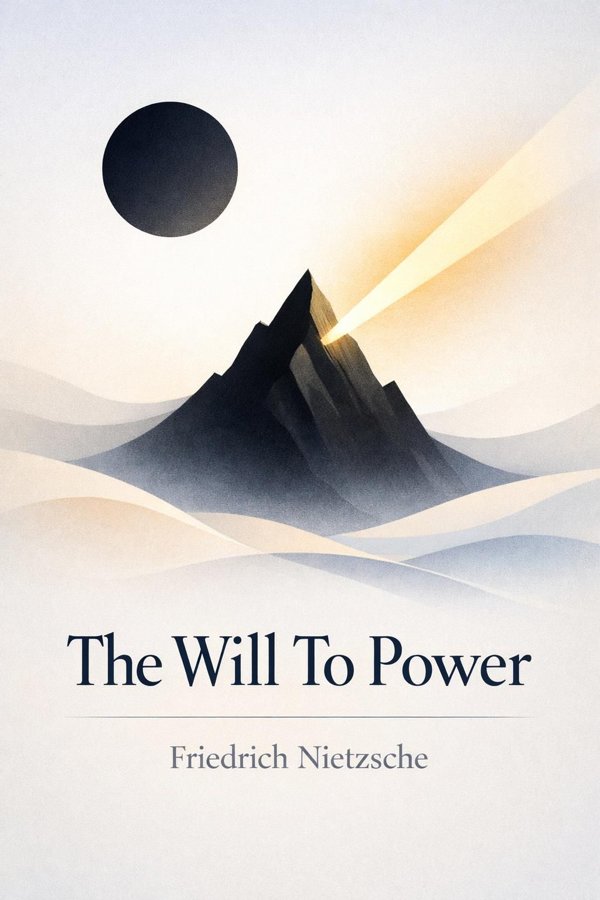
The Will To Power: Summary & Key Insights
 10 min5 chaptersAudio available
What Is The Will To Power About?
The Will To Power by Friedrich Nietzsche is a western_phil book spanning 5 pages. The Will to Power is a posthumous collection of Friedrich Nietzsche’s notebooks, compiled and edited by his sister Elisabeth Förster-Nietzsche and Peter Gast. It explores Nietzsche’s reflections on nihilism, art, morality, religion, and the theory of knowledge, presenting his concept of the 'will to power' as a fundamental driving force in human life and culture. The work remains one of the most influential and debated texts in modern philosophy.
This FizzRead summary covers all 5 key chapters of The Will To Power in approximately 10 minutes, distilling the most important ideas, arguments, and takeaways from Friedrich Nietzsche's work. Also available as an audio summary and Key Quotes Podcast.
The Will To Power
The Will to Power is a posthumous collection of Friedrich Nietzsche’s notebooks, compiled and edited by his sister Elisabeth Förster-Nietzsche and Peter Gast. It explores Nietzsche’s reflections on nihilism, art, morality, religion, and the theory of knowledge, presenting his concept of the 'will to power' as a fundamental driving force in human life and culture. The work remains one of the most influential and debated texts in modern philosophy.
Who Should Read The Will To Power?
This book is perfect for anyone interested in western_phil and looking to gain actionable insights in a short read. Whether you're a student, professional, or lifelong learner, the key ideas from The Will To Power by Friedrich Nietzsche will help you think differently.
- ✓Readers who enjoy western_phil and want practical takeaways
- ✓Professionals looking to apply new ideas to their work and life
- ✓Anyone who wants the core insights of The Will To Power in just 10 minutes
Want the full summary?
Get instant access to this book summary and 100K+ more with Fizz Moment.
Get Free SummaryAvailable on App Store • Free to download
Key Chapters
In these notes, Nietzsche begins with a relentless critique of metaphysics and morality—those pillars that have governed Western thought since Plato. He sees in metaphysical systems, whether religious or rationalist, an impulse to deny life. All metaphysics, he argues, rests on an illusion: the belief in an unchanging world of truth or spirit beyond the flux of becoming. For Nietzsche, this is symptomatic of weakness—a refusal to face the chaos and play of existence.
Morality, in its traditional form, shares this sickness. It seeks absolutes—good and evil, virtue and sin—and thus freezes the dynamic process of life into rigid categories. Nietzsche attacks this because it enslaves the human spirit. He calls it a ‘slave morality,’ one born out of resentment by those who cannot affirm life’s cruelty and creativity. Under such morality, strength becomes sin and weakness becomes virtue.
As Nietzsche develops this critique, he exposes how metaphysical and moral systems serve as tools of domination—not by the strong, but by the weak. Christianity, Kantian ethics, even the democratic ideal of equality—all, he claims, are the triumph of ressentiment: the revenge of those who resent the vitality they cannot embody. He calls for a reinterpretation of values, not through logical argument but through a deeper psychological insight: that every morality is an expression of a will.
In rejecting absolutes, Nietzsche is not descending into chaos; he is clearing the path for creation. Once we see morality as man-made, as an interpretation rather than a law, we gain the power to revalue. That freedom—to make values rather than obey them—is the essence of the will to power. It demands courage, because it annihilates the comfort of universal truths. Yet it also grants a sublime independence: the right to shape one’s own meaning.
Nihilism is Nietzsche’s diagnosis of the modern soul, the collective malaise that follows the collapse of moral and religious absolutes. When he declares that ‘God is dead,’ he does not mean a literal event; rather, he names a historical condition. The old sources of meaning—Christian morality, Platonic truth, metaphysical certainty—have lost credibility. Yet our instincts still cling to them. The result is paralysis: a world without purpose but still haunted by the ghosts of its former gods.
In *The Will to Power*, Nietzsche dissects this nihilism. It is not simply despair but a transitional state—a bridge between the old and the new. Once the old values die, humanity must create again. But nihilism can take two forms: passive and active. Passive nihilism manifests as resignation, the longing for nothingness, comfort, and avoidance of suffering. Active nihilism, however, becomes a force of renewal—it destroys in order to create.
Nietzsche asks whether humanity can endure the truth of purposelessness without falling back into old illusions. His answer is yes—if we understand that power itself can become our grounding. Instead of seeking meaning in transcendent ideals, he invites us to find meaning in the act of creating, striving, and overcoming. The will to power becomes not a doctrine but a practice: the refusal to submit to decay.
Returning from nihilism requires a new type of human being—one who does not seek salvation but affirmation. Such a person transforms chaos into a canvas. Nietzsche’s challenge is sobering: only through the courage to create values anew can we escape nihilism’s suffocating embrace. He insists that every epoch of humanity must face this crisis, and that our age—modernity—is precisely that turning point. The question is no longer, ‘What is truth?’ but ‘What can we create?’
+ 3 more chapters — available in the FizzRead app
All Chapters in The Will To Power
About the Author
Friedrich Nietzsche (1844–1900) was a German philosopher, philologist, and cultural critic known for his profound influence on modern thought. His works, including Thus Spoke Zarathustra and Beyond Good and Evil, challenged traditional moral and religious values and inspired generations of thinkers in philosophy, literature, and psychology.
Get This Summary in Your Preferred Format
Read or listen to the The Will To Power summary by Friedrich Nietzsche anytime, anywhere. FizzRead offers multiple formats so you can learn on your terms — all free.
Available formats: App · Audio · PDF · EPUB — All included free with FizzRead
Download The Will To Power PDF and EPUB Summary
Key Quotes from The Will To Power
“In these notes, Nietzsche begins with a relentless critique of metaphysics and morality—those pillars that have governed Western thought since Plato.”
“Nihilism is Nietzsche’s diagnosis of the modern soul, the collective malaise that follows the collapse of moral and religious absolutes.”
Frequently Asked Questions about The Will To Power
The Will To Power by Friedrich Nietzsche is a western_phil book that explores key ideas across 5 chapters. The Will to Power is a posthumous collection of Friedrich Nietzsche’s notebooks, compiled and edited by his sister Elisabeth Förster-Nietzsche and Peter Gast. It explores Nietzsche’s reflections on nihilism, art, morality, religion, and the theory of knowledge, presenting his concept of the 'will to power' as a fundamental driving force in human life and culture. The work remains one of the most influential and debated texts in modern philosophy.
More by Friedrich Nietzsche

You Might Also Like
A Little History of Philosophy
Nigel Warburton
10 min
Areopagitica
John Milton
10 min
How To Think Like A Philosopher: Essential Principles For Clear Thinking
Peter Cave
10 min
Language, Truth and Logic
A. J. Ayer
10 min
The Age of Reason
Thomas Paine
10 min
The Essays
Michel De Montaigne
10 minBrowse by Category
Ready to read The Will To Power?
Get the full summary and 100K+ more books with Fizz Moment.