
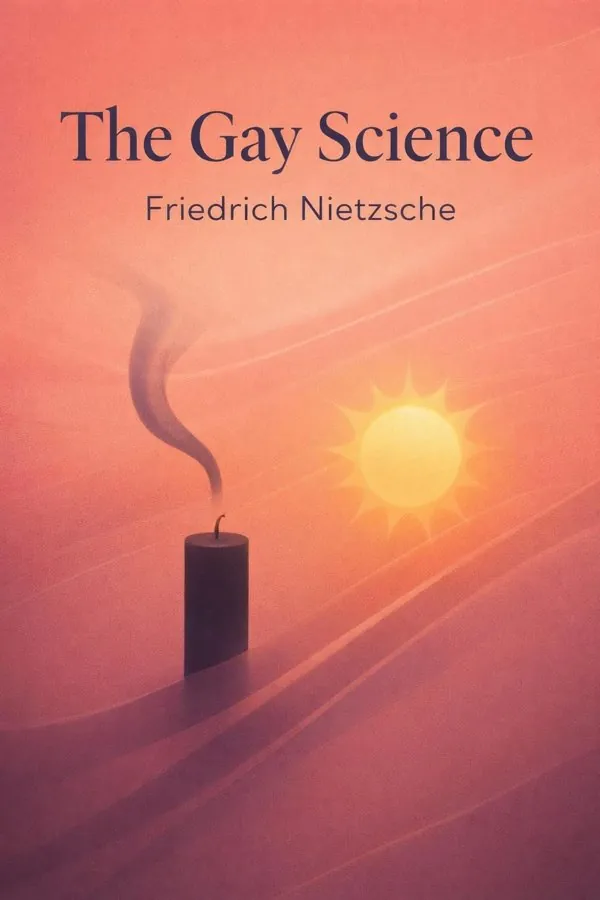
The Gay Science: Summary & Key Insights
 10 min6 chaptersAudio available
What Is The Gay Science About?
The Gay Science by Friedrich Nietzsche is a philosophy book published in 1974 spanning 6 pages. First published in 1882 and expanded in 1887, "The Gay Science" is one of Friedrich Nietzsche’s most important works. It marks the transition from his early aphoristic philosophy to the mature ideas later developed in "Thus Spoke Zarathustra." The book contains Nietzsche’s famous proclamation of the "death of God" and explores themes of art, science, morality, and the affirmation of life. Written in a poetic and often ironic style, Nietzsche challenges readers to embrace life creatively and joyfully despite its inherent tragedy.
This FizzRead summary covers all 6 key chapters of The Gay Science in approximately 10 minutes, distilling the most important ideas, arguments, and takeaways from Friedrich Nietzsche's work. Also available as an audio summary and Key Quotes Podcast.
The Gay Science
First published in 1882 and expanded in 1887, "The Gay Science" is one of Friedrich Nietzsche’s most important works. It marks the transition from his early aphoristic philosophy to the mature ideas later developed in "Thus Spoke Zarathustra." The book contains Nietzsche’s famous proclamation of the "death of God" and explores themes of art, science, morality, and the affirmation of life. Written in a poetic and often ironic style, Nietzsche challenges readers to embrace life creatively and joyfully despite its inherent tragedy.
Who Should Read The Gay Science?
This book is perfect for anyone interested in philosophy and looking to gain actionable insights in a short read. Whether you're a student, professional, or lifelong learner, the key ideas from The Gay Science by Friedrich Nietzsche will help you think differently.
- ✓Readers who enjoy philosophy and want practical takeaways
- ✓Professionals looking to apply new ideas to their work and life
- ✓Anyone who wants the core insights of The Gay Science in just 10 minutes
Want the full summary?
Get instant access to this book summary and 100K+ more with Fizz Moment.
Get Free SummaryAvailable on App Store • Free to download
Key Chapters
At the beginning of my journey, I wished to free philosophy from its somber masks. Knowledge, I argue, must not serve as a burden but as a celebration. The spirit of inquiry should resemble an act of dancing rather than dissecting — a dance that moves with the rhythm of life instead of against it. Dogmatic philosophy has too long clung to a belief in absolute truths and moral certainties, suffocating the vitality of thought. I ask: what if truth itself were a kind of illusion we have forgotten how to enjoy?
In this first movement of 'The Gay Science,' I turn my gaze toward the harmony between art and reason. The scientist and the artist, I suggest, once shared a common heritage — both sought beauty, both sought meaning. Yet the modern mind often forgets this kinship, treating knowledge as a lifeless collection of facts. I urge the reader to love knowledge as one loves a lover: passionately, with risk, and without guarantee. Knowledge should intoxicate us, not tranquilize us.
I also remind us that life itself is not a static problem to be solved but a dynamic process to be created. The one who knows how to laugh, how to mock themselves, how to endure contradiction — that person is closest to truth. The joyful wisdom I celebrate is built on an awareness that every truth is a form of poetry, that even science lives upon metaphors, images, and instincts. Thus, I call upon all free spirits to rediscover the art of joyful thinking — to become experimenters, creators, and comedians of existence.
In the second book, my reflections turn toward morality and conscience — toward the hidden origins of our values. We have, for centuries, revered moral systems as if they were divine commandments. But I urge you to look deeper: morality is the residue of human fear, the codification of instinct, the sediment left by long-forgotten impulses. It is not a gift from the heavens, but a human creation — one that must be reexamined if we wish to live truly.
I ask: what if the so-called 'moral good' has been a form of weakness disguised as virtue? The conscience, which accuses us from within, often serves as the priest’s most effective invention — a means of enslaving the noble impulses of life itself. To become moral often meant to become sick — to turn our creative energies inward in guilt rather than outward in action. Yet I do not condemn morality outright; I wish to understand it as a historical and psychological event, a product of human adaptation.
This analysis leads me to the realization that we must reclaim the right to value. If we do not create our own values, we will forever live beneath inherited ones. The true philosopher, I say, is a sculptor of conscience — one who molds their inner life according to their own strength, not according to inherited dogma. Only through this revaluation of morals can life become rich again, can conscience transform from a chain into an instrument of creation.
+ 4 more chapters — available in the FizzRead app
All Chapters in The Gay Science
About the Author
Friedrich Nietzsche (1844–1900) was a German philosopher, philologist, and writer, regarded as one of the most influential thinkers of modern times. His works, including "Thus Spoke Zarathustra," "Beyond Good and Evil," and "The Gay Science," profoundly shaped philosophy, literature, and psychology. Nietzsche critiqued traditional morality, religion, and metaphysics, developing concepts such as the Übermensch, the will to power, and eternal recurrence.
Get This Summary in Your Preferred Format
Read or listen to the The Gay Science summary by Friedrich Nietzsche anytime, anywhere. FizzRead offers multiple formats so you can learn on your terms — all free.
Available formats: App · Audio · PDF · EPUB — All included free with FizzRead
Download The Gay Science PDF and EPUB Summary
Key Quotes from The Gay Science
“At the beginning of my journey, I wished to free philosophy from its somber masks.”
“In the second book, my reflections turn toward morality and conscience — toward the hidden origins of our values.”
Frequently Asked Questions about The Gay Science
The Gay Science by Friedrich Nietzsche is a philosophy book that explores key ideas across 6 chapters. First published in 1882 and expanded in 1887, "The Gay Science" is one of Friedrich Nietzsche’s most important works. It marks the transition from his early aphoristic philosophy to the mature ideas later developed in "Thus Spoke Zarathustra." The book contains Nietzsche’s famous proclamation of the "death of God" and explores themes of art, science, morality, and the affirmation of life. Written in a poetic and often ironic style, Nietzsche challenges readers to embrace life creatively and joyfully despite its inherent tragedy.
More by Friedrich Nietzsche


You Might Also Like



Browse by Category
Ready to read The Gay Science?
Get the full summary and 100K+ more books with Fizz Moment.