
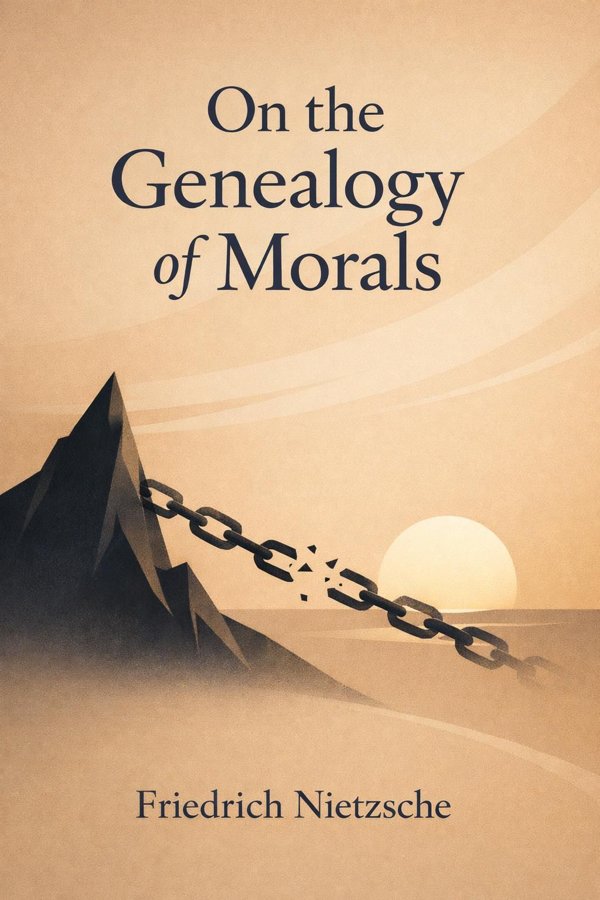
On the Genealogy of Morals: Summary & Key Insights
 10 min3 chaptersAudio available
What Is On the Genealogy of Morals About?
On the Genealogy of Morals by Friedrich Nietzsche is a western_phil book spanning 3 pages. On the Genealogy of Morals is a philosophical work by Friedrich Nietzsche, first published in 1887. It explores the origins and development of moral values, challenging traditional Christian morality. Nietzsche examines concepts such as guilt, bad conscience, and asceticism, arguing that moral systems are expressions of power relations and psychological drives.
This FizzRead summary covers all 3 key chapters of On the Genealogy of Morals in approximately 10 minutes, distilling the most important ideas, arguments, and takeaways from Friedrich Nietzsche's work. Also available as an audio summary and Key Quotes Podcast.
On the Genealogy of Morals
On the Genealogy of Morals is a philosophical work by Friedrich Nietzsche, first published in 1887. It explores the origins and development of moral values, challenging traditional Christian morality. Nietzsche examines concepts such as guilt, bad conscience, and asceticism, arguing that moral systems are expressions of power relations and psychological drives.
Who Should Read On the Genealogy of Morals?
This book is perfect for anyone interested in western_phil and looking to gain actionable insights in a short read. Whether you're a student, professional, or lifelong learner, the key ideas from On the Genealogy of Morals by Friedrich Nietzsche will help you think differently.
- ✓Readers who enjoy western_phil and want practical takeaways
- ✓Professionals looking to apply new ideas to their work and life
- ✓Anyone who wants the core insights of On the Genealogy of Morals in just 10 minutes
Want the full summary?
Get instant access to this book summary and 100K+ more with Fizz Moment.
Get Free SummaryAvailable on App Store • Free to download
Key Chapters
When I first asked myself where our notions of 'good' and 'evil' came from, I noticed how strange and self-evident people think these words are. Yet if we peer back far enough, we discover that 'good' once meant something profoundly different from what we now believe. Among the noble and powerful, 'good' referred to what was life-affirming: strength, courage, health, vitality. 'Bad' described what was common, base, and weak—not morally evil, but simply lesser.
In the aristocratic societies of antiquity, this noble morality sprang from an overflowing of life. It was an affirmation of one’s own being. The noble said 'yes' to himself and by contrast 'no' to the weak. It was not built upon hatred, nor upon pity. But history changed when the priestly class, a group of the weak yet intellectually cunning, rose in opposition to the warriors. Unable to overcome the mighty through force, they turned their resentment—what I call *ressentiment*—into moral invention.
Ressentiment gives birth to 'slave morality.' Here strength becomes evil, and weakness becomes good. The poor and suffering, unable to act outwardly, turn their impotence inward and invent a moral world where their condition is virtuous. Revenge is achieved not through action but through revaluation—through transforming the meanings of 'good' and 'evil' so that the powerful appear guilty by nature.
In this way, the priests, with their deep psychological insight, accomplish a genius reversal: the proud warrior is condemned for his instincts, while the meek are glorified for their passivity. Christianity inherits this moral inversion completely. It declares that the blessed are the poor in spirit, that suffering redeems, and that power must apologize for itself. Thus begins the long history of moral sickness—a psychology where life turns against itself.
To see this clearly is to recognize that morality is not universal; it is born of conflict. Each value we hold today is the descendant of ancient passions—the will to dominate, the will to survive, the will to justify suffering. That is why moral ideas still fight within us. In the noble morality, life expresses itself directly; in the slave morality, life defends itself through negation. In you, these two forces coexist. And only by tracing their genealogy can you know which one speaks when you say something is 'good.'
+ 1 more chapters — available in the FizzRead app
All Chapters in On the Genealogy of Morals
About the Author
Friedrich Nietzsche (1844–1900) was a German philosopher, philologist, and writer. He is regarded as one of the most influential thinkers of modern times. His works, including Thus Spoke Zarathustra and Beyond Good and Evil, shaped existentialism, post-structuralism, and modern cultural criticism.
Get This Summary in Your Preferred Format
Read or listen to the On the Genealogy of Morals summary by Friedrich Nietzsche anytime, anywhere. FizzRead offers multiple formats so you can learn on your terms — all free.
Available formats: App · Audio · PDF · EPUB — All included free with FizzRead
Download On the Genealogy of Morals PDF and EPUB Summary
Key Quotes from On the Genealogy of Morals
“When I first asked myself where our notions of 'good' and 'evil' came from, I noticed how strange and self-evident people think these words are.”
“Once moral values were inverted by the priestly class, humanity began to internalize aggression.”
Frequently Asked Questions about On the Genealogy of Morals
On the Genealogy of Morals by Friedrich Nietzsche is a western_phil book that explores key ideas across 3 chapters. On the Genealogy of Morals is a philosophical work by Friedrich Nietzsche, first published in 1887. It explores the origins and development of moral values, challenging traditional Christian morality. Nietzsche examines concepts such as guilt, bad conscience, and asceticism, arguing that moral systems are expressions of power relations and psychological drives.
More by Friedrich Nietzsche




You Might Also Like

A Little History of Philosophy
Nigel Warburton
10 min
Areopagitica
John Milton
10 min
How To Think Like A Philosopher: Essential Principles For Clear Thinking
Peter Cave
10 min
Language, Truth and Logic
A. J. Ayer
10 min
The Age of Reason
Thomas Paine
10 min
The Essays
Michel De Montaigne
10 minBrowse by Category
Ready to read On the Genealogy of Morals?
Get the full summary and 100K+ more books with Fizz Moment.