
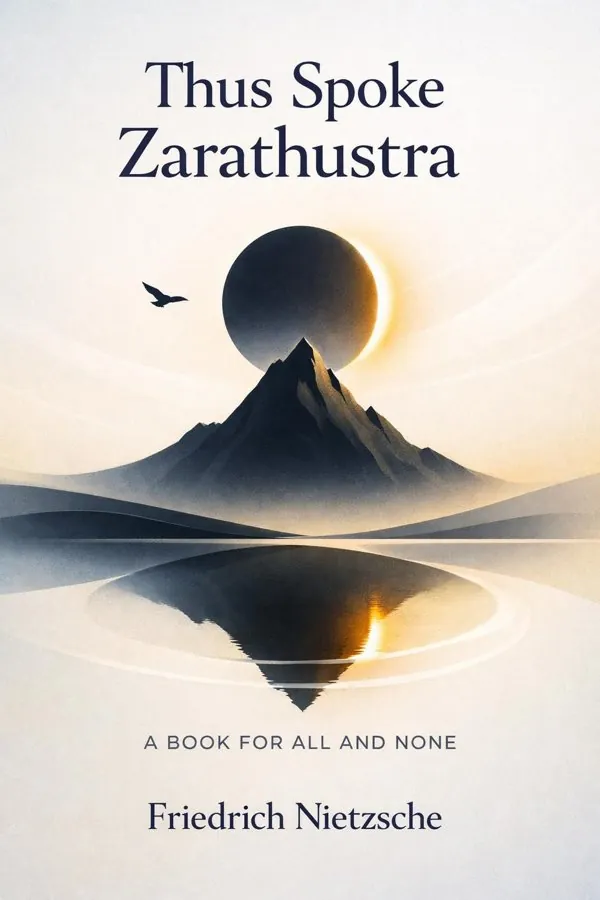
Thus Spoke Zarathustra: A Book for All and None: Summary & Key Insights
 10 min9 chaptersAudio available
Key Takeaways from Thus Spoke Zarathustra: A Book for All and None
Real insight is tested not in solitude but in the marketplace of human life.
The most dangerous assumption is that human beings, as they are now, are the final measure of value.
When old certainties collapse, the real crisis is not disbelief but emptiness.
A meaningful life is not found by preserving the self exactly as it is, but by repeatedly transforming it.
Anyone who breaks with convention must eventually face loneliness.
What Is Thus Spoke Zarathustra: A Book for All and None About?
Thus Spoke Zarathustra: A Book for All and None by Friedrich Nietzsche is a western_phil book spanning 5 pages. Thus Spoke Zarathustra is Friedrich Nietzsche’s most famous and most enigmatic work: part philosophical manifesto, part poetic scripture, part psychological drama. First published between 1883 and 1885, it follows the prophet-like figure Zarathustra as he leaves a decade of solitude in the mountains to announce a radical message to humanity. He speaks of the death of God, the need to create new values, the possibility of the Overman, and the challenge of saying yes to life even in suffering. Rather than argue like a conventional philosopher, Nietzsche writes in parables, songs, speeches, and symbolic encounters, making the book feel like a spiritual text for a post-religious age. Its importance lies in its attempt to confront the collapse of old certainties and ask what kind of human being can live courageously without them. Nietzsche was uniquely equipped to write such a work: trained as a classical philologist and renowned as one of modernity’s most original philosophers, he brought together literary brilliance, cultural criticism, and psychological insight. Thus Spoke Zarathustra remains essential reading for anyone interested in freedom, meaning, and human self-overcoming.
This FizzRead summary covers all 9 key chapters of Thus Spoke Zarathustra: A Book for All and None in approximately 10 minutes, distilling the most important ideas, arguments, and takeaways from Friedrich Nietzsche's work. Also available as an audio summary and Key Quotes Podcast.
Thus Spoke Zarathustra: A Book for All and None
Thus Spoke Zarathustra is Friedrich Nietzsche’s most famous and most enigmatic work: part philosophical manifesto, part poetic scripture, part psychological drama. First published between 1883 and 1885, it follows the prophet-like figure Zarathustra as he leaves a decade of solitude in the mountains to announce a radical message to humanity. He speaks of the death of God, the need to create new values, the possibility of the Overman, and the challenge of saying yes to life even in suffering. Rather than argue like a conventional philosopher, Nietzsche writes in parables, songs, speeches, and symbolic encounters, making the book feel like a spiritual text for a post-religious age. Its importance lies in its attempt to confront the collapse of old certainties and ask what kind of human being can live courageously without them. Nietzsche was uniquely equipped to write such a work: trained as a classical philologist and renowned as one of modernity’s most original philosophers, he brought together literary brilliance, cultural criticism, and psychological insight. Thus Spoke Zarathustra remains essential reading for anyone interested in freedom, meaning, and human self-overcoming.
Who Should Read Thus Spoke Zarathustra: A Book for All and None?
This book is perfect for anyone interested in western_phil and looking to gain actionable insights in a short read. Whether you're a student, professional, or lifelong learner, the key ideas from Thus Spoke Zarathustra: A Book for All and None by Friedrich Nietzsche will help you think differently.
- ✓Readers who enjoy western_phil and want practical takeaways
- ✓Professionals looking to apply new ideas to their work and life
- ✓Anyone who wants the core insights of Thus Spoke Zarathustra: A Book for All and None in just 10 minutes
Want the full summary?
Get instant access to this book summary and 100K+ more with Fizz Moment.
Get Free SummaryAvailable on App Store • Free to download
Key Chapters
Real insight is tested not in solitude but in the marketplace of human life. That is the force of Zarathustra’s opening gesture: after ten years alone in the mountains, he descends to share what he has learned. His solitude has not made him indifferent to humanity; instead, it has ripened him. Nietzsche uses this movement downward to suggest that wisdom is not complete until it meets resistance, misunderstanding, and reality.
Zarathustra’s retreat symbolizes the necessary distance required for deep transformation. People often live inside inherited opinions, social expectations, and habits of thought. Solitude creates the space to question them. But Nietzsche does not present withdrawal as a permanent ideal. The thinker must return. The creator must risk speaking. A life spent only in retreat becomes sterile; a life spent only in society becomes conformist.
In practical terms, this idea applies to anyone trying to live deliberately. A leader may need time away from constant noise to clarify principles. An artist may need periods of seclusion to create original work. Even in everyday life, stepping back from social media, routine obligations, or group pressure can reveal what one truly values. Yet the next step is crucial: those values must be tested in action, relationships, and decisions.
Zarathustra’s descent also shows that truth is rarely welcomed. He arrives not to applause but to confusion. Nietzsche prepares us for a hard lesson: if your vision is genuinely new, many people will resist it. Actionable takeaway: make room for reflection, but do not hide there. Withdraw long enough to discover what matters, then re-enter the world and let your convictions prove themselves in lived experience.
The most dangerous assumption is that human beings, as they are now, are the final measure of value. Zarathustra’s teaching of the Overman challenges that complacency. He declares that man is a rope stretched between animal and Overman, a bridge rather than a destination. Nietzsche is not describing a biological superhuman or a political ruler. He is naming an ideal of self-overcoming: a person who creates values, disciplines impulses, and shapes life into a work of strength and meaning.
The Overman represents growth beyond herd morality, resentment, and passive comfort. Most people seek safety, approval, and familiar rules. Nietzsche sees this as stagnation. The higher possibility of human life lies in transforming suffering into strength, instinct into style, and existence into self-directed creation. The Overman does not obey values merely because they were inherited; he tests, refines, and generates them.
This idea can be applied without grandiosity. A person pursuing the Overman’s path might stop defining success by social comparison and instead ask: What capacities in me remain undeveloped? What fears keep me average? A teacher could reject institutional complacency and invent more alive ways of educating. An individual could turn personal setbacks into occasions for growth rather than excuses for bitterness. The point is not perfection but ongoing transcendence of one’s current limits.
Nietzsche’s image is demanding because it removes excuses. You are not merely something to be preserved. You are something to be surpassed. Actionable takeaway: identify one area of life where you have settled for comfort over growth, and choose a deliberate act of self-overcoming that moves you closer to the person you could become.
When old certainties collapse, the real crisis is not disbelief but emptiness. Nietzsche’s famous proclamation that “God is dead” does not simply mean that religious belief has faded. It means that the highest values of Western culture have lost their unquestioned authority. If those values no longer persuade, what will guide human life? Zarathustra enters this vacuum with both warning and possibility.
For Nietzsche, the death of God creates a danger: nihilism. If traditional morality, cosmic purpose, and divine command no longer hold, people may conclude that nothing matters. But he also sees an opportunity. The decline of inherited absolutes makes room for value creation. Human beings must become responsible for meaning rather than merely receiving it from tradition.
This is one of the book’s most unsettling and liberating claims. Many people live by scripts they did not choose: family ideals, social conventions, institutional definitions of success. When those scripts stop feeling convincing, some respond with cynicism or distraction. Nietzsche urges a harder task: to examine which values genuinely strengthen life and which merely produce obedience, guilt, or weakness.
A practical example might be someone raised to equate worth with status or self-denial. Once that framework breaks down, they can drift aimlessly—or consciously rebuild a life around creativity, courage, excellence, and responsibility. Organizations can face the same challenge when old missions no longer inspire. They must articulate living values rather than empty slogans.
Nietzsche does not offer easy replacements. He demands maturity: the courage to live without borrowed certainty. Actionable takeaway: list the values currently guiding your life, then ask of each one: Did I choose this consciously, and does it increase vitality, honesty, and strength?
A meaningful life is not found by preserving the self exactly as it is, but by repeatedly transforming it. Self-overcoming is one of the deepest currents running through Thus Spoke Zarathustra. Nietzsche sees life itself as growth, expansion, reinterpretation, and struggle. To live well is not merely to survive or remain morally respectable; it is to become more than one has been.
Zarathustra’s speeches repeatedly challenge fixed identities. He attacks vanity, complacency, pity when it weakens, and the craving for approval. Why? Because these are forms of attachment to a smaller self. Self-overcoming requires the ability to confront one’s own habits, illusions, and hidden motives. It means not only resisting external obstacles but mastering internal ones: laziness, resentment, fear, and the wish to be comforted by the crowd.
This idea is especially relevant in a culture that often equates authenticity with simply “being yourself.” Nietzsche would ask: Which self? The current bundle of habits and reactions? Or the higher possibility struggling to emerge? True authenticity may require disciplined transformation rather than self-acceptance alone.
In practical life, self-overcoming could mean learning from criticism rather than defensively rejecting it. It could mean leaving a role that no longer expresses your highest capacities. It could mean turning anger into action, pain into art, or disappointment into clearer ambition. Athletes, entrepreneurs, scholars, and parents all know some version of this process: one must outgrow old capacities to meet new demands.
Nietzsche’s challenge is severe but invigorating. You are not called merely to maintain yourself; you are called to surpass yourself. Actionable takeaway: choose one recurring weakness or limiting pattern, and design a specific practice that transforms it into a source of discipline, strength, or creative power.
Anyone who breaks with convention must eventually face loneliness. Zarathustra’s journey is not a triumphant march from revelation to influence. Again and again he confronts misunderstanding, disappointment, temptation, and isolation. Nietzsche shows that higher development is psychologically costly. To reject inherited values is exhilarating at first, but the absence of communal approval can become a profound burden.
Zarathustra is tempted in several ways: by the desire to be admired, by discouragement over humanity’s mediocrity, by pity for weakness, and by the possibility of withdrawing permanently from the difficult task of teaching. These temptations are not random; they reveal what threatens any creator or thinker. The need for validation can dilute truth. Despair can harden into contempt. Compassion can become indulgence. Solitude can turn from strength into escape.
Nietzsche does not romanticize loneliness. He treats it as both necessary and dangerous. Solitude can purify perception, but it can also distort it if one loses the ability to re-engage with life. That is why Zarathustra repeatedly leaves and returns, wrestles with himself, and learns to bear the weight of being apart without becoming sterile or cruel.
Modern readers can recognize this pattern easily. Choosing a nontraditional career, changing beliefs, ending a destructive social pattern, or refusing collective cynicism can all produce isolation. The question is whether that isolation matures you or embitters you. Healthy solitude deepens your center; unhealthy solitude feeds self-importance and alienation.
The lesson is not to avoid loneliness but to survive it productively. Actionable takeaway: when you feel isolated because of a conviction or life change, ask whether your solitude is clarifying your purpose or merely feeding resentment, and then reconnect intentionally with people and activities that strengthen your best self.
The highest measure of a life may be whether you would choose it again, exactly as it is. Nietzsche’s idea of eternal recurrence appears in Zarathustra as one of his most demanding teachings. Imagine, he says, that every moment of your life—every joy, shame, failure, grief, and triumph—must return endlessly, in the same sequence, forever. Could you affirm that? Or would the thought crush you?
Whether taken as a cosmological doctrine or a psychological thought experiment, eternal recurrence functions as a test of life-affirmation. It asks whether you live in such a way that you can say yes not merely to selected highlights but to existence as a whole. This is difficult because most people divide life into what they accept and what they resent. Nietzsche pushes beyond that division. Greatness lies in affirming even suffering as part of the process that formed you.
Practically, eternal recurrence can sharpen decision-making. Before committing to a habit, relationship, or pattern of work, ask: Would I want to live this again and again? If the answer is no, the thought experiment reveals misalignment. It can also change how you interpret hardship. Instead of asking, “How do I erase this pain?” you might ask, “How can I transform this experience into something I could one day affirm?”
This does not mean approving injustice or pretending suffering is pleasant. It means refusing to let pain have the final word. The ideal is amor fati—love of fate—the ability to embrace one’s life fully, not selectively.
Actionable takeaway: use eternal recurrence as a filter this week. In one important choice, ask whether this is a way of living you could willingly repeat forever, and let that answer guide your action.
A civilization can decay not only through violence or chaos, but through comfort. One of Nietzsche’s most memorable warnings in Thus Spoke Zarathustra is the figure of the “last man.” This type does not strive, create, or risk. He seeks convenience, security, amusement, and the avoidance of suffering above all else. He does not dream of greatness because greatness is disruptive. He wants a painless life, not a meaningful one.
The last man is the opposite of the Overman. Where the Overman is self-transcending, the last man is self-preserving. Where the Overman creates values, the last man consumes prefabricated ones. Nietzsche presents this figure as the outcome of a culture that prizes equality of comfort over excellence, and distraction over depth. The danger is not dramatic tyranny alone, but soft mediocrity: a society in which ambition is mocked, struggle is pathologized, and higher aspirations are reduced to vanity.
This warning feels strikingly contemporary. A person can spend years optimizing convenience while neglecting growth. Endless entertainment can replace reflection. Professional safety can crowd out vocation. Institutions can reward predictability over courage. None of this looks catastrophic in the short term, yet together it produces shallowness.
Nietzsche’s point is not that comfort is evil, but that comfort becomes corrosive when it becomes the highest good. A flourishing life requires friction, risk, and demanding aims. If every discomfort is treated as a problem to be eliminated, the conditions for greatness disappear.
Actionable takeaway: identify one area where convenience has quietly become your highest value—work, learning, health, relationships—and introduce a meaningful challenge that stretches you beyond passive comfort into deliberate growth.
Not everyone who rises above the crowd rises high enough. In the later parts of the book, Zarathustra encounters various “higher men”—figures who are superior in intelligence, refinement, suffering, or spiritual ambition, yet still incomplete. Nietzsche uses these encounters to show that greatness has many false summits. One can be above the ordinary and still be trapped by guilt, weariness, dependency, vanity, or the inability to affirm life fully.
These higher men are important because they reveal Nietzsche’s standards. It is not enough to be critical, cultured, or exceptional. One must also be able to laugh, dance, create, and say yes to existence. Some of Zarathustra’s visitors are noble but burdened; others are insightful but still imprisoned by old ideals. They have escaped the herd, but not entirely themselves.
This is a subtle lesson for ambitious readers. Many forms of achievement can disguise incompleteness. A successful professional may be outwardly accomplished yet inwardly driven by resentment. An intellectual may reject conventional morality but remain emotionally dependent on the approval of opponents. A spiritual seeker may rise above materialism yet still cling to self-denial and guilt. Nietzsche insists that higher development includes psychological liberation, not just distinction.
Zarathustra’s response is not to flatter these figures but to challenge them beyond seriousness and heaviness. The truly elevated person must have lightness as well as depth. Wisdom without joy remains unfinished.
Actionable takeaway: examine one area in which you feel superior, advanced, or accomplished, and ask honestly what hidden dependency, bitterness, or rigidity still keeps your development incomplete.
The deepest achievement in Nietzsche’s vision is not criticism but affirmation. Zarathustra does not descend merely to destroy old idols; he seeks a mode of existence able to celebrate life in its fullness. This is why images of dancing, laughter, music, and creation recur throughout the book. Nietzsche’s philosophy is often mistaken as purely negative because it attacks religion, herd morality, and complacency. Yet its ultimate aim is profoundly positive: to make possible a stronger, freer, more joyful form of human life.
Affirmation here does not mean optimism or naïve happiness. It means embracing existence without demanding that it become painless, perfectly rational, or morally tidy first. Life includes loss, contradiction, struggle, and change. To affirm life is to participate in it creatively rather than stand apart in resentment. Creation becomes the practical form of affirmation: making values, shaping character, producing art, building institutions, forging relationships, and turning one’s life into an expression of chosen form.
This is what gives Zarathustra its lasting power. It is not only a diagnosis of cultural collapse but a call to artistic living. You need not be a literal artist to answer it. A parent can create a family culture of courage and honesty. A founder can create a company animated by excellence rather than fear. An individual can create rituals, standards, and meanings that embody a wholehearted yes to life.
Nietzsche wants us to stop asking life for guarantees and start giving it style. Actionable takeaway: choose one domain of your life and approach it as a creative act—something to be shaped intentionally with courage, discipline, and joy rather than merely endured or managed.
All Chapters in Thus Spoke Zarathustra: A Book for All and None
About the Author
Friedrich Nietzsche (1844–1900) was a German philosopher, classical philologist, and writer whose work transformed modern thought. Appointed a professor of philology at Basel at just 24, he later left academia due to poor health and devoted himself to writing. Across books such as The Birth of Tragedy, The Gay Science, Beyond Good and Evil, On the Genealogy of Morality, and Thus Spoke Zarathustra, he challenged Christianity, conventional morality, and the philosophical search for absolute truth. Nietzsche developed influential ideas including the death of God, the will to power, the Overman, and eternal recurrence. Though controversial and often misunderstood, his work had a profound impact on philosophy, literature, psychology, and cultural criticism, shaping thinkers from existentialists to post-structuralists.
Get This Summary in Your Preferred Format
Read or listen to the Thus Spoke Zarathustra: A Book for All and None summary by Friedrich Nietzsche anytime, anywhere. FizzRead offers multiple formats so you can learn on your terms — all free.
Available formats: App · Audio · PDF · EPUB — All included free with FizzRead
Download Thus Spoke Zarathustra: A Book for All and None PDF and EPUB Summary
Key Quotes from Thus Spoke Zarathustra: A Book for All and None
“Real insight is tested not in solitude but in the marketplace of human life.”
“The most dangerous assumption is that human beings, as they are now, are the final measure of value.”
“When old certainties collapse, the real crisis is not disbelief but emptiness.”
“A meaningful life is not found by preserving the self exactly as it is, but by repeatedly transforming it.”
“Anyone who breaks with convention must eventually face loneliness.”
Frequently Asked Questions about Thus Spoke Zarathustra: A Book for All and None
Thus Spoke Zarathustra: A Book for All and None by Friedrich Nietzsche is a western_phil book that explores key ideas across 9 chapters. Thus Spoke Zarathustra is Friedrich Nietzsche’s most famous and most enigmatic work: part philosophical manifesto, part poetic scripture, part psychological drama. First published between 1883 and 1885, it follows the prophet-like figure Zarathustra as he leaves a decade of solitude in the mountains to announce a radical message to humanity. He speaks of the death of God, the need to create new values, the possibility of the Overman, and the challenge of saying yes to life even in suffering. Rather than argue like a conventional philosopher, Nietzsche writes in parables, songs, speeches, and symbolic encounters, making the book feel like a spiritual text for a post-religious age. Its importance lies in its attempt to confront the collapse of old certainties and ask what kind of human being can live courageously without them. Nietzsche was uniquely equipped to write such a work: trained as a classical philologist and renowned as one of modernity’s most original philosophers, he brought together literary brilliance, cultural criticism, and psychological insight. Thus Spoke Zarathustra remains essential reading for anyone interested in freedom, meaning, and human self-overcoming.
More by Friedrich Nietzsche

You Might Also Like
A Little History of Philosophy
Nigel Warburton
10 min
Areopagitica
John Milton
10 min
How To Think Like A Philosopher: Essential Principles For Clear Thinking
Peter Cave
10 min
Language, Truth and Logic
A. J. Ayer
10 min
The Age of Reason
Thomas Paine
10 min
The Essays
Michel De Montaigne
10 minBrowse by Category
Ready to read Thus Spoke Zarathustra: A Book for All and None?
Get the full summary and 100K+ more books with Fizz Moment.