
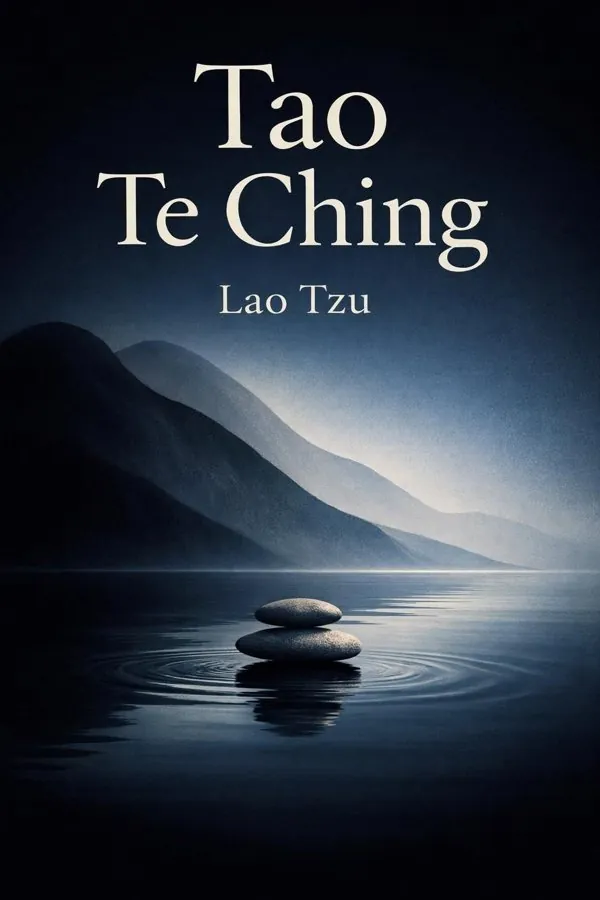
Tao Te Ching: Summary & Key Insights
by Lao Tzu
 10 min14 chaptersAudio available
Key Takeaways from Tao Te Ching
The Tao is the starting point of the entire book, yet Lao Tzu immediately tells us it cannot be fully captured in language.
Lao Tzu describes the Tao through paradox because ordinary logic cannot contain it.
Wu wei is one of the most misunderstood ideas in the Tao Te Ching.
The Tao Te Ching consistently praises simplicity because complexity often feeds ego, distraction, and dissatisfaction.
In the Tao Te Ching, the sage is not a distant mystic but a model of wise living.
What Is Tao Te Ching About?
Tao Te Ching by Lao Tzu is a philosophy book published in 1997 spanning 14 pages. Few books have shaped spiritual thought, leadership, and personal reflection as deeply as the Tao Te Ching. Though brief in length, this ancient classic opens a surprisingly vast way of seeing life: one that values stillness over strain, humility over ego, and alignment over force. At a time when modern life often rewards speed, control, and constant self-assertion, the Tao Te Ching offers a radically different path. It suggests that the most effective way to live is not by pushing harder, but by moving in harmony with the deeper patterns of existence. Attributed to Lao Tzu, the revered sage traditionally associated with the founding of Daoism, this text has endured for more than two millennia because it speaks to timeless human struggles: how to lead without dominating, act without exhausting yourself, and find peace in a world of change. Divided into reflections on the Tao, or the Way, and Te, often translated as virtue or inner power, the book blends poetic paradox with practical wisdom. Its teachings on non-action, simplicity, and natural balance continue to influence philosophy, politics, spirituality, and self-development around the world.
This FizzRead summary covers all 14 key chapters of Tao Te Ching in approximately 10 minutes, distilling the most important ideas, arguments, and takeaways from Lao Tzu's work. Also available as an audio summary and Key Quotes Podcast.
Tao Te Ching
Few books have shaped spiritual thought, leadership, and personal reflection as deeply as the Tao Te Ching. Though brief in length, this ancient classic opens a surprisingly vast way of seeing life: one that values stillness over strain, humility over ego, and alignment over force. At a time when modern life often rewards speed, control, and constant self-assertion, the Tao Te Ching offers a radically different path. It suggests that the most effective way to live is not by pushing harder, but by moving in harmony with the deeper patterns of existence.
Attributed to Lao Tzu, the revered sage traditionally associated with the founding of Daoism, this text has endured for more than two millennia because it speaks to timeless human struggles: how to lead without dominating, act without exhausting yourself, and find peace in a world of change. Divided into reflections on the Tao, or the Way, and Te, often translated as virtue or inner power, the book blends poetic paradox with practical wisdom. Its teachings on non-action, simplicity, and natural balance continue to influence philosophy, politics, spirituality, and self-development around the world.
Who Should Read Tao Te Ching?
This book is perfect for anyone interested in philosophy and looking to gain actionable insights in a short read. Whether you're a student, professional, or lifelong learner, the key ideas from Tao Te Ching by Lao Tzu will help you think differently.
- ✓Readers who enjoy philosophy and want practical takeaways
- ✓Professionals looking to apply new ideas to their work and life
- ✓Anyone who wants the core insights of Tao Te Ching in just 10 minutes
Want the full summary?
Get instant access to this book summary and 100K+ more with Fizz Moment.
Get Free SummaryAvailable on App Store • Free to download
Key Chapters
The Tao is the starting point of the entire book, yet Lao Tzu immediately tells us it cannot be fully captured in language. “The Tao that can be spoken is not the eternal Tao” is not a rejection of thought, but a warning against mistaking labels for reality. Words divide and define; the Tao precedes all division. It is the source from which heaven, earth, and all living things emerge. Before we classify the world into success and failure, good and bad, self and other, there is a deeper wholeness already present.
This idea matters because much of human suffering comes from clinging to names, roles, and fixed identities. We say, “I must be this kind of person” or “life must unfold this way,” and then struggle when reality refuses to cooperate. Lao Tzu invites us to loosen that grip. Instead of trying to master life intellectually, we can learn to sense its movement directly. A practical way to do this is to pause before reacting: notice your breath, your surroundings, and the larger context before imposing judgment. In that pause, the mind softens, and something more natural can guide action. The Tao is not a theory to memorize, but a reality to attune to through presence, receptivity, and trust.
Lao Tzu describes the Tao through paradox because ordinary logic cannot contain it. It is empty, yet never used up. It is invisible, yet everything depends on it. It does not force, yet nothing is left undone. These contradictions are not meant to confuse us; they train us to see beyond surface appearances. The Tao is like the open space in a cup or the hollow center of a wheel: what appears “nothing” is often what makes everything else useful.
This insight has practical power. In modern life, people often focus only on what can be counted—output, possessions, credentials, opinions. The Tao Te Ching reminds us that what is unseen often matters most: silence in a conversation, rest between efforts, patience before a decision, space in a home, and mental clarity amid complexity. For example, a great manager is not the one who controls every detail, but the one who creates enough trust and room for others to do their best work. A healthy relationship is not built by constant pressure, but by emotional spaciousness and understanding.
To align with the Tao’s nature, practice valuing what seems subtle or empty. Leave room in your schedule. Listen without rushing to respond. Let problems settle before forcing solutions. Lao Tzu’s message is simple but profound: fullness comes from honoring emptiness, and true effectiveness often grows from restraint.
Wu wei is one of the most misunderstood ideas in the Tao Te Ching. It does not mean laziness, passivity, or refusing to act. It means acting without strain, forcing, or needless interference. Wu wei is effortless action—responding in a way that fits the moment so well that energy is not wasted in friction. Think of a skilled athlete, musician, or craftsperson fully immersed in what they are doing. Their actions are precise and effective, not because they are tense, but because they are aligned.
Lao Tzu teaches that many problems grow worse when we try too hard to control them. A parent who micromanages a child may create rebellion. A leader who overdirects a team can destroy initiative. A person who constantly chases happiness often feels more anxious. Wu wei asks us to stop confusing effort with effectiveness. Sometimes the wisest move is to wait, observe, and act only when the path is clear.
A practical way to apply wu wei is to ask, “Am I helping this situation unfold, or am I forcing it?” In conversation, this may mean listening instead of interrupting. In work, it may mean simplifying a process instead of adding more rules. In personal growth, it may mean creating better conditions rather than trying to control every outcome. Wu wei teaches that natural, timely action often accomplishes more than aggressive striving.
The Tao Te Ching consistently praises simplicity because complexity often feeds ego, distraction, and dissatisfaction. Lao Tzu sees unnecessary desire as a source of inner turmoil. The more we accumulate—possessions, status markers, rigid opinions—the more burdened we become. Simplicity, by contrast, restores clarity. It helps us distinguish what is essential from what is merely noisy. Humility works the same way. It keeps us grounded, open to learning, and less driven by the need to prove ourselves.
This teaching is especially relevant today. Modern culture often tells us that more is always better: more productivity, more visibility, more upgrades, more self-promotion. Yet many people discover that endless pursuit leads to exhaustion rather than fulfillment. Lao Tzu suggests another route: reduce excess and return to what is plain, useful, and real. A simpler home can bring a calmer mind. A simpler schedule can improve relationships. A humbler posture in conflict can preserve peace.
Actionable examples include decluttering one area of your life, saying no to commitments that do not reflect your values, and speaking less in situations where you feel tempted to impress. Humility is not self-erasure; it is freedom from self-importance. Simplicity is not deprivation; it is choosing what truly nourishes. Together, they create a life with more ease, integrity, and depth.
In the Tao Te Ching, the sage is not a distant mystic but a model of wise living. The sage leads without dominating, teaches without preaching, and influences others without seeking credit. This figure embodies deep trust in the Tao and therefore does not need to display power or force outcomes. Instead, the sage remains calm, observant, and responsive. Because ego does not drive their behavior, their actions tend to benefit others more naturally.
This vision of leadership is strikingly modern. The best teachers, mentors, and leaders often create conditions in which others can thrive rather than making everything about themselves. A good manager, for example, gives guidance but does not suffocate initiative. A wise parent models steadiness rather than constant control. A respected friend offers perspective without needing to win every conversation. The sage’s strength lies in presence, not performance.
Lao Tzu also suggests that the sage avoids extremes: excess ambition, unnecessary conflict, and attachment to praise. A practical lesson here is to lead by subtraction. Ask yourself what you can stop doing that interferes with natural order. Can you reduce micromanagement, emotional reactivity, or the need for recognition? The sage does not become effective by adding more authority, but by removing ego-driven behavior. In a world obsessed with visibility, the Tao Te Ching reminds us that quiet influence is often the most powerful kind.
One of the Tao Te Ching’s most important insights is that opposites define one another. We know beauty because there is ugliness, success because there is failure, and difficulty because there is ease. Lao Tzu is not celebrating confusion; he is showing that reality is relational, fluid, and dynamic. Many of the categories we cling to are not absolute truths but shifting perspectives. This is why the book often speaks in paradox: softness overcomes hardness, yielding becomes strength, and not-knowing can be wiser than certainty.
This teaching encourages flexibility. Much of human conflict comes from assuming our viewpoint is complete and final. But once we see that many judgments depend on context, we become less rigid and more compassionate. For example, what looks like a setback may later reveal itself as protection or redirection. What seems weak in the short term—such as patience or restraint—may prove far stronger than aggression.
A practical way to work with paradox is to challenge binary thinking. When faced with a problem, ask: What if the opposite also contains truth? In conflict, consider how the other person’s position makes sense from their perspective. In decision-making, allow room for uncertainty rather than demanding instant clarity. Lao Tzu teaches that wisdom grows when we stop forcing life into fixed categories and begin noticing how apparent opposites belong to a larger whole.
Te, often translated as virtue, is not moral performance or rule-following. In the Tao Te Ching, Te is the natural power that arises when a person lives in alignment with the Tao. It is less about appearing good and more about being deeply rooted. A person with Te does not need to advertise integrity; their way of being quietly expresses it. Their presence feels stable, trustworthy, and unforced.
This distinction matters because people often confuse virtue with image. Someone may appear impressive, righteous, or disciplined while acting from fear, ego, or the need for approval. Lao Tzu points toward something more organic. Real virtue is like a tree growing according to its nature. It does not strain to convince anyone. It nourishes by being what it is. In daily life, Te shows up as consistency between inner values and outward action.
To cultivate Te, start with small acts of alignment. Speak honestly without exaggeration. Keep commitments without seeking praise. Choose what is right even when no one is watching. Notice where your actions are motivated by image management rather than sincerity. Over time, integrity becomes less of a performance and more of a settled character. Lao Tzu’s message is that genuine virtue cannot be manufactured through force. It emerges when we stop pretending and return to a simpler, truer way of being.
The Tao Te Ching presents inner power as something very different from domination, charisma, or outward control. Real strength comes from self-mastery, groundedness, and integrity. A person who is easily flattered, provoked, or thrown off balance may appear powerful, but inwardly they are unstable. Lao Tzu praises the one who remains centered because they are not ruled by impulses, vanity, or external noise.
This idea is highly practical. In work, inner power means staying calm under pressure instead of spreading panic. In relationships, it means responding thoughtfully instead of reacting defensively. In personal development, it means building a life from principles rather than chasing every trend or opinion. Integrity is the bridge between insight and action. It is what allows wisdom to become visible in ordinary choices.
One useful practice is to identify the situations that pull you away from yourself—criticism, praise, urgency, comparison, fear of missing out. Then develop a pause ritual: breathe, wait, and return to your values before acting. Another is to simplify your commitments so your actions better match your priorities. Lao Tzu reminds us that the strongest person is not the loudest or most aggressive, but the one who cannot be easily manipulated because they are inwardly whole. Inner power is quiet, durable, and deeply connected to truthfulness.
The Tao Te Ching is not only a spiritual text; it also offers a philosophy of governance. Lao Tzu argues that the best rulers govern lightly. They do not overwhelm people with excessive laws, punishments, and displays of authority. Instead, they create conditions in which life can unfold naturally. When leadership becomes intrusive and controlling, society grows restless, cunning, and resistant. When leadership is simple, steady, and restrained, people are more likely to live in balance.
This does not mean society should have no structure. Rather, Lao Tzu warns against the arrogance of overengineering human life. The more rulers try to manipulate every outcome, the more unintended consequences they create. This insight applies well beyond politics. In organizations, overmanagement kills creativity. In families, too many rigid rules can undermine trust. In communities, lasting order depends more on shared values and moderation than constant enforcement.
A practical takeaway is to lead by creating healthy conditions rather than controlling every detail. If you manage a team, clarify priorities but avoid micromanaging methods. If you influence a household, build rhythms of trust instead of relying only on correction. Lao Tzu’s ideal society is modest, peaceful, and not driven by greed or unnecessary ambition. Good governance, in this view, is less about spectacle and more about invisible stewardship that supports harmony.
A recurring theme in the Tao Te Ching is return. Everything rises, changes, expands, and eventually returns to its origin. This is not presented as loss, but as a law of harmony. To return to the source is to come back to stillness, simplicity, and the deeper ground beneath restless activity. Lao Tzu sees this return as wisdom because life becomes distorted when we move too far from our center.
In practical terms, many people live in a state of constant outward movement—doing, acquiring, reacting, performing. Over time, this creates fatigue and alienation. The Tao Te Ching invites us to reverse that drift. Return may mean coming back to silence after overstimulation, to your values after comparison, or to the present moment after mental scattering. Like a river returning to the sea, this movement is not regression; it is restoration.
You can apply this idea through regular practices of reset. Take quiet walks without devices. Begin the day with stillness before engaging the world. When stressed, ask, “What would returning to center look like right now?” It may mean resting, simplifying, apologizing, or letting go of a needless struggle. Lao Tzu’s wisdom here is deeply comforting: beneath the noise of life, there is always a source to which you can return—a place of balance, clarity, and renewal.
Lao Tzu repeatedly shows that emptiness is not a deficiency but a form of usefulness. A bowl is useful because of its hollow center. A room is livable because of the empty space inside it. This simple observation becomes a profound philosophy: what we usually overlook may be what makes life work. Emptiness creates capacity. Without pause, nothing can be digested. Without silence, words lose meaning. Without spaciousness, life becomes cluttered and rigid.
Modern culture tends to fear emptiness. People fill every minute with stimulation, every surface with possessions, and every uncertainty with opinion. The result is often exhaustion rather than abundance. The Tao Te Ching suggests that making room is a creative act. Empty space allows insight, rest, and adaptation. For example, a calendar packed with obligations leaves no room for reflection or meaningful relationships. A conversation filled with constant talking leaves no room for understanding.
To practice the value of emptiness, intentionally leave margin in your day. Avoid solving every silence with noise. Clear one physical space in your home and notice how it affects your mind. Before making a new commitment, ask what space it will consume. Lao Tzu teaches that emptiness is not mere absence; it is potential. When we stop trying to fill everything, we create the conditions for wisdom and vitality to emerge.
One of the Tao Te Ching’s most famous lessons is that softness can overcome hardness. Water is the classic example: it is gentle, flexible, and yielding, yet over time it wears down stone and reshapes landscapes. Lao Tzu uses this image to challenge common assumptions about strength. What is rigid may seem powerful, but rigidity often breaks under pressure. What bends can endure.
This teaching applies to both character and action. In conflict, a harsh response may escalate tension, while a calm and yielding one can dissolve it. In leadership, adaptability often outperforms stubborn control. In personal life, people who can adjust, listen, and learn tend to navigate change better than those attached to fixed identities. Yielding does not mean surrendering your values; it means choosing responsiveness over brittle resistance.
A useful practice is to notice where you become unnecessarily hard: insisting on being right, resisting change, or reacting defensively to feedback. Then experiment with a softer approach. Ask one more question before arguing. Pause before replying to criticism. Adapt your method without abandoning your purpose. Lao Tzu’s point is not that life should be passive, but that flexibility is a deeper form of power. Softness preserves energy, reduces conflict, and allows us to move with reality rather than constantly against it.
The Tao Te Ching makes a subtle distinction between useful understanding and the kind of knowledge that inflates the ego. Lao Tzu is skeptical of cleverness when it distances us from direct experience. To “know” in the deepest sense is not merely to collect information, but to recognize limits, remain open, and stay rooted in reality. This is why the text often honors not-knowing. It is not anti-intellectual; it is anti-pretension.
In everyday life, people often mistake certainty for wisdom. They rush to explain, label, and judge, even when situations are complex. But rigid certainty can block real insight. A doctor who listens carefully may help more than one who assumes too quickly. A leader who admits uncertainty may make better decisions than one who projects false confidence. A person who knows their blind spots is often wiser than someone full of opinions.
To apply this teaching, practice intellectual humility. Ask more questions. Distinguish facts from assumptions. Notice when you are using knowledge to feel superior rather than to understand. Spend time in direct observation—of nature, of people, of your own mind—without immediately turning the experience into a conclusion. Lao Tzu teaches that wisdom grows when we let go of the need to appear all-knowing. Sometimes clarity comes not from adding more concepts, but from becoming quiet enough to see what is already true.
At the heart of the Tao Te Ching is the idea that human beings flourish when they live in harmony with nature rather than trying to dominate it. Nature, for Lao Tzu, is not just forests and rivers; it is the spontaneous pattern by which life unfolds. Seasons change, water flows downward, plants grow without strain, and living systems maintain balance through rhythm. Humans suffer when they ignore these patterns and try to live in constant opposition to them.
This principle can be read ecologically, psychologically, and spiritually. Ecologically, it encourages respect for natural limits and interdependence. Psychologically, it reminds us that rest, cycles, and emotional ebb and flow are normal. Spiritually, it suggests that wisdom comes from observing how life actually works instead of imposing artificial ideals. For instance, sleep cannot be replaced by sheer willpower, relationships cannot be forced into perfect control, and meaningful growth often takes time.
A practical application is to align your habits with natural rhythms. Work with periods of focus and rest instead of nonstop output. Spend regular time outdoors to recalibrate attention. Accept that some phases of life are for growth, some for waiting, and some for letting go. Lao Tzu’s insight is deeply relevant today: harmony with nature is not sentimental—it is a sane and sustainable way to live. When we stop fighting life’s patterns, we become more peaceful, resilient, and whole.
All Chapters in Tao Te Ching
About the Author
Lao Tzu, also known as Li Er, is traditionally remembered as an ancient Chinese philosopher and the founder of Daoism. He is most closely associated with the Tao Te Ching, a brief yet influential text that explores the Tao, or Way, as the fundamental principle of existence. His teachings emphasize naturalness, humility, simplicity, and wu wei, often translated as non-action or effortless action. Revered as a sage, Lao Tzu has shaped Chinese spiritual, philosophical, and cultural traditions for over two millennia. His ideas have also traveled far beyond China, influencing global discussions on ethics, leadership, spirituality, and the art of living well.
Get This Summary in Your Preferred Format
Read or listen to the Tao Te Ching summary by Lao Tzu anytime, anywhere. FizzRead offers multiple formats so you can learn on your terms — all free.
Available formats: App · Audio · PDF · EPUB — All included free with FizzRead
Download Tao Te Ching PDF and EPUB Summary
Key Quotes from Tao Te Ching
“The Tao is the starting point of the entire book, yet Lao Tzu immediately tells us it cannot be fully captured in language.”
“Lao Tzu describes the Tao through paradox because ordinary logic cannot contain it.”
“Wu wei is one of the most misunderstood ideas in the Tao Te Ching.”
“The Tao Te Ching consistently praises simplicity because complexity often feeds ego, distraction, and dissatisfaction.”
“In the Tao Te Ching, the sage is not a distant mystic but a model of wise living.”
Frequently Asked Questions about Tao Te Ching
Tao Te Ching by Lao Tzu is a philosophy book that explores key ideas across 14 chapters. Few books have shaped spiritual thought, leadership, and personal reflection as deeply as the Tao Te Ching. Though brief in length, this ancient classic opens a surprisingly vast way of seeing life: one that values stillness over strain, humility over ego, and alignment over force. At a time when modern life often rewards speed, control, and constant self-assertion, the Tao Te Ching offers a radically different path. It suggests that the most effective way to live is not by pushing harder, but by moving in harmony with the deeper patterns of existence. Attributed to Lao Tzu, the revered sage traditionally associated with the founding of Daoism, this text has endured for more than two millennia because it speaks to timeless human struggles: how to lead without dominating, act without exhausting yourself, and find peace in a world of change. Divided into reflections on the Tao, or the Way, and Te, often translated as virtue or inner power, the book blends poetic paradox with practical wisdom. Its teachings on non-action, simplicity, and natural balance continue to influence philosophy, politics, spirituality, and self-development around the world.
Compare Tao Te Ching
You Might Also Like
Featured In
Tim Ferriss's Book Picks
Tim Ferriss's Toolkit: Books for Peak Performance
Jay Shetty's Book Picks
Jay Shetty's Mindful Reading List
Paulo Coelho's Book Picks
Paulo Coelho's Spiritual Reading Journey
Curated's Book Picks
Best Philosophy Books — Timeless Wisdom for Modern Life
Curated's Book Picks
Must-Read Books Before You Die — The Essential List
Browse by Category
Ready to read Tao Te Ching?
Get the full summary and 100K+ more books with Fizz Moment.