
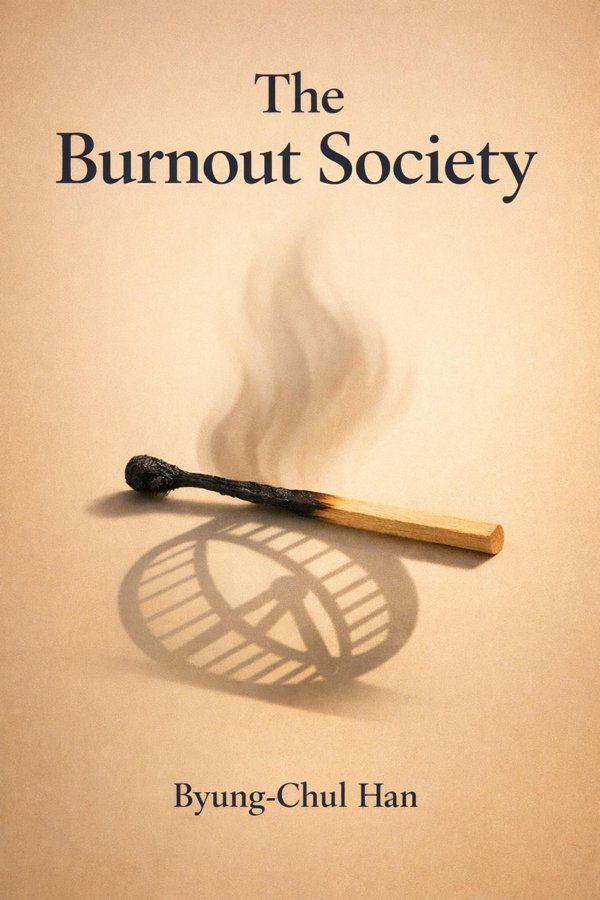
The Burnout Society: Summary & Key Insights
 10 min9 chaptersAudio available
Key Takeaways from The Burnout Society
A society can oppress people not only by saying “no,” but also by relentlessly saying “you can.
The most efficient system of control is one in which people believe they are acting freely while carrying out the system’s demands.
Not all violence is loud, direct, or visible; some forms appear as overstimulation, overexposure, and excessive positivity.
The cruelest form of coercion may be the one we mistake for freedom.
When exhaustion becomes normal, fatigue is no longer just a personal state; it becomes a social diagnosis.
What Is The Burnout Society About?
The Burnout Society by Byung-Chul Han is a philosophy book published in 2015 spanning 11 pages. In The Burnout Society, Byung-Chul Han offers a sharp, unsettling diagnosis of modern life: we no longer live mainly under repression, but under the pressure to perform, improve, and optimize ourselves without end. Instead of being disciplined by external authority, we are driven by internalized demands to become more productive, more visible, more resilient, and more successful. What looks like freedom, Han argues, often turns into a subtler form of coercion—self-exploitation. The result is a society marked not by obedience, but by exhaustion, anxiety, depression, and burnout. Though brief, the book is remarkably influential because it gives language to experiences many people already feel but struggle to explain. Han connects work culture, digital communication, attention fragmentation, and the loss of contemplation into a broader philosophical critique of neoliberal life. As a South Korean–German philosopher known for his incisive cultural analysis, Han writes with unusual clarity and force. This book matters because it helps readers see that burnout is not merely a personal failure or productivity problem. It is a social condition rooted in the very ideals our era celebrates.
This FizzRead summary covers all 9 key chapters of The Burnout Society in approximately 10 minutes, distilling the most important ideas, arguments, and takeaways from Byung-Chul Han's work. Also available as an audio summary and Key Quotes Podcast.
The Burnout Society
In The Burnout Society, Byung-Chul Han offers a sharp, unsettling diagnosis of modern life: we no longer live mainly under repression, but under the pressure to perform, improve, and optimize ourselves without end. Instead of being disciplined by external authority, we are driven by internalized demands to become more productive, more visible, more resilient, and more successful. What looks like freedom, Han argues, often turns into a subtler form of coercion—self-exploitation. The result is a society marked not by obedience, but by exhaustion, anxiety, depression, and burnout.
Though brief, the book is remarkably influential because it gives language to experiences many people already feel but struggle to explain. Han connects work culture, digital communication, attention fragmentation, and the loss of contemplation into a broader philosophical critique of neoliberal life. As a South Korean–German philosopher known for his incisive cultural analysis, Han writes with unusual clarity and force. This book matters because it helps readers see that burnout is not merely a personal failure or productivity problem. It is a social condition rooted in the very ideals our era celebrates.
Who Should Read The Burnout Society?
This book is perfect for anyone interested in philosophy and looking to gain actionable insights in a short read. Whether you're a student, professional, or lifelong learner, the key ideas from The Burnout Society by Byung-Chul Han will help you think differently.
- ✓Readers who enjoy philosophy and want practical takeaways
- ✓Professionals looking to apply new ideas to their work and life
- ✓Anyone who wants the core insights of The Burnout Society in just 10 minutes
Want the full summary?
Get instant access to this book summary and 100K+ more with Fizz Moment.
Get Free SummaryAvailable on App Store • Free to download
Key Chapters
A society can oppress people not only by saying “no,” but also by relentlessly saying “you can.” Han’s central claim is that modern Western societies have shifted from what he calls a disciplinary model to a performance model. In the older framework, power worked through rules, prohibitions, institutions, and obedience. People were told what they could not do, and conformity was enforced from the outside. In the newer framework, power appears more positive and liberating. The language is no longer about duty and punishment, but about initiative, potential, flexibility, and self-realization.
This change sounds liberating, yet Han argues it is psychologically more invasive. When the message becomes “nothing is impossible” or “you can be anything,” limits do not disappear; they become internalized. Failure now feels entirely personal. If success is theoretically available to everyone, then exhaustion, stagnation, or mediocrity seem like private shortcomings rather than structural consequences. The pressure once imposed by factories, bosses, or institutions is now carried within the self.
You can see this shift in workplace language. Employees are called entrepreneurs of themselves, urged to be proactive, passionate, and constantly available. Students are taught not merely to learn, but to maximize their potential and build personal brands. Even leisure is framed as optimization: fitness, mindfulness, and hobbies often become projects of self-improvement.
Han’s insight helps explain why modern pressure feels both voluntary and exhausting. The command has not disappeared; it has changed tone. Actionable takeaway: notice where the language of possibility in your life actually functions like a demand, and begin distinguishing genuine freedom from pressure disguised as empowerment.
The most efficient system of control is one in which people believe they are acting freely while carrying out the system’s demands. Han calls the modern individual the achievement subject: a person who sees life as a project of continuous output, growth, and self-surpassing. Unlike the obedient subject of disciplinary society, this person is not primarily shaped by prohibition. Instead, they are animated by motivation, ambition, and the belief that they must constantly become more.
This achievement subject says, “I can,” rather than “I must.” But Han argues that this positive language conceals a new form of domination. The achievement subject becomes both master and laborer, both exploiter and exploited. There is no need for a harsh external overseer when the self monitors its own productivity, compares itself to others, and pushes beyond its own limits. The pressure feels self-chosen, which makes resistance more difficult.
Consider the freelancer who answers emails late at night because they want to stay competitive, the student who turns every interest into a credential, or the professional who feels guilty for resting because there is always more they could be doing. In each case, coercion operates through self-management. People become trapped in the logic of endless performance precisely because it appears as self-expression.
Han’s critique is powerful because it explains why burnout often affects high-functioning, motivated individuals. They are not crushed by simple obedience, but by the constant need to actualize themselves. Actionable takeaway: examine one area where your identity depends on always achieving more, and create a boundary that protects your worth from being measured only by output.
Not all violence is loud, direct, or visible; some forms appear as overstimulation, overexposure, and excessive positivity. Han argues that the pathologies of our time are not primarily infections from an outside enemy, but neuronal illnesses produced by too much pressure to perform. Depression, burnout, attention disorders, and chronic exhaustion are not random individual malfunctions. They are the psychological symptoms of a culture that demands constant activity and self-optimization.
In older social models, conflict came from repression and prohibition. In Han’s account, contemporary suffering stems from excess: too much communication, too many options, too many demands to improve, too much compulsion to be active and available. The subject collapses not because it is denied possibilities, but because it cannot sustain the weight of infinite possibility. Depression emerges when the self can no longer keep saying “I can.” Burnout appears when motivational energy is consumed faster than it can be restored.
This helps explain why many people feel tired even when they are supposedly in control of their schedules. A person may work in a modern office with flexible hours, enjoy digital tools and personal autonomy, yet still feel internally depleted. They are never fully off duty because performance has become a permanent mode of being. Even self-care can become another task to manage efficiently.
Han asks us to see these conditions socially, not merely medically. That does not deny the reality of mental illness; it places it in context. Actionable takeaway: if you experience chronic exhaustion, ask not only “What is wrong with me?” but also “What in my environment makes endless performance feel normal?”
The cruelest form of coercion may be the one we mistake for freedom. Han’s analysis turns on this paradox. Contemporary society celebrates autonomy, creativity, and self-direction. People are no longer simply ordered around; they are encouraged to choose, initiate, and express themselves. Yet the very form of this freedom binds them more deeply to systems of productivity, competition, and exposure.
Han does not claim that freedom is an illusion in the simple sense that nothing has changed. Rather, he argues that freedom has been absorbed into the machinery of performance. The modern subject experiences pressure as personal aspiration. Because demands are internalized, they no longer feel imposed from outside. This makes them more total. You can resist a boss, a law, or a visible institution more easily than you can resist your own desire to optimize yourself.
Think about how people use phrases such as “I should be doing more,” “I need to stay relevant,” or “I can’t fall behind.” No police force is required. The metric-driven workplace, social comparison on digital platforms, and entrepreneurial culture all encourage people to govern themselves according to productivity norms. Even time off is often justified instrumentally: rest in order to perform better later.
Han’s point is not that all freedom is false, but that freedom detached from limits becomes self-coercive. When every moment can be used, every talent monetized, and every trait improved, life becomes an endless project. Actionable takeaway: practice one form of non-instrumental freedom this week—do something valuable that is not designed to make you more productive, marketable, or efficient.
When exhaustion becomes normal, fatigue is no longer just a personal state; it becomes a social diagnosis. Han describes our era as a fatigue society, one in which tiredness is widespread because people are overstretched mentally, emotionally, and cognitively. This fatigue differs from the healthy tiredness that follows meaningful effort. It is not restorative. It is a depleted, fragmented, isolating exhaustion produced by constant activation.
Healthy fatigue can deepen connection. After real work, physical labor, or shared experience, people may feel pleasantly tired and open to rest. By contrast, the fatigue Han is concerned with leaves people irritable, numb, distracted, and unable to recover. It comes from multitasking, perpetual responsiveness, and the inability to withdraw. Because individuals are expected to remain functional under all conditions, they lose access to genuine pauses.
You can observe this in everyday routines: checking messages upon waking, switching between screens all day, answering work requests during evenings, and filling every spare minute with content. The nervous system never settles. Many people mistake this for normal modern life, then blame themselves for failing to keep up.
Han’s contribution is to show that collective tiredness signals a deeper problem with how society values human beings. If worth is tied to constant performance, fatigue becomes both inevitable and shameful. People continue pushing until collapse. Actionable takeaway: treat recurring exhaustion as information rather than weakness—identify one recurring source of needless activation, such as notifications or after-hours work, and reduce it deliberately.
A healthy life requires encounter with what is truly other—what resists us, surprises us, and cannot be reduced to our preferences. Han argues that contemporary culture increasingly eliminates this otherness. In a performance society, difference is often flattened into sameness: people consume what confirms them, connect through curated identities, and interact in systems designed for frictionless exchange. The result is not deeper community but a world of mirrors.
For Han, the disappearance of the other has ethical and psychological consequences. If everything is organized around self-expression, personal branding, and self-optimization, then relationships become extensions of the self rather than encounters with genuine alterity. Other people are valued for networking, validation, collaboration, or emotional utility. Even disagreement becomes difficult to bear, because the culture of positivity prefers affirmation over tension.
This idea applies strongly to digital life. Algorithms feed users content similar to what they already like. Social platforms reward recognizable identities and familiar opinions. Communication becomes faster, but also narrower. Instead of confronting the unfamiliar, people remain enclosed within loops of preference and comparison.
Han suggests that the loss of the other contributes to exhaustion because true renewal often comes through interruption, silence, distance, and surprise. Without that, consciousness circles back on itself. Life becomes more manageable but less meaningful. Actionable takeaway: seek one regular encounter each week with something not tailored to your tastes—a difficult book, a serious conversation with someone unlike you, or time in an environment that interrupts your habits of self-confirmation.
Digital technology does not merely connect us; it intensifies the demand to be visible, available, and responsive. Han sees contemporary communication systems as amplifiers of the performance society. Email, messaging apps, social media, and constant connectivity blur the boundary between work and rest, public and private, expression and exposure. The subject becomes both producer and product, continuously presenting itself to the world.
What makes this particularly exhausting is that digital participation often feels voluntary and enjoyable. People post, respond, track, share, and engage because these actions promise connection, recognition, and opportunity. Yet beneath that surface lies a system of continuous activation. There is always another message to answer, another update to check, another audience to address. The self becomes a stream of outputs.
In practical terms, this means attention is repeatedly broken into small fragments. A worker trying to focus on a report checks team notifications every few minutes. A student reading a difficult text interrupts the effort to respond to social messages. A creator feels pressure not only to make good work but to maintain constant online presence around the work. Performance extends beyond the task to the management of visibility.
Han’s critique remains highly relevant because digital culture often rewards immediacy over depth. Communication becomes abundant, but not necessarily meaningful. Actionable takeaway: create one protected zone of technological non-exposure each day—an hour without posting, messaging, or checking updates—so that your mind can return to sustained thought instead of continuous self-display.
A civilization that cannot sustain attention eventually loses the ability to think deeply, create meaningfully, and rest fully. Han argues that the modern crisis of attention is not simply about distraction in a casual sense. It reflects a broader cultural condition in which hyperactivity replaces contemplation. The mind is trained to scan, react, and switch rapidly, but not to linger, dwell, or endure complexity.
Han contrasts this with forms of deep attention that once made contemplation, art, philosophy, and serious work possible. Such attention requires patience, receptivity, and a willingness to encounter resistance. In the performance society, however, these capacities are undermined by multitasking and constant stimuli. People become effective at managing fragments, yet less able to sustain a genuine relation to anything difficult or profound.
This is visible in how many people consume information today. Articles are skimmed, books are abandoned quickly, conversations are half-held while glancing at phones, and reflection is displaced by instant response. Over time, this weakens not only concentration but also judgment. Without depth of attention, experience becomes thinner and more reactive.
Han’s argument matters because attention is not merely a mental skill; it is a form of life. The quality of your attention shapes the quality of your relationships, work, and inner world. A distracted society is easier to mobilize, but harder to humanize. Actionable takeaway: rebuild deep attention through one daily practice of uninterrupted focus—reading, writing, walking, or thinking for 20 to 30 minutes without switching tasks or checking devices.
Not every meaningful act needs to be productive, and not every pause needs to justify itself. One of Han’s most important implications is that modern life has lost forms of ritual, contemplation, and stillness that once gave structure and depth to human experience. In a culture dominated by performance, time is flattened into a sequence of tasks, opportunities, and outputs. Rituals appear inefficient, contemplation appears unproductive, and pauses are tolerated only if they improve later performance.
Han sees this loss as spiritually and psychologically costly. Rituals create rhythm; they slow time and free actions from pure utility. Contemplation allows us to receive rather than produce. Silence gives shape to language, and rest gives shape to work. Without these experiences, life becomes continuous motion without orientation. People stay busy, but struggle to feel grounded.
Practical examples are simple but powerful: meals eaten without screens, regular walks without audio input, weekly practices that are repeated for their own sake, quiet reading without the urge to summarize or post about it, shared traditions that are not optimized for efficiency. These acts restore texture to life precisely because they resist the demand to turn everything into performance.
Han is not proposing nostalgia or withdrawal from the modern world. He is pointing toward conditions under which freedom becomes livable again. We recover ourselves not only through action, but through intervals of non-action. Actionable takeaway: establish one recurring ritual of pause—a device-free meal, evening silence, weekly long walk, or reflective practice—and protect it from being converted into another self-improvement metric.
All Chapters in The Burnout Society
About the Author
Byung-Chul Han is a South Korean–German philosopher, essayist, and cultural critic known for his penetrating analyses of contemporary society. Born in Seoul, he later moved to Germany, where he studied philosophy, German literature, and theology. He has taught at several German universities, including the Berlin University of the Arts, and has become one of the most widely discussed contemporary philosophers writing about digital culture, neoliberalism, and modern subjectivity. Han is especially known for short, aphoristic books that diagnose the hidden pressures of the present age, including fatigue, transparency, self-optimization, and the erosion of ritual and contemplation. His work combines continental philosophy with sharp social observation, making complex ideas accessible while challenging readers to rethink freedom, work, attention, and power in everyday life.
Get This Summary in Your Preferred Format
Read or listen to the The Burnout Society summary by Byung-Chul Han anytime, anywhere. FizzRead offers multiple formats so you can learn on your terms — all free.
Available formats: App · Audio · PDF · EPUB — All included free with FizzRead
Download The Burnout Society PDF and EPUB Summary
Key Quotes from The Burnout Society
“A society can oppress people not only by saying “no,” but also by relentlessly saying “you can.”
“The most efficient system of control is one in which people believe they are acting freely while carrying out the system’s demands.”
“Not all violence is loud, direct, or visible; some forms appear as overstimulation, overexposure, and excessive positivity.”
“The cruelest form of coercion may be the one we mistake for freedom.”
“When exhaustion becomes normal, fatigue is no longer just a personal state; it becomes a social diagnosis.”
Frequently Asked Questions about The Burnout Society
The Burnout Society by Byung-Chul Han is a philosophy book that explores key ideas across 9 chapters. In The Burnout Society, Byung-Chul Han offers a sharp, unsettling diagnosis of modern life: we no longer live mainly under repression, but under the pressure to perform, improve, and optimize ourselves without end. Instead of being disciplined by external authority, we are driven by internalized demands to become more productive, more visible, more resilient, and more successful. What looks like freedom, Han argues, often turns into a subtler form of coercion—self-exploitation. The result is a society marked not by obedience, but by exhaustion, anxiety, depression, and burnout. Though brief, the book is remarkably influential because it gives language to experiences many people already feel but struggle to explain. Han connects work culture, digital communication, attention fragmentation, and the loss of contemplation into a broader philosophical critique of neoliberal life. As a South Korean–German philosopher known for his incisive cultural analysis, Han writes with unusual clarity and force. This book matters because it helps readers see that burnout is not merely a personal failure or productivity problem. It is a social condition rooted in the very ideals our era celebrates.
Compare The Burnout Society

You Might Also Like
Featured In
Browse by Category
Ready to read The Burnout Society?
Get the full summary and 100K+ more books with Fizz Moment.