
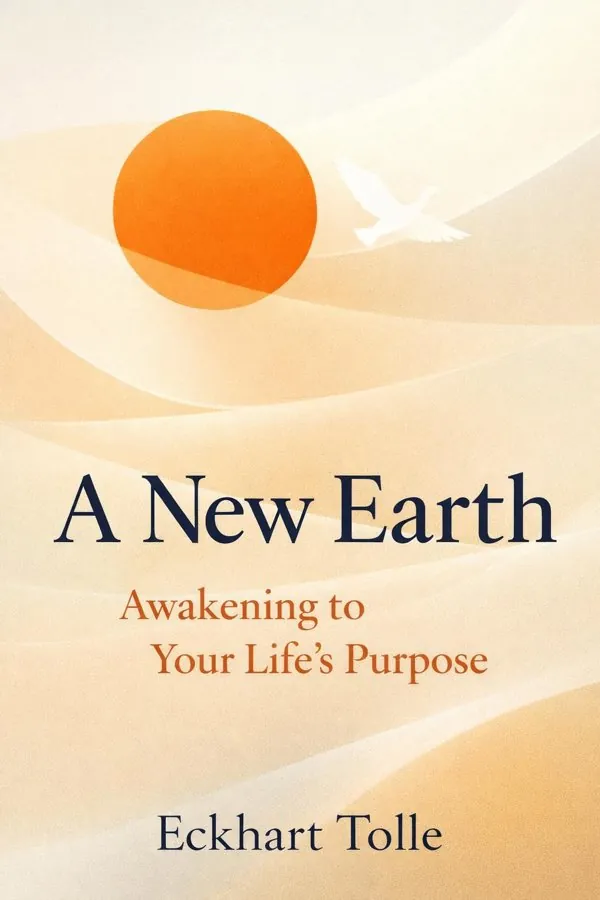
A New Earth: Summary & Key Insights
 10 min9 chaptersAudio available
Key Takeaways from A New Earth
Human beings may be more technologically advanced than ever, yet inwardly many still live in confusion, fear, and conflict.
Much of what people call “me” is actually a story they are constantly trying to maintain.
Some emotional reactions feel larger than the immediate moment because they are.
Most people think freedom comes from solving all their problems, but Tolle argues that freedom begins by stepping out of unconscious mental time.
Success without consciousness often leaves people strangely empty.
What Is A New Earth About?
A New Earth by Eckhart Tolle is a eastern_wisdom book published in 2005 spanning 11 pages. A New Earth is Eckhart Tolle’s bold and accessible exploration of what keeps human beings trapped in conflict, anxiety, and dissatisfaction—and what it would take to move beyond those patterns. At the center of the book is a simple but far-reaching claim: much of human suffering is created by the ego, the false sense of self built from thought, status, memory, and identification with form. Tolle argues that real transformation does not begin with changing the outer world alone, but with awakening to a deeper consciousness beneath compulsive thinking. What makes this book matter is its scope. It is both an intensely personal guide to inner peace and a sweeping diagnosis of humanity’s collective crises, from destructive relationships to social conflict and environmental imbalance. Tolle connects everyday emotional habits with the larger destiny of the planet, suggesting that inner awakening is not a luxury but an evolutionary necessity. Tolle writes with the authority of a teacher whose work has helped millions rethink their relationship to thought, presence, and identity. Following the impact of The Power of Now, A New Earth expands his message into a practical vision for personal and collective awakening.
This FizzRead summary covers all 9 key chapters of A New Earth in approximately 10 minutes, distilling the most important ideas, arguments, and takeaways from Eckhart Tolle's work. Also available as an audio summary and Key Quotes Podcast.
A New Earth
A New Earth is Eckhart Tolle’s bold and accessible exploration of what keeps human beings trapped in conflict, anxiety, and dissatisfaction—and what it would take to move beyond those patterns. At the center of the book is a simple but far-reaching claim: much of human suffering is created by the ego, the false sense of self built from thought, status, memory, and identification with form. Tolle argues that real transformation does not begin with changing the outer world alone, but with awakening to a deeper consciousness beneath compulsive thinking.
What makes this book matter is its scope. It is both an intensely personal guide to inner peace and a sweeping diagnosis of humanity’s collective crises, from destructive relationships to social conflict and environmental imbalance. Tolle connects everyday emotional habits with the larger destiny of the planet, suggesting that inner awakening is not a luxury but an evolutionary necessity.
Tolle writes with the authority of a teacher whose work has helped millions rethink their relationship to thought, presence, and identity. Following the impact of The Power of Now, A New Earth expands his message into a practical vision for personal and collective awakening.
Who Should Read A New Earth?
This book is perfect for anyone interested in eastern_wisdom and looking to gain actionable insights in a short read. Whether you're a student, professional, or lifelong learner, the key ideas from A New Earth by Eckhart Tolle will help you think differently.
- ✓Readers who enjoy eastern_wisdom and want practical takeaways
- ✓Professionals looking to apply new ideas to their work and life
- ✓Anyone who wants the core insights of A New Earth in just 10 minutes
Want the full summary?
Get instant access to this book summary and 100K+ more with Fizz Moment.
Get Free SummaryAvailable on App Store • Free to download
Key Chapters
Human beings may be more technologically advanced than ever, yet inwardly many still live in confusion, fear, and conflict. That contrast is where Tolle begins: evolution is not finished, and the next leap is not physical but psychological and spiritual. Just as life has passed through dramatic thresholds before, humanity now faces a possible shift from ego-dominated awareness to awakened consciousness.
Tolle suggests that the crises we see around us are not random signs of failure alone. They are also symptoms of an outdated level of consciousness reaching its limit. Environmental destruction, political hostility, compulsive consumption, and personal anxiety all reflect the same root problem: identification with the ego. The old way of being is unsustainable because it creates separation—between self and others, humans and nature, desire and contentment.
This idea reframes personal growth. Awakening is not just about becoming calmer or more fulfilled; it is participation in a larger movement of human evolution. When individuals become less reactive, less identified with thought, and more present, they help create a different collective field. The transformation of the world begins with the transformation of consciousness.
In practice, this means seeing your inner life as deeply consequential. A person who notices irritation before it becomes attack, or who chooses presence over compulsive distraction, is already contributing to a new kind of world. The shift may seem private, but its effects ripple outward through families, workplaces, and communities.
Actionable takeaway: Treat moments of awareness—pausing before reacting, observing your thoughts, returning to the present—as part of a larger evolutionary step, not a small personal habit.
Much of what people call “me” is actually a story they are constantly trying to maintain. Tolle’s central insight is that the ego is not the true self but a psychological construction made from memories, labels, roles, possessions, opinions, and emotional patterns. It survives by identification: my success, my suffering, my reputation, my belief, my grievance. The more tightly we cling to these, the more fragile and defensive we become.
The ego is subtle because it often hides behind socially acceptable forms. It can appear as superiority, but also as inferiority. It can show up in boasting, but also in chronic self-pity. It seeks validation, comparison, control, and recognition because it depends on external forms to feel real. This is why even achievement often fails to bring peace. Once one identity is secured, the ego looks for another threat or another goal.
Tolle does not suggest eliminating personality or practical identity. You still use your name, do your job, and fulfill responsibilities. The problem arises when you mistake these temporary forms for who you are. Then criticism feels like annihilation, disagreement feels like attack, and loss feels like the collapse of self.
In ordinary life, ego can be seen when someone cannot admit being wrong, feels diminished by another person’s success, or becomes upset when not receiving attention. It can also appear in spiritual settings when a person becomes attached to being “more conscious” than others. Ego can use any content.
Actionable takeaway: Notice one place today where you feel defensive, superior, offended, or needy for recognition, and ask: “What identity am I protecting right now?” That question weakens egoic identification.
Some emotional reactions feel larger than the immediate moment because they are. Tolle introduces the “pain-body” as an accumulated field of old emotional pain living in the mind and body. It is made of unresolved hurt, anger, fear, sadness, and resentment from the past. When activated, it can temporarily take over perception and behavior, making a person react in ways that feel disproportionate, compulsive, and deeply familiar.
The pain-body is one reason people repeat destructive emotional patterns. A small slight can trigger intense rage; a mild disappointment can awaken despair. The present event is only the spark. The fuel is the stored pain that wants more of the same energy. In Tolle’s view, the pain-body feeds on negativity. It seeks situations, thoughts, and interpretations that allow it to renew itself.
This idea is especially helpful because it creates a gap between awareness and emotional storm. Instead of saying “I am angry,” you begin to notice “anger is moving through me.” That shift does not deny the experience; it makes conscious observation possible. Tolle is not asking readers to suppress emotion but to witness it without complete identification.
In relationships, pain-bodies often clash. One person’s insecurity triggers another’s resentment, and the interaction escalates rapidly. In families, these patterns can be passed across generations. The good news is that the pain-body cannot thrive in sustained awareness. Once it is seen clearly, it loses some of its grip.
Actionable takeaway: The next time you feel emotionally flooded, pause before speaking and silently name the experience: “This may be my pain-body activating.” That simple recognition creates space for choice.
Most people think freedom comes from solving all their problems, but Tolle argues that freedom begins by stepping out of unconscious mental time. The ego lives through constant entanglement with past and future—regret, resentment, anticipation, anxiety, and endless psychological projection. Presence, by contrast, is direct contact with the reality of this moment without the extra burden of compulsive mental commentary.
This does not mean ignoring practical planning or memory. Tolle distinguishes between clock time, which is useful for schedules and goals, and psychological time, which is the self-created drama of becoming, fearing, and reliving. When you are trapped in psychological time, the present is treated as an obstacle, a means to an end, or a source of dissatisfaction. When you are present, the current moment becomes the primary place of life rather than a waiting room for something else.
Practically, presence changes how you move through ordinary experiences. Washing dishes, listening to a colleague, waiting in traffic, or walking to the store can become moments of stillness instead of irritation. Presence also interrupts escalation. If you notice tension in your body while someone criticizes you, feel your breath and inner aliveness before answering. That brief return to the now can prevent an ego-driven reaction.
Tolle presents presence as the gateway to sanity. It reveals that awareness is deeper than thought and that many problems are intensified by the mind’s resistance to what already is. Clarity, creativity, and wise action emerge more easily when the mind is not in constant conflict with the moment.
Actionable takeaway: Build a daily presence cue—such as feeling one conscious breath before opening your phone, replying to a message, or entering a meeting.
Success without consciousness often leaves people strangely empty. Tolle explains this through the distinction between outer purpose and inner purpose. Outer purpose concerns what you do—career, projects, achievements, roles, and goals. Inner purpose concerns how you do it—the state of consciousness you bring to each moment. Most people focus almost exclusively on outer purpose and then wonder why accomplishment does not deliver lasting fulfillment.
According to Tolle, inner purpose is awakening. It means bringing presence, attention, and non-reactivity into the activity of living. Outer purpose can change many times across a lifetime, but inner purpose remains constant. Whether you are leading a company, caring for a child, studying, or recovering from loss, the deeper task is the same: to be present enough that action arises from consciousness rather than ego.
This perspective changes ambition. Goals are not rejected, but they are no longer expected to complete your identity. You can work hard without turning achievement into self-worth. You can pursue excellence without being psychologically consumed by comparison. A teacher can focus on students rather than on appearing important. An entrepreneur can build something meaningful without tying their entire being to outcomes.
Tolle’s framework also helps in uncertain seasons. When outer purpose is unclear—during unemployment, illness, or transition—inner purpose remains available. You may not know the next chapter, but you can still inhabit the current one with awareness.
Actionable takeaway: Choose one recurring activity today—writing emails, parenting, cooking, commuting—and define success not only by results but by the quality of presence you bring to it.
A crowded mind leaves little room for reality. Tolle emphasizes the importance of discovering “inner space,” the silent field of awareness in which thoughts, emotions, sensations, and perceptions appear. Most people are so absorbed in mental content that they never notice the consciousness behind it. Yet that silent background is where peace, stillness, and genuine intelligence become accessible.
Inner space is not an abstract mystical idea. It can be sensed whenever you notice the pause between thoughts, listen without mentally preparing a response, or become deeply attentive to nature, sound, or bodily sensation. In those moments, awareness is no longer completely entangled with thinking. There is a sense of openness rather than contraction.
Tolle also connects inner space with the appreciation of outer space. When you stop labeling everything compulsively, ordinary things regain depth: the sound of rain, the texture of light in a room, the silence between words. This shift reduces the ego’s need to dominate experience. Instead of constantly extracting meaning for the self, you begin to participate in life more directly.
For many readers, this is one of the most practical teachings in the book because it offers a concrete antidote to overstimulation. In a world of constant notifications, opinions, and demands, inner space restores psychological room. It can make decision-making clearer and emotional responses less automatic.
You do not need to escape your responsibilities to find it. Even in a busy office or household, brief moments of spacious awareness are possible. The key is not adding more thought but noticing what is present before thought takes over.
Actionable takeaway: Several times a day, stop for ten seconds and sense the stillness beneath sounds, thoughts, or activity. Let attention rest in that open space.
Nothing exposes unconsciousness faster than closeness to another human being. Tolle sees relationships not merely as emotional partnerships but as powerful spiritual practice. Why? Because the ego becomes highly activated wherever attachment, expectation, fear, and identity are involved. Romantic relationships, family bonds, and even close friendships can become theaters in which pain-body patterns and ego defenses play out repeatedly.
Many people enter relationships seeking completion, validation, or escape from inner lack. At first, attraction can create the illusion of wholeness. But when the other person fails to sustain that feeling, ego reappears as blame, control, jealousy, neediness, or withdrawal. Tolle’s point is not cynical; it is liberating. Relationships often become difficult not because love is impossible, but because they uncover what is unconscious in us.
Used consciously, relationship conflict becomes a mirror. If your partner’s tone instantly triggers anger, or a friend’s independence triggers abandonment fear, there is an invitation to observe rather than simply accuse. This does not mean tolerating mistreatment or abandoning boundaries. Conscious relating includes honesty and self-respect. But it replaces automatic reactivity with awareness.
Tolle also highlights the power of presence in communication. Truly listening without mentally defending yourself changes the emotional field. Naming what is happening—“I feel my defensiveness rising”—can shift a conflict from attack to inquiry. When even one person in a relationship becomes more conscious, familiar patterns can begin to loosen.
Actionable takeaway: In your next emotionally charged interaction, focus first on observing your inner state—body tension, emotional surge, mental story—before trying to correct the other person.
Resistance often masquerades as strength, but inwardly it creates suffering. Tolle repeatedly returns to the transformative power of accepting what is. Acceptance does not mean passivity, agreement, or resignation. It means acknowledging the reality of this moment before deciding how to respond. Without that first step, action tends to arise from anger, fear, denial, or egoic struggle.
When people resist what has already happened, they add a second layer of pain to the original situation. There is the event itself, and then there is the mental refusal: “This should not be happening.” Tolle argues that this inner opposition is one of the primary sources of unnecessary suffering. Acceptance dissolves that secondary struggle and returns energy to the present.
Consider common situations: a delayed flight, an illness, a job setback, a difficult conversation, or aging itself. Resistance produces agitation and self-pity. Acceptance allows clarity. You may still take practical steps—rebook the flight, seek treatment, change jobs, set limits—but your action no longer comes from psychological warfare with reality.
This teaching becomes especially powerful in hardship. Tolle does not trivialize pain. Instead, he suggests that peace is possible even in difficult circumstances when you stop arguing internally with what is already here. From that stillness, wiser responses emerge.
Acceptance also makes room for gratitude. When the mind is no longer consumed with demanding that life match its expectations, simple being becomes more visible: breath, connection, beauty, existence itself.
Actionable takeaway: When faced with something unpleasant today, say internally, “This is what is here right now.” Feel the difference between acknowledging reality and fighting it.
The book’s title points to its most expansive claim: a new world becomes possible when human consciousness changes. Tolle is not proposing a political blueprint or ideal society imposed from the outside. He is describing a transformed way of inhabiting the world. A “new earth” arises when enough people are no longer governed primarily by ego, compulsion, and unconscious fear.
This vision is both personal and collective. On the personal level, awakening means less identification with thought, greater presence, and more freedom from pain-body patterns. On the collective level, it means institutions, relationships, and cultural systems shaped by consciousness rather than greed, domination, or chronic deficiency. Tolle implies that many global problems persist because they are generated by the same unconsciousness operating through individuals.
Importantly, he does not ask readers to save the world through grand self-importance. Ego can easily hijack activism, spirituality, and even compassion. Instead, the contribution is simpler and deeper: embody presence where you are. The quality of consciousness you bring to conversation, work, parenting, leadership, and conflict matters. A conscious individual affects the field around them.
This final idea ties the book together. Awakening is not withdrawal from life but a new participation in it. You still engage in the world, but from a deeper identity not rooted in form. This changes how you use power, respond to challenge, and relate to others and the planet.
Actionable takeaway: Ask each morning, “What would it look like to bring less ego and more presence into the world through my ordinary actions today?” Then practice that answer in one concrete interaction.
All Chapters in A New Earth
About the Author
Eckhart Tolle is a German-born spiritual teacher and author whose work has had a major influence on contemporary discussions of mindfulness, presence, and consciousness. After experiencing a profound inner transformation in early adulthood, he devoted his life to exploring the nature of suffering, the ego, and spiritual awakening. He rose to international prominence with The Power of Now, a bestselling book that introduced millions of readers to the practice of present-moment awareness. His follow-up, A New Earth, expanded those ideas into a broader vision of individual and collective transformation. Tolle’s teaching draws from a range of spiritual traditions but is not confined to any single religion. He is widely known for presenting deep spiritual concepts in clear, practical language that speaks to modern readers seeking clarity, peace, and inner freedom.
Get This Summary in Your Preferred Format
Read or listen to the A New Earth summary by Eckhart Tolle anytime, anywhere. FizzRead offers multiple formats so you can learn on your terms — all free.
Available formats: App · Audio · PDF · EPUB — All included free with FizzRead
Download A New Earth PDF and EPUB Summary
Key Quotes from A New Earth
“Human beings may be more technologically advanced than ever, yet inwardly many still live in confusion, fear, and conflict.”
“Much of what people call “me” is actually a story they are constantly trying to maintain.”
“Some emotional reactions feel larger than the immediate moment because they are.”
“Most people think freedom comes from solving all their problems, but Tolle argues that freedom begins by stepping out of unconscious mental time.”
“Success without consciousness often leaves people strangely empty.”
Frequently Asked Questions about A New Earth
A New Earth by Eckhart Tolle is a eastern_wisdom book that explores key ideas across 9 chapters. A New Earth is Eckhart Tolle’s bold and accessible exploration of what keeps human beings trapped in conflict, anxiety, and dissatisfaction—and what it would take to move beyond those patterns. At the center of the book is a simple but far-reaching claim: much of human suffering is created by the ego, the false sense of self built from thought, status, memory, and identification with form. Tolle argues that real transformation does not begin with changing the outer world alone, but with awakening to a deeper consciousness beneath compulsive thinking. What makes this book matter is its scope. It is both an intensely personal guide to inner peace and a sweeping diagnosis of humanity’s collective crises, from destructive relationships to social conflict and environmental imbalance. Tolle connects everyday emotional habits with the larger destiny of the planet, suggesting that inner awakening is not a luxury but an evolutionary necessity. Tolle writes with the authority of a teacher whose work has helped millions rethink their relationship to thought, presence, and identity. Following the impact of The Power of Now, A New Earth expands his message into a practical vision for personal and collective awakening.
More by Eckhart Tolle
You Might Also Like
The Daily Stoic
Ryan Holiday, Stephen Hanselman
10 min
Buddhism: Plain and Simple
Steve Hagen
10 min
Enchiridion
Epictetus
10 min
The Book of Tea
Kakuzō Okakura
10 min
The Light We Give: How Sikh Wisdom Can Transform Your Life
Simran Jeet Singh
10 min
The Miracle of Mindfulness: An Introduction to the Practice of Meditation
Thich Nhat Hanh
10 minFeatured In
Browse by Category
Ready to read A New Earth?
Get the full summary and 100K+ more books with Fizz Moment.