
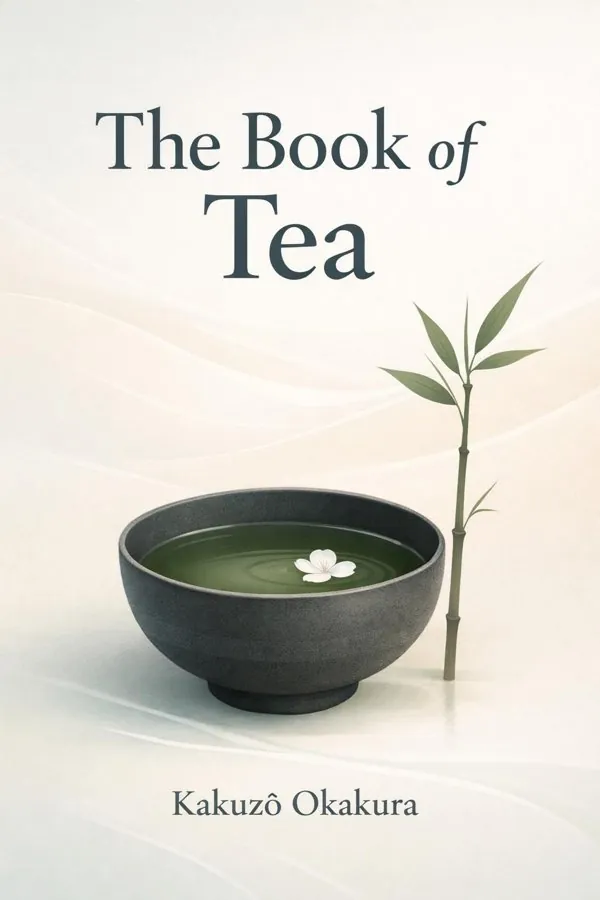
The Book of Tea: Summary & Key Insights
 10 min9 chaptersAudio available
Key Takeaways from The Book of Tea
A cup of tea can express an entire civilization.
Perfection can be lifeless; imperfection invites participation.
When nothing unnecessary remains, attention deepens.
Civilization is tested in small encounters.
Spaces shape the soul more than we admit.
What Is The Book of Tea About?
The Book of Tea by Kakuzō Okakura is a eastern_wisdom book. The Book of Tea is far more than a meditation on a drink. First published in English in 1906, Kakuzō Okakura uses tea as a doorway into the deepest values of Japanese and East Asian culture: simplicity, harmony, humility, beauty, and spiritual awareness. Written for Western readers at a time of intense cultural misunderstanding, the book argues that the tea ceremony is not a quaint ritual but a complete philosophy of life. Through the quiet acts of preparing, serving, and drinking tea, Okakura reveals a worldview that honors imperfection, cherishes the ordinary, and finds dignity in restraint. What makes this book endure is its unusual combination of elegance and challenge. Okakura does not merely describe the aesthetics of tea; he contrasts Eastern and Western habits of thought, invites readers to question materialism, and shows how art, architecture, ethics, and daily behavior are all connected. As a scholar, art critic, and leading interpreter of Japanese culture to the world, Okakura writes with both authority and poetic force. The result is a short but profound classic that helps readers see beauty not as luxury, but as a disciplined way of living.
This FizzRead summary covers all 9 key chapters of The Book of Tea in approximately 10 minutes, distilling the most important ideas, arguments, and takeaways from Kakuzō Okakura's work. Also available as an audio summary and Key Quotes Podcast.
The Book of Tea
The Book of Tea is far more than a meditation on a drink. First published in English in 1906, Kakuzō Okakura uses tea as a doorway into the deepest values of Japanese and East Asian culture: simplicity, harmony, humility, beauty, and spiritual awareness. Written for Western readers at a time of intense cultural misunderstanding, the book argues that the tea ceremony is not a quaint ritual but a complete philosophy of life. Through the quiet acts of preparing, serving, and drinking tea, Okakura reveals a worldview that honors imperfection, cherishes the ordinary, and finds dignity in restraint.
What makes this book endure is its unusual combination of elegance and challenge. Okakura does not merely describe the aesthetics of tea; he contrasts Eastern and Western habits of thought, invites readers to question materialism, and shows how art, architecture, ethics, and daily behavior are all connected. As a scholar, art critic, and leading interpreter of Japanese culture to the world, Okakura writes with both authority and poetic force. The result is a short but profound classic that helps readers see beauty not as luxury, but as a disciplined way of living.
Who Should Read The Book of Tea?
This book is perfect for anyone interested in eastern_wisdom and looking to gain actionable insights in a short read. Whether you're a student, professional, or lifelong learner, the key ideas from The Book of Tea by Kakuzō Okakura will help you think differently.
- ✓Readers who enjoy eastern_wisdom and want practical takeaways
- ✓Professionals looking to apply new ideas to their work and life
- ✓Anyone who wants the core insights of The Book of Tea in just 10 minutes
Want the full summary?
Get instant access to this book summary and 100K+ more with Fizz Moment.
Get Free SummaryAvailable on App Store • Free to download
Key Chapters
A cup of tea can express an entire civilization. That is the startling premise of The Book of Tea. Okakura argues that tea is not important simply because people enjoy drinking it, but because the culture surrounding tea reveals a way of seeing the world. In tea, small actions matter: how a room is prepared, how a bowl is held, how guests are welcomed, how silence is respected. These gestures turn an ordinary act into a discipline of awareness.
Okakura presents tea as a moral and aesthetic philosophy grounded in modesty. Instead of seeking grand declarations, tea values the overlooked and the fleeting. It teaches that refinement does not require extravagance. A simple room, a carefully chosen flower, and a shared moment of attention may hold more meaning than expensive display. In this sense, tea becomes a critique of excess and ego. It reminds us that culture is not only preserved in monuments and theories, but also in habits of everyday care.
This idea remains highly practical today. Many people rush through meals, multitask during conversations, and treat rest as unproductive time. Okakura would see this as a loss of spiritual balance. To practice the philosophy of tea in modern life could mean making one daily ritual deliberate: preparing morning coffee without checking a phone, setting a table with care, or greeting a guest with full attention rather than distraction.
The deeper lesson is that beauty and ethics are inseparable. The way we arrange a room, share food, or listen to another person reveals our character. Actionable takeaway: choose one routine each day and perform it slowly, respectfully, and with full awareness, turning habit into art.
Perfection can be lifeless; imperfection invites participation. One of Okakura’s most enduring insights is that true beauty often lies in what is unfinished, irregular, or subtly flawed. The tea tradition does not worship polished symmetry for its own sake. Instead, it values the crack in a bowl, the rough texture of handmade pottery, the asymmetry of an arrangement, and the suggestion rather than the full statement of meaning.
This idea connects closely to the broader Japanese aesthetic later often associated with wabi and sabi, though Okakura presents it in his own interpretive style. In the tea room, emptiness is not neglect. It creates space for imagination. A decoration is not meant to overwhelm the senses but to guide them. The host leaves room for the guest to complete the experience inwardly. Beauty becomes collaborative rather than imposed.
Modern culture often pushes in the opposite direction. We are encouraged to optimize endlessly, edit every flaw, and curate every image until it feels sterile. Yet many of the things people cherish most are imperfect: a worn wooden table that holds family history, handwritten notes with uneven lines, a handmade cup whose shape fits the hand more intimately than a factory-perfect product. These objects feel alive because they bear the marks of time and touch.
Applying this idea means resisting the impulse to overcorrect everything. In creative work, leave some breathing room instead of explaining every point. In your home, allow natural materials and signs of use to remain visible. In relationships, stop expecting flawless communication and learn to value sincerity over polish.
Actionable takeaway: keep or create one intentionally imperfect object or space in your life, and let it remind you that authenticity is often more beautiful than perfection.
When nothing unnecessary remains, attention deepens. Okakura treats simplicity not as deprivation but as liberation. The tea room is small, spare, and carefully arranged. Its power lies precisely in what it excludes. By limiting decoration and reducing distraction, it helps participants become more sensitive to subtle details: the steam rising from a bowl, the sound of water, the presence of others, the emotional tone of the gathering.
This simplicity has ethical implications. It opposes vanity, competition, and accumulation for their own sake. The tea ideal suggests that if we crowd our environments and schedules with excess, we dull our perception. We stop noticing nuance. We consume more while experiencing less. Simplicity restores proportion. It gives things room to matter.
In practical terms, this insight applies far beyond aesthetics. A cluttered workspace often produces mental fatigue. A packed calendar leaves no room for reflection. A conversation filled with interruptions prevents real connection. Simplifying does not mean rejecting comfort or ambition; it means removing what distracts from what is essential.
Consider how this might work in daily life. You might clear one corner of your home and treat it as a space for reading, reflection, or tea. You might host a small gathering with a few meaningful elements rather than an excess of entertainment. Even in work, a simpler presentation or cleaner design may communicate more powerfully than something overloaded with features.
Okakura’s larger point is that civilization is judged not only by what it produces, but by what it knows how to omit. Taste requires selection. Wisdom requires restraint.
Actionable takeaway: choose one area of life—your desk, calendar, phone screen, or living room—and remove anything that does not support calm, clarity, or genuine usefulness.
Civilization is tested in small encounters. A major theme in The Book of Tea is that harmony is not an abstract ideal but a practiced social art. Tea culture turns hospitality into a moral exercise. The host considers the guest, the season, the setting, and the emotional atmosphere. Nothing is random, yet nothing is forced. The aim is not performance, but thoughtful presence.
Okakura shows that respect is expressed through sensitivity to context. The choice of utensils, the arrangement of flowers, and the timing of the event all acknowledge that human beings are shaped by place and moment. Such attention creates harmony because it makes others feel seen rather than managed. Tea, then, is a school of relational intelligence.
This lesson has great relevance now. Many people think respect is mainly verbal, but often it is environmental and behavioral. It appears in being on time, putting away distractions, noticing another person’s comfort, and adjusting one’s approach to suit the occasion. A good meeting, dinner, or conversation often depends less on brilliance than on atmosphere.
Imagine applying this at home or work. Before inviting someone over, you might prepare the room to feel calm and welcoming rather than impressive. Before a difficult conversation, you might choose a quieter space, slow your speech, and remove interruptions. Before a team meeting, you might create a simple ritual that helps everyone arrive mentally, such as a minute of silence or a clear opening intention.
Okakura suggests that beauty and courtesy reinforce each other. A harmonious environment encourages harmonious conduct, and considerate conduct reveals the beauty of character.
Actionable takeaway: before your next shared meal, meeting, or conversation, spend five minutes preparing the environment with the other person’s experience in mind.
Spaces shape the soul more than we admit. Okakura pays close attention to the tea room because it embodies a philosophy in physical form. Its modest scale, subdued materials, and intentional emptiness are not decorative accidents. They train the mind toward humility, concentration, and receptivity. By crossing into the tea room, one leaves behind status, noise, and ordinary social display.
The architecture itself carries meaning. A small entrance may require guests to bow, symbolically lowering rank and ego. Sparse decoration prevents overstimulation. Natural materials keep the room close to the rhythms of the world rather than the artificiality of spectacle. The tea room is therefore not only a place where tea is served; it is an instrument for producing a certain state of mind.
This is a powerful reminder that our environments teach us constantly. Offices teach urgency or calm. Homes teach intimacy or distraction. Public spaces teach indifference or care. If a room is crowded, noisy, and visually aggressive, it becomes harder to feel reflective. If it is balanced and intentional, attention settles naturally.
You do not need a traditional tea house to apply this principle. A bedroom can become more restful by reducing visual clutter and introducing one meaningful object. A work area can become more focused by simplifying surfaces, using natural light, and designating a place for transition before beginning tasks. Even digital spaces matter: a cleaner interface and fewer notifications create mental architecture too.
Okakura reminds us that architecture is ethical. It influences how we behave toward ourselves and others. To build or arrange a space carelessly is to neglect one of the strongest forces shaping consciousness.
Actionable takeaway: redesign one small space today so that its layout, objects, and atmosphere support the state of mind you most want to cultivate there.
Art dies when it is sealed away from life. Okakura rejects the idea that beauty is something reserved for museums, elites, or rare occasions. In the world of tea, art is woven into ordinary experience: the ceramic bowl, the hanging scroll, the flower arrangement, the room itself, and the gestures of serving. Everyday use does not diminish beauty; it fulfills it.
This view challenges a modern split between utility and aesthetics. We often assume practical things need only function, while beauty is optional decoration. Okakura disagrees. He sees beauty as a civilizing force that refines perception and conduct. To drink from a thoughtfully made cup is different from using a purely disposable object. The former invites gratitude, attention, and a sense of relation to craft, materials, and maker.
There is also a democratic side to this insight. If art belongs in daily life, then everyone can participate in it. One need not be wealthy or academically trained to develop taste. Choosing a simple object that is honest in form, arranging a table with care, or placing a single branch in a room are all acts of aesthetic participation.
Today this can mean buying less but choosing better, supporting artisans, repairing rather than discarding meaningful items, or designing routines with visual and sensory awareness. It can also mean treating your work, however practical, as something that can be done beautifully. A well-written email, a thoughtfully prepared meal, or a carefully organized shelf can all express artistic integrity.
Okakura’s deeper claim is that beauty is not an indulgence. It shapes attention, and attention shapes character.
Actionable takeaway: identify one object you use every day and replace, arrange, or use it in a way that adds beauty and intention to an otherwise ordinary moment.
Misunderstanding often begins when one culture mistakes its habits for universal truth. Okakura wrote The Book of Tea partly to address Western readers who viewed Asia through caricature, superiority, or shallow exoticism. Rather than offering a defensive argument alone, he uses tea to reveal the sophistication of Eastern thought and to expose how easily societies misread one another.
His method remains relevant because cultural ignorance still thrives in subtler forms. People often reduce traditions they do not understand to trends, symbols, or stereotypes. Tea itself can be commercialized as lifestyle branding while its philosophical depth is ignored. Okakura asks readers to approach another civilization not as a spectacle to consume, but as a coherent world of values that may challenge their own assumptions.
Humility is essential here. Genuine understanding requires patience, context, and willingness to suspend judgment. It means recognizing that another society may organize beauty, morality, and meaning differently without being inferior. It also means being alert to what your own culture overlooks. Okakura is not asking readers to romanticize the East; he is asking them to see that every civilization carries blind spots.
Practically, this insight applies whenever you encounter unfamiliar customs, spiritual practices, or artistic forms. Read beyond summaries. Learn historical background. Ask what problem a tradition was solving or what human need it expresses. In conversation, replace quick comparison with curiosity. In travel, observe before interpreting.
The broader lesson is that cultural respect is not passive tolerance. It is active, informed attention.
Actionable takeaway: choose one tradition from a culture not your own and spend time learning its history, values, and context before forming an opinion about it.
What we repeat shapes who we become. Okakura shows that ritual, when practiced sincerely, can rescue life from carelessness. The tea ceremony is ritualized, but not mechanical. Its repeated forms are meant to heighten awareness, not suppress it. By giving structure to movement and attention, ritual turns fleeting moments into occasions of presence.
Modern people often resist ritual because they associate it with rigidity or empty tradition. Yet in reality, human life already contains rituals: morning routines, greetings, meals, work habits, celebrations. The question is not whether we live ritually, but whether our rituals are conscious or accidental. Tea offers an example of how repetition can cultivate grace, gratitude, and inner steadiness.
Think about the difference between hurriedly eating lunch at a screen and pausing to arrange a simple meal, take a breath, and begin with awareness. The food may be similar, but the experience and its effect on the mind are not. Ritual creates thresholds. It helps us transition from haste to attention, from public role to inner life, from routine time to meaningful time.
You can create this quality without imitating formal tea ceremony. Light a candle before reading in the evening. Pause for one breath before opening a meeting. Use one cup only for your morning tea or coffee and wash it carefully. Mark the end of the workday by tidying your desk and writing a closing note. These small repeated acts can stabilize the mind and restore dignity to daily life.
Okakura’s point is simple but profound: ritual is one of the ways culture protects depth against speed.
Actionable takeaway: create one small daily ritual that begins or ends an important part of your day, and practice it consistently for a week.
The most profound experiences are often the least dramatic. Running through The Book of Tea is a quiet but radical claim: the ordinary moment, properly attended to, contains enough depth for a meaningful life. Tea does not require spectacle, luxury, or conquest. It asks only that we be present to simple things: warmth, texture, silence, companionship, season, and transience.
This perspective pushes back against a culture that equates significance with scale. Many people assume fulfillment will come from major achievements, constant stimulation, or public recognition. Okakura offers another path. He suggests that civilization matures when it learns to honor nuance. The greatness of a life may be measured not by how much it accumulates, but by how finely it perceives and how gracefully it shares.
There is practical power in this idea. When people stop postponing meaning until some future milestone, they become capable of living now. A brief tea break between tasks can become restorative rather than empty. A rainy afternoon can become beautiful instead of inconvenient. A conversation with one friend can feel abundant without needing entertainment or display.
This mindset also strengthens resilience. If joy depends only on extraordinary experiences, life will often feel lacking. But if meaning can be found in the arrangement of light, the making of tea, or the tone of a thoughtful exchange, then richness becomes more available and less fragile.
Okakura ultimately teaches reverence for the commonplace. The ordinary is not the opposite of the sacred; it is often where the sacred waits to be noticed.
Actionable takeaway: once each day, pause for three minutes to fully notice an ordinary experience—drinking tea, washing dishes, opening a window—and treat it as if it deserves complete attention.
All Chapters in The Book of Tea
About the Author
Kakuzō Okakura, also known as Okakura Tenshin, was a Japanese art critic, scholar, and cultural reformer born in 1862 in Yokohama. He lived during Japan’s rapid modernization and became one of the most important defenders of traditional Japanese and Asian art at a time when Western influence was reshaping the country. Educated in English as well as classical Japanese learning, he developed a rare ability to speak across cultures. Okakura helped found the Tokyo School of Fine Arts and played a key role in major museum and art movements in Japan and abroad. He later worked with the Museum of Fine Arts, Boston. His writings, especially The Book of Tea, introduced global readers to Japanese aesthetics, philosophy, and the spiritual significance of everyday beauty.
Get This Summary in Your Preferred Format
Read or listen to the The Book of Tea summary by Kakuzō Okakura anytime, anywhere. FizzRead offers multiple formats so you can learn on your terms — all free.
Available formats: App · Audio · PDF · EPUB — All included free with FizzRead
Download The Book of Tea PDF and EPUB Summary
Key Quotes from The Book of Tea
“A cup of tea can express an entire civilization.”
“Perfection can be lifeless; imperfection invites participation.”
“When nothing unnecessary remains, attention deepens.”
“Civilization is tested in small encounters.”
“Spaces shape the soul more than we admit.”
Frequently Asked Questions about The Book of Tea
The Book of Tea by Kakuzō Okakura is a eastern_wisdom book that explores key ideas across 9 chapters. The Book of Tea is far more than a meditation on a drink. First published in English in 1906, Kakuzō Okakura uses tea as a doorway into the deepest values of Japanese and East Asian culture: simplicity, harmony, humility, beauty, and spiritual awareness. Written for Western readers at a time of intense cultural misunderstanding, the book argues that the tea ceremony is not a quaint ritual but a complete philosophy of life. Through the quiet acts of preparing, serving, and drinking tea, Okakura reveals a worldview that honors imperfection, cherishes the ordinary, and finds dignity in restraint. What makes this book endure is its unusual combination of elegance and challenge. Okakura does not merely describe the aesthetics of tea; he contrasts Eastern and Western habits of thought, invites readers to question materialism, and shows how art, architecture, ethics, and daily behavior are all connected. As a scholar, art critic, and leading interpreter of Japanese culture to the world, Okakura writes with both authority and poetic force. The result is a short but profound classic that helps readers see beauty not as luxury, but as a disciplined way of living.
You Might Also Like
A New Earth
Eckhart Tolle
10 min
The Daily Stoic
Ryan Holiday, Stephen Hanselman
10 min
Buddhism: Plain and Simple
Steve Hagen
10 min
Enchiridion
Epictetus
10 min
The Light We Give: How Sikh Wisdom Can Transform Your Life
Simran Jeet Singh
10 min
The Miracle of Mindfulness: An Introduction to the Practice of Meditation
Thich Nhat Hanh
10 minBrowse by Category
Ready to read The Book of Tea?
Get the full summary and 100K+ more books with Fizz Moment.