
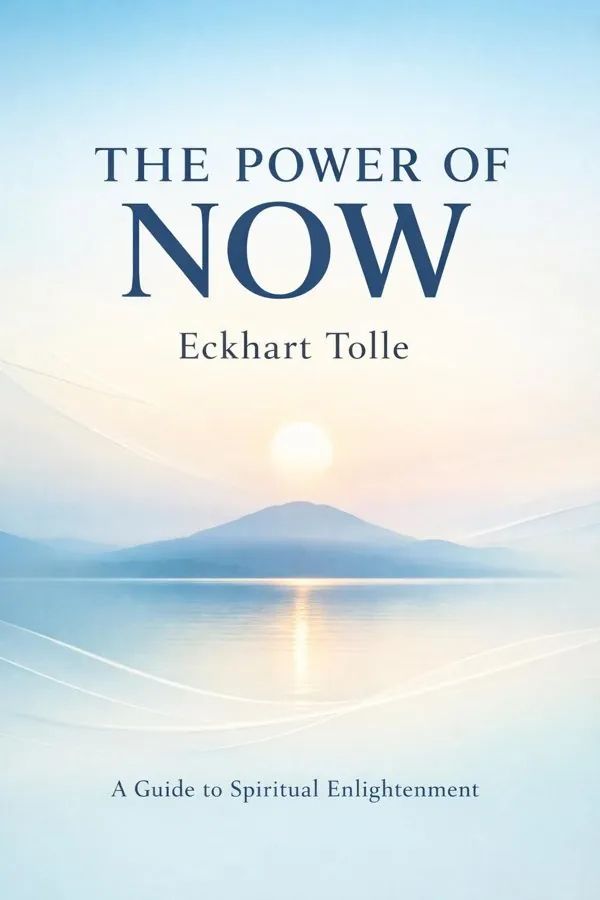
The Power of Now: A Guide to Spiritual Enlightenment: Summary & Key Insights
 10 min10 chaptersAudio available
Key Takeaways from The Power of Now: A Guide to Spiritual Enlightenment
Most people live as if real life exists somewhere else—in memory, anticipation, regret, or hope.
A mind that never stops talking can easily become a prison.
Not all emotional pain belongs only to the present moment.
A surprising amount of human suffering comes not from circumstances themselves, but from our inner opposition to them.
Transformation does not begin by becoming someone new; it begins by seeing clearly who you have been unconsciously.
What Is The Power of Now: A Guide to Spiritual Enlightenment About?
The Power of Now: A Guide to Spiritual Enlightenment by Eckhart Tolle is a eastern_wisdom book spanning 10 pages. The Power of Now is a modern spiritual classic that argues that most human suffering is created not by life itself, but by our compulsive attachment to thought, time, and ego. Eckhart Tolle invites readers to discover a radically different way of living: one rooted in direct presence rather than endless mental noise. Instead of treating spirituality as a belief system, he presents it as an experience available in any ordinary moment—through awareness, surrender, and attention to what is happening right now. The book matters because it addresses a problem nearly everyone recognizes: overthinking, anxiety, emotional pain, and a constant sense of being pulled away from peace. Tolle’s central claim is both simple and profound: freedom begins when we stop identifying with the mind and recognize ourselves as the awareness behind it. Drawing from Eastern wisdom, meditation traditions, and his own dramatic spiritual awakening after intense inner suffering, Tolle writes with the authority of lived transformation rather than abstract theory. For readers seeking calm, clarity, and a deeper sense of self, this book offers both a philosophy and a daily practice.
This FizzRead summary covers all 10 key chapters of The Power of Now: A Guide to Spiritual Enlightenment in approximately 10 minutes, distilling the most important ideas, arguments, and takeaways from Eckhart Tolle's work. Also available as an audio summary and Key Quotes Podcast.
The Power of Now: A Guide to Spiritual Enlightenment
The Power of Now is a modern spiritual classic that argues that most human suffering is created not by life itself, but by our compulsive attachment to thought, time, and ego. Eckhart Tolle invites readers to discover a radically different way of living: one rooted in direct presence rather than endless mental noise. Instead of treating spirituality as a belief system, he presents it as an experience available in any ordinary moment—through awareness, surrender, and attention to what is happening right now.
The book matters because it addresses a problem nearly everyone recognizes: overthinking, anxiety, emotional pain, and a constant sense of being pulled away from peace. Tolle’s central claim is both simple and profound: freedom begins when we stop identifying with the mind and recognize ourselves as the awareness behind it. Drawing from Eastern wisdom, meditation traditions, and his own dramatic spiritual awakening after intense inner suffering, Tolle writes with the authority of lived transformation rather than abstract theory. For readers seeking calm, clarity, and a deeper sense of self, this book offers both a philosophy and a daily practice.
Who Should Read The Power of Now: A Guide to Spiritual Enlightenment?
This book is perfect for anyone interested in eastern_wisdom and looking to gain actionable insights in a short read. Whether you're a student, professional, or lifelong learner, the key ideas from The Power of Now: A Guide to Spiritual Enlightenment by Eckhart Tolle will help you think differently.
- ✓Readers who enjoy eastern_wisdom and want practical takeaways
- ✓Professionals looking to apply new ideas to their work and life
- ✓Anyone who wants the core insights of The Power of Now: A Guide to Spiritual Enlightenment in just 10 minutes
Want the full summary?
Get instant access to this book summary and 100K+ more with Fizz Moment.
Get Free SummaryAvailable on App Store • Free to download
Key Chapters
Most people live as if real life exists somewhere else—in memory, anticipation, regret, or hope. Tolle’s first major insight is that the present moment is not merely one part of life; it is the only place where life actually happens. The past survives only as memory traces in the mind, and the future appears only as imagination or projection. Yet we often sacrifice the only real moment we have by resisting it, rushing through it, or treating it as a means to an imagined better future.
Tolle does not deny practical time. We still need clocks, calendars, plans, and goals. His point is that psychological time—living through constant mental replay and anticipation—creates suffering. When your identity is tied to what happened before or what might happen next, you lose contact with the aliveness of now. This loss of presence shows up as stress, impatience, dissatisfaction, and a vague sense that fulfillment is always just out of reach.
In practice, living in the present does not mean becoming passive or careless. It means giving full attention to whatever is here: a conversation, a task, a breath, a feeling. Washing dishes, walking to work, or waiting in line can become opportunities to experience presence rather than irritation. The present moment may not always be pleasant, but meeting it directly reduces the suffering added by mental resistance.
Actionable takeaway: Several times today, pause and ask, “What is missing in this moment?” Then bring your full attention to your breath, body, and immediate surroundings for thirty seconds.
A mind that never stops talking can easily become a prison. Tolle’s second core teaching is that thought itself is not the enemy; the problem begins when we become completely identified with it. Most people assume that the voice in their head—the one that comments, judges, compares, fears, and narrates—is who they are. Tolle challenges this assumption by asking a liberating question: If you can observe your thoughts, then who is the observer?
The moment you notice your thinking, a space opens between awareness and the mind. In that space, a deeper identity becomes available. You are not the stream of mental content but the consciousness in which that content appears. This shift sounds subtle, but it changes everything. Instead of being dragged by every worry, irritation, or opinion, you begin to witness them without being consumed by them.
This teaching is especially useful in daily stress. Imagine receiving a critical email. The mind instantly creates stories: “I’m failing,” “They don’t respect me,” “This always happens.” If you are identified with those thoughts, your mood and behavior follow them. But if you notice, “My mind is generating defensive thoughts,” you gain freedom. You can respond more intelligently and less reactively.
Tolle is not asking readers to stop thinking altogether. He is asking them to use the mind as a tool rather than letting it dominate consciousness. Clear thinking becomes easier when it is no longer mixed with compulsive self-talk.
Actionable takeaway: The next time strong thoughts arise, silently say, “I am aware of this thought.” Repeat until you feel the difference between the thought and the awareness noticing it.
Not all emotional pain belongs only to the present moment. Tolle introduces the idea of the pain-body, an accumulated field of old emotional pain that lives within us and periodically becomes active. It may be formed from personal wounds, childhood hurt, conflict, rejection, grief, or even deeper collective patterns. When activated, the pain-body seeks more pain. It influences thoughts, distorts perception, and can make minor events feel disproportionately intense.
This explains why a simple disagreement can suddenly become explosive, or why certain moods seem to arrive with a life of their own. The pain-body wants identification. It thrives when we say, “This is me,” or when we act out its energy through blame, self-pity, resentment, or dramatic conflict. Once active, it can take over relationships, decisions, and behavior.
The key is not suppression but conscious observation. When you notice a wave of anger, sadness, or emotional heaviness, Tolle suggests recognizing that a pain-body may be activated. Instead of becoming the emotion or projecting it outward, you bring alert attention to it. Awareness becomes a transforming force. The pain-body loses strength when it is witnessed without feeding on thought and reaction.
For example, if criticism from a partner triggers an unusually intense response, pause before replying. Feel the energy in the body—the tight chest, heat in the face, knot in the stomach. By staying present with the sensation instead of the story, you interrupt the cycle.
Actionable takeaway: When emotional intensity rises, stop explaining it mentally. Feel where it lives in the body for one full minute and observe it without judgment before speaking or acting.
A surprising amount of human suffering comes not from circumstances themselves, but from our inner opposition to them. Tolle argues that resistance—mental complaint, emotional refusal, and internal argument with what already is—creates tension and unhappiness. Entering the Now means dropping this resistance and allowing the present moment to be as it is before deciding what to do about it.
Acceptance is often misunderstood as weakness or resignation. Tolle means something more precise: acknowledging reality inwardly so that clear action becomes possible. If it is raining, fighting the fact that it is raining changes nothing. If a meeting is delayed, mentally complaining does not improve the situation. Resistance adds a second layer of suffering on top of life’s actual conditions.
This principle becomes powerful in everyday frustrations. Traffic, noise, delays, mistakes, illness, and difficult personalities often trigger disproportionate irritation because the mind insists, “This should not be happening.” But once you notice the resistance itself, you can relax around the moment. That relaxed attention often leads to better choices. You may still set boundaries, solve problems, or leave unhealthy situations, but without the extra burden of psychological struggle.
Presence is not the absence of action. It is the absence of unconscious reactivity. When resistance drops, intelligence functions more cleanly. You stop wasting energy on what has already happened and become available for the next wise step.
Actionable takeaway: The next time you catch yourself complaining internally, pause and say, “This is what is.” Then decide on one constructive action—or choose to let the moment be.
Transformation does not begin by becoming someone new; it begins by seeing clearly who you have been unconsciously. Tolle describes awakening as the rise of consciousness out of habitual identification with mental patterns. This awakening is not a dramatic mystical event for everyone. Often it begins quietly: noticing repetitive thoughts, observing emotional triggers, and sensing a stable stillness behind changing experiences.
The more you observe yourself without judgment, the less power old conditioning has over you. Judgment tends to strengthen the ego because it creates another layer of identity—“I am the kind of person who should not feel this.” Observation is different. It simply sees: “Fear is here,” “Defensiveness is here,” “The need to be right is here.” In that seeing, consciousness becomes stronger than the pattern.
A practical benefit of this teaching is that it makes spiritual growth immediate and accessible. You do not need to wait for perfect conditions. A difficult boss, an anxious commute, or a tense family visit can all become part of the practice. Each moment of awareness weakens automaticity. Over time, life feels less like a series of reactions and more like a field of conscious choice.
Tolle also emphasizes that awakened consciousness carries qualities the mind cannot manufacture: spaciousness, peace, clarity, and compassion. These are not achievements to acquire but natural expressions of presence when the ego’s grip loosens.
Actionable takeaway: Choose one recurring pattern—such as interrupting others, catastrophizing, or seeking approval—and observe it for a week without trying to fix it immediately. Let awareness itself begin the transformation.
Nothing exposes unconsciousness faster than another human being. Tolle sees relationships as one of the most powerful arenas for spiritual practice because they trigger attachment, fear, expectation, and the pain-body. In close relationships, we often look to the other person for identity, emotional completion, or rescue from inner emptiness. That dependency creates conflict, disappointment, and cycles of blame.
The ego wants to be right, recognized, needed, and protected. In relationships, this can appear as defensiveness, control, passive aggression, emotional withdrawal, or constant complaint. Tolle’s insight is not that relationships are the problem, but that they mirror our inner state. Instead of using conflict to prove our case, we can use it to become conscious.
For example, if your partner forgets something important and you feel a surge of anger, the usual pattern is immediate accusation. Presence invites a different response: notice the emotional charge, feel it in the body, observe the thoughts, and then speak from clarity rather than reaction. The conversation becomes less about winning and more about understanding.
Tolle also reframes love. Genuine love is not possessiveness or emotional addiction. It arises from presence and allows freedom, honesty, and deep listening. When two people bring awareness to a relationship, conflict does not disappear, but it no longer has to become unconscious drama.
Actionable takeaway: During your next disagreement, focus first on remaining present in your body and breath while the other person speaks. Make understanding more important than immediate self-defense.
Many people believe peace will come after they control life. Tolle reverses this logic: peace comes when we stop demanding that reality conform to the mind’s preferences. He calls this surrender. Far from defeat, surrender is an inner yes to what already exists. It is the willingness to face the present moment without resistance, denial, or victimhood.
Surrender is especially relevant when life becomes difficult—loss, illness, uncertainty, failure, or endings. The ego interprets these moments as personal threats and responds with fear or bitterness. But when we surrender inwardly, a different quality emerges. We may still feel grief, pain, or sadness, but we are no longer adding mental warfare to the experience. This often reveals unexpected strength and calm.
Consider a job loss. The unsurrendered mind loops through resentment, panic, and identity collapse: “This should not have happened. My future is ruined.” Surrender does not mean liking the situation. It means admitting the fact of it completely. From there, energy returns. Practical action—updating a resume, asking for help, exploring new paths—becomes possible.
For Tolle, surrender is one of the deepest spiritual practices because it dissolves egoic resistance and reconnects us to the intelligence of life. It aligns us with reality instead of exhausting us in opposition to it.
Actionable takeaway: Identify one situation you have been mentally fighting. Write down the sentence, “This is my reality right now.” Read it slowly and notice what changes when you stop arguing with the fact.
Presence becomes easier when attention moves out of abstract thinking and into direct experience. One of Tolle’s most practical methods is awareness of the inner body—the subtle felt sense of aliveness within. Rather than focusing only on external events or mental narratives, he encourages readers to sense the body from within: the hands, feet, chest, abdomen, and overall field of living energy.
This practice acts as an anchor. When thoughts spiral, the inner body interrupts the mind’s momentum and brings consciousness into the present. It is especially useful during anxiety, conflict, waiting, or overstimulation. By sensing the body internally, even for a few seconds, you become less absorbed in mental stories and more grounded in immediate being.
Unlike some forms of concentration that require intense effort, inner-body awareness is gentle and portable. You can do it while listening, walking, working, or resting. In a tense meeting, for example, you might keep part of your attention in your hands and breath. This subtle grounding can reduce reactivity and improve clarity. Before sleep, feeling the inner body may quiet mental chatter and create calm.
Tolle sees the body not merely as flesh but as a doorway into deeper presence. The body exists now; it does not inhabit past and future the way the mind does. Returning to it reconnects you with stillness.
Actionable takeaway: Three times today, close your eyes for twenty seconds and feel the inner aliveness in your hands and chest. Use this as your reset whenever the mind becomes overwhelming.
Time is necessary for practical life, but disastrous when it becomes the basis of identity. Tolle distinguishes between clock time and psychological time. Clock time helps us organize life: schedules, appointments, deadlines, and long-term plans. Psychological time, however, is the mind’s habit of turning life into an endless story of what was and what will be. It keeps us trapped in guilt, nostalgia, anxiety, impatience, and striving.
When people say, “I’ll be at peace when…,” they usually reveal psychological time at work. Peace is postponed into the future, while the present becomes merely an obstacle or preparation. The same pattern appears in fixation on the past: “If that had not happened, I would be whole.” In both cases, the mind treats the Now as insufficient.
Tolle’s insight does not abolish goals. You can work toward something while staying rooted in presence. The difference lies in whether your inner state depends on an outcome. A conscious person may prepare for an exam, launch a business, or train for a race, but without sacrificing peace to imagined futures.
This is deeply practical. If you are constantly rushing, ask whether the urgency is truly required or mentally manufactured. If you are reliving an old mistake, ask whether the mind is extracting wisdom or simply rehearsing pain. Presence restores proportion and reduces unnecessary suffering.
Actionable takeaway: The next time you think, “I just need to get through this,” stop and give complete attention to the current step. Let the process matter as much as the result.
Spiritual insight matters only if it transforms ordinary life. Tolle’s final message is that awakening is not an escape from the world but a new way of inhabiting it. After glimpsing presence, life does not become permanently easy or free from challenge. What changes is your relationship to thoughts, emotions, problems, and action. You become less identified with passing mental states and more rooted in awareness itself.
This shift affects work, creativity, health, decision-making, and service. In work, presence improves focus because energy is not constantly leaking into resistance and mental drama. In difficult moments, you respond with more steadiness. In success, you are less likely to build identity around achievement. In failure, you recover more quickly because your worth is no longer fused with outcomes.
Awakening also deepens ethical life. Presence naturally increases empathy and reduces unconscious harm. When the ego no longer needs constant reinforcement, there is more space for listening, patience, and genuine care. Even small acts—making tea, answering a message, walking into a room—carry a different quality when done consciously.
Tolle does not present enlightenment as a final status to possess. He presents it as an ongoing deepening into presence. Each moment offers a fresh chance to awaken from mental sleep and live from a quieter, truer center.
Actionable takeaway: Pick one routine activity—drinking coffee, opening your laptop, or getting into the car—and turn it into a daily ritual of presence by doing it with full attention and zero rush.
All Chapters in The Power of Now: A Guide to Spiritual Enlightenment
About the Author
Eckhart Tolle is a German-born spiritual teacher and bestselling author whose work has influenced millions of readers around the world. After experiencing years of intense inner distress in early adulthood, he underwent a profound personal transformation that became the foundation of his teaching. He later settled in Canada and began sharing a message centered on presence, consciousness, and freedom from ego-based suffering. Tolle became internationally known with the publication of The Power of Now, followed by other influential works such as A New Earth. His approach blends insights associated with Eastern wisdom, meditation, and spiritual inquiry, while remaining accessible to contemporary readers. Through books, lectures, and retreats, he has become one of the most recognized voices in modern spiritual literature.
Get This Summary in Your Preferred Format
Read or listen to the The Power of Now: A Guide to Spiritual Enlightenment summary by Eckhart Tolle anytime, anywhere. FizzRead offers multiple formats so you can learn on your terms — all free.
Available formats: App · Audio · PDF · EPUB — All included free with FizzRead
Download The Power of Now: A Guide to Spiritual Enlightenment PDF and EPUB Summary
Key Quotes from The Power of Now: A Guide to Spiritual Enlightenment
“Most people live as if real life exists somewhere else—in memory, anticipation, regret, or hope.”
“A mind that never stops talking can easily become a prison.”
“Not all emotional pain belongs only to the present moment.”
“A surprising amount of human suffering comes not from circumstances themselves, but from our inner opposition to them.”
“Transformation does not begin by becoming someone new; it begins by seeing clearly who you have been unconsciously.”
Frequently Asked Questions about The Power of Now: A Guide to Spiritual Enlightenment
The Power of Now: A Guide to Spiritual Enlightenment by Eckhart Tolle is a eastern_wisdom book that explores key ideas across 10 chapters. The Power of Now is a modern spiritual classic that argues that most human suffering is created not by life itself, but by our compulsive attachment to thought, time, and ego. Eckhart Tolle invites readers to discover a radically different way of living: one rooted in direct presence rather than endless mental noise. Instead of treating spirituality as a belief system, he presents it as an experience available in any ordinary moment—through awareness, surrender, and attention to what is happening right now. The book matters because it addresses a problem nearly everyone recognizes: overthinking, anxiety, emotional pain, and a constant sense of being pulled away from peace. Tolle’s central claim is both simple and profound: freedom begins when we stop identifying with the mind and recognize ourselves as the awareness behind it. Drawing from Eastern wisdom, meditation traditions, and his own dramatic spiritual awakening after intense inner suffering, Tolle writes with the authority of lived transformation rather than abstract theory. For readers seeking calm, clarity, and a deeper sense of self, this book offers both a philosophy and a daily practice.
More by Eckhart Tolle
You Might Also Like
A New Earth
Eckhart Tolle
10 min
The Daily Stoic
Ryan Holiday, Stephen Hanselman
10 min
Buddhism: Plain and Simple
Steve Hagen
10 min
Enchiridion
Epictetus
10 min
The Book of Tea
Kakuzō Okakura
10 min
The Light We Give: How Sikh Wisdom Can Transform Your Life
Simran Jeet Singh
10 minBrowse by Category
Ready to read The Power of Now: A Guide to Spiritual Enlightenment?
Get the full summary and 100K+ more books with Fizz Moment.