
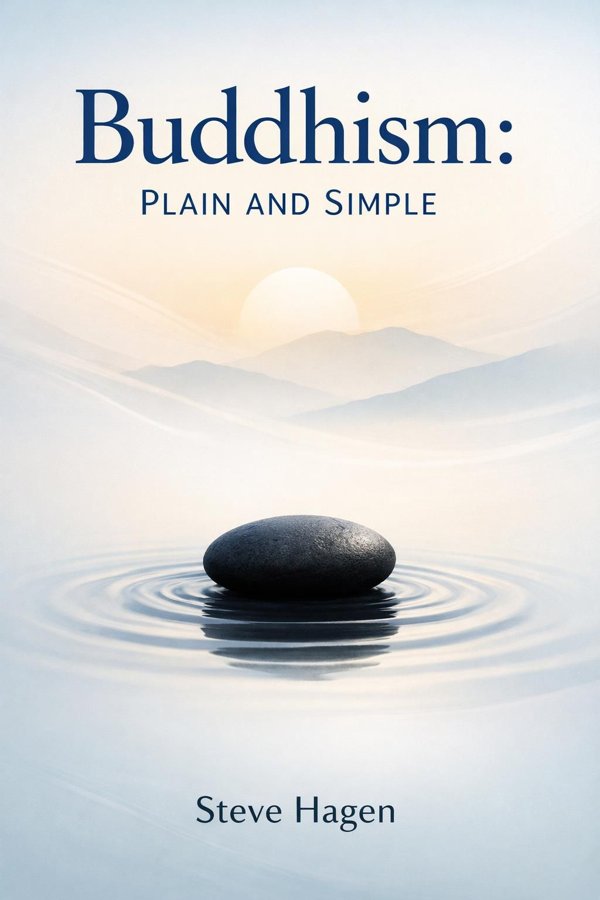
Buddhism: Plain and Simple: Summary & Key Insights
by Steve Hagen
 10 min8 chaptersAudio available
Key Takeaways from Buddhism: Plain and Simple
One of the book’s most challenging insights is that truth cannot be borrowed.
We often assume suffering is caused mainly by difficult events, but Hagen points out that suffering deepens when we misunderstand what is happening.
A great deal of human fear comes from treating change as an enemy.
Few ideas are as unsettling or freeing as the Buddhist insight that the self we defend so fiercely may not be as fixed as we think.
If confusion keeps us trapped, attention begins to set us free.
What Is Buddhism: Plain and Simple About?
Buddhism: Plain and Simple by Steve Hagen is a eastern_wisdom book. Steve Hagen’s Buddhism: Plain and Simple is an invitation to look directly at experience rather than rely on beliefs, doctrines, or secondhand spiritual ideas. Instead of presenting Buddhism as an exotic religion or a system of abstract philosophy, Hagen strips it down to its essential insight: suffering arises when we fail to see reality clearly, and freedom becomes possible when we wake up to things as they are. The book guides readers through core Buddhist ideas such as attention, impermanence, self, desire, and awareness in language that is strikingly direct and accessible. What makes this book matter is its refusal to let Buddhism remain merely intellectual. Hagen insists that truth is not something to admire from a distance; it must be discovered in immediate experience, here and now. That approach makes the book especially valuable for modern readers who want practical wisdom rather than metaphysical complexity. As a Zen priest and meditation teacher, Hagen writes with both authority and simplicity, translating profound teachings into everyday understanding. The result is a concise but powerful introduction for anyone seeking clarity, inner freedom, and a more honest way of meeting life.
This FizzRead summary covers all 8 key chapters of Buddhism: Plain and Simple in approximately 10 minutes, distilling the most important ideas, arguments, and takeaways from Steve Hagen's work. Also available as an audio summary and Key Quotes Podcast.
Buddhism: Plain and Simple
Steve Hagen’s Buddhism: Plain and Simple is an invitation to look directly at experience rather than rely on beliefs, doctrines, or secondhand spiritual ideas. Instead of presenting Buddhism as an exotic religion or a system of abstract philosophy, Hagen strips it down to its essential insight: suffering arises when we fail to see reality clearly, and freedom becomes possible when we wake up to things as they are. The book guides readers through core Buddhist ideas such as attention, impermanence, self, desire, and awareness in language that is strikingly direct and accessible.
What makes this book matter is its refusal to let Buddhism remain merely intellectual. Hagen insists that truth is not something to admire from a distance; it must be discovered in immediate experience, here and now. That approach makes the book especially valuable for modern readers who want practical wisdom rather than metaphysical complexity. As a Zen priest and meditation teacher, Hagen writes with both authority and simplicity, translating profound teachings into everyday understanding. The result is a concise but powerful introduction for anyone seeking clarity, inner freedom, and a more honest way of meeting life.
Who Should Read Buddhism: Plain and Simple?
This book is perfect for anyone interested in eastern_wisdom and looking to gain actionable insights in a short read. Whether you're a student, professional, or lifelong learner, the key ideas from Buddhism: Plain and Simple by Steve Hagen will help you think differently.
- ✓Readers who enjoy eastern_wisdom and want practical takeaways
- ✓Professionals looking to apply new ideas to their work and life
- ✓Anyone who wants the core insights of Buddhism: Plain and Simple in just 10 minutes
Want the full summary?
Get instant access to this book summary and 100K+ more with Fizz Moment.
Get Free SummaryAvailable on App Store • Free to download
Key Chapters
One of the book’s most challenging insights is that truth cannot be borrowed. Steve Hagen argues that the central task of Buddhism is not to adopt a new set of beliefs, but to see reality directly for yourself. We usually live through ideas, labels, memories, and expectations. We think we know what life is because we have concepts about it. But according to Hagen, concepts are not the same as reality. They can point toward truth, yet they can also block us from experiencing what is actually here.
This is why Buddhism, in Hagen’s presentation, is radically practical. It asks: What are you experiencing right now? What is this moment before you explain it? When we stop rushing to interpret everything, we begin to notice how much of our suffering comes from living in thought rather than in reality. We compare the present with our plans, fears, and judgments, and then wonder why we feel disconnected.
A simple example is listening to someone during a conversation. Often, we are not really listening; we are preparing a response, defending ourselves, or filtering their words through old stories. Direct seeing means noticing the actual tone, emotion, and meaning in the moment. Another example is eating a meal without distraction and realizing how rarely we truly taste our food.
Hagen’s point is not anti-thinking. Thought has its place. But wisdom begins when we recognize the limits of thought and return to immediate awareness. The practical benefit is profound: less confusion, less projection, and a stronger connection to life as it unfolds.
Actionable takeaway: Several times a day, pause for one minute and ask, “What is happening right now before I name it?” Then notice sensations, sounds, and feelings directly.
We often assume suffering is caused mainly by difficult events, but Hagen points out that suffering deepens when we misunderstand what is happening. Pain is part of life, yet psychological suffering grows from resistance, grasping, and confusion. In Buddhism: Plain and Simple, suffering is not treated as punishment or pessimism. It is presented as a clue. It shows us that something in the way we are seeing reality is out of alignment.
We suffer because we want life to be permanent when it is changing. We want ourselves to be solid when we are fluid and changing too. We want certainty in a world that offers movement, complexity, and unpredictability. Instead of meeting what is here, we fight against it mentally and emotionally. That struggle becomes anxiety, frustration, resentment, or despair.
Consider a common situation: a plan falls apart. The event itself may be inconvenient, but much of the suffering comes from the thought, “This should not be happening.” Or someone criticizes us. The words may sting, but the larger torment often comes from the image of ourselves that we feel must be defended. In both cases, suffering increases when reality conflicts with our fixed expectations.
Hagen’s teaching is not to become passive or emotionally numb. It is to see clearly that suffering is intensified by our refusal to accept the nature of experience. When we notice this mechanism, we become less trapped by it. We stop adding layers of mental pain on top of life’s inevitable difficulties.
Actionable takeaway: The next time you feel upset, ask, “What part of this is the event itself, and what part is my resistance to it?” That question can reveal where freedom begins.
A great deal of human fear comes from treating change as an enemy. Hagen reminds readers that impermanence is not a tragic flaw in existence; it is the basic nature of reality. Everything changes: moods, relationships, bodies, thoughts, roles, possessions, success, and failure. We may understand this intellectually, yet we still live as if permanence were possible. Buddhism calls us to stop fighting this truth and start seeing it clearly.
What makes impermanence difficult is our attachment to stability. We want pleasant experiences to last and unpleasant ones to disappear immediately. But because all things arise and pass, clinging becomes a source of distress. If you try to freeze a moment of happiness, you suffer. If you assume pain will last forever, you also suffer. In both cases, reality is being misread.
Hagen’s treatment of impermanence is not bleak. It is liberating. If everything changes, then painful states are not fixed identities. Anxiety is not a permanent self. Failure is not a final definition. Even the stories we tell about who we are can soften when we recognize their changing nature. Impermanence makes healing, growth, and transformation possible.
In everyday life, this insight can change how we respond to stress. A difficult workweek does not define your entire life. A conflict in a relationship is not the whole relationship. A moment of embarrassment will pass. Likewise, joyful moments deserve full appreciation precisely because they are fleeting.
Instead of demanding permanence, Buddhism encourages presence. We meet each moment as it is, knowing it cannot be held.
Actionable takeaway: When you experience something pleasant or unpleasant today, silently say, “This too is changing.” Let that reminder help you relax your grip and stay present.
Few ideas are as unsettling or freeing as the Buddhist insight that the self we defend so fiercely may not be as fixed as we think. Hagen explains that what we usually call “me” is a shifting process rather than a permanent entity. Thoughts change, emotions change, memories evolve, the body ages, preferences move, and roles come and go. Yet we keep assuming there is a solid inner owner behind all of it.
This assumption creates tension. We become preoccupied with protecting an identity, proving our worth, and maintaining a story about who we are. We feel wounded when that story is threatened and proud when it is praised. But if the self is not a fixed thing, much of this drama begins to loosen. The point is not that we do not exist in any practical sense. Rather, the self is not the independent, permanent object we imagine.
Think about how differently you act with friends, family, strangers, and coworkers. Which one is the “real” you? Or consider how the person you were ten years ago differs from who you are now. The self is not a simple object; it is a fluid pattern of habits, memories, sensations, and reactions. Seeing this can reduce ego-driven suffering.
This insight has practical effects. Criticism becomes easier to hear because it does not strike a fixed core. Success becomes less intoxicating because it does not permanently define you. Compassion also grows, because if the self is fluid in you, it is fluid in others as well.
Actionable takeaway: When you feel defensive, pause and ask, “What exactly am I protecting right now?” Trace the feeling to an image or story, and notice how temporary it is.
If confusion keeps us trapped, attention begins to set us free. Hagen places enormous emphasis on awareness, not as a mystical state but as a direct and disciplined way of being present. Most of the time, attention is scattered. We drift through habits, replay old conversations, anticipate future outcomes, and barely notice our actual lives. In this distracted state, we are easily carried away by craving, fear, and emotional reactivity.
Awareness interrupts that automatic momentum. When you notice a thought as a thought, it has less power. When you notice anger rising in the body, there is a chance to respond differently. When you become aware of restlessness, you are no longer completely ruled by it. Hagen’s teaching is simple but demanding: wake up to what is happening now.
This is why meditation matters in the Buddhist path. It is not about escaping life or manufacturing special experiences. It is training in seeing clearly. By sitting still and observing breath, sensations, thoughts, and impulses, we start to understand the mind’s habits. We see how quickly it clings, resists, fantasizes, and judges. That seeing itself is transformative.
Practical applications are everywhere. Before sending an angry email, notice your body and breathing. During a stressful meeting, feel your feet on the ground. While washing dishes, just wash dishes. These ordinary acts become opportunities to return to attention rather than disappear into mental noise.
Hagen makes clear that freedom is not hidden somewhere else. It emerges in the very moment we stop sleepwalking through experience.
Actionable takeaway: Pick one daily activity, such as brushing your teeth or making coffee, and do it with full attention for one week. Notice how often the mind wanders, then gently return.
Desire itself is not the whole problem; the real problem is clinging. Hagen carefully distinguishes between natural preferences and the grasping mind that insists, “I must have this,” or “This must not change.” Human life includes wanting food, connection, safety, beauty, and accomplishment. Buddhism does not ask us to become lifeless. It asks us to understand what happens when wanting hardens into attachment.
Clinging distorts experience. We stop relating to people, goals, and possessions wisely and begin using them to stabilize our sense of self. We imagine that the next achievement, purchase, relationship, or recognition will finally complete us. For a brief moment, satisfaction may come. But because reality is changing and no object can secure a permanent self, dissatisfaction returns.
This cycle is visible in ordinary life. You buy something you really wanted, then quickly adapt and want something else. You seek praise, enjoy it briefly, then worry about losing approval. You long for a specific outcome, and if it does not happen, frustration takes over. Even when it does happen, anxiety about keeping it often follows.
Hagen does not propose repression. Instead, he encourages seeing desire clearly as it arises. When you observe craving without immediately obeying it, space opens. You realize that an urge is not a command. This reduces compulsion and helps you act from wisdom rather than habit.
The shift is subtle but powerful: instead of trying to possess experience, you participate in it. You can enjoy what comes without building your identity around it.
Actionable takeaway: The next time you strongly want something, pause and name the feeling: “wanting is here.” Wait a few breaths before acting, and notice whether the intensity changes.
Many people approach spiritual traditions as systems of belief, but Hagen insists that Buddhism is fundamentally experiential. Its truth is not established by accepting doctrines on faith; it is verified through observation. This is one reason the book feels so fresh and direct. Hagen avoids turning Buddhism into metaphysical speculation and instead keeps returning to lived experience.
This matters because belief can become another form of sleep. We may feel secure because we hold the right opinions, repeat wise phrases, or identify with a spiritual tradition. Yet none of this guarantees insight. You can believe in impermanence and still cling. You can admire compassion and still react with hostility. You can study meditation and never sit still for five minutes. For Hagen, genuine understanding only appears when teachings are tested in life.
That practical emphasis makes Buddhism accessible to skeptics and beginners. You do not have to accept claims blindly. You can look at your own mind. Do thoughts change? Does grasping lead to agitation? Does careful attention reduce confusion? These are not abstract questions. They can be observed directly.
In everyday terms, this means the path is less about collecting ideas and more about changing how you meet experience. Reading about patience is not the same as practicing patience in traffic. Agreeing with non-attachment is not the same as letting go when plans collapse. The teachings become real only when lived.
Hagen’s approach protects Buddhism from becoming ornamental wisdom. It demands honesty and direct engagement.
Actionable takeaway: Choose one teaching from the book, such as impermanence or attention, and test it in real life for seven days. Focus on observation rather than opinion.
A common misunderstanding is that awakening belongs to monasteries, special retreats, or unusually serene people. Hagen dismantles this idea by showing that Buddhist practice happens in the middle of ordinary life. The path is not elsewhere. It appears in traffic, at work, in relationships, in boredom, in grief, and in moments of joy. Every situation reveals the mind’s habits and offers a chance to wake up.
This is one of the book’s most empowering contributions. You do not need to wait for ideal conditions to begin. In fact, difficult conditions often become the clearest teachers. When someone interrupts you, impatience is exposed. When uncertainty arises, your need for control becomes visible. When something pleasant appears, attachment can be seen in real time. Daily life becomes a laboratory for insight.
This perspective also prevents spirituality from turning into escape. It is easy to imagine that peace will come once life becomes more organized, people become easier, or circumstances become favorable. Hagen points out that such thinking postpones freedom indefinitely. The invitation is to meet this moment, exactly as it is, with awareness.
A parent dealing with a crying child can practice presence. A manager can notice defensiveness in a meeting. A student can observe anxiety before an exam. A person standing in line can feel the body, the impatience, and the urge to distract themselves. None of these moments are outside the path.
By grounding Buddhism in ordinary experience, Hagen makes awakening feel intimate and immediate rather than remote.
Actionable takeaway: At the end of each day, reflect on one ordinary moment that triggered stress or impatience. Ask, “What did it reveal about my mind, and how could I meet it more consciously next time?”
All Chapters in Buddhism: Plain and Simple
About the Author
Steve Hagen is a Zen Buddhist teacher, author, and meditation instructor known for presenting Buddhist wisdom in clear, accessible language. He has served as a priest and guiding teacher within the Zen tradition and has spent decades helping students explore awareness, suffering, and the nature of mind through direct experience rather than abstract belief. Hagen is especially respected for making core Buddhist teachings understandable to modern readers who may be new to meditation or wary of religious complexity. His writing emphasizes simplicity, attention, and the importance of seeing reality firsthand. Through books such as Buddhism: Plain and Simple, he has become a trusted guide for readers seeking an honest, practical introduction to Buddhist practice and insight.
Get This Summary in Your Preferred Format
Read or listen to the Buddhism: Plain and Simple summary by Steve Hagen anytime, anywhere. FizzRead offers multiple formats so you can learn on your terms — all free.
Available formats: App · Audio · PDF · EPUB — All included free with FizzRead
Download Buddhism: Plain and Simple PDF and EPUB Summary
Key Quotes from Buddhism: Plain and Simple
“One of the book’s most challenging insights is that truth cannot be borrowed.”
“We often assume suffering is caused mainly by difficult events, but Hagen points out that suffering deepens when we misunderstand what is happening.”
“A great deal of human fear comes from treating change as an enemy.”
“Few ideas are as unsettling or freeing as the Buddhist insight that the self we defend so fiercely may not be as fixed as we think.”
“If confusion keeps us trapped, attention begins to set us free.”
Frequently Asked Questions about Buddhism: Plain and Simple
Buddhism: Plain and Simple by Steve Hagen is a eastern_wisdom book that explores key ideas across 8 chapters. Steve Hagen’s Buddhism: Plain and Simple is an invitation to look directly at experience rather than rely on beliefs, doctrines, or secondhand spiritual ideas. Instead of presenting Buddhism as an exotic religion or a system of abstract philosophy, Hagen strips it down to its essential insight: suffering arises when we fail to see reality clearly, and freedom becomes possible when we wake up to things as they are. The book guides readers through core Buddhist ideas such as attention, impermanence, self, desire, and awareness in language that is strikingly direct and accessible. What makes this book matter is its refusal to let Buddhism remain merely intellectual. Hagen insists that truth is not something to admire from a distance; it must be discovered in immediate experience, here and now. That approach makes the book especially valuable for modern readers who want practical wisdom rather than metaphysical complexity. As a Zen priest and meditation teacher, Hagen writes with both authority and simplicity, translating profound teachings into everyday understanding. The result is a concise but powerful introduction for anyone seeking clarity, inner freedom, and a more honest way of meeting life.
You Might Also Like
A New Earth
Eckhart Tolle
10 min
The Daily Stoic
Ryan Holiday, Stephen Hanselman
10 min
Enchiridion
Epictetus
10 min
The Book of Tea
Kakuzō Okakura
10 min
The Light We Give: How Sikh Wisdom Can Transform Your Life
Simran Jeet Singh
10 min
The Miracle of Mindfulness: An Introduction to the Practice of Meditation
Thich Nhat Hanh
10 minFeatured In
Browse by Category
Ready to read Buddhism: Plain and Simple?
Get the full summary and 100K+ more books with Fizz Moment.