
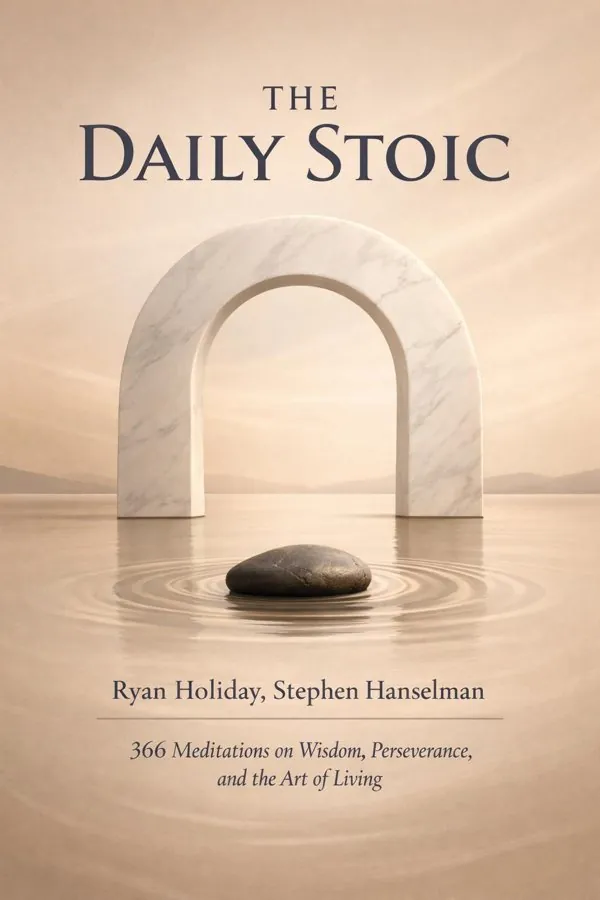
The Daily Stoic: Summary & Key Insights
by Ryan Holiday, Stephen Hanselman
 10 min9 chaptersAudio available
Key Takeaways from The Daily Stoic
The first battle in life is rarely with events themselves; it is with the story you tell yourself about them.
Clear thinking matters, but Stoicism is not just a philosophy of inner calm; it is a philosophy of ethical action.
No philosophy is serious if it only works when life is pleasant.
One of Stoicism’s most liberating ideas is also one of its simplest: some things are up to you, and some are not.
Much of what derails people is not a lack of talent or opportunity, but an excess of ego.
What Is The Daily Stoic About?
The Daily Stoic by Ryan Holiday, Stephen Hanselman is a eastern_wisdom book published in 2016 spanning 3 pages. The Daily Stoic is a practical guide to living with greater clarity, steadiness, and self-command. Structured as 366 short meditations—one for each day of the year—it draws on the timeless wisdom of Marcus Aurelius, Seneca, and Epictetus, then translates their ideas into language that speaks to modern work, relationships, ambition, anxiety, and adversity. Rather than presenting Stoicism as a dry historical philosophy, Ryan Holiday and Stephen Hanselman show it as a daily discipline: a way to train your mind, direct your actions, and meet life’s uncertainties without being ruled by them. What makes the book matter is its usefulness. These reflections are not designed to impress you intellectually; they are meant to change how you respond when plans fail, tempers rise, egos flare, or fears take over. Holiday, known for bringing Stoic philosophy into contemporary culture, and Hanselman, a seasoned translator and interpreter of classical thought, make ancient insights feel immediate and actionable. The result is a book that can be read a page at a time yet shape an entire outlook—a manual for becoming calmer, wiser, and more resilient in everyday life.
This FizzRead summary covers all 9 key chapters of The Daily Stoic in approximately 10 minutes, distilling the most important ideas, arguments, and takeaways from Ryan Holiday, Stephen Hanselman's work. Also available as an audio summary and Key Quotes Podcast.
The Daily Stoic
The Daily Stoic is a practical guide to living with greater clarity, steadiness, and self-command. Structured as 366 short meditations—one for each day of the year—it draws on the timeless wisdom of Marcus Aurelius, Seneca, and Epictetus, then translates their ideas into language that speaks to modern work, relationships, ambition, anxiety, and adversity. Rather than presenting Stoicism as a dry historical philosophy, Ryan Holiday and Stephen Hanselman show it as a daily discipline: a way to train your mind, direct your actions, and meet life’s uncertainties without being ruled by them.
What makes the book matter is its usefulness. These reflections are not designed to impress you intellectually; they are meant to change how you respond when plans fail, tempers rise, egos flare, or fears take over. Holiday, known for bringing Stoic philosophy into contemporary culture, and Hanselman, a seasoned translator and interpreter of classical thought, make ancient insights feel immediate and actionable. The result is a book that can be read a page at a time yet shape an entire outlook—a manual for becoming calmer, wiser, and more resilient in everyday life.
Who Should Read The Daily Stoic?
This book is perfect for anyone interested in eastern_wisdom and looking to gain actionable insights in a short read. Whether you're a student, professional, or lifelong learner, the key ideas from The Daily Stoic by Ryan Holiday, Stephen Hanselman will help you think differently.
- ✓Readers who enjoy eastern_wisdom and want practical takeaways
- ✓Professionals looking to apply new ideas to their work and life
- ✓Anyone who wants the core insights of The Daily Stoic in just 10 minutes
Want the full summary?
Get instant access to this book summary and 100K+ more with Fizz Moment.
Get Free SummaryAvailable on App Store • Free to download
Key Chapters
The first battle in life is rarely with events themselves; it is with the story you tell yourself about them. This is the foundation of the Stoic discipline of perception, and it sits at the heart of The Daily Stoic. The Stoics argued that most suffering does not come directly from what happens, but from the judgments we attach to what happens. An insult, a delay, a financial setback, a rejected proposal—these are facts. The panic, shame, resentment, and self-pity that often follow are interpretations.
Holiday and Hanselman repeatedly return to this principle because it is where freedom begins. If you cannot control whether traffic is bad, whether someone misunderstands you, or whether markets rise and fall, you can still control how you frame the experience. Is this disaster, or inconvenience? Is this humiliation, or feedback? Is this a dead end, or a test of creativity? Stoicism does not demand denial. It asks for accuracy. It teaches you to strip away exaggeration and emotional distortion so you can see what is actually in front of you.
In practical terms, this means pausing before reacting. A manager receives critical feedback and instantly assumes her career is threatened. A Stoic response would be to separate the facts from the fear: What exactly was said? What is under my control? What action can I take next? The same applies in personal life. If a friend is distant, you need not jump immediately to betrayal or rejection. You can choose curiosity over assumption.
Perception is powerful because it determines whether you become reactive or resourceful. Train yourself to question your first interpretation, and many problems will shrink to their true size. Actionable takeaway: when something upsets you today, write down the event in one sentence without adjectives or drama, then ask, “What judgment am I adding to this?”
Clear thinking matters, but Stoicism is not just a philosophy of inner calm; it is a philosophy of ethical action. The Daily Stoic emphasizes that once you learn to interpret events wisely, you must also learn to behave well within them. This is the discipline of action: doing what is right, useful, courageous, and fair even when it is inconvenient, unnoticed, or difficult.
The Stoics believed virtue is the highest good. That means your real task each day is not to win every argument, get every advantage, or protect your image. It is to act with integrity. Can you be patient when provoked? Can you do the hard work without complaint? Can you resist gossip, pettiness, and retaliation? Can you fulfill your responsibilities even when your mood tells you not to? These are not minor matters in Stoicism; they are the measure of your life.
Holiday’s commentary makes this intensely practical. In the workplace, the discipline of action means focusing on contribution instead of status. Rather than asking, “How do I look?” ask, “What is needed?” In conflict, it means refusing to mirror the worst behavior of others. If a colleague is political or rude, Stoicism does not ask you to be passive. It asks you to stay principled. In family life, right action may mean listening more carefully, apologizing sooner, or doing small duties reliably instead of chasing dramatic gestures.
The key is that action should be guided by values, not feelings. Waiting to “feel like it” is unreliable. The Stoic acts from commitment. Small repeated choices build moral strength just as physical training builds muscle. Actionable takeaway: choose one role you hold today—parent, colleague, partner, friend—and ask, “What would excellence in this role look like for the next hour?” Then do exactly that.
No philosophy is serious if it only works when life is pleasant. The Daily Stoic’s third major theme, the discipline of will, concerns how you respond to what you cannot avoid: pain, uncertainty, aging, loss, setbacks, and death. The Stoics did not promise escape from hardship. They taught that hardship can become training if you meet it with endurance, humility, and perspective.
This idea is easy to admire and hard to live. When plans collapse or suffering arrives, the instinct is to resist reality, to ask why this is happening, or to imagine that life has singled you out unfairly. Stoicism offers a different posture. It tells you to stop demanding that the world match your preferences. Instead, develop the strength to work with what is here. The obstacle becomes the lesson. The delay becomes a chance to practice patience. The loss becomes a reminder of what truly matters. The insult becomes an opportunity to master ego.
Holiday and Hanselman present will not as grim toughness, but as disciplined acceptance. Acceptance is not surrendering your agency; it is refusing to waste energy fighting facts. If an illness changes your routine, you can still choose dignity, gratitude, and steadiness. If a project fails, you can still choose reflection, improvement, and another attempt. The Stoic does not control outcomes, but preserves freedom in how they are met.
This mindset is especially powerful in modern life, where many people crumble not from catastrophe but from constant frustration. Delays, criticism, uncertainty, and discomfort can become intolerable when you expect life to be smooth. Stoicism resets that expectation. Difficulty is not an exception to the path; it is part of the path. Actionable takeaway: the next time you face something unavoidable, stop asking, “How do I get rid of this?” and ask, “What quality is this situation asking me to practice?”
One of Stoicism’s most liberating ideas is also one of its simplest: some things are up to you, and some are not. The Daily Stoic repeatedly returns to this distinction because confusion here creates endless frustration. You control your judgments, intentions, effort, and conduct. You do not control other people’s opinions, world events, random timing, or final outcomes. Much of human misery comes from investing emotional energy in the second category while neglecting the first.
This principle is not meant to reduce ambition. It sharpens it. When you stop trying to manage what is uncontrollable, you recover attention for what is actually actionable. A student cannot guarantee admission to a dream school, but can control study habits, preparation, and resilience. An entrepreneur cannot control the market, but can control product quality, responsiveness, and decision-making. A person in a difficult relationship cannot force another person to change, but can control boundaries, honesty, and self-respect.
Holiday’s interpretation helps show how modern this ancient idea remains. Social media, office politics, and nonstop news cycles constantly tempt you to obsess over validation, reputation, and forces far outside your reach. Stoicism does not say those things are irrelevant. It says your peace should not depend on them. The disciplined life is built from internal ownership, not external volatility.
A useful test is to ask, before reacting strongly, “Is this mine to govern?” If the answer is no, release the demand for control. If the answer is yes, act decisively and well. This habit reduces anxiety because it transforms vague overwhelm into clear responsibility. You may not command the world, but you can command your next choice. Actionable takeaway: make two columns when stressed—“within my control” and “outside my control”—and commit to spending today’s energy only on the first.
Much of what derails people is not a lack of talent or opportunity, but an excess of ego. Throughout The Daily Stoic, readers are reminded that pride, vanity, self-importance, and the hunger to be admired distort judgment. Ego makes criticism unbearable, success intoxicating, and failure humiliating. It turns every moment into a referendum on identity. Stoicism seeks to free you from this trap by directing attention away from image and back to substance.
The Stoics were deeply suspicious of the need to appear impressive. They believed that if your worth depends on recognition, you become fragile. You start chasing applause instead of excellence, defending your persona instead of correcting your mistakes, and resenting anyone who threatens your self-story. Holiday often highlights how dangerous this is for ambitious people. The very drive that helps you achieve can also make you defensive, impatient, and blind.
In practical life, reducing ego changes everything. It allows you to say, “I was wrong,” without collapse. It lets you learn from people below you in status. It makes service easier because not every action must elevate your profile. In leadership, it means putting the mission ahead of your personal spotlight. In relationships, it means listening instead of merely waiting to be affirmed.
Humility in Stoicism is not self-belittlement. It is clear-seeing. You are neither the center of the universe nor a helpless victim of it. You are a person with work to do. That perspective is stabilizing. When praise comes, accept it lightly. When criticism comes, examine it honestly. In both cases, return to the task. Actionable takeaway: when you feel defensive today, pause and ask, “Am I protecting what is true, or merely protecting my self-image?”
A restless mind makes poor choices. One of the subtler lessons in The Daily Stoic is that wisdom requires stillness—not inactivity, but inner quiet. Stoicism trains you to resist impulsiveness, mental clutter, and emotional overreaction so you can respond from principle rather than turbulence. In a noisy world of notifications, outrage, and constant stimulation, this may be one of the book’s most valuable contributions.
The Stoics understood that a disturbed mind magnifies problems. When you are agitated, every inconvenience feels personal, every uncertainty feels threatening, and every desire feels urgent. Stillness creates distance between stimulus and response. That distance is where reason can operate. A calm person is not someone who never feels anger, fear, or excitement; it is someone who is not dragged helplessly by them.
Holiday and Hanselman encourage habits that foster this steadiness: morning reflection, journaling, reviewing the day, and consciously slowing down your interpretations. These practices are not merely relaxing. They are forms of mental training. A leader who takes five minutes before replying to a provocative email often avoids damage. A parent who notices rising frustration before speaking may prevent unnecessary conflict. A professional who steps back from panic during a setback can see solutions hidden by emotion.
Stillness also sharpens values. When your mind is less crowded by comparison, craving, and noise, you can better recognize what actually matters. Many people are exhausted not because life is impossible, but because their attention is scattered and undisciplined. Stoicism gathers it back.
This is why the daily format of the book matters. Short meditations create recurring pauses in the rush of living. They remind you that composure is built in moments, not achieved once and for all. Actionable takeaway: create one non-negotiable daily pause—five quiet minutes before checking messages—to ask, “What deserves my energy today, and what does not?”
To remember death is not morbid in Stoicism; it is clarifying. The Daily Stoic often invites readers to reflect on impermanence, not to darken life, but to sharpen it. If time is limited—and it is—then wasted attention, petty grudges, endless procrastination, and trivial status games become harder to justify. Mortality strips away illusion. It asks what is actually worth your days.
The Stoics believed many people live as if they have an unlimited supply of tomorrows. They postpone courage, delay important conversations, and drift through routines that do not match their values. By contrast, contemplating death creates urgency without panic. It can make you more present, more grateful, and more decisive. If this were not guaranteed to last, how would you speak to the people you love? What work would you stop postponing? What resentments would seem too expensive to keep carrying?
This idea has practical force because modern life is full of distraction but poor at perspective. It is easy to become consumed by small irritations or endless optimization while ignoring whether your life is aligned with what you truly care about. Stoicism uses mortality as a measuring stick. Not everything deserves emotional investment. Not every opportunity deserves a yes. Not every fight deserves to be fought.
The point is not to become detached from life, but more deeply engaged in it. When you remember that time is finite, simple moments gain value. Duty becomes more serious. Gratitude becomes more natural. You stop acting as though your best self can wait indefinitely.
Actionable takeaway: at the end of today, ask one question—“If I had only a year left, what would I change about how I spent this week?” Then make one concrete adjustment immediately.
Most people want a philosophy that helps them avoid discomfort. The Daily Stoic offers something stronger: a way to use discomfort well. Across its meditations, adversity is presented not merely as something to survive, but as a teacher that reveals character, tests values, and develops resilience. This is not romanticizing pain. It is recognizing that challenge often exposes weaknesses that comfort keeps hidden.
When everything goes smoothly, you may never discover how impatient, dependent, fearful, or prideful you are. Pressure reveals these tendencies. A delayed promotion can reveal how much your self-worth depends on validation. A public mistake can reveal how much ego controls your reactions. A difficult season can reveal whether your routines and beliefs are real or merely convenient. Stoicism treats these revelations as useful. The problem is not that hardship shows you your flaws. The problem is ignoring what it shows.
Holiday’s approach is especially effective because he frames adversity as a training ground for ordinary life, not just dramatic crises. You do not need tragedy to practice Stoicism. Long lines, rude strangers, uncertainty at work, physical fatigue, criticism, boredom, and inconvenience all become opportunities to rehearse patience, discipline, courage, and restraint. In this way, daily life itself becomes a gymnasium for the soul.
This perspective also reduces self-pity. Instead of asking, “Why is this happening to me?” you can ask, “How can this make me better?” That question does not erase pain, but it prevents useless suffering layered on top of pain. It restores agency in conditions where you may have little control.
Actionable takeaway: choose one recurring annoyance in your life and deliberately reframe it as training. Name the virtue it can help you build—patience, discipline, humility, or endurance—and practice that virtue every time it appears.
A powerful idea means little if it is not rehearsed. One reason The Daily Stoic has endured is that it treats philosophy as a practice, not a one-time insight. The daily reading format reflects a core Stoic truth: knowing what is wise is easy compared with remembering it under pressure. Human beings forget, drift, react, indulge, and rationalize. That is why training must be regular.
Holiday and Hanselman do not present Stoicism as something you master by finishing a book. They present it as something you return to repeatedly, especially because life keeps producing new tests. You may understand the value of patience, then lose it in traffic. You may believe in humility, then become arrogant after praise. You may admire resilience, then complain at the first inconvenience. Daily reminders are not evidence of failure. They are the mechanism of growth.
This has broad application. Athletes do not build skill by understanding technique once; they practice until it becomes instinct. Musicians do not perform well because they intellectually grasp rhythm; they train it into the body. Stoicism asks for the same repetition in moral and emotional life. Journaling, morning intention-setting, evening review, and returning to core principles are not decorative rituals. They are how philosophy becomes character.
This emphasis is especially valuable for readers who consume a lot of self-improvement content without changing much. The Daily Stoic quietly insists that consistency beats intensity. A small reflection acted on every day will outlast a burst of motivation. The goal is not to feel inspired for an hour. It is to become steadier over years.
Actionable takeaway: pair your reading with one daily Stoic ritual—such as writing a morning intention or evening review—and keep it simple enough that you can maintain it for a month without excuse.
All Chapters in The Daily Stoic
About the Authors
Ryan Holiday is an American author, strategist, and one of the most influential modern interpreters of Stoic philosophy. His books, including The Obstacle Is the Way, Ego Is the Enemy, and Stillness Is the Key, have introduced classical wisdom to a broad contemporary audience. Known for blending philosophy with practical advice, he writes about discipline, resilience, ambition, and self-mastery. Stephen Hanselman is a writer, editor, translator, and former bookseller with a strong background in literature and classical thought. His work often helps bridge ancient texts and modern readers through careful interpretation and accessible language. Together, Holiday and Hanselman combine practical insight with historical grounding, making Stoicism understandable, relevant, and usable in everyday life.
Get This Summary in Your Preferred Format
Read or listen to the The Daily Stoic summary by Ryan Holiday, Stephen Hanselman anytime, anywhere. FizzRead offers multiple formats so you can learn on your terms — all free.
Available formats: App · Audio · PDF · EPUB — All included free with FizzRead
Download The Daily Stoic PDF and EPUB Summary
Key Quotes from The Daily Stoic
“The first battle in life is rarely with events themselves; it is with the story you tell yourself about them.”
“Clear thinking matters, but Stoicism is not just a philosophy of inner calm; it is a philosophy of ethical action.”
“No philosophy is serious if it only works when life is pleasant.”
“One of Stoicism’s most liberating ideas is also one of its simplest: some things are up to you, and some are not.”
“Much of what derails people is not a lack of talent or opportunity, but an excess of ego.”
Frequently Asked Questions about The Daily Stoic
The Daily Stoic by Ryan Holiday, Stephen Hanselman is a eastern_wisdom book that explores key ideas across 9 chapters. The Daily Stoic is a practical guide to living with greater clarity, steadiness, and self-command. Structured as 366 short meditations—one for each day of the year—it draws on the timeless wisdom of Marcus Aurelius, Seneca, and Epictetus, then translates their ideas into language that speaks to modern work, relationships, ambition, anxiety, and adversity. Rather than presenting Stoicism as a dry historical philosophy, Ryan Holiday and Stephen Hanselman show it as a daily discipline: a way to train your mind, direct your actions, and meet life’s uncertainties without being ruled by them. What makes the book matter is its usefulness. These reflections are not designed to impress you intellectually; they are meant to change how you respond when plans fail, tempers rise, egos flare, or fears take over. Holiday, known for bringing Stoic philosophy into contemporary culture, and Hanselman, a seasoned translator and interpreter of classical thought, make ancient insights feel immediate and actionable. The result is a book that can be read a page at a time yet shape an entire outlook—a manual for becoming calmer, wiser, and more resilient in everyday life.
More by Ryan Holiday, Stephen Hanselman
You Might Also Like
A New Earth
Eckhart Tolle
10 min
Buddhism: Plain and Simple
Steve Hagen
10 min
Enchiridion
Epictetus
10 min
The Book of Tea
Kakuzō Okakura
10 min
The Light We Give: How Sikh Wisdom Can Transform Your Life
Simran Jeet Singh
10 min
The Miracle of Mindfulness: An Introduction to the Practice of Meditation
Thich Nhat Hanh
10 minFeatured In
Browse by Category
Ready to read The Daily Stoic?
Get the full summary and 100K+ more books with Fizz Moment.