
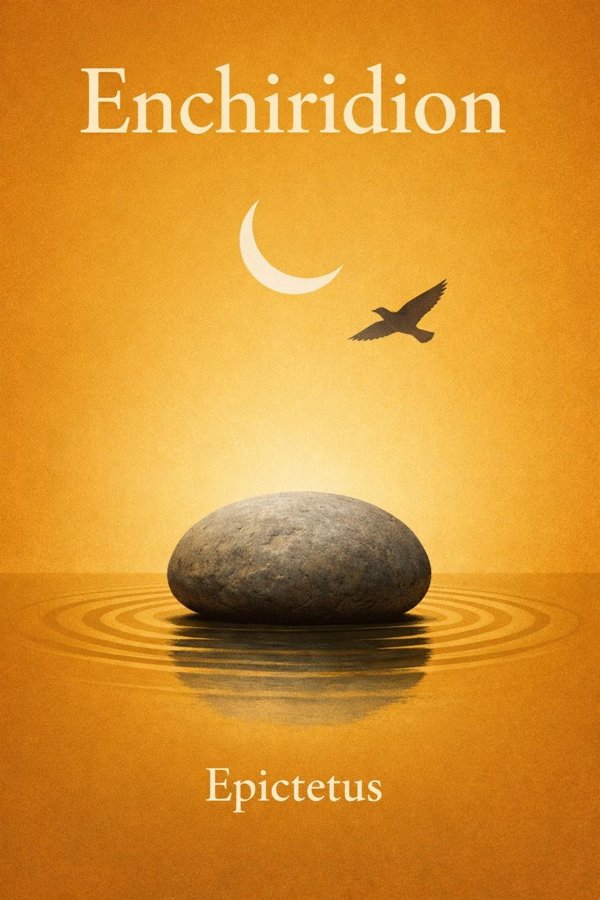
Enchiridion: Summary & Key Insights
by Epictetus
 10 min9 chaptersAudio available
Key Takeaways from Enchiridion
Most suffering begins with a confusion: we try to control what was never ours to command.
A hard truth sits at the center of Stoic psychology: people are disturbed not by things, but by the views they take of them.
What we chase determines the kind of life we live.
We cling most tightly to what we imagine will always remain.
Many people spend their lives protecting an image while neglecting the self that image is supposed to represent.
What Is Enchiridion About?
Enchiridion by Epictetus is a eastern_wisdom book. The Enchiridion, or "Handbook," is one of the clearest and most enduring guides to inner freedom ever written. Attributed to the Stoic teacher Epictetus and compiled by his student Arrian, this brief work distills a lifetime of philosophical instruction into practical advice for everyday living. Its central promise is both simple and radical: peace of mind does not come from controlling the world, but from mastering our judgments, desires, and actions. In a culture still obsessed with status, certainty, comfort, and external success, Epictetus offers a bracing alternative. He teaches that we suffer less from events themselves than from our opinions about them, and that the surest path to resilience is learning the difference between what is in our control and what is not. Though written in the ancient world, the Enchiridion feels startlingly modern because it addresses timeless human problems: anxiety, frustration, disappointment, ambition, loss, and self-discipline. For readers seeking clarity, steadiness, and moral strength, this compact Stoic manual remains a powerful and practical companion.
This FizzRead summary covers all 9 key chapters of Enchiridion in approximately 10 minutes, distilling the most important ideas, arguments, and takeaways from Epictetus's work. Also available as an audio summary and Key Quotes Podcast.
Enchiridion
The Enchiridion, or "Handbook," is one of the clearest and most enduring guides to inner freedom ever written. Attributed to the Stoic teacher Epictetus and compiled by his student Arrian, this brief work distills a lifetime of philosophical instruction into practical advice for everyday living. Its central promise is both simple and radical: peace of mind does not come from controlling the world, but from mastering our judgments, desires, and actions. In a culture still obsessed with status, certainty, comfort, and external success, Epictetus offers a bracing alternative. He teaches that we suffer less from events themselves than from our opinions about them, and that the surest path to resilience is learning the difference between what is in our control and what is not. Though written in the ancient world, the Enchiridion feels startlingly modern because it addresses timeless human problems: anxiety, frustration, disappointment, ambition, loss, and self-discipline. For readers seeking clarity, steadiness, and moral strength, this compact Stoic manual remains a powerful and practical companion.
Who Should Read Enchiridion?
This book is perfect for anyone interested in eastern_wisdom and looking to gain actionable insights in a short read. Whether you're a student, professional, or lifelong learner, the key ideas from Enchiridion by Epictetus will help you think differently.
- ✓Readers who enjoy eastern_wisdom and want practical takeaways
- ✓Professionals looking to apply new ideas to their work and life
- ✓Anyone who wants the core insights of Enchiridion in just 10 minutes
Want the full summary?
Get instant access to this book summary and 100K+ more with Fizz Moment.
Get Free SummaryAvailable on App Store • Free to download
Key Chapters
Most suffering begins with a confusion: we try to control what was never ours to command. Epictetus opens the Enchiridion with the distinction that defines Stoic practice. Some things are up to us, and some things are not. Our opinions, intentions, desires, aversions, and choices belong to us. Our body, reputation, possessions, social status, and the actions of other people do not. This is not a pessimistic idea; it is a liberating one. When we demand control over unstable things, we become anxious, angry, and dependent on circumstances. When we focus on our own judgments and conduct, we recover dignity and calm.
This principle can be applied almost everywhere. If a colleague criticizes your work unfairly, you may not control their opinion, but you do control whether you respond defensively, thoughtfully, or with restraint. If an investment drops, you cannot reverse the market by worrying, but you can act prudently and avoid panic. If someone does not appreciate you, their approval is not your possession to claim. Your integrity, however, remains yours.
Epictetus does not say external things are meaningless. He says they are secondary. The deepest form of freedom comes from refusing to tie your well-being to what chance can take away. This requires discipline because the mind constantly slips into blame, fear, and attachment. But every time you separate what depends on you from what does not, you reduce emotional chaos.
Actionable takeaway: In any stressful moment, pause and ask, "What here is truly mine to govern?" Then place your effort only there.
A hard truth sits at the center of Stoic psychology: people are disturbed not by things, but by the views they take of them. Epictetus is not denying pain, injustice, or difficulty. He is showing that between an event and our suffering lies interpretation. This insight makes emotional freedom possible. If our distress came directly and mechanically from events, we would be helpless. But if judgment shapes experience, then we can retrain judgment.
Imagine missing a flight, being ignored by a friend, or receiving a disappointing diagnosis. The event matters, but the mind quickly adds stories: "This always happens to me," "I am being disrespected," "My life is ruined." These interpretations intensify the original difficulty. The Stoic task is to notice the first impression without surrendering to it. An impression says, "This is terrible." Reason replies, "Is it terrible, or is it simply difficult? What is the wise response now?"
This practice does not make a person cold or detached in a shallow sense. Instead, it creates space between stimulus and reaction. A parent can respond more patiently to a child’s mistake. A manager can address failure without turning it into personal humiliation. A person facing illness can grieve honestly without believing their worth has vanished.
Epictetus trains readers to challenge automatic conclusions. He asks us to replace dramatic interpretations with accurate ones, and emotional impulsiveness with deliberate appraisal. The mind becomes more stable not because life becomes easier, but because we stop multiplying pain with rash judgment.
Actionable takeaway: When upset, write down the event and then separately write your interpretation of it. Challenge the interpretation before acting.
What we chase determines the kind of life we live. Epictetus warns that if you desire what is not in your control, frustration is inevitable. If you fear what is not in your control, anxiety becomes constant. The problem is not desire itself, but misplaced desire. We often want outcomes, admiration, security, health, or permanence as if they were guaranteed possessions. Stoicism redirects desire toward what can actually be achieved: good judgment, self-command, honesty, courage, and appropriate action.
This shift has enormous practical value. A student who desires only top grades may become brittle, fearful, and dishonest under pressure. A student who desires disciplined study and intellectual growth can work hard without being emotionally destroyed by a result. A professional who craves promotion at all costs becomes vulnerable to office politics and envy. One who values excellence, reliability, and fairness can remain steady whether advancement comes quickly or not.
Epictetus also applies this to aversion. If you fear embarrassment, aging, loss, or death as absolute evils, your life shrinks. But if you reserve aversion for moral failure, such as cowardice or deceit, then your fear becomes useful rather than crippling. You cannot avoid all pain, but you can avoid living dishonorably.
The Stoic reeducation of desire is not passive resignation. It is strategic realism. It asks you to stop investing your deepest hopes in unstable things and instead anchor them in character. That is the only possession fortune cannot easily seize.
Actionable takeaway: Replace one outcome-based goal this week with a character-based goal, such as "I will act patiently and thoroughly," regardless of the result.
We cling most tightly to what we imagine will always remain. Epictetus urges readers to remember the fragile nature of everything external: loved ones, possessions, status, and even the body itself. At first, this can sound severe. Yet his aim is not emotional numbness but wiser attachment. When we treat temporary things as permanent rights, we become shocked by reality. When we remember their impermanence, we meet them with gratitude, sobriety, and less panic.
He suggests mentally reframing ordinary experiences. When you kiss your child, remember that your child is mortal. When you use a cup, remember it can break. The point is not to become morbid. The point is to align expectation with truth. Then, if loss comes, grief may still be present, but outrage against the nature of life is reduced. We suffer less from the event because we have stopped pretending the world made promises it never made.
In modern terms, this resembles negative visualization: occasionally imagining change, loss, or reversal so that appreciation deepens and entitlement weakens. A person who reflects on the temporary nature of youth may care for health more responsibly. Someone who recognizes that friendships require care may become more attentive and kind. A leader who remembers status can disappear may act with more humility.
Epictetus does not ask us to love less. He asks us to love with awareness. To appreciate fully, we must stop demanding permanence from temporary things. Acceptance of fragility makes room for gratitude, tenderness, and resilience.
Actionable takeaway: Once a day, briefly reflect on one valued thing in your life as temporary, then let that awareness guide a more grateful action.
Many people spend their lives protecting an image while neglecting the self that image is supposed to represent. Epictetus repeatedly directs attention away from reputation and toward character. Other people may praise or mock you, misunderstand you, or assign you a place in their social hierarchy. None of that determines whether you are just, disciplined, wise, or sincere. If you make public opinion your master, your peace will rise and fall with every rumor and reaction.
This lesson remains strikingly relevant in a world shaped by performance and visibility. Social media amplifies the temptation to confuse appearing good with being good. A person may cultivate a polished identity while privately becoming reactive, vain, and dependent on validation. Epictetus cuts through this by asking a simple question: what sort of person are you becoming through your choices? That question matters more than whether others recognize it.
In practical life, this means resisting the urge to show off knowledge, virtue, or hardship. It means doing the right thing without needing applause. If you are insulted, you need not launch a dramatic defense to preserve status. If you succeed, you need not advertise it. If you are learning, it is better to practice than to boast about principles you have not embodied.
For Epictetus, philosophy is visible in conduct, not clever speech. Calmness under pressure, fairness in conflict, moderation in pleasure, and dignity in loss reveal more than self-description ever could. Respect earned this way is durable because it is rooted in substance.
Actionable takeaway: Choose one area where you seek appearance over substance, and redirect effort from being seen a certain way to actually becoming that kind of person.
Life gives each person a part to play, but not the power to write the whole script. Epictetus compares human life to a drama in which your task is not to choose every circumstance but to perform your assigned role nobly. You may be given health or illness, influence or obscurity, wealth or hardship, authority or dependence. The Stoic question is not, "Why wasn’t I given a different role?" but "How can I fulfill this one with excellence?"
This perspective discourages envy and self-pity. People often compare their lives with those of others and conclude they have been shortchanged. But comparison distracts from agency. A person born into difficulty may still act with courage and wisdom. A person born into privilege may still fail morally. What matters is not the apparent glamour of the role but the quality of performance.
In everyday terms, this means taking responsibilities seriously without becoming possessive about circumstances. A caregiver can see service not as punishment but as a field for patience and love. A junior employee can treat small tasks as opportunities for reliability rather than signs of insignificance. Someone facing limitation can still choose honesty, fortitude, and grace.
Epictetus also encourages social duty. We are not isolated minds floating above obligation. We are children, parents, citizens, neighbors, friends, and colleagues. Fulfilling these relationships honorably is part of living in accordance with nature. The point is not grand achievement but faithful conduct within the conditions given.
Actionable takeaway: Identify one role you currently resist, and ask how you can perform it today with more dignity, responsibility, and goodwill.
Self-mastery reveals itself quickly in conversation. Epictetus warns against gossip, excessive talk, complaint, and impulsive emotional display because they scatter the mind and weaken discipline. Speech is not merely expression; it is training. Each time you indulge in blame, vanity, or exaggeration, you reinforce habits of confusion. Each time you speak with restraint, honesty, and purpose, you strengthen command over yourself.
This idea is especially useful in conflict. Many problems worsen because people react before understanding. An insult triggers counterattack. A disagreement becomes a performance. A moment of embarrassment turns into resentment. Stoic discipline asks for a delay between impression and response. Silence, or a measured answer, often preserves dignity better than quick retaliation.
In practical settings, this might mean declining to join destructive workplace gossip, refusing to complain endlessly about inconveniences, or not using philosophy as a way to sound superior. It also means accepting correction without immediate defensiveness. A person who can listen, sort truth from tone, and respond calmly has a major advantage in relationships and leadership.
Epictetus is not recommending passivity or fake politeness. He is recommending governance of the tongue as part of governance of the mind. Words can clarify values, reduce conflict, and protect attention. They can also reveal when ego is in charge. The disciplined speaker uses language in service of truth and usefulness rather than impulse.
Actionable takeaway: For one full day, practice a Stoic speech filter: before speaking, ask whether what you are about to say is true, necessary, and self-governed.
People often imagine freedom as the ability to do whatever they want. Epictetus offers a sharper definition: freedom is not being ruled by fear, craving, or circumstance. A person who cannot tolerate discomfort, who needs praise, or who collapses when plans change is not free, even if outwardly powerful. A person who governs desire and judgment is free, even under constraint. This insight reflects Epictetus’s own authority, since he taught as a former enslaved man who understood the difference between external bondage and internal liberty.
Inner self-rule means refusing to hand over your mind to unstable conditions. If your mood depends on compliments, your peace belongs to others. If your choices depend on avoiding all inconvenience, comfort rules you. If anger dictates your reactions, you serve your impulses. Stoicism trains a different kind of strength: the capacity to remain principled under pressure.
Modern life provides endless tests. Delayed gratification in money, food, technology, and ambition all reveal whether we are governing ourselves or being dragged by appetite. The person who can stop scrolling, decline a petty argument, admit a mistake, or endure temporary discomfort for a better aim is building freedom in the Stoic sense.
This freedom is not abstract. It produces steadier relationships, clearer priorities, and greater resilience. You become less manipulable because fewer hooks remain in you. Fortune can still affect your situation, but it does not so easily possess your soul.
Actionable takeaway: Identify one habit where impulse currently rules you, and practice one small act of deliberate restraint every day for a week.
Wisdom that remains theoretical is ornamental, not transformative. Epictetus repeatedly emphasizes that philosophy is a way of living, not a collection of impressive ideas. The Enchiridion is short because it is meant to be used like a handbook: reviewed, remembered, and applied in concrete situations. Knowing Stoic principles intellectually means little if irritation, vanity, fear, and indulgence still govern behavior.
This is one reason the work has endured. It speaks to the gap between admiration and practice. Many people enjoy discussing resilience, virtue, and detachment, but daily life exposes what has truly been learned. The test comes in traffic, illness, criticism, temptation, boredom, and disappointment. Philosophy earns its value only when it changes how a person meets those moments.
A practical Stoic routine might include morning reflection on likely challenges, reminders during the day about what is in one’s control, and evening review of actions and judgments. If something disturbs you, examine the belief behind it. If you failed, correct yourself without self-hatred. If you succeeded, avoid pride and continue training. Repetition matters because the mind is shaped by habit, not occasional inspiration.
Epictetus also advises modesty in learning. Do not proclaim yourself a philosopher. Live in a way that makes the label unnecessary. Steadiness, fairness, gratitude, and restraint are stronger evidence than argument.
Actionable takeaway: Create a simple daily Stoic practice: one morning intention, one midday reminder about control, and one evening review of where you reacted well or poorly.
All Chapters in Enchiridion
About the Author
Epictetus was a Stoic philosopher born around 50 CE in Hierapolis, in the Roman Empire. He began life as a slave and later gained his freedom, an experience that deeply shaped his philosophy of inner liberty and self-mastery. He studied under the Stoic teacher Musonius Rufus in Rome and eventually founded his own school in Nicopolis, where he became known for his practical, morally demanding teaching style. Epictetus wrote nothing himself; his student Arrian recorded his lectures in the Discourses and distilled their core lessons into the Enchiridion. His philosophy emphasizes the distinction between what we can control and what we cannot, making him one of the most influential voices in Stoicism. His work continues to inspire readers seeking resilience, clarity, and ethical discipline.
Get This Summary in Your Preferred Format
Read or listen to the Enchiridion summary by Epictetus anytime, anywhere. FizzRead offers multiple formats so you can learn on your terms — all free.
Available formats: App · Audio · PDF · EPUB — All included free with FizzRead
Download Enchiridion PDF and EPUB Summary
Key Quotes from Enchiridion
“Most suffering begins with a confusion: we try to control what was never ours to command.”
“A hard truth sits at the center of Stoic psychology: people are disturbed not by things, but by the views they take of them.”
“What we chase determines the kind of life we live.”
“We cling most tightly to what we imagine will always remain.”
“Many people spend their lives protecting an image while neglecting the self that image is supposed to represent.”
Frequently Asked Questions about Enchiridion
Enchiridion by Epictetus is a eastern_wisdom book that explores key ideas across 9 chapters. The Enchiridion, or "Handbook," is one of the clearest and most enduring guides to inner freedom ever written. Attributed to the Stoic teacher Epictetus and compiled by his student Arrian, this brief work distills a lifetime of philosophical instruction into practical advice for everyday living. Its central promise is both simple and radical: peace of mind does not come from controlling the world, but from mastering our judgments, desires, and actions. In a culture still obsessed with status, certainty, comfort, and external success, Epictetus offers a bracing alternative. He teaches that we suffer less from events themselves than from our opinions about them, and that the surest path to resilience is learning the difference between what is in our control and what is not. Though written in the ancient world, the Enchiridion feels startlingly modern because it addresses timeless human problems: anxiety, frustration, disappointment, ambition, loss, and self-discipline. For readers seeking clarity, steadiness, and moral strength, this compact Stoic manual remains a powerful and practical companion.
More by Epictetus
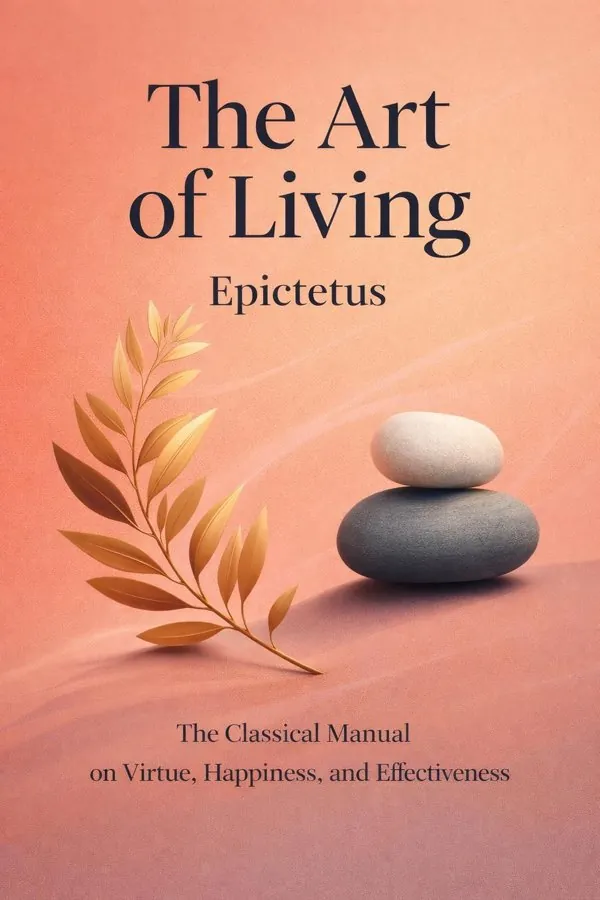
You Might Also Like
A New Earth
Eckhart Tolle
10 min
The Daily Stoic
Ryan Holiday, Stephen Hanselman
10 min
Buddhism: Plain and Simple
Steve Hagen
10 min
The Book of Tea
Kakuzō Okakura
10 min
The Light We Give: How Sikh Wisdom Can Transform Your Life
Simran Jeet Singh
10 min
The Miracle of Mindfulness: An Introduction to the Practice of Meditation
Thich Nhat Hanh
10 minBrowse by Category
Ready to read Enchiridion?
Get the full summary and 100K+ more books with Fizz Moment.