
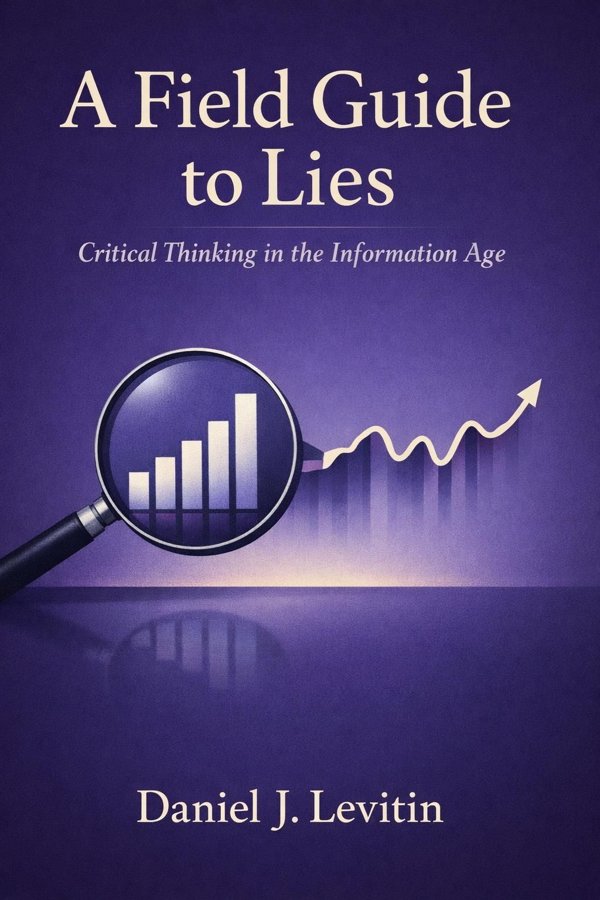
A Field Guide to Lies: Critical Thinking in the Information Age: Summary & Key Insights
 10 min3 chaptersAudio available
What Is A Field Guide to Lies: Critical Thinking in the Information Age About?
A Field Guide to Lies: Critical Thinking in the Information Age by Daniel J. Levitin is a cognition book spanning 3 pages. A Field Guide to Lies is a nonfiction book by cognitive psychologist and neuroscientist Daniel J. Levitin that teaches readers how to critically evaluate information in the modern world. It explores how data, statistics, and arguments can be manipulated, and provides tools for distinguishing truth from misinformation in media, politics, and everyday life.
This FizzRead summary covers all 3 key chapters of A Field Guide to Lies: Critical Thinking in the Information Age in approximately 10 minutes, distilling the most important ideas, arguments, and takeaways from Daniel J. Levitin's work. Also available as an audio summary and Key Quotes Podcast.
A Field Guide to Lies: Critical Thinking in the Information Age
A Field Guide to Lies is a nonfiction book by cognitive psychologist and neuroscientist Daniel J. Levitin that teaches readers how to critically evaluate information in the modern world. It explores how data, statistics, and arguments can be manipulated, and provides tools for distinguishing truth from misinformation in media, politics, and everyday life.
Who Should Read A Field Guide to Lies: Critical Thinking in the Information Age?
This book is perfect for anyone interested in cognition and looking to gain actionable insights in a short read. Whether you're a student, professional, or lifelong learner, the key ideas from A Field Guide to Lies: Critical Thinking in the Information Age by Daniel J. Levitin will help you think differently.
- ✓Readers who enjoy cognition and want practical takeaways
- ✓Professionals looking to apply new ideas to their work and life
- ✓Anyone who wants the core insights of A Field Guide to Lies: Critical Thinking in the Information Age in just 10 minutes
Want the full summary?
Get instant access to this book summary and 100K+ more with Fizz Moment.
Get Free SummaryAvailable on App Store • Free to download
Key Chapters
Let’s start with the realm that seems most objective of all: numbers. Numbers feel precise, pure, and reliable. But as I’ve learned through both science and experience, they can be some of the most deceptive tools in communication. Statistics are powerful because they compress complexity into simplicity — yet that compression often hides the nuances that define truth.
Take averages. The mean, median, and mode are deceptively simple concepts, yet each tells a subtly different story. If five people earn $30,000 and one earns $500,000, the average income might suggest a community of wealth, while the median reveals widespread poverty. Knowing which measure a communicator chooses — and why — can expose what narrative they’re trying to promote.
Probabilities are equally slippery. We often see headlines declaring 'a 30% increase in risk' without any context about base rates or comparative data. If your lifetime risk of developing a condition rises from one in a million to two in a million, that’s technically a 100% increase, but practically negligible. The framing of risk plays on fear and hope, making us overestimate some dangers and underestimate others.
Then come graphs — those colorful, persuasive images that translate numbers into seemingly undeniable visual truths. But a graph’s power depends entirely on its design. Change a scale, omit a data range, or zoom in on a particular section, and the story shifts dramatically. Our brains intuit patterns even where they don’t exist. In one example I discuss, the illusion of a steep upward trend was created simply by compressing the vertical axis; the data itself hardly changed at all.
In all these cases, the lesson is straightforward: data never speaks for itself. It’s always someone’s data, filtered through someone’s choices. Being numerate means not just knowing how to calculate, but knowing how to question. What was measured? Who collected it? How was it presented? These are the questions that cut through statistical fog.
When you learn to see the hidden stories behind numbers, you start to reclaim power — the power to think independently and make informed judgments that align with reality rather than rhetoric.
Numbers may lie subtly, but words can deceive spectacularly. Every argument, every claim, every advertisement depends on language — and language shapes how we interpret information. We tend to trust words that sound articulate and confident, but eloquence is not truth.
Consider correlation versus causation. The difference between these two ideas is the border between science and superstition. Correlation means two things occur together; causation means one causes the other. The old fallacy that 'ice cream causes drowning' arises because both rise in summer — a shared correlation, not a causal link. Yet the media often blurs this boundary with phrasing that implies direct causality, such as 'video games lead to violence' or 'living near power lines causes cancer,' when the evidence suggests only correlation or none at all.
Authority and expertise pose another linguistic trap. Humans have evolved to trust confident voices; we naturally assume certainty signals competence. But confidence and expertise are different currencies. True expertise rests on evidence, peer review, and transparency. False authority thrives on appeal to credentials, status, or emotional persuasion. When assessing someone’s claims, don’t ask merely, 'Who said this?' Ask, 'What proof supports it?' In the book, I stress that a genuine expert can explain complex ideas clearly and admits where uncertainty remains. A false expert deflects, argues from position, and refuses scrutiny.
Rhetoric can also distort truth through framing. A policy framed as '85% effective' feels reassuring, but the same described as '15% failure rate' triggers anxiety. Both are true; the framing makes the difference. Politicians, advertisers, and pundits know this instinctively — they shape perception not through facts but through emphasis.
Words are not neutral tools. They guide emotion, direct attention, and manipulate interpretation. Learning to evaluate words with precision means recognizing tone, context, and implied meaning. The beauty of language is that it can illuminate truth; its danger is that it can obscure it just as easily. Mastering critical thinking demands we listen actively — not just to what is said, but to how, why, and by whom it’s said.
+ 1 more chapters — available in the FizzRead app
All Chapters in A Field Guide to Lies: Critical Thinking in the Information Age
About the Author
Daniel J. Levitin is a Canadian-American cognitive psychologist, neuroscientist, and author known for his research on music, cognition, and critical thinking. He has written several bestselling books that bridge science and everyday life, including This Is Your Brain on Music and The Organized Mind.
Get This Summary in Your Preferred Format
Read or listen to the A Field Guide to Lies: Critical Thinking in the Information Age summary by Daniel J. Levitin anytime, anywhere. FizzRead offers multiple formats so you can learn on your terms — all free.
Available formats: App · Audio · PDF · EPUB — All included free with FizzRead
Download A Field Guide to Lies: Critical Thinking in the Information Age PDF and EPUB Summary
Key Quotes from A Field Guide to Lies: Critical Thinking in the Information Age
“Let’s start with the realm that seems most objective of all: numbers.”
“Numbers may lie subtly, but words can deceive spectacularly.”
Frequently Asked Questions about A Field Guide to Lies: Critical Thinking in the Information Age
A Field Guide to Lies: Critical Thinking in the Information Age by Daniel J. Levitin is a cognition book that explores key ideas across 3 chapters. A Field Guide to Lies is a nonfiction book by cognitive psychologist and neuroscientist Daniel J. Levitin that teaches readers how to critically evaluate information in the modern world. It explores how data, statistics, and arguments can be manipulated, and provides tools for distinguishing truth from misinformation in media, politics, and everyday life.
More by Daniel J. Levitin
This Is Your Brain on Music: The Science of a Human Obsession
Daniel J. Levitin
10 min
Successful Aging: A Neuroscientist Explores the Power and Potential of Our Lives
Daniel J. Levitin
10 min
The Organized Mind: Thinking Straight in the Age of Information Overload
Daniel J. Levitin
10 min
Weaponized Lies: How to Think Critically in the Post-Truth Era
Daniel J. Levitin
10 minYou Might Also Like
A Theory of Cognitive Dissonance
Leon Festinger
10 min
Black-And-White Thinking: The Burden of a Binary Brain in a Complex World
Kevin Dutton
10 min
Born Liars: Why We Can’t Live Without Deceit
Ian Leslie
10 min
Collective Illusions: Conformity, Complicity, and the Science of Why We Make Bad Decisions
Todd Rose
10 min
Concrete Mathematics: A Foundation for Computer Science
Ronald L. Graham, Donald E. Knuth, Oren Patashnik
10 min
Consciousness Explained
Daniel C. Dennett
10 minBrowse by Category
Ready to read A Field Guide to Lies: Critical Thinking in the Information Age?
Get the full summary and 100K+ more books with Fizz Moment.