
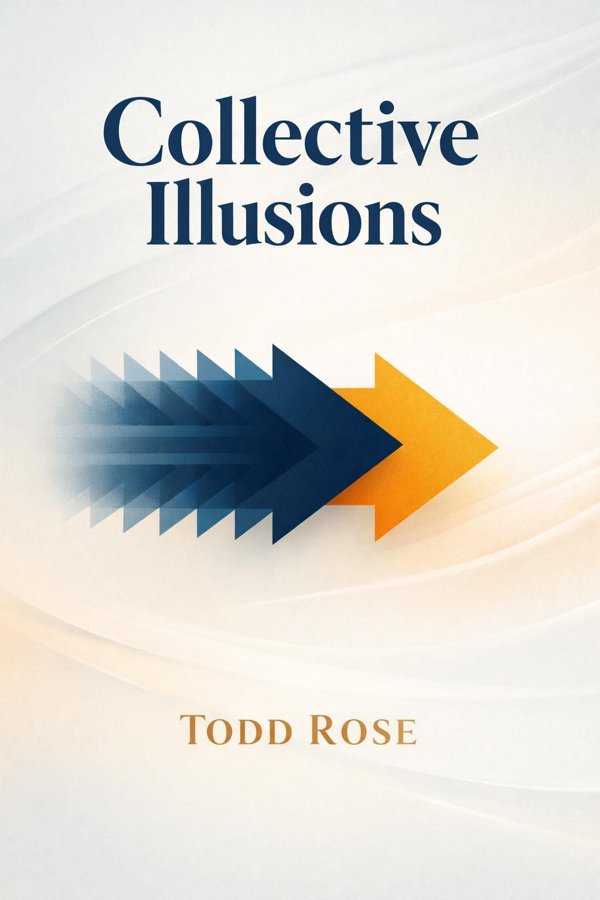
Collective Illusions: Conformity, Complicity, and the Science of Why We Make Bad Decisions: Summary & Key Insights
by Todd Rose
 10 min8 chaptersAudio available
What Is Collective Illusions: Conformity, Complicity, and the Science of Why We Make Bad Decisions About?
Collective Illusions: Conformity, Complicity, and the Science of Why We Make Bad Decisions by Todd Rose is a cognition book spanning 8 pages. Collective Illusions explores how false beliefs about what others think shape our decisions and behaviors. Drawing on neuroscience and social psychology, Todd Rose reveals how conformity and misperception lead societies to make poor choices, and how individuals can reclaim authenticity by understanding these hidden social dynamics.
This FizzRead summary covers all 8 key chapters of Collective Illusions: Conformity, Complicity, and the Science of Why We Make Bad Decisions in approximately 10 minutes, distilling the most important ideas, arguments, and takeaways from Todd Rose's work. Also available as an audio summary and Key Quotes Podcast.
Collective Illusions: Conformity, Complicity, and the Science of Why We Make Bad Decisions
Collective Illusions explores how false beliefs about what others think shape our decisions and behaviors. Drawing on neuroscience and social psychology, Todd Rose reveals how conformity and misperception lead societies to make poor choices, and how individuals can reclaim authenticity by understanding these hidden social dynamics.
Who Should Read Collective Illusions: Conformity, Complicity, and the Science of Why We Make Bad Decisions?
This book is perfect for anyone interested in cognition and looking to gain actionable insights in a short read. Whether you're a student, professional, or lifelong learner, the key ideas from Collective Illusions: Conformity, Complicity, and the Science of Why We Make Bad Decisions by Todd Rose will help you think differently.
- ✓Readers who enjoy cognition and want practical takeaways
- ✓Professionals looking to apply new ideas to their work and life
- ✓Anyone who wants the core insights of Collective Illusions: Conformity, Complicity, and the Science of Why We Make Bad Decisions in just 10 minutes
Want the full summary?
Get instant access to this book summary and 100K+ more with Fizz Moment.
Get Free SummaryAvailable on App Store • Free to download
Key Chapters
To understand collective illusions, we must first understand the human need for belonging. Evolution wired us for connection because cooperation ensured survival. Early humans who sensed the group’s intentions and stayed in sync were rewarded with protection; those who defied social norms risked exile and death. That wiring still operates today, though our 'tribes' have become vast and abstract—nations, corporations, online communities. The consequence is that our brains still prioritize perceived social harmony over independent judgment.
Research in neuroscience illuminates this. Studies show that the anterior cingulate cortex, which registers social pain, activates when we feel excluded or judged. Our minds seek to minimize that hurt by aligning with what we believe the group values. Yet the catch is this: most of us don’t know what the group truly values. We rely on signals—media coverage, social posts, what’s said aloud—and those signals are almost always distorted by a minority of loud voices. Thus, we mistake fringe opinions for majority norms.
Social psychology adds another layer. Solomon Asch’s conformity experiments revealed that even obvious errors in group judgment can override individual perception. When participants saw a group confidently choose a wrong answer, most conformed at least once, doubting their own eyes. That impulse—'they must know better'—translates directly into modern decision-making, from boardrooms to ballot boxes.
The science tells us that our brains overestimate consensus because belonging is emotionally vital. We prefer perceived unity to truth. Recognizing this biological tendency is crucial: it allows us to see conformity not as weakness but as a predictable response to social threat. Once we acknowledge that, we can learn strategies to pause, reflect, and ask, 'Is this really what I believe, or just what I think others expect?' That single question begins to dissolve the illusion.
Two psychological mechanisms sustain collective illusions: false consensus and pluralistic ignorance. False consensus occurs when we assume our views are typical, projecting our own beliefs onto others. Pluralistic ignorance, conversely, is when we privately reject a norm but assume others accept it. The danger arises when both dynamics coexist—each person misreads the group, creating a majority that secretly disagrees but outwardly conforms.
Consider university students and attitudes toward alcohol, a classic case in sociology. Repeated surveys show that most students overestimate peer approval of heavy drinking. In reality, the majority prefer moderate or no drinking at all, yet act otherwise to fit in. What results is a culture nobody intended. The same holds true in workplaces where employees assume their colleagues prioritize profit or competition above ethics. When private disapproval meets public silence, norms distort.
In *Collective Illusions*, I illustrate how this mechanism drives political polarization. Many Americans privately endorse cooperation and compromise, but public discourse—dominated by extreme voices—makes moderation seem shameful. So, people stay quiet, reinforcing illusions of division. When silence replaces honest expression, entire democracies drift into self-created mirages of conflict.
Understanding pluralistic ignorance reminds us that cultural realities are often misperceived social performances. The fix requires courageous transparency. Each time someone shares their true stance, it punctures the illusion, allowing others to reveal their own alignment. The moment truth becomes visible, consensus reemerges.
+ 6 more chapters — available in the FizzRead app
All Chapters in Collective Illusions: Conformity, Complicity, and the Science of Why We Make Bad Decisions
About the Author
Get This Summary in Your Preferred Format
Read or listen to the Collective Illusions: Conformity, Complicity, and the Science of Why We Make Bad Decisions summary by Todd Rose anytime, anywhere. FizzRead offers multiple formats so you can learn on your terms — all free.
Available formats: App · Audio · PDF · EPUB — All included free with FizzRead
Download Collective Illusions: Conformity, Complicity, and the Science of Why We Make Bad Decisions PDF and EPUB Summary
Key Quotes from Collective Illusions: Conformity, Complicity, and the Science of Why We Make Bad Decisions
“To understand collective illusions, we must first understand the human need for belonging.”
“Two psychological mechanisms sustain collective illusions: false consensus and pluralistic ignorance.”
Frequently Asked Questions about Collective Illusions: Conformity, Complicity, and the Science of Why We Make Bad Decisions
Collective Illusions: Conformity, Complicity, and the Science of Why We Make Bad Decisions by Todd Rose is a cognition book that explores key ideas across 8 chapters. Collective Illusions explores how false beliefs about what others think shape our decisions and behaviors. Drawing on neuroscience and social psychology, Todd Rose reveals how conformity and misperception lead societies to make poor choices, and how individuals can reclaim authenticity by understanding these hidden social dynamics.
More by Todd Rose
You Might Also Like
A Field Guide to Lies: Critical Thinking in the Information Age
Daniel J. Levitin
10 min
A Theory of Cognitive Dissonance
Leon Festinger
10 min
Black-And-White Thinking: The Burden of a Binary Brain in a Complex World
Kevin Dutton
10 min
Born Liars: Why We Can’t Live Without Deceit
Ian Leslie
10 min
Concrete Mathematics: A Foundation for Computer Science
Ronald L. Graham, Donald E. Knuth, Oren Patashnik
10 min
Consciousness Explained
Daniel C. Dennett
10 minBrowse by Category
Ready to read Collective Illusions: Conformity, Complicity, and the Science of Why We Make Bad Decisions?
Get the full summary and 100K+ more books with Fizz Moment.