
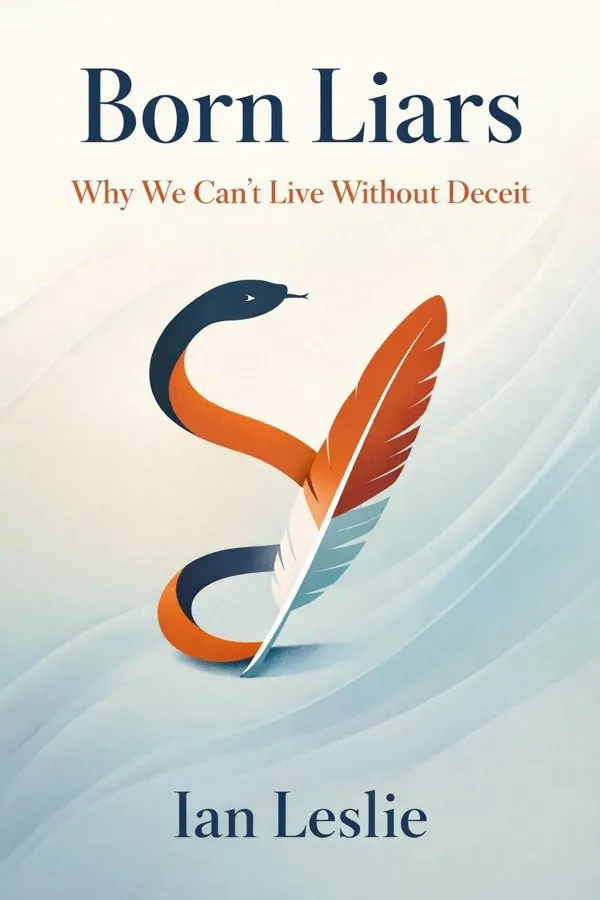
Born Liars: Why We Can’t Live Without Deceit: Summary & Key Insights
by Ian Leslie
 10 min9 chaptersAudio available
Key Takeaways from Born Liars: Why We Can’t Live Without Deceit
A powerful way to understand lying is to stop treating it as a uniquely human sin and start seeing it as an ancient survival strategy.
A child’s first lie can feel alarming, but it often signals development rather than decline.
Lying is mentally demanding because the brain must do more than invent a false statement.
If everyone said exactly what they thought at every moment, social life would become unlivable.
Some of the most important lies are the ones we tell ourselves.
What Is Born Liars: Why We Can’t Live Without Deceit About?
Born Liars: Why We Can’t Live Without Deceit by Ian Leslie is a cognition book spanning 9 pages. Born Liars: Why We Can’t Live Without Deceit is a provocative exploration of one of the most uncomfortable truths about being human: deception is not merely a moral failure or social defect, but a deeply embedded part of how our minds, relationships, and cultures work. Ian Leslie examines lying from multiple angles—evolution, childhood development, neuroscience, history, politics, fiction, and selfhood—to argue that deceit is woven into human intelligence itself. We lie to protect ourselves, attract others, preserve harmony, tell stories, and even maintain our sense of identity. That does not make all lies harmless, but it does mean that honesty and deception cannot be cleanly separated. Leslie is especially effective because he blends psychology, philosophy, biology, and journalism into a clear, engaging narrative. As a British author and journalist known for writing about behavior and culture, he brings both intellectual range and storytelling skill to the subject. The result is a book that challenges simplistic moral judgments and helps readers think more realistically about why people lie, when deceit becomes dangerous, and what truthful living actually requires.
This FizzRead summary covers all 9 key chapters of Born Liars: Why We Can’t Live Without Deceit in approximately 10 minutes, distilling the most important ideas, arguments, and takeaways from Ian Leslie's work. Also available as an audio summary and Key Quotes Podcast.
Born Liars: Why We Can’t Live Without Deceit
Born Liars: Why We Can’t Live Without Deceit is a provocative exploration of one of the most uncomfortable truths about being human: deception is not merely a moral failure or social defect, but a deeply embedded part of how our minds, relationships, and cultures work. Ian Leslie examines lying from multiple angles—evolution, childhood development, neuroscience, history, politics, fiction, and selfhood—to argue that deceit is woven into human intelligence itself. We lie to protect ourselves, attract others, preserve harmony, tell stories, and even maintain our sense of identity. That does not make all lies harmless, but it does mean that honesty and deception cannot be cleanly separated. Leslie is especially effective because he blends psychology, philosophy, biology, and journalism into a clear, engaging narrative. As a British author and journalist known for writing about behavior and culture, he brings both intellectual range and storytelling skill to the subject. The result is a book that challenges simplistic moral judgments and helps readers think more realistically about why people lie, when deceit becomes dangerous, and what truthful living actually requires.
Who Should Read Born Liars: Why We Can’t Live Without Deceit?
This book is perfect for anyone interested in cognition and looking to gain actionable insights in a short read. Whether you're a student, professional, or lifelong learner, the key ideas from Born Liars: Why We Can’t Live Without Deceit by Ian Leslie will help you think differently.
- ✓Readers who enjoy cognition and want practical takeaways
- ✓Professionals looking to apply new ideas to their work and life
- ✓Anyone who wants the core insights of Born Liars: Why We Can’t Live Without Deceit in just 10 minutes
Want the full summary?
Get instant access to this book summary and 100K+ more with Fizz Moment.
Get Free SummaryAvailable on App Store • Free to download
Key Chapters
A powerful way to understand lying is to stop treating it as a uniquely human sin and start seeing it as an ancient survival strategy. Leslie argues that deception did not suddenly appear with civilization, education, or moral corruption. It emerged much earlier in the evolutionary struggle to eat, avoid being eaten, attract mates, and compete for status. Nature is full of forms of deceit: animals camouflage themselves, mimic other species, fake weakness, or bluff strength. These behaviors are not signs of wickedness. They are adaptive responses to environments where survival depends on manipulating what others perceive.
Human lying grows out of this deeper biological inheritance, but it becomes vastly more sophisticated because of language and social complexity. Unlike a moth blending into bark, humans can conceal intentions, distort memories, invent explanations, and coordinate falsehoods with others. Our deceptive abilities evolved alongside our mind-reading abilities. Once we became good at guessing what others think, we also became good at influencing those thoughts.
This helps explain why lying is so widespread and so difficult to eradicate. We are not creatures who occasionally fall into deceit; we are social animals built to navigate strategic environments. In workplaces, friendships, politics, and romance, people constantly manage impressions, omit truths, and test how much honesty a situation can tolerate. The point is not that all deception is acceptable, but that it is natural.
A practical application is to become more realistic about human behavior. Instead of expecting total transparency, build systems that reduce incentives for harmful deceit—clear accountability, better incentives, and room for honest disagreement. Actionable takeaway: judge lies not by fantasy standards of perfect honesty, but by understanding the human pressures and purposes that make deception so persistent.
A child’s first lie can feel alarming, but it often signals development rather than decline. Leslie shows that lying in childhood is closely tied to cognitive growth. To lie successfully, a child must recognize that other people have separate minds, understand that those minds can be manipulated, and maintain two versions of reality at once—the truth and the false story. In other words, deception requires imagination, memory, and social awareness.
This is why very young children often lie badly. They deny taking the cookie while crumbs remain on their face, or insist they did not draw on the wall while still holding the crayon. These clumsy lies reveal something important: the child is practicing perspective-taking. As children mature, their lies become more strategic because their understanding of others becomes more sophisticated.
That does not mean parents should celebrate dishonesty. It means they should respond intelligently. If adults treat every lie as evidence of bad character, they may miss the underlying developmental milestone and overreact in ways that encourage more secrecy. A better response is to distinguish between experimentation, fear-based lying, and manipulative deception. Children often lie to avoid punishment, protect self-esteem, or imitate the social behavior they observe in adults.
The broader lesson is that honesty is not automatic. It must be taught within relationships of trust. Children need environments where truth is safe enough to tell and valued enough to matter. Instead of demanding perfection, adults can model truthful behavior, reward confession, and discuss motives openly. Actionable takeaway: when a child lies, treat it as both a moral teaching moment and a window into developing social intelligence.
Lying is mentally demanding because the brain must do more than invent a false statement. It has to suppress the truth, predict how the listener will respond, monitor consistency, and manage emotional stress. Leslie draws on neuroscience to show that deception recruits systems involved in executive control, working memory, and social cognition. This is one reason lying can be effortful: the mind is juggling competing realities while trying to appear natural.
Yet the brain is not simply wired to tell the truth and occasionally malfunction. It is built to balance truth with strategy. In everyday life, people constantly decide what to reveal, what to soften, and what to leave unsaid. A job candidate highlights strengths and downplays weaknesses. A friend says, "I’m fine," when the fuller truth would be complicated. A partner chooses timing carefully before raising a painful issue. These are not always full lies, but they rely on the same mental machinery of controlled disclosure.
The neuroscience of deceit also helps explain why lie detection is so unreliable. There is no single facial expression, vocal cue, or brain signal that cleanly reveals dishonesty across contexts. Because truthful and deceptive communication use overlapping systems, we are often overconfident in our ability to spot lies. This has serious consequences in policing, management, and personal relationships, where false certainty can do real damage.
A practical implication is to be cautious with snap judgments. Instead of relying on intuition alone, look for patterns, incentives, inconsistencies over time, and corroborating evidence. At the same time, notice how much mental energy deception consumes in your own life. Actionable takeaway: reduce unnecessary lying by creating situations where honesty is easier, safer, and less cognitively costly than keeping up a false front.
Some of the most important lies are the ones we tell ourselves. Leslie treats self-deception not as an odd psychological glitch but as a central feature of human life. People routinely exaggerate their virtues, minimize their faults, reinterpret failures, and construct flattering narratives about their motives. We do this because living with complete, unfiltered self-knowledge would often be emotionally crushing and socially disabling. Confidence, hope, ambition, and resilience sometimes depend on selective interpretation.
Self-deception can be useful. An entrepreneur may overestimate the likelihood of success and thereby persist long enough to achieve it. A grieving person may temporarily deny reality in order to absorb painful news gradually. An athlete may sustain a performance-enhancing belief in their own capacity. In these cases, illusion supports action.
But the same mechanism can become corrosive. Leaders convince themselves they are acting for the common good when they are preserving power. Partners insist a relationship is healthy while ignoring repeated evidence to the contrary. Professionals claim they are too ethical to be biased, which makes them more vulnerable to bias, not less. Self-deception is dangerous precisely because it hides from scrutiny under the language of sincerity.
The practical challenge is to preserve enough self-belief to function while building habits that puncture comforting fantasies. Seek honest feedback, compare intentions with outcomes, and notice recurring justifications. Journaling, trusted friends, and structured reflection can expose patterns that your conscious story keeps editing out. Actionable takeaway: do not aim for perfect self-transparency; aim instead for regular reality checks that keep your self-story useful without letting it become delusional.
Lying may be universal, but the rules around it are not. Leslie explores how cultures and historical periods differ in what kinds of deceit they condemn, tolerate, or even reward. Some societies place a premium on directness, while others value face-saving, diplomacy, and social harmony. In one setting, withholding an opinion may look dishonest; in another, it may look civilized. These differences matter because they shape everything from parenting and politics to negotiation and friendship.
History also shows that attitudes toward lying change with institutions. As markets expand, bureaucracies grow, and media systems evolve, the opportunities and consequences of deception shift. Modern societies rely heavily on trust among strangers, which makes certain forms of dishonesty especially damaging. At the same time, public life often rewards image management, branding, and strategic ambiguity. The more complex society becomes, the more it depends on both truth-telling norms and sophisticated forms of presentation.
This perspective prevents moral simplification. It reminds us that people are often not merely truthful or deceptive by nature; they are responding to social scripts about what is polite, loyal, prudent, or honorable. Consider cross-cultural business communication: one party may view a tactful non-answer as respectful, while another experiences it as evasive and suspicious.
A practical application is to interpret deception contextually before judging it absolutely. Ask what norms govern this interaction, what pressures exist, and what a “truthful” response would look like in that environment. This does not excuse harmful lying, but it improves understanding. Actionable takeaway: when honesty clashes with etiquette, learn the local social rules so you can communicate clearly without mistaking cultural difference for bad faith.
One of Leslie’s most intriguing arguments is that storytelling and fiction are forms of sanctioned deception that help humans understand reality more deeply. A novel is, in one sense, a lie: the characters never existed, the events never happened, and the world is invented. Yet readers often emerge from fiction with sharper insight into human motives, relationships, suffering, ambition, and moral conflict. This paradox matters because it shows that not all falsehood is opposed to truth.
Stories train the social mind. They allow us to simulate situations we have never lived through, inhabit other perspectives, and practice emotional interpretation. A child listening to fairy tales, a teenager absorbed in novels, or an adult watching drama is engaging in a highly sophisticated exchange of imagined realities for psychological understanding. Fiction also depends on the cooperative nature of deception: readers consent to be misled in order to be moved, challenged, or enlightened.
This helps explain why humans are such compulsive storytellers in daily life. We narrate our past, edit our memories, dramatize our experiences, and shape events into meaningful arcs. These stories are rarely perfectly accurate, but they make life intelligible. The danger comes when narrative coherence overrides factual responsibility—when propaganda, conspiracy thinking, or personal mythmaking turns persuasive fiction into harmful false belief.
Practically, this means we should treat stories with both appreciation and discipline. Read fiction to expand empathy and complexity, but be alert to the stories you and others use to simplify reality too neatly. Actionable takeaway: use narrative as a tool for understanding, while regularly asking whether your most compelling story is also your most honest interpretation.
Technology did not invent lying, but it changed its scale, speed, and style. Leslie shows that modern life creates countless new arenas for strategic self-presentation: social media profiles, curated professional identities, online dating, political messaging, advertising, and data-driven persuasion. These environments reward attention, image control, and emotional impact, all of which blur the line between communication and manipulation.
In digital spaces, deception often becomes easier because cues are limited and identities are malleable. People can exaggerate accomplishments, edit appearances, hide intentions, or spread misinformation with little immediate friction. Institutions also deceive more effectively when they can micro-target messages, test emotional triggers, and flood public conversation with partial truths. The problem is not only individual lying; it is the design of systems that incentivize distortion.
At the same time, modern culture demands authenticity. People are expected to “be real” while constantly performing for audiences. This creates a strange double pressure: we must appear spontaneous, sincere, and transparent while carefully managing impressions. No wonder so many people feel exhausted, suspicious, or fragmented.
The practical response is not retreat from modern communication but stronger habits of verification and restraint. Check sources before sharing, distinguish branding from substance, and notice when a platform pushes you toward exaggeration. In personal life, resist the urge to curate an identity so polished that it becomes alienating. Actionable takeaway: treat digital communication as a high-risk environment for distortion, and build personal rules that favor verification, nuance, and less performative self-presentation.
Because deception is natural and often functional, the moral challenge is not simply “never lie.” Leslie’s deeper point is that we need better criteria for distinguishing necessary, harmless, and destructive deceit. Some lies protect privacy, preserve hope, or spare unnecessary pain. Others exploit trust, deny reality, or allow power to evade accountability. Ethical judgment requires asking what the lie does to the relationship and to the wider social world.
A useful distinction is between lies that sustain cooperation and lies that poison it. A tactful omission may preserve mutual respect. A fraudulent promise, by contrast, turns another person into a tool. Repeated deception in intimate or institutional settings does more than misstate facts; it erodes the background trust that makes collective life possible. Once people assume they are constantly being manipulated, even truthful communication loses force.
This is why honesty remains indispensable even in a world built partly on deceit. Trust cannot exist without some expectation that words connect to reality. Law, science, medicine, journalism, and friendship all depend on norms stronger than mere strategic advantage. The point is not moral absolutism, but moral seriousness.
In practical terms, before deceiving, ask three questions: Who benefits? What trust does this weaken? Would I accept this lie if I were the one being misled? These questions clarify whether a falsehood is a temporary kindness or an act of domination. Actionable takeaway: judge deception by its effect on trust, dignity, and accountability, not only by whether it avoids discomfort in the moment.
All Chapters in Born Liars: Why We Can’t Live Without Deceit
About the Author
Ian Leslie is a British author, journalist, and commentator whose work focuses on psychology, human behavior, ideas, and contemporary culture. He has written for leading outlets including The Economist, The Guardian, and the BBC, earning recognition for translating complex research into clear, engaging prose. Leslie is known for exploring how people think, communicate, and make decisions, often combining scientific insight with philosophical reflection and sharp observation. In addition to Born Liars: Why We Can’t Live Without Deceit, he is the author of Curious, about the power of curiosity, and Conflicted, on the value of productive disagreement. His writing is marked by intellectual range, accessibility, and a talent for finding big questions inside ordinary human behavior.
Get This Summary in Your Preferred Format
Read or listen to the Born Liars: Why We Can’t Live Without Deceit summary by Ian Leslie anytime, anywhere. FizzRead offers multiple formats so you can learn on your terms — all free.
Available formats: App · Audio · PDF · EPUB — All included free with FizzRead
Download Born Liars: Why We Can’t Live Without Deceit PDF and EPUB Summary
Key Quotes from Born Liars: Why We Can’t Live Without Deceit
“A powerful way to understand lying is to stop treating it as a uniquely human sin and start seeing it as an ancient survival strategy.”
“A child’s first lie can feel alarming, but it often signals development rather than decline.”
“Lying is mentally demanding because the brain must do more than invent a false statement.”
“If everyone said exactly what they thought at every moment, social life would become unlivable.”
“Some of the most important lies are the ones we tell ourselves.”
Frequently Asked Questions about Born Liars: Why We Can’t Live Without Deceit
Born Liars: Why We Can’t Live Without Deceit by Ian Leslie is a cognition book that explores key ideas across 9 chapters. Born Liars: Why We Can’t Live Without Deceit is a provocative exploration of one of the most uncomfortable truths about being human: deception is not merely a moral failure or social defect, but a deeply embedded part of how our minds, relationships, and cultures work. Ian Leslie examines lying from multiple angles—evolution, childhood development, neuroscience, history, politics, fiction, and selfhood—to argue that deceit is woven into human intelligence itself. We lie to protect ourselves, attract others, preserve harmony, tell stories, and even maintain our sense of identity. That does not make all lies harmless, but it does mean that honesty and deception cannot be cleanly separated. Leslie is especially effective because he blends psychology, philosophy, biology, and journalism into a clear, engaging narrative. As a British author and journalist known for writing about behavior and culture, he brings both intellectual range and storytelling skill to the subject. The result is a book that challenges simplistic moral judgments and helps readers think more realistically about why people lie, when deceit becomes dangerous, and what truthful living actually requires.
More by Ian Leslie
You Might Also Like
A Field Guide to Lies: Critical Thinking in the Information Age
Daniel J. Levitin
10 min
A Theory of Cognitive Dissonance
Leon Festinger
10 min
Black-And-White Thinking: The Burden of a Binary Brain in a Complex World
Kevin Dutton
10 min
Collective Illusions: Conformity, Complicity, and the Science of Why We Make Bad Decisions
Todd Rose
10 min
Concrete Mathematics: A Foundation for Computer Science
Ronald L. Graham, Donald E. Knuth, Oren Patashnik
10 min
Consciousness Explained
Daniel C. Dennett
10 minBrowse by Category
Ready to read Born Liars: Why We Can’t Live Without Deceit?
Get the full summary and 100K+ more books with Fizz Moment.