
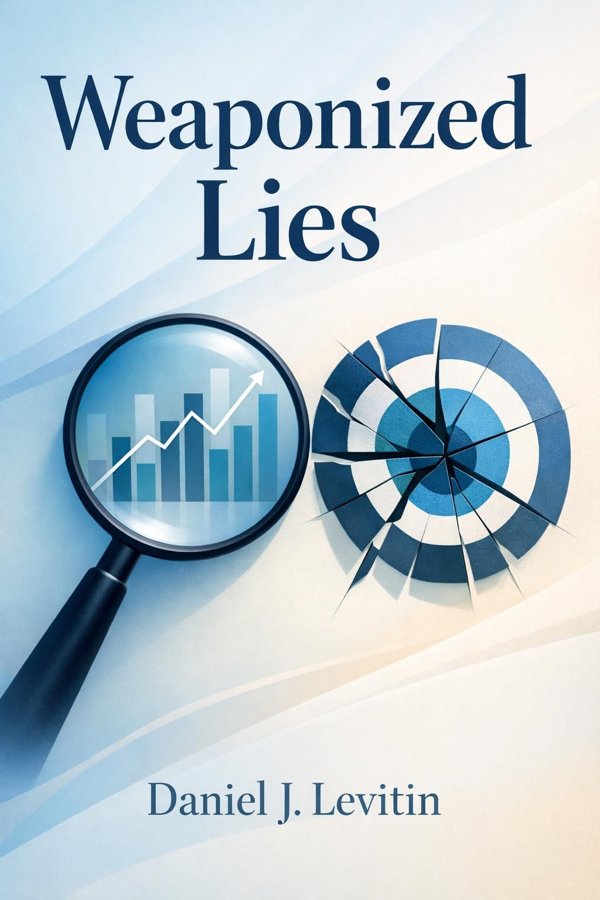
Weaponized Lies: How to Think Critically in the Post-Truth Era: Summary & Key Insights
 10 min9 chaptersAudio available
Key Takeaways from Weaponized Lies: How to Think Critically in the Post-Truth Era
Numbers can look objective even when they are being used to manipulate you.
An average can summarize reality, but it can also disguise it.
A misleading chart can do in seconds what a misleading paragraph may fail to do in minutes.
Two things moving together does not mean one caused the other.
In the post-truth era, information is abundant but credibility is scarce.
What Is Weaponized Lies: How to Think Critically in the Post-Truth Era About?
Weaponized Lies: How to Think Critically in the Post-Truth Era by Daniel J. Levitin is a cognition book spanning 11 pages. In an age when headlines travel faster than facts and statistics are used as weapons in public debate, Daniel J. Levitin’s Weaponized Lies offers a practical survival guide for the modern mind. The book examines how numbers, graphs, expert claims, political messages, and media narratives can be manipulated to mislead us, often without our noticing. Rather than simply warning that misinformation exists, Levitin shows readers exactly how deception works and how to resist it. What makes this book especially valuable is its blend of scientific rigor and everyday usefulness. Levitin is a cognitive psychologist and neuroscientist, so he understands both how evidence should be evaluated and how human thinking can go wrong. He explains why people are vulnerable to bad arguments, false certainty, and emotional persuasion, then gives clear tools for spotting weak logic, misleading statistics, and unreliable sources. This is not a book just for academics or policy experts. It is for anyone who reads the news, uses social media, votes, shops, parents, or makes decisions in a data-saturated world. Its central promise is empowering: critical thinking is not an innate gift. It is a learnable habit.
This FizzRead summary covers all 9 key chapters of Weaponized Lies: How to Think Critically in the Post-Truth Era in approximately 10 minutes, distilling the most important ideas, arguments, and takeaways from Daniel J. Levitin's work. Also available as an audio summary and Key Quotes Podcast.
Weaponized Lies: How to Think Critically in the Post-Truth Era
In an age when headlines travel faster than facts and statistics are used as weapons in public debate, Daniel J. Levitin’s Weaponized Lies offers a practical survival guide for the modern mind. The book examines how numbers, graphs, expert claims, political messages, and media narratives can be manipulated to mislead us, often without our noticing. Rather than simply warning that misinformation exists, Levitin shows readers exactly how deception works and how to resist it.
What makes this book especially valuable is its blend of scientific rigor and everyday usefulness. Levitin is a cognitive psychologist and neuroscientist, so he understands both how evidence should be evaluated and how human thinking can go wrong. He explains why people are vulnerable to bad arguments, false certainty, and emotional persuasion, then gives clear tools for spotting weak logic, misleading statistics, and unreliable sources.
This is not a book just for academics or policy experts. It is for anyone who reads the news, uses social media, votes, shops, parents, or makes decisions in a data-saturated world. Its central promise is empowering: critical thinking is not an innate gift. It is a learnable habit.
Who Should Read Weaponized Lies: How to Think Critically in the Post-Truth Era?
This book is perfect for anyone interested in cognition and looking to gain actionable insights in a short read. Whether you're a student, professional, or lifelong learner, the key ideas from Weaponized Lies: How to Think Critically in the Post-Truth Era by Daniel J. Levitin will help you think differently.
- ✓Readers who enjoy cognition and want practical takeaways
- ✓Professionals looking to apply new ideas to their work and life
- ✓Anyone who wants the core insights of Weaponized Lies: How to Think Critically in the Post-Truth Era in just 10 minutes
Want the full summary?
Get instant access to this book summary and 100K+ more with Fizz Moment.
Get Free SummaryAvailable on App Store • Free to download
Key Chapters
Numbers can look objective even when they are being used to manipulate you. One of Levitin’s most important insights is that data does not arrive with meaning attached. Every statistic depends on how it was collected, which sample was used, what question was asked, and what comparison was left out. A number in isolation can create false confidence because it appears precise. But precision is not the same as truth.
Levitin urges readers to slow down whenever they encounter percentages, rankings, totals, or trend claims. If a news report says crime is up 20 percent, you need more than the percentage. Up compared to when? In what area? From what baseline? A rise from 5 cases to 6 is technically a 20 percent increase, but it carries a very different meaning than a jump from 5,000 to 6,000. Likewise, a claim that a product is “50 percent more effective” may be meaningless unless you know what “effective” measures and against what standard.
This idea applies everywhere: political speeches, advertisements, workplace reports, even health advice. During election seasons, campaign teams often flood voters with carefully selected facts that sound convincing while omitting inconvenient context. Businesses do the same by highlighting favorable metrics and hiding less flattering ones.
The deeper lesson is epistemic humility. We should not ask only whether a number is true, but whether it is meaningful. Numbers need framing, comparison, and scrutiny before they deserve trust.
Actionable takeaway: whenever you see a striking statistic, ask three questions before accepting it: compared to what, measured how, and according to whom?
An average can summarize reality, but it can also disguise it. Levitin explains that mean, median, and mode are often treated as interchangeable in public discourse, even though they describe very different things. When communicators choose one average over another, they can create dramatically different impressions without technically lying.
Consider income. If a town contains a handful of billionaires and many low-income workers, the mean income may appear very high, making the area seem broadly prosperous. The median, however, might reveal that the typical resident earns far less. If a politician cites the mean to argue that people are doing well, the number may be statistically correct while socially misleading. The same issue appears in real estate, test scores, waiting times, and hospital outcomes.
Levitin’s larger point is that summary statistics compress complexity. They can be useful, but only if we understand what has been compressed away. Dispersion matters. Are outcomes clustered tightly, or are they wildly uneven? Outliers matter. Is a result driven by a few extreme cases? Distribution matters. Are there subgroups with entirely different experiences hidden inside one average?
In daily life, this matters when evaluating salaries, school performance, medical studies, and financial products. A mutual fund boasting “average annual returns” may hide years of volatility. A school praising its “average student achievement” may obscure significant gaps between demographics.
The smartest response is not to reject averages, but to interrogate them. Ask what kind of average is being used and what alternative summary might tell a different story.
Actionable takeaway: whenever someone cites an average, ask for the median, the range, and whether outliers are skewing the picture.
A misleading chart can do in seconds what a misleading paragraph may fail to do in minutes. Levitin shows how graphs and visual displays create an immediate impression of authority because the brain processes images quickly and often uncritically. Yet visual data is especially easy to manipulate through scale, truncation, color, design choices, and selective framing.
A bar chart with a y-axis that starts at 95 instead of 0 can make a tiny difference look enormous. A line graph that compresses time can exaggerate volatility or smooth it away. Pie charts can imply certainty even when categories overlap or data quality is poor. Even the order of bars and labels can subtly guide interpretation. These tricks are common in corporate presentations, political messaging, media reporting, and social media infographics.
Levitin encourages readers to look beyond the visual drama and examine the construction of the graphic. What is the axis range? Are units clearly labeled? Is the sample size shown? Is uncertainty represented? Does the graph omit relevant comparison groups? If a chart looks emotionally powerful, that is often the moment to become most skeptical.
This skill is increasingly important because so much public persuasion now happens visually. Viral posts often rely on screenshots of charts that are detached from sources and stripped of methodological detail. Once a graph confirms what people want to believe, it spreads rapidly.
Critical reading of graphs is really a form of self-defense. The goal is not to become cynical about every chart, but to understand that visuals are arguments, not neutral windows onto reality.
Actionable takeaway: before trusting any graph, inspect the axes, labels, time frame, and source, and ask whether the same data could be made to tell a different story.
Two things moving together does not mean one caused the other. This is one of the oldest lessons in critical thinking, yet one of the easiest to forget, especially when a causal story feels intuitive. Levitin stresses that human beings are natural pattern seekers. We want events to make sense, so when two variables line up, we instinctively imagine a cause-and-effect relationship.
But correlations can emerge for many reasons. One variable may cause the other, the reverse may be true, both may be caused by a third factor, or the relationship may be coincidence. Ice cream sales and drowning deaths both rise in summer, not because ice cream causes drowning, but because warm weather increases both. Similar errors appear in health reporting, education debates, and business strategy. A study might show that children who read more score higher on tests, but that alone does not prove that reading quantity caused the improvement; family income, parental involvement, or school quality may also play major roles.
Levitin does not argue that correlation is useless. On the contrary, it is often the beginning of discovery. The problem arises when preliminary association is oversold as proven causation. Journalists, marketers, and political advocates often collapse this distinction because causal claims are more compelling and easier to act on.
For readers, the remedy is disciplined curiosity. Ask what kind of evidence supports the claim. Was there an experiment? Were variables controlled? Is there a plausible mechanism? Were alternative explanations considered?
Actionable takeaway: when you hear “X leads to Y,” pause and ask whether the evidence shows causation, mere association, or simply an appealing story built on coincidence.
In the post-truth era, information is abundant but credibility is scarce. Levitin argues that one of the most important modern literacy skills is source evaluation. The key question is no longer just what is being said, but who is saying it, how they know it, and what incentives may shape their claims.
A polished website, confident speaker, or viral post can easily create the illusion of expertise. But authority should be earned, not assumed. Levitin suggests examining whether a source has relevant qualifications, whether evidence is cited transparently, whether the work has been reviewed or challenged, and whether conflicts of interest are disclosed. A medical claim from a licensed physician drawing on peer-reviewed studies carries more weight than the same claim from an influencer selling supplements.
This does not mean experts are always right. Experts disagree, and institutions can fail. But expertise still matters because informed judgment is generally more reliable than uninformed opinion. The challenge is distinguishing genuine expertise from manufactured credibility.
Levitin also highlights the value of triangulation. Instead of relying on a single article or commentator, compare multiple reputable sources. If independent outlets with different incentives converge on the same account, confidence should rise. If a claim appears only in partisan or fringe spaces, caution is warranted.
This practice is especially useful online, where algorithms reward novelty, outrage, and certainty rather than accuracy. A claim can feel omnipresent because it is repeated widely within one network, not because it is well supported.
Actionable takeaway: before accepting an important claim, check the original source, the author’s expertise, the evidence provided, and whether independent credible sources corroborate it.
Bad arguments often succeed not because they are strong, but because they fit our cognitive habits. Levitin explains that logical fallacies work by hijacking shortcuts in human thinking. They substitute emotional force, social pressure, or rhetorical distraction for real evidence, and they appear constantly in politics, media, and everyday conversation.
Ad hominem attacks shift attention from the argument to the person making it. False dilemmas pretend there are only two choices when reality offers many. Straw man arguments oversimplify an opponent’s position so it can be easily attacked. Appeals to popularity suggest that if many people believe something, it must be true. Slippery slope arguments claim that one action will inevitably trigger extreme consequences without demonstrating the chain of causation.
These fallacies are effective because they often feel persuasive in the moment. They reduce complexity, provide villains, and satisfy emotional needs for certainty and belonging. In a heated discussion, people may accept weak reasoning because it supports their tribe or confirms prior beliefs.
Levitin’s contribution is not merely cataloging fallacies, but showing that recognizing them improves judgment across domains. At work, it helps you evaluate proposals. In family life, it reduces unproductive arguments. In civic life, it protects against manipulative rhetoric disguised as debate.
The goal is not to become pedantic or combative. It is to notice when an argument has shifted from evidence to performance. Once you see the move, you can return the discussion to facts, definitions, and reasoning.
Actionable takeaway: when an argument feels forceful, identify its structure and ask, “What is the actual evidence here, and does the conclusion really follow from it?”
Many people assume science is a collection of facts, but Levitin reminds us that science is first and foremost a method of disciplined doubt. Scientific thinking does not demand absolute certainty before acting. Instead, it compares explanations, tests claims against evidence, updates beliefs when new information appears, and remains honest about uncertainty.
This matters because misinformation often gains traction by exploiting discomfort with ambiguity. False claims are frequently delivered with complete confidence, while trustworthy scientific statements may include caveats, margins of error, and probabilities. To the untrained ear, the overconfident speaker can sound more convincing. But Levitin argues that uncertainty, when properly understood, is a sign of intellectual seriousness, not weakness.
He encourages readers to look for hallmarks of scientific reasoning: clear definitions, testable hypotheses, reproducible methods, peer review, error correction, and openness to revision. A claim that cannot be tested, challenged, or falsified is not operating on scientific grounds. Similarly, a single sensational study should rarely overturn a well-established body of evidence.
In practical life, scientific thinking helps with health choices, financial decisions, parenting advice, and public policy. Rather than asking, “What should I believe forever?” a better question is, “What does the best available evidence support right now?” This mindset lowers the emotional cost of changing one’s mind.
Levitin’s larger message is liberating: you do not need to know everything to think well. You need habits for evaluating evidence and revising beliefs responsibly.
Actionable takeaway: prefer claims that acknowledge limits, explain methods, and can be tested over claims that offer certainty without transparency.
One of the most dangerous forms of misinformation does not come from others. It comes from our own minds. Levitin explains that memory is not a recording device but a reconstructive process, and that cognitive biases shape what we notice, remember, and believe. This means sincere people can still be profoundly mistaken.
Confirmation bias leads us to seek and remember information that supports existing views while discounting contradictions. Availability bias makes vivid or recent examples feel more common than they really are. Anchoring causes early numbers or impressions to influence later judgment, even when they are arbitrary. Repetition can create an illusion of truth, making familiar claims feel credible simply because we have heard them before.
These tendencies help explain why misinformation is so resilient. A false statement that aligns with identity or emotion can lodge in memory and survive correction. Even after being debunked, it may continue to influence judgment because the original impression remains psychologically powerful.
Levitin’s analysis is especially useful because it redirects critical thinking inward. It is easy to spot gullibility in others and overlook it in ourselves. But real intellectual maturity begins when we accept that our own intuitions are fallible. That recognition encourages better habits: checking sources before sharing, separating memory from evidence, and welcoming disconfirming information.
This principle matters in personal disagreements as much as public controversies. People often defend recollections with complete confidence, not realizing how unreliable confidence can be.
Actionable takeaway: when a claim feels obviously true because it matches what you already think or remember, treat that feeling as a cue to verify rather than as proof.
Information systems do not merely transmit ideas. They shape which ideas flourish. Levitin shows how modern media and algorithmic platforms amplify emotionally charged, simplistic, and polarizing content because such material captures attention. In this environment, misinformation is not an accidental side effect. It is often structurally rewarded.
Traditional media can distort through sensational framing, selective coverage, and false balance, giving fringe claims more legitimacy than evidence warrants. Digital platforms intensify the problem by personalizing information streams. Algorithms prioritize what keeps users engaged, not what makes them informed. As a result, people can live inside curated realities where certain stories are repeated, others disappear, and outrage becomes a business model.
Levitin also warns about the seductive authority of big data and algorithms. People often assume that computational systems are neutral because they are mathematical. But algorithms inherit the assumptions, training data, and goals of their designers. A predictive model can reproduce social bias, mistake correlation for significance, or optimize for clicks at the expense of truth.
This does not mean technology is the enemy. It means technological outputs must be interpreted critically. We should ask what data went in, what objective was optimized, what errors are known, and who benefits from the system’s design.
The practical implication is that media literacy now includes platform literacy. To think clearly, you must understand not only arguments and evidence, but also the environments that distribute them.
Actionable takeaway: diversify your information sources, resist instant sharing, and remember that what appears in your feed is shaped by incentives and algorithms, not just by truth.
All Chapters in Weaponized Lies: How to Think Critically in the Post-Truth Era
About the Author
Daniel J. Levitin is a cognitive psychologist, neuroscientist, musician, and bestselling author known for translating complex research into engaging, practical writing. He has taught at McGill University and held academic roles connected to psychology, neuroscience, and music cognition. Levitin first gained wide recognition for books such as This Is Your Brain on Music, which explored how the brain processes sound and emotion. Across his work, he focuses on how people think, remember, decide, and make sense of the world. That background makes him especially well suited to write about misinformation and critical thinking. In Weaponized Lies, he combines scientific expertise with clear communication, helping readers understand both the mechanics of deception and the mental habits required to reason more carefully in everyday life.
Get This Summary in Your Preferred Format
Read or listen to the Weaponized Lies: How to Think Critically in the Post-Truth Era summary by Daniel J. Levitin anytime, anywhere. FizzRead offers multiple formats so you can learn on your terms — all free.
Available formats: App · Audio · PDF · EPUB — All included free with FizzRead
Download Weaponized Lies: How to Think Critically in the Post-Truth Era PDF and EPUB Summary
Key Quotes from Weaponized Lies: How to Think Critically in the Post-Truth Era
“Numbers can look objective even when they are being used to manipulate you.”
“An average can summarize reality, but it can also disguise it.”
“A misleading chart can do in seconds what a misleading paragraph may fail to do in minutes.”
“Two things moving together does not mean one caused the other.”
“In the post-truth era, information is abundant but credibility is scarce.”
Frequently Asked Questions about Weaponized Lies: How to Think Critically in the Post-Truth Era
Weaponized Lies: How to Think Critically in the Post-Truth Era by Daniel J. Levitin is a cognition book that explores key ideas across 9 chapters. In an age when headlines travel faster than facts and statistics are used as weapons in public debate, Daniel J. Levitin’s Weaponized Lies offers a practical survival guide for the modern mind. The book examines how numbers, graphs, expert claims, political messages, and media narratives can be manipulated to mislead us, often without our noticing. Rather than simply warning that misinformation exists, Levitin shows readers exactly how deception works and how to resist it. What makes this book especially valuable is its blend of scientific rigor and everyday usefulness. Levitin is a cognitive psychologist and neuroscientist, so he understands both how evidence should be evaluated and how human thinking can go wrong. He explains why people are vulnerable to bad arguments, false certainty, and emotional persuasion, then gives clear tools for spotting weak logic, misleading statistics, and unreliable sources. This is not a book just for academics or policy experts. It is for anyone who reads the news, uses social media, votes, shops, parents, or makes decisions in a data-saturated world. Its central promise is empowering: critical thinking is not an innate gift. It is a learnable habit.
More by Daniel J. Levitin
A Field Guide to Lies: Critical Thinking in the Information Age
Daniel J. Levitin
10 min
This Is Your Brain on Music: The Science of a Human Obsession
Daniel J. Levitin
10 min
Successful Aging: A Neuroscientist Explores the Power and Potential of Our Lives
Daniel J. Levitin
10 min
The Organized Mind: Thinking Straight in the Age of Information Overload
Daniel J. Levitin
10 minYou Might Also Like
A Field Guide to Lies: Critical Thinking in the Information Age
Daniel J. Levitin
10 min
A Theory of Cognitive Dissonance
Leon Festinger
10 min
Black-And-White Thinking: The Burden of a Binary Brain in a Complex World
Kevin Dutton
10 min
Born Liars: Why We Can’t Live Without Deceit
Ian Leslie
10 min
Collective Illusions: Conformity, Complicity, and the Science of Why We Make Bad Decisions
Todd Rose
10 min
Concrete Mathematics: A Foundation for Computer Science
Ronald L. Graham, Donald E. Knuth, Oren Patashnik
10 minBrowse by Category
Ready to read Weaponized Lies: How to Think Critically in the Post-Truth Era?
Get the full summary and 100K+ more books with Fizz Moment.