
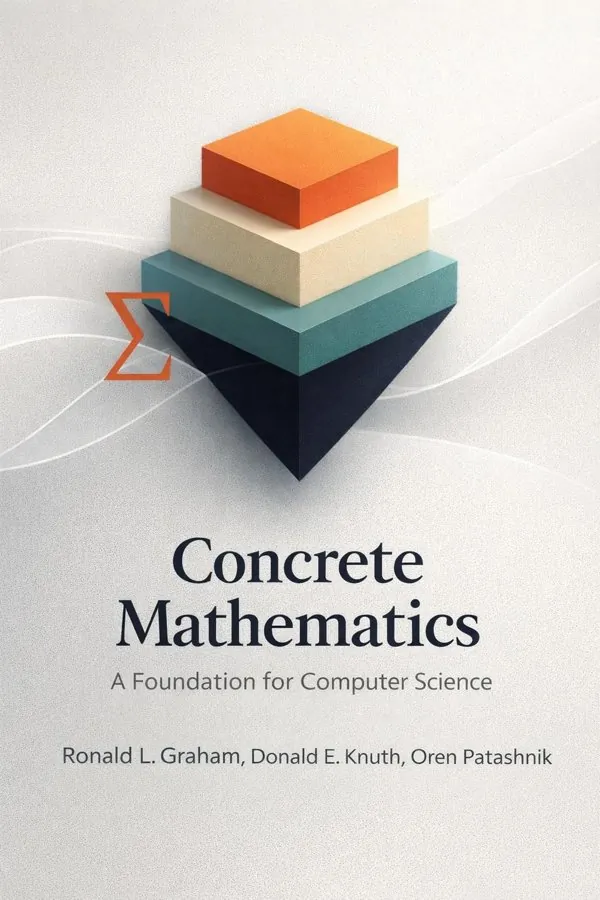
Concrete Mathematics: A Foundation for Computer Science: Summary & Key Insights
by Ronald L. Graham, Donald E. Knuth, Oren Patashnik
 10 min12 chaptersAudio available
What Is Concrete Mathematics: A Foundation for Computer Science About?
Concrete Mathematics: A Foundation for Computer Science by Ronald L. Graham, Donald E. Knuth, Oren Patashnik is a cognition book spanning 12 pages. Concrete Mathematics es una obra fundamental que combina la matemática discreta y continua para proporcionar las herramientas necesarias en la ciencia de la computación. El libro cubre temas como sumas, recurrencias, números especiales, aproximaciones y probabilidad, con un enfoque en la resolución de problemas y el razonamiento matemático riguroso.
This FizzRead summary covers all 12 key chapters of Concrete Mathematics: A Foundation for Computer Science in approximately 10 minutes, distilling the most important ideas, arguments, and takeaways from Ronald L. Graham, Donald E. Knuth, Oren Patashnik's work. Also available as an audio summary and Key Quotes Podcast.
Concrete Mathematics: A Foundation for Computer Science
Concrete Mathematics es una obra fundamental que combina la matemática discreta y continua para proporcionar las herramientas necesarias en la ciencia de la computación. El libro cubre temas como sumas, recurrencias, números especiales, aproximaciones y probabilidad, con un enfoque en la resolución de problemas y el razonamiento matemático riguroso.
Who Should Read Concrete Mathematics: A Foundation for Computer Science?
This book is perfect for anyone interested in cognition and looking to gain actionable insights in a short read. Whether you're a student, professional, or lifelong learner, the key ideas from Concrete Mathematics: A Foundation for Computer Science by Ronald L. Graham, Donald E. Knuth, Oren Patashnik will help you think differently.
- ✓Readers who enjoy cognition and want practical takeaways
- ✓Professionals looking to apply new ideas to their work and life
- ✓Anyone who wants the core insights of Concrete Mathematics: A Foundation for Computer Science in just 10 minutes
Want the full summary?
Get instant access to this book summary and 100K+ more with Fizz Moment.
Get Free SummaryAvailable on App Store • Free to download
Key Chapters
From the beginning, we wanted this book to reflect two intertwined ideas: mathematical rigor and the art of problem solving. Computer science thrives on algorithmic thought, and algorithms themselves are nothing but structured sequences of mathematical reasoning. Yet it’s not enough to possess formulas. One must learn to derive them, transform them, and understand why they work. Throughout 'Concrete Mathematics,' each section presents mathematical tools not as ends, but as steps toward mastery of reasoning.
The recurrent theme is discipline—every equation, every identity is tested, derived, and applied. We begin with recurrence relations not merely to solve abstract numerical puzzles but to understand how algorithms grow and evolve. The concept of recurrence expresses the essence of repetition, iteration, and recursion—the language of computing itself. To handle such structures rigorously, we adopt algebraic manipulation, substitution methods, and characteristic equations—the very techniques that underlie both division-and-conquer algorithms and iterative computations.
Rigor, however, must coexist with playfulness. Mathematics, as we teach it here, invites exploration. We deliberately include challenging exercises that push you beyond rote calculation. When you derive a result independently—say, by induction, by generating functions, or by combinatorial reasoning—you achieve more than correctness; you achieve insight. This combination of precision and creativity is the hallmark of algorithmic thinking.
Recurrence relations are among the most powerful mathematical models of computation. They describe how current values depend on prior ones—a pattern mirrored in recursive algorithms. In this chapter, we start with simple examples such as the Fibonacci sequence, then gradually introduce linear and non-linear recurrences. You’ll see techniques for solving them: iteration, characteristic roots, and the ingenious use of generating functions.
We emphasize that every recurrence has a story. Some arise from counting problems, others from iterative approximations, and many from algorithmic complexity analyses. For instance, the time complexity of mergesort or quicksort is expressed through recurrence relations. Learning to untangle such relations means learning to understand how algorithms behave as input grows.
Through proofs and illustrative examples, we illuminate the beauty of recurrence: its ability to express self-reference, modular growth, and mathematical elegance. Solving a recurrence isn’t just an exercise—it’s the unveiling of the hidden structure beneath computation.
+ 10 more chapters — available in the FizzRead app
All Chapters in Concrete Mathematics: A Foundation for Computer Science
About the Authors
Ronald L. Graham fue un matemático estadounidense conocido por sus contribuciones a la teoría de números y combinatoria. Donald E. Knuth es un pionero en la informática teórica y autor de 'The Art of Computer Programming'. Oren Patashnik es un matemático y científico de la computación especializado en algoritmos y combinatoria.
Get This Summary in Your Preferred Format
Read or listen to the Concrete Mathematics: A Foundation for Computer Science summary by Ronald L. Graham, Donald E. Knuth, Oren Patashnik anytime, anywhere. FizzRead offers multiple formats so you can learn on your terms — all free.
Available formats: App · Audio · PDF · EPUB — All included free with FizzRead
Download Concrete Mathematics: A Foundation for Computer Science PDF and EPUB Summary
Key Quotes from Concrete Mathematics: A Foundation for Computer Science
“From the beginning, we wanted this book to reflect two intertwined ideas: mathematical rigor and the art of problem solving.”
“Recurrence relations are among the most powerful mathematical models of computation.”
Frequently Asked Questions about Concrete Mathematics: A Foundation for Computer Science
Concrete Mathematics: A Foundation for Computer Science by Ronald L. Graham, Donald E. Knuth, Oren Patashnik is a cognition book that explores key ideas across 12 chapters. Concrete Mathematics es una obra fundamental que combina la matemática discreta y continua para proporcionar las herramientas necesarias en la ciencia de la computación. El libro cubre temas como sumas, recurrencias, números especiales, aproximaciones y probabilidad, con un enfoque en la resolución de problemas y el razonamiento matemático riguroso.
You Might Also Like
A Field Guide to Lies: Critical Thinking in the Information Age
Daniel J. Levitin
10 min
A Theory of Cognitive Dissonance
Leon Festinger
10 min
Black-And-White Thinking: The Burden of a Binary Brain in a Complex World
Kevin Dutton
10 min
Born Liars: Why We Can’t Live Without Deceit
Ian Leslie
10 min
Collective Illusions: Conformity, Complicity, and the Science of Why We Make Bad Decisions
Todd Rose
10 min
Consciousness Explained
Daniel C. Dennett
10 minBrowse by Category
Ready to read Concrete Mathematics: A Foundation for Computer Science?
Get the full summary and 100K+ more books with Fizz Moment.