
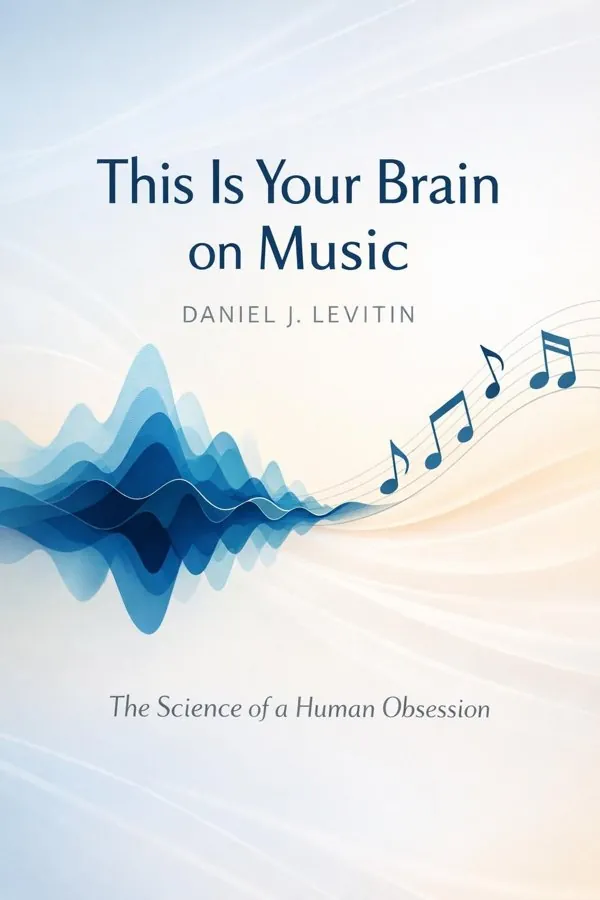
This Is Your Brain on Music: The Science of a Human Obsession: Summary & Key Insights
 10 min11 chaptersAudio available
What Is This Is Your Brain on Music: The Science of a Human Obsession About?
This Is Your Brain on Music: The Science of a Human Obsession by Daniel J. Levitin is a neuroscience book spanning 11 pages. This book explores the intersection of neuroscience and music, explaining how our brains perceive, process, and respond to musical patterns. Drawing on research in cognitive psychology and neurobiology, Levitin reveals why music evokes emotion, how it shapes memory, and what it tells us about human creativity and evolution.
This FizzRead summary covers all 11 key chapters of This Is Your Brain on Music: The Science of a Human Obsession in approximately 10 minutes, distilling the most important ideas, arguments, and takeaways from Daniel J. Levitin's work. Also available as an audio summary and Key Quotes Podcast.
This Is Your Brain on Music: The Science of a Human Obsession
This book explores the intersection of neuroscience and music, explaining how our brains perceive, process, and respond to musical patterns. Drawing on research in cognitive psychology and neurobiology, Levitin reveals why music evokes emotion, how it shapes memory, and what it tells us about human creativity and evolution.
Who Should Read This Is Your Brain on Music: The Science of a Human Obsession?
This book is perfect for anyone interested in neuroscience and looking to gain actionable insights in a short read. Whether you're a student, professional, or lifelong learner, the key ideas from This Is Your Brain on Music: The Science of a Human Obsession by Daniel J. Levitin will help you think differently.
- ✓Readers who enjoy neuroscience and want practical takeaways
- ✓Professionals looking to apply new ideas to their work and life
- ✓Anyone who wants the core insights of This Is Your Brain on Music: The Science of a Human Obsession in just 10 minutes
Want the full summary?
Get instant access to this book summary and 100K+ more with Fizz Moment.
Get Free SummaryAvailable on App Store • Free to download
Key Chapters
We begin with the ingredients that make music what it is—pitch, rhythm, timbre, and harmony. These elements seem simple, but they represent astonishing feats of auditory processing. Every sound reaching your ears is a complex wave pattern, and the brain decomposes it into component frequencies. Pitch relates to how the brain interprets frequency; it gives structure to melody. Rhythm is the organization of time, an internal dance between expectation and fulfillment. Timbre, often called tone color, is how we distinguish a violin from a trumpet even if both play the same note. Harmony arises when pitches coexist, forming tension and release that stir emotion.
In my research, I’ve found that the brain doesn’t just detect these qualities—it predicts and organizes them. When you hear a melody, your auditory cortex anticipates what should come next, building expectations from experience. That expectation mechanism explains why surprises in music—sudden key changes or syncopations—feel so delightful. The pleasure comes from balancing certainty and uncertainty, a fundamental cognitive pattern.
From infancy, humans are sensitive to rhythm. Babies move instinctively to beats, showing that musical timing connects deeply to motor systems. Timbre processing involves complex networks linking auditory regions with memory centers, which allow you to identify familiar voices or instruments instantly. Altogether, these sensory foundations illustrate how music transforms perception into meaning, inviting both emotion and intellect to collaborate.
To perceive music is to construct it mentally. The brain doesn’t merely record sound; it interprets waveforms, predicts sequences, and assembles them into coherent phrases. The auditory cortex translates physical vibrations into neural signals, but cognition gives those signals shape. Through pattern recognition, the mind detects motifs, rhythms, and harmonic progressions. As listeners, we’re continuously guessing what will happen next—and whether our expectations will be met or violated.
Neuroscience demonstrates that listening is an active form of thinking. Each musical moment engages working memory, attention, and imagination. Even silence has cognitive weight; it forms part of our predictive structure. This is why musical phrasing feels conversational—the brain treats melody and rhythm as communicative cues, much like spoken language.
When we listen repeatedly to a song, networks of neurons grow more efficient. Familiarity breeds predictive power. This fusion of sensory processing and cognition makes musical perception a model for how the mind organizes chaos into pattern—a reflection of our evolutionary need to find order amid noise.
+ 9 more chapters — available in the FizzRead app
All Chapters in This Is Your Brain on Music: The Science of a Human Obsession
About the Author
Daniel J. Levitin is a cognitive neuroscientist, musician, and author. He has served as a professor at McGill University and has published widely on the neuroscience of music, perception, and cognition.
Get This Summary in Your Preferred Format
Read or listen to the This Is Your Brain on Music: The Science of a Human Obsession summary by Daniel J. Levitin anytime, anywhere. FizzRead offers multiple formats so you can learn on your terms — all free.
Available formats: App · Audio · PDF · EPUB — All included free with FizzRead
Download This Is Your Brain on Music: The Science of a Human Obsession PDF and EPUB Summary
Key Quotes from This Is Your Brain on Music: The Science of a Human Obsession
“We begin with the ingredients that make music what it is—pitch, rhythm, timbre, and harmony.”
“To perceive music is to construct it mentally.”
Frequently Asked Questions about This Is Your Brain on Music: The Science of a Human Obsession
This Is Your Brain on Music: The Science of a Human Obsession by Daniel J. Levitin is a neuroscience book that explores key ideas across 11 chapters. This book explores the intersection of neuroscience and music, explaining how our brains perceive, process, and respond to musical patterns. Drawing on research in cognitive psychology and neurobiology, Levitin reveals why music evokes emotion, how it shapes memory, and what it tells us about human creativity and evolution.
More by Daniel J. Levitin

A Field Guide to Lies: Critical Thinking in the Information Age
Daniel J. Levitin
10 min
Successful Aging: A Neuroscientist Explores the Power and Potential of Our Lives
Daniel J. Levitin
10 min
The Organized Mind: Thinking Straight in the Age of Information Overload
Daniel J. Levitin
10 min
Weaponized Lies: How to Think Critically in the Post-Truth Era
Daniel J. Levitin
10 minYou Might Also Like
Anxious
Joseph LeDoux
10 min
Hallucinations
Oliver Sacks
10 min
The Biological Mind: How Brain, Body, and Environment Collaborate to Make Us Who We Are
Alan Jasanoff
10 min
The Feeling of Life Itself: Why Consciousness Is Widespread but Can't Be Computed
Christof Koch
10 min
The No-Nonsense Meditation Book
Steven Laureys
10 min
A General Theory of Love
Thomas Lewis, Fari Amini, Richard Lannon
10 minBrowse by Category
Ready to read This Is Your Brain on Music: The Science of a Human Obsession?
Get the full summary and 100K+ more books with Fizz Moment.