
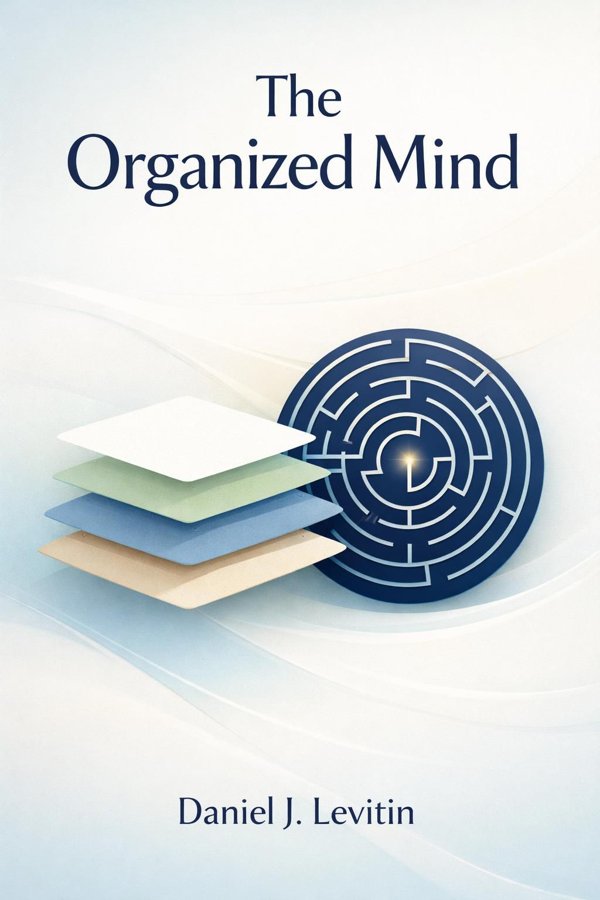
The Organized Mind: Thinking Straight in the Age of Information Overload: Summary & Key Insights
 10 min10 chaptersAudio available
Key Takeaways from The Organized Mind: Thinking Straight in the Age of Information Overload
One of the book’s most important insights is that attention feels broad, but it is actually extremely limited.
We often talk about memory as if it were a single mental muscle, but Levitin shows that memory is really a network of systems with different jobs.
A cluttered environment is often a symptom of a deeper problem: too many uncategorized decisions.
Modern life does not just overwhelm us with information; it overwhelms us with decisions.
Home organization is not just about cleanliness or aesthetics.
What Is The Organized Mind: Thinking Straight in the Age of Information Overload About?
The Organized Mind: Thinking Straight in the Age of Information Overload by Daniel J. Levitin is a neuroscience book spanning 10 pages. The Organized Mind examines one of the defining problems of modern life: our brains are ancient biological systems trying to cope with a world of endless emails, notifications, choices, and demands. In this practical and deeply researched book, neuroscientist Daniel J. Levitin explains how attention, memory, decision-making, and organization actually work inside the brain—and why so many of our daily habits leave us mentally exhausted. His central argument is reassuring: feeling overwhelmed is not a personal failure. It is often the predictable result of asking the brain to do more than it was designed to do at once. Levitin combines cognitive neuroscience, psychology, and real-world examples to show how we can reduce mental clutter, structure our environments, and make better use of external systems like calendars, lists, folders, routines, and schedules. Rather than offering superficial productivity hacks, he connects everyday struggles to the architecture of the mind itself. As a neuroscientist, professor, and bestselling author known for making brain science accessible, Levitin brings both authority and clarity to a subject that affects students, professionals, parents, and anyone trying to think clearly in a distracted age.
This FizzRead summary covers all 10 key chapters of The Organized Mind: Thinking Straight in the Age of Information Overload in approximately 10 minutes, distilling the most important ideas, arguments, and takeaways from Daniel J. Levitin's work. Also available as an audio summary and Key Quotes Podcast.
The Organized Mind: Thinking Straight in the Age of Information Overload
The Organized Mind examines one of the defining problems of modern life: our brains are ancient biological systems trying to cope with a world of endless emails, notifications, choices, and demands. In this practical and deeply researched book, neuroscientist Daniel J. Levitin explains how attention, memory, decision-making, and organization actually work inside the brain—and why so many of our daily habits leave us mentally exhausted. His central argument is reassuring: feeling overwhelmed is not a personal failure. It is often the predictable result of asking the brain to do more than it was designed to do at once.
Levitin combines cognitive neuroscience, psychology, and real-world examples to show how we can reduce mental clutter, structure our environments, and make better use of external systems like calendars, lists, folders, routines, and schedules. Rather than offering superficial productivity hacks, he connects everyday struggles to the architecture of the mind itself. As a neuroscientist, professor, and bestselling author known for making brain science accessible, Levitin brings both authority and clarity to a subject that affects students, professionals, parents, and anyone trying to think clearly in a distracted age.
Who Should Read The Organized Mind: Thinking Straight in the Age of Information Overload?
This book is perfect for anyone interested in neuroscience and looking to gain actionable insights in a short read. Whether you're a student, professional, or lifelong learner, the key ideas from The Organized Mind: Thinking Straight in the Age of Information Overload by Daniel J. Levitin will help you think differently.
- ✓Readers who enjoy neuroscience and want practical takeaways
- ✓Professionals looking to apply new ideas to their work and life
- ✓Anyone who wants the core insights of The Organized Mind: Thinking Straight in the Age of Information Overload in just 10 minutes
Want the full summary?
Get instant access to this book summary and 100K+ more with Fizz Moment.
Get Free SummaryAvailable on App Store • Free to download
Key Chapters
One of the book’s most important insights is that attention feels broad, but it is actually extremely limited. We like to believe we can monitor messages, answer emails, hold conversations, and make decisions all at once, yet the brain does not truly multitask on demanding activities. Instead, it switches rapidly between them, paying a hidden cost each time. Levitin explains that the prefrontal cortex, which helps us plan, focus, and manage goals, can only hold a small amount of active information at once. Every interruption forces it to reload context, which drains mental energy and increases mistakes.
This is why a five-second glance at a notification can leave you struggling to remember what you were doing. The interruption itself may be tiny, but the recovery time is not. The brain must reconstruct your place in the task, re-establish priorities, and suppress competing inputs again. Over a full day, these micro-disruptions can erode productivity and create a constant feeling of cognitive fatigue.
Levitin’s point is not that we should become monks or avoid all stimulation. It is that we need to respect the bottlenecks built into the brain. Turning off unnecessary alerts, batching communication, and protecting blocks of uninterrupted time are not signs of rigidity. They are ways of aligning daily work with how attention actually functions.
A useful example is email. Instead of checking it every few minutes, checking it at two or three designated times reduces switching costs and preserves concentration for deeper work. The same principle applies to meetings, studying, and household tasks.
Actionable takeaway: Treat focused attention as a scarce resource—remove avoidable interruptions and work on one cognitively demanding task at a time.
We often talk about memory as if it were a single mental muscle, but Levitin shows that memory is really a network of systems with different jobs. Working memory is the brain’s temporary scratchpad, the place where we hold phone numbers, follow instructions, or compare options. It is useful, but fragile and sharply limited. Long-term memory, by contrast, stores knowledge, experiences, habits, and associations over time. Problems arise when we expect working memory to carry more than it can handle.
Many daily frustrations come from this mismatch. We try to remember errands, passwords, deadlines, and ideas without writing them down, then blame ourselves when something slips. Levitin argues that this is not a character flaw. It is a design problem. Working memory can only juggle a few chunks of information at once, so relying on it as a life-management tool is inefficient from the start.
The solution is to build external systems that support the brain rather than compete with it. Lists, labeled folders, calendars, checklists, and designated storage places reduce the burden on working memory and free mental space for thinking. In other words, organization is not merely tidiness; it is cognitive offloading.
He also emphasizes the role of categorization in long-term memory. We remember better when new information is attached to meaningful structures. Grouping similar items, using clear labels, and creating routines makes information easier to store and retrieve later.
For example, keeping all travel items in one drawer, all bills in one folder, and all appointments in one calendar reduces search time and mental friction. The brain retrieves information more easily when it knows where to look.
Actionable takeaway: Stop asking your memory to do the job of a system—externalize important information into reliable, consistent structures.
A cluttered environment is often a symptom of a deeper problem: too many uncategorized decisions. Levitin explains that the brain naturally organizes the world through categories. This ability helps us reduce complexity, recognize patterns, and act quickly. Without categories, every object, message, and obligation would have to be reconsidered from scratch. Mental life would become unbearably slow.
This is why organization matters so much. When we decide in advance where things belong, what type of task something is, or which priority bucket an obligation fits into, we reduce the number of choices the brain must make in the moment. Categories act like shortcuts. They convert chaos into a manageable map.
The same principle applies to both physical and digital spaces. A desk piled with unrelated papers creates cognitive drag because each item silently asks a question: keep, discard, file, read, respond, or ignore? But a simple folder system—urgent, waiting, archive, reference—shrinks those decisions dramatically. Likewise, digital files become easier to manage when they follow consistent naming conventions and logical groupings.
Levitin also suggests that categories should reflect how you actually use information, not some abstract ideal. A filing system that looks elegant but does not match your habits will eventually fail. Good organization is not perfection; it is friction reduction.
At home, this may mean giving everyday objects fixed locations near where they are used. In knowledge work, it may mean creating project-based folders instead of endless miscellaneous documents. The goal is to make retrieval intuitive.
Actionable takeaway: Create a small number of practical categories for your spaces, tasks, and files so your brain spends less time deciding and more time doing.
Modern life does not just overwhelm us with information; it overwhelms us with decisions. Levitin shows that decision-making is one of the most energy-intensive things the brain does. Each choice draws on attention, memory, emotional forecasting, and value comparison. When too many choices pile up, we become slower, sloppier, and more impulsive. This is the logic behind decision fatigue.
The brain is not equally good at every decision at every hour. As mental resources decline, we become more likely to defer choices, choose the default, or chase short-term relief rather than long-term value. That helps explain why people may make thoughtful strategic decisions in the morning and then order takeout, ignore bills, or doom-scroll at night.
Levitin recommends reducing avoidable decisions so that cognitive energy is reserved for what actually matters. This does not mean living mechanically. It means automating the routine. Standard meals, preset budgets, recurring calendar blocks, and habitual morning sequences all lower decision load. When the predictable parts of life are systematized, the mind becomes more available for creativity, judgment, and problem-solving.
He also notes that decisions improve when information is constrained. Instead of evaluating every possible option, narrow the field first. For instance, define criteria before shopping, interviewing, or planning. If you know your budget, priorities, and deal-breakers, the brain can compare options more efficiently.
In work settings, checklists and pre-commitments are especially useful. They prevent the brain from renegotiating the same issue repeatedly under pressure.
Actionable takeaway: Minimize trivial choices and set clear criteria in advance so your best mental energy goes to decisions that truly deserve it.
In many workplaces, busyness is mistaken for productivity. Levitin pushes back on this by showing that real productivity depends less on visible activity than on the intelligent management of cognitive resources. Open office noise, constant messaging, poorly structured meetings, and fragmented workflows all consume attention that could have gone to meaningful work.
The modern workplace often asks the brain to remain in a state of permanent responsiveness. But responsiveness and deep thinking are not the same mode. One is reactive; the other is generative. Levitin argues that organizations perform better when they recognize this distinction and design systems accordingly.
Practical changes can make a major difference. Meetings should have clear agendas, relevant participants, and defined outcomes. Email should not be treated as an always-on conversation. Projects should be broken into stages with explicit ownership. Shared documents and folders should follow naming rules so knowledge can be found later. In other words, good workplace organization reduces ambiguity.
For individuals, this may mean creating daily priority lists, blocking time for concentrated work, and separating shallow tasks from deep ones. For teams, it may mean clarifying channels: what belongs in chat, what belongs in email, what requires a meeting, and what can be documented asynchronously. Every such rule saves attention.
Levitin’s broader point is that systems are not bureaucratic obstacles when they are well designed. They are memory aids for groups. Just as individuals offload cognition onto lists and calendars, organizations offload cognition onto processes, norms, and tools.
Actionable takeaway: Build workplace routines that reduce ambiguity—protect focus time, structure communication, and standardize how information is stored and shared.
Time is one of the hardest things for the brain to organize because it is invisible, abstract, and always moving. Levitin explains that people often fail at time management not because they are lazy, but because the brain is poor at intuitively tracking future commitments amid present distractions. Deadlines, durations, and sequencing need external representation.
This is why calendars, schedules, reminders, and timelines are so powerful. They convert time from a vague mental burden into something concrete and reviewable. Once obligations are externalized, the mind no longer has to rehearse them constantly just to avoid forgetting. This reduces anxiety while improving follow-through.
Levitin also highlights a common planning error: we underestimate how long tasks take. The brain tends to imagine best-case scenarios and ignore transition time, setup time, and interruptions. Better planning requires realism. Buffer space, task batching, and calendar blocks help account for the actual shape of a day.
Another useful distinction is between reactive time and proactive time. If every hour is available to other people’s requests, important but non-urgent work never gets done. Scheduling thinking time, writing time, administrative time, and recovery time makes priorities visible before urgency takes over.
This idea extends to personal life as well. Exercise, family conversations, and sleep often disappear when left to intention alone. Putting them on the calendar gives them structural protection.
Levitin’s message is clear: you cannot manage time solely inside your head. You need a trusted system that reflects commitments, helps you estimate realistically, and surfaces priorities in advance.
Actionable takeaway: Use a single reliable calendar and schedule time blocks with buffers so your priorities exist in a visible system, not just in intention.
Technology is often presented as the cure for information overload, yet Levitin shows that it can just as easily become the cause. Digital tools are incredibly effective at storing information, automating routines, and connecting people, but they also compete aggressively for attention. The problem is not technology itself. It is whether we use it as an extension of cognition or allow it to fragment cognition.
When devices are configured poorly, they become engines of interruption. Every alert, badge, vibration, and recommendation invites the brain into a new context. Because novelty is rewarding, we are easily drawn into loops of checking and reacting. The result is a mind that feels busy all day while accomplishing little of lasting value.
Levitin’s balanced view is that technology should serve as external memory and structured support. Searchable notes, cloud storage, digital calendars, task managers, and automated reminders can dramatically reduce mental clutter when used intentionally. The key is to design digital environments with the same care we bring to physical ones.
That means limiting notifications to the essential, organizing files and apps logically, using one trusted capture system for tasks, and separating tools for different purposes. It may also mean creating device-free times for reading, conversation, or concentrated work. The smartest tool is not the one with the most features, but the one that lowers cognitive friction.
A person who uses a calendar, shared documents, and automated bill payments wisely gains mental space. A person who checks five platforms every three minutes loses it.
Actionable takeaway: Configure technology to store, sort, and remind—while disabling unnecessary interruptions that pull your mind away from meaningful focus.
Perhaps the most encouraging idea in the book is that being organized is not a fixed personality trait. It is a set of learnable practices built around the realities of human cognition. Levitin does not promise a perfect life with zero distraction, but he does argue that small structural changes can dramatically improve clarity, calm, and effectiveness.
The organized mind is not the mind that remembers everything. It is the mind that knows what to attend to, what to ignore, what to delegate to systems, and how to create environments that support good decisions. This means that improvement often begins outside the mind: with routines, containers, labels, schedules, defaults, and boundaries.
Levitin’s approach is especially useful because it avoids moralizing. People often describe themselves as disorganized as if this were a deep flaw. But many struggles stem from using no system, too many systems, or systems that contradict the brain’s limits. The remedy is not self-criticism. It is redesign.
Start small. Create one capture tool for tasks. Designate one place for essentials. Batch one recurring activity. Protect one daily focus block. Review one calendar consistently. Each habit strengthens the larger principle that cognition works better when supported by structure.
Over time, this produces compounding benefits: fewer forgotten commitments, less searching, cleaner decisions, lower stress, and more attention available for creative and meaningful work. Organization, in Levitin’s view, is not about becoming robotic. It is about freeing the mind for what humans do best.
Actionable takeaway: Build organization as a skill through small, repeatable systems that reduce friction and let your brain focus on thinking rather than constant remembering.
All Chapters in The Organized Mind: Thinking Straight in the Age of Information Overload
About the Author
Daniel J. Levitin is a neuroscientist, cognitive psychologist, musician, and bestselling author known for making complex brain science accessible to general readers. Before entering academia, he worked in the music industry as a session musician, producer, and sound engineer, experiences that later informed his influential writing on music and the brain. He has held faculty positions at major universities and conducted research on perception, memory, attention, and cognitive neuroscience. Levitin is the author of several acclaimed books, including This Is Your Brain on Music, The World in Six Songs, and Successful Aging. His writing stands out for blending scientific rigor with practical insight, helping readers understand how the mind works in everyday life. In The Organized Mind, he applies that approach to modern distraction, decision-making, and information overload.
Get This Summary in Your Preferred Format
Read or listen to the The Organized Mind: Thinking Straight in the Age of Information Overload summary by Daniel J. Levitin anytime, anywhere. FizzRead offers multiple formats so you can learn on your terms — all free.
Available formats: App · Audio · PDF · EPUB — All included free with FizzRead
Download The Organized Mind: Thinking Straight in the Age of Information Overload PDF and EPUB Summary
Key Quotes from The Organized Mind: Thinking Straight in the Age of Information Overload
“One of the book’s most important insights is that attention feels broad, but it is actually extremely limited.”
“We often talk about memory as if it were a single mental muscle, but Levitin shows that memory is really a network of systems with different jobs.”
“A cluttered environment is often a symptom of a deeper problem: too many uncategorized decisions.”
“Modern life does not just overwhelm us with information; it overwhelms us with decisions.”
“Home organization is not just about cleanliness or aesthetics.”
Frequently Asked Questions about The Organized Mind: Thinking Straight in the Age of Information Overload
The Organized Mind: Thinking Straight in the Age of Information Overload by Daniel J. Levitin is a neuroscience book that explores key ideas across 10 chapters. The Organized Mind examines one of the defining problems of modern life: our brains are ancient biological systems trying to cope with a world of endless emails, notifications, choices, and demands. In this practical and deeply researched book, neuroscientist Daniel J. Levitin explains how attention, memory, decision-making, and organization actually work inside the brain—and why so many of our daily habits leave us mentally exhausted. His central argument is reassuring: feeling overwhelmed is not a personal failure. It is often the predictable result of asking the brain to do more than it was designed to do at once. Levitin combines cognitive neuroscience, psychology, and real-world examples to show how we can reduce mental clutter, structure our environments, and make better use of external systems like calendars, lists, folders, routines, and schedules. Rather than offering superficial productivity hacks, he connects everyday struggles to the architecture of the mind itself. As a neuroscientist, professor, and bestselling author known for making brain science accessible, Levitin brings both authority and clarity to a subject that affects students, professionals, parents, and anyone trying to think clearly in a distracted age.
More by Daniel J. Levitin

A Field Guide to Lies: Critical Thinking in the Information Age
Daniel J. Levitin
10 min
This Is Your Brain on Music: The Science of a Human Obsession
Daniel J. Levitin
10 min
Successful Aging: A Neuroscientist Explores the Power and Potential of Our Lives
Daniel J. Levitin
10 min
Weaponized Lies: How to Think Critically in the Post-Truth Era
Daniel J. Levitin
10 minYou Might Also Like

Anxious
Joseph LeDoux
10 min
Hallucinations
Oliver Sacks
10 min
The Biological Mind: How Brain, Body, and Environment Collaborate to Make Us Who We Are
Alan Jasanoff
10 min
The Feeling of Life Itself: Why Consciousness Is Widespread but Can't Be Computed
Christof Koch
10 min
The No-Nonsense Meditation Book
Steven Laureys
10 min
A General Theory of Love
Thomas Lewis, Fari Amini, Richard Lannon
10 minBrowse by Category
Ready to read The Organized Mind: Thinking Straight in the Age of Information Overload?
Get the full summary and 100K+ more books with Fizz Moment.