
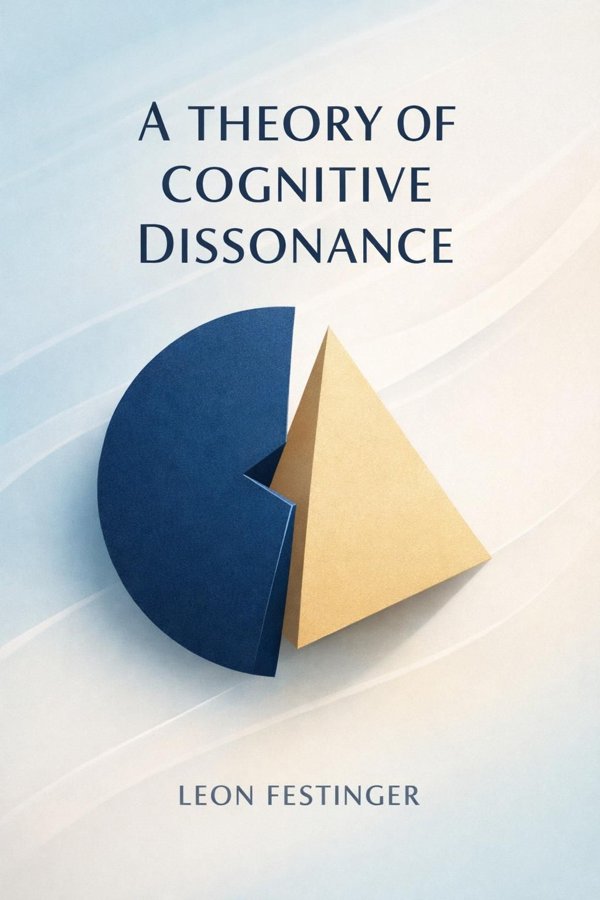
A Theory of Cognitive Dissonance: Summary & Key Insights
 10 min9 chaptersAudio available
Key Takeaways from A Theory of Cognitive Dissonance
A troubling contradiction inside the mind can feel more urgent than a problem in the outside world.
Not every inconsistency shakes us equally; some contradictions are mild irritations, while others threaten our sense of self.
When the mind cannot tolerate contradiction, it starts negotiating with reality.
Choosing is not the end of conflict; often it is the moment conflict becomes psychologically vivid.
This is the basis of forced compliance.
What Is A Theory of Cognitive Dissonance About?
A Theory of Cognitive Dissonance by Leon Festinger is a cognition book spanning 10 pages. Why do people defend bad decisions, justify behavior they know is wrong, or reject evidence that threatens what they already believe? In A Theory of Cognitive Dissonance, Leon Festinger offers a powerful answer: human beings are deeply motivated to maintain internal consistency among their beliefs, actions, and self-image. When those elements clash, we experience psychological discomfort—dissonance—and we are driven to reduce it, often in surprisingly creative ways. First published in 1957, this book transformed social psychology by shifting attention from simple reward-and-punishment models to the internal tensions that shape judgment and behavior. Festinger shows that attitude change does not always come from persuasion imposed from outside; often it begins within, as people try to resolve contradictions in their own minds. The theory helps explain everything from buyer’s remorse and political polarization to group loyalty, moral rationalization, and personal growth. Festinger was one of the most influential psychologists of the twentieth century, and this work remains foundational because it reveals a timeless truth: people do not merely seek truth or comfort in isolation—they seek coherence. Understanding that impulse helps us understand ourselves.
This FizzRead summary covers all 9 key chapters of A Theory of Cognitive Dissonance in approximately 10 minutes, distilling the most important ideas, arguments, and takeaways from Leon Festinger's work. Also available as an audio summary and Key Quotes Podcast.
A Theory of Cognitive Dissonance
Why do people defend bad decisions, justify behavior they know is wrong, or reject evidence that threatens what they already believe? In A Theory of Cognitive Dissonance, Leon Festinger offers a powerful answer: human beings are deeply motivated to maintain internal consistency among their beliefs, actions, and self-image. When those elements clash, we experience psychological discomfort—dissonance—and we are driven to reduce it, often in surprisingly creative ways.
First published in 1957, this book transformed social psychology by shifting attention from simple reward-and-punishment models to the internal tensions that shape judgment and behavior. Festinger shows that attitude change does not always come from persuasion imposed from outside; often it begins within, as people try to resolve contradictions in their own minds. The theory helps explain everything from buyer’s remorse and political polarization to group loyalty, moral rationalization, and personal growth.
Festinger was one of the most influential psychologists of the twentieth century, and this work remains foundational because it reveals a timeless truth: people do not merely seek truth or comfort in isolation—they seek coherence. Understanding that impulse helps us understand ourselves.
Who Should Read A Theory of Cognitive Dissonance?
This book is perfect for anyone interested in cognition and looking to gain actionable insights in a short read. Whether you're a student, professional, or lifelong learner, the key ideas from A Theory of Cognitive Dissonance by Leon Festinger will help you think differently.
- ✓Readers who enjoy cognition and want practical takeaways
- ✓Professionals looking to apply new ideas to their work and life
- ✓Anyone who wants the core insights of A Theory of Cognitive Dissonance in just 10 minutes
Want the full summary?
Get instant access to this book summary and 100K+ more with Fizz Moment.
Get Free SummaryAvailable on App Store • Free to download
Key Chapters
A troubling contradiction inside the mind can feel more urgent than a problem in the outside world. Festinger begins with the idea that people strive for consistency among their cognitions—their beliefs, attitudes, memories, values, and awareness of their own behavior. When two cognitions fit together, they are consonant. When they clash, they are dissonant. That clash produces psychological discomfort, and the mind becomes motivated to reduce it.
This is the foundation of cognitive dissonance theory. If a person believes, “I am honest,” but also remembers lying to a friend, those cognitions are inconsistent. If someone values health but smokes regularly, the conflict between knowledge and behavior creates tension. Dissonance is not just a logical mismatch; it is a motivational state. It pushes people to act, reinterpret, deny, or justify until a more tolerable sense of coherence is restored.
Festinger’s key insight is that behavior and belief are linked through this internal pressure. People do not simply hold attitudes and then act on them. Sometimes they act first and revise beliefs later in order to make sense of what they have done. That is why people may become more committed after choosing, defending, sacrificing, or publicly supporting something.
In everyday life, this explains why we rationalize expensive purchases, excuse our bad habits, or selectively remember information that makes us feel consistent. It also explains why confronting people with facts does not always change their minds; facts that create dissonance can trigger defensiveness instead.
Actionable takeaway: When you feel unusually defensive, ask yourself which two cognitions are colliding. Naming the inconsistency is the first step toward responding thoughtfully rather than rationalizing automatically.
Not every inconsistency shakes us equally; some contradictions are mild irritations, while others threaten our sense of self. Festinger argues that the magnitude of dissonance depends mainly on two things: how important the relevant cognitions are and how much dissonant material exists relative to consonant material. In simple terms, conflicts hurt more when they concern something central to who we are and when we have fewer supporting thoughts to offset the contradiction.
Consider two examples. If you think of yourself as environmentally responsible but occasionally forget a reusable bag, the dissonance may be modest. But if you publicly campaign for sustainability while flying privately every week, the discomfort is likely to be far greater because the issue is central, visible, and difficult to excuse. Likewise, a student who cheats once on a minor quiz may feel less conflict than a student who sees honesty as a core moral value and cheats on a final exam that defines their academic future.
This helps explain why some people make dramatic changes after a contradiction while others barely react. It also clarifies why identity-related challenges—around ethics, politics, religion, health, or relationships—provoke stronger emotional responses than trivial inconsistencies. The more important the belief, and the more directly behavior contradicts it, the stronger the pressure to reduce dissonance.
Organizations experience this too. A company that markets itself as customer-first but repeatedly ignores complaints creates institutional dissonance. Employees and leaders then face pressure either to improve practices or to invent narratives that excuse the gap.
Actionable takeaway: If a contradiction keeps resurfacing, measure its magnitude. Ask what value, identity, or goal is truly at stake. The strongest discomfort usually points to an issue that deserves real change rather than cosmetic justification.
When the mind cannot tolerate contradiction, it starts negotiating with reality. Festinger explains that people typically reduce dissonance through three broad strategies: changing behavior, changing cognition, or adding new consonant cognitions that justify the inconsistency. These strategies differ in honesty and usefulness, but all serve the same purpose—restoring internal harmony.
The most direct route is behavioral change. If you believe smoking is dangerous and want to live healthily, quitting smoking reduces the conflict. A second path is changing the belief itself: minimizing the risks, doubting the evidence, or deciding health is less important than enjoyment. A third route is adding justifications: “My grandfather smoked and lived to ninety,” or “I exercise, so it balances out.” The behavior may stay the same, but the mind builds a support structure around it.
These mechanisms show why humans are so skilled at self-justification. We do not only seek accuracy; we seek tolerable coherence. This can be adaptive when it helps us recover after unavoidable contradictions, but it can also trap us in denial. A leader who made a poor decision may reinterpret evidence to protect ego. A consumer may praise a disappointing purchase to avoid feeling foolish. A person in an unhealthy relationship may focus obsessively on small positive moments to justify staying.
Festinger’s theory is practical because it teaches us to distinguish genuine resolution from rationalization. Some forms of dissonance reduction improve life by bringing action into line with values. Others merely protect self-esteem while preserving the problem.
Actionable takeaway: The next time you justify a difficult choice, sort your response into one of the three categories—behavior change, belief change, or added justification—and ask which one brings you closer to reality.
Choosing is not the end of conflict; often it is the moment conflict becomes psychologically vivid. Festinger shows that after making a decision between two attractive alternatives, people experience dissonance because the chosen option has drawbacks and the rejected option has advantages. The more important and difficult the choice, the stronger the post-decision tension.
Imagine choosing between two job offers. Once you accept one, you immediately live with the disadvantages of your chosen role and the lost benefits of the other. To reduce dissonance, you begin to emphasize the strengths of what you selected and downplay what you gave up. This is not always deliberate dishonesty. It is often a natural mental process that helps us stabilize commitment after uncertainty.
This mechanism appears in purchases, relationships, education, politics, and career paths. After buying a car, people often seek articles and reviews praising their model while ignoring criticism. After voting for a candidate, they may reinterpret troubling news more charitably. After committing to a partner, they may focus more strongly on that person’s virtues while minimizing attractive alternatives.
Post-decision dissonance can be useful because it supports follow-through. Without it, choices might remain perpetually unstable. But it can also make us cling to poor decisions simply because reversing them would intensify dissonance. Sunk-cost thinking often lives here: the need to believe our earlier choice was justified.
The theory suggests that commitment and belief reinforce each other after action is taken. We do not simply choose what we value; we often come to value what we choose.
Actionable takeaway: After an important decision, pause before defending it too quickly. Review both the gains and losses honestly so commitment becomes informed rather than merely self-protective.
One of Festinger’s most striking insights is that people can come to believe what they were initially pressured to say or do—especially when the external pressure is not strong enough to fully explain their behavior. This is the basis of forced compliance. When someone acts contrary to their private belief, dissonance arises. If they cannot point to a compelling external reason, they may reduce the tension by changing their internal attitude.
Suppose an employee publicly praises a policy they privately dislike. If they were threatened with termination, the external justification is strong, and internal dissonance may stay limited: “I said it because I had to.” But if the pressure was mild—perhaps a small incentive or subtle expectation—they may think, “Why did I endorse that so willingly?” To answer that question and reduce discomfort, they may begin to believe the policy is not so bad after all.
This principle became famous because it challenged the assumption that bigger rewards always produce bigger attitude change. Sometimes smaller inducements create more internal change because they leave more room for self-justification through altered belief. It helps explain workplace conformity, public declarations, hazing rituals, and even some forms of social media performance, where repeated expression can gradually reshape conviction.
The broader lesson is unsettling: behavior can lead belief, especially when we need to see ourselves as coherent and autonomous. What we repeatedly say under modest pressure may become part of what we genuinely think.
Actionable takeaway: Be careful about what you publicly endorse “just to go along.” Small compromises can reshape self-perception over time, so protect your beliefs by noticing when your words and values start to diverge.
People like to imagine they are open-minded seekers of truth, yet Festinger shows that we often seek information strategically. When facing dissonance, individuals tend to avoid messages that intensify conflict and gravitate toward information that confirms existing choices, beliefs, or behavior. In other words, information selection is often a form of self-protection.
A smoker may avoid medical articles about lung disease. A partisan voter may consume only friendly news sources after an election. A person who has made a risky investment may ignore warnings and search for bullish opinions instead. This pattern is not random laziness; it is motivated selectivity. The mind anticipates discomfort and manages exposure accordingly.
Festinger’s account helps explain modern phenomena such as echo chambers, algorithmic polarization, and defensive media habits. People do not merely disagree because they have different facts. They often curate different informational worlds to reduce dissonance. Once a belief becomes tied to identity, contradictory evidence can feel like a personal threat rather than a neutral correction.
Still, selective exposure is not absolute. People may seek conflicting information when they expect it to be useful, when the issue is unavoidable, or when they feel secure enough to tolerate challenge. This means the goal is not to shame ourselves for preference, but to understand the motive beneath it. Avoidance often signals that a belief is psychologically loaded.
For learning, leadership, and citizenship, this matters immensely. Good judgment requires not only access to information but also the emotional capacity to engage with what unsettles us.
Actionable takeaway: Audit your information diet. If you notice you are consuming only material that flatters your current position, deliberately read one credible source that challenges it and observe your emotional reaction.
Contradictions feel easier to bear when other people share them with us. Festinger emphasizes that social support plays a major role in managing dissonance. When our beliefs are validated by a group, the discomfort of inconsistency weakens. When a group is threatened, members often work together to reinterpret events, protect doctrine, and preserve commitment.
This dynamic explains why communities can become more unified in the face of disconfirming evidence. If a political movement makes a failed prediction, members may not abandon it immediately. Instead, they may double down, reinterpret the failure, or frame it as proof of persecution. Shared belief acts as insulation. The group provides consonant cognitions: “We are still right,” “outsiders misunderstand us,” or “the setback confirms our mission.”
Festinger later became especially known for observing such processes in real groups, but the theoretical roots are already present here. Social reinforcement matters because beliefs are not held in isolation. They are embedded in networks of status, loyalty, identity, and belonging. To change a belief may mean risking rejection, humiliation, or loss of community. In that context, preserving consistency is not just about internal comfort; it is also about social survival.
This can be dangerous when groups normalize denial, but it can also be constructive. Recovery groups, ethical teams, and disciplined communities can reduce dissonance by helping members align actions with values rather than escape from conflict through excuses.
Actionable takeaway: Notice whether your social circle helps you confront reality or avoid it. Choose communities that support honest alignment, not just emotional reassurance.
We commonly assume that changing minds requires changing opinions first. Festinger reverses that sequence. In many cases, attitude change follows action. Once a person behaves in a certain way, especially voluntarily and publicly, they may revise their attitudes to match what they have done. This makes cognitive dissonance one of the most powerful hidden engines of persuasion.
A volunteer who initially joins a cause to please a friend may later become sincerely committed. A student who starts practicing disciplined study habits may begin to see themselves as serious and capable. Someone who donates to a charity, signs a petition, or advocates a position can grow more attached to that stance after the act itself. The behavior creates a need for explanation, and the easiest explanation is often, “I must care about this.”
This insight has major implications for education, management, marketing, therapy, and politics. Lasting change often depends less on hearing the perfect argument than on creating conditions where people can take small, meaningful, self-endorsed actions. Once behavior shifts, identity may follow. The reverse is also true: repeated harmful actions can harden harmful beliefs.
The practical power of the theory lies in its realism. Human beings are not detached processors of evidence. We are interpreters of our own conduct. What we do becomes data about who we are, and we strive to make that data coherent.
Actionable takeaway: If you want to strengthen a value, act on it in a small voluntary way today. Behavior is not just an outcome of belief; it is one of belief’s most effective builders.
The same force that leads people to deny uncomfortable truths can also push them toward meaningful self-correction. That is one of the deepest implications of Festinger’s theory. Cognitive dissonance is not simply a flaw in reasoning; it is a basic motivational process that can produce either defensiveness or development depending on how we respond.
On the destructive side, dissonance can fuel prejudice, stubbornness, hypocrisy, moral disengagement, and ideological rigidity. People may distort evidence, rewrite memory, or blame others to preserve a positive self-image. Institutions can do the same, protecting reputation instead of confronting failure. But on the constructive side, dissonance can initiate growth. When individuals tolerate discomfort instead of escaping it, contradiction becomes a catalyst for revision. A person who notices the gap between values and conduct may become more ethical, disciplined, honest, or compassionate.
This dual nature makes the theory enduringly relevant. It applies to personal habits, romantic commitments, consumer behavior, political identity, organizational culture, and social conflict. It also offers a humane explanation for irrationality. People are often not simply stupid or malicious; they are trying to preserve coherence under pressure.
Festinger’s broader contribution is to show that motivation is cognitive as well as emotional. Human beings are driven not only by pleasure, fear, or reward, but by the need to live in a world that makes psychological sense. If we understand that, we can design better conversations, institutions, and habits for truth-seeking.
Actionable takeaway: Treat discomfort as information. When you feel resistance to a fact or feedback, ask whether the feeling is protecting your ego or inviting your growth.
All Chapters in A Theory of Cognitive Dissonance
About the Author
Leon Festinger (1919–1989) was an American social psychologist whose work changed the direction of modern psychology. Educated at the City College of New York and the University of Iowa, he became known for bringing theoretical depth and experimental rigor to the study of social behavior. Festinger made two especially lasting contributions: social comparison theory and cognitive dissonance theory, both of which remain central to psychology and behavioral science. He was interested in how people evaluate themselves, form beliefs, and respond to contradiction, uncertainty, and social influence. Across his academic career, he taught at leading institutions and produced research that shaped generations of scholars. Festinger is remembered not only for introducing powerful concepts, but for revealing how deeply human behavior is driven by the need for psychological coherence.
Get This Summary in Your Preferred Format
Read or listen to the A Theory of Cognitive Dissonance summary by Leon Festinger anytime, anywhere. FizzRead offers multiple formats so you can learn on your terms — all free.
Available formats: App · Audio · PDF · EPUB — All included free with FizzRead
Download A Theory of Cognitive Dissonance PDF and EPUB Summary
Key Quotes from A Theory of Cognitive Dissonance
“A troubling contradiction inside the mind can feel more urgent than a problem in the outside world.”
“Not every inconsistency shakes us equally; some contradictions are mild irritations, while others threaten our sense of self.”
“When the mind cannot tolerate contradiction, it starts negotiating with reality.”
“Choosing is not the end of conflict; often it is the moment conflict becomes psychologically vivid.”
“People like to imagine they are open-minded seekers of truth, yet Festinger shows that we often seek information strategically.”
Frequently Asked Questions about A Theory of Cognitive Dissonance
A Theory of Cognitive Dissonance by Leon Festinger is a cognition book that explores key ideas across 9 chapters. Why do people defend bad decisions, justify behavior they know is wrong, or reject evidence that threatens what they already believe? In A Theory of Cognitive Dissonance, Leon Festinger offers a powerful answer: human beings are deeply motivated to maintain internal consistency among their beliefs, actions, and self-image. When those elements clash, we experience psychological discomfort—dissonance—and we are driven to reduce it, often in surprisingly creative ways. First published in 1957, this book transformed social psychology by shifting attention from simple reward-and-punishment models to the internal tensions that shape judgment and behavior. Festinger shows that attitude change does not always come from persuasion imposed from outside; often it begins within, as people try to resolve contradictions in their own minds. The theory helps explain everything from buyer’s remorse and political polarization to group loyalty, moral rationalization, and personal growth. Festinger was one of the most influential psychologists of the twentieth century, and this work remains foundational because it reveals a timeless truth: people do not merely seek truth or comfort in isolation—they seek coherence. Understanding that impulse helps us understand ourselves.
You Might Also Like
A Field Guide to Lies: Critical Thinking in the Information Age
Daniel J. Levitin
10 min
Black-And-White Thinking: The Burden of a Binary Brain in a Complex World
Kevin Dutton
10 min
Born Liars: Why We Can’t Live Without Deceit
Ian Leslie
10 min
Collective Illusions: Conformity, Complicity, and the Science of Why We Make Bad Decisions
Todd Rose
10 min
Concrete Mathematics: A Foundation for Computer Science
Ronald L. Graham, Donald E. Knuth, Oren Patashnik
10 min
Consciousness Explained
Daniel C. Dennett
10 minBrowse by Category
Ready to read A Theory of Cognitive Dissonance?
Get the full summary and 100K+ more books with Fizz Moment.