
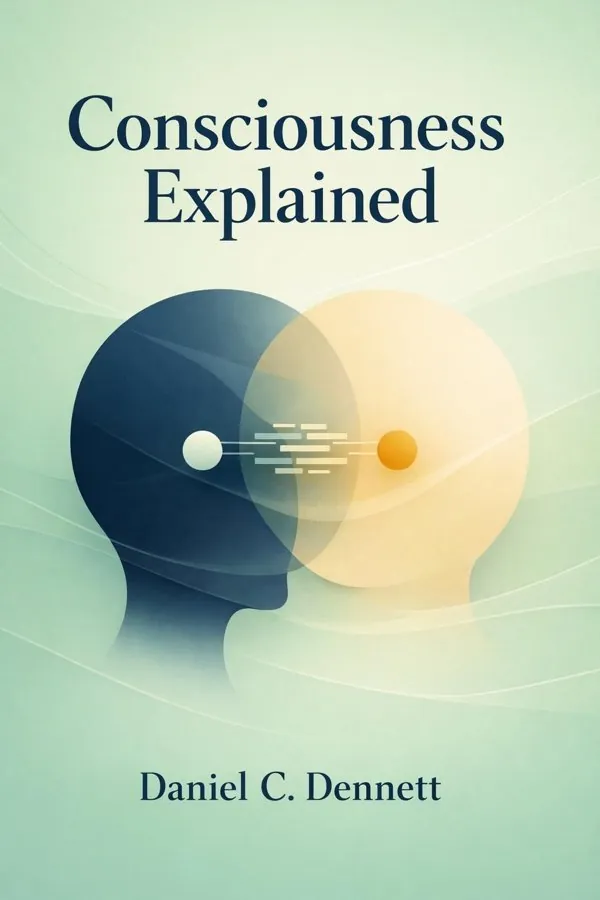
Consciousness Explained: Summary & Key Insights
 10 min9 chaptersAudio available
What Is Consciousness Explained About?
Consciousness Explained by Daniel C. Dennett is a cognition book spanning 9 pages. In this groundbreaking work, philosopher Daniel C. Dennett presents a comprehensive theory of consciousness that challenges traditional dualist and Cartesian views. He argues that consciousness is not a single, unified phenomenon but rather the result of multiple parallel processes occurring in the brain. Dennett introduces the 'multiple drafts' model, suggesting that what we experience as consciousness is a narrative constructed from these processes. The book integrates insights from cognitive science, neuroscience, and philosophy to offer a naturalistic explanation of the mind.
This FizzRead summary covers all 9 key chapters of Consciousness Explained in approximately 10 minutes, distilling the most important ideas, arguments, and takeaways from Daniel C. Dennett's work. Also available as an audio summary and Key Quotes Podcast.
Consciousness Explained
In this groundbreaking work, philosopher Daniel C. Dennett presents a comprehensive theory of consciousness that challenges traditional dualist and Cartesian views. He argues that consciousness is not a single, unified phenomenon but rather the result of multiple parallel processes occurring in the brain. Dennett introduces the 'multiple drafts' model, suggesting that what we experience as consciousness is a narrative constructed from these processes. The book integrates insights from cognitive science, neuroscience, and philosophy to offer a naturalistic explanation of the mind.
Who Should Read Consciousness Explained?
This book is perfect for anyone interested in cognition and looking to gain actionable insights in a short read. Whether you're a student, professional, or lifelong learner, the key ideas from Consciousness Explained by Daniel C. Dennett will help you think differently.
- ✓Readers who enjoy cognition and want practical takeaways
- ✓Professionals looking to apply new ideas to their work and life
- ✓Anyone who wants the core insights of Consciousness Explained in just 10 minutes
Want the full summary?
Get instant access to this book summary and 100K+ more with Fizz Moment.
Get Free SummaryAvailable on App Store • Free to download
Key Chapters
Before we reconstruct consciousness on new foundations, we must understand the intellectual landscape that led us here. Philosophy began its long entanglement with mind through Descartes, who reasoned that while he could doubt the existence of the external world, he could not doubt his own thinking. From this was born a view that mind and matter are separate substances—an intuition so powerful that even today many neuroscientists unconsciously inherit it. The Cartesian legacy deeply shaped the scientific quest to locate the mind: experimenters searched for the brain’s 'seat of the soul,' as though an inner observer must reside somewhere physical.
Later, behaviorism tried to escape this trap by declaring consciousness scientifically irrelevant; if the mind’s contents could not be observed, they could be ignored. Yet this move merely suppressed the question, not resolved it. With the rise of cognitive science, thinkers reintroduced the language of representation and computation, invoking information processing as an alternative to ethereal dualism. Though progress came, lurking beneath their models remained the hidden assumption of a central vantage point in the mind—a place where representations met awareness.
My purpose was to bring clarity and consistency to this endeavor. We cannot understand the mind by mixing metaphors, or by smuggling subjective unity into mechanistic terms. The challenge is to explain how the diverse activities of the nervous system can together yield the patterns we call consciousness, without assuming that something within simultaneously 'reads' them. Once we appreciate the historical trajectory—from Descartes to behaviorism to cognitive science—we see that each stage tried to tame the same alluring picture: that inside each person is an inner movie projected onto the screen of the soul. The alternative, which I offer, begins by discarding the projectionist fallacy altogether.
Imagine, for a moment, the traditional conception of your mind as a control room where all sensory inputs converge, are interpreted, and finally presented to an audience of one. This is the Cartesian Theater in its purest form: an inner sanctum where a little observer—the homunculus—watches, judges, and somehow translates neural activity into conscious experience. The problem with this picture is not merely that the homunculus is mythic—it’s that the explanation never ends. If there’s an observer inside you, who observes for him? The chain collapses into infinite regress.
My critique is not a mere rejection of introspection but a reconstruction of the relationship between experience and brain. In reality, there is no precise time or place at which information 'arrives in consciousness.' Perception, cognition, and action are dynamic systems operating across distributed networks. What we call 'becoming aware' of something is not a distinct event but a shift in how certain information influences subsequent processing and behavior. There is no master show; there are many competing performances, each struggling for relevance, and only some become woven into the personal narrative you recall.
The Cartesian Theater dies not in despair but in acknowledgment: once we trace the operations of neurons and modules, we find no seat of consciousness awaiting us. We find a multitude of coordinated mechanisms, some delivering language, others coordinating attention, others registering bodily states. To pretend these are coordinated by a ghostly commentator misses the beauty of what actually happens. Consciousness is the organization of multiple local achievements—not a spotlight centered on one, but a changing field where local victories of processing become global influence.
+ 7 more chapters — available in the FizzRead app
All Chapters in Consciousness Explained
About the Author
Daniel Clement Dennett is an American philosopher, writer, and cognitive scientist known for his research on the philosophy of mind, science, and biology, particularly as those fields relate to evolutionary theory and cognitive science. He is a co-director of the Center for Cognitive Studies at Tufts University and one of the most influential contemporary thinkers in philosophy of mind.
Get This Summary in Your Preferred Format
Read or listen to the Consciousness Explained summary by Daniel C. Dennett anytime, anywhere. FizzRead offers multiple formats so you can learn on your terms — all free.
Available formats: App · Audio · PDF · EPUB — All included free with FizzRead
Download Consciousness Explained PDF and EPUB Summary
Key Quotes from Consciousness Explained
“Before we reconstruct consciousness on new foundations, we must understand the intellectual landscape that led us here.”
“Imagine, for a moment, the traditional conception of your mind as a control room where all sensory inputs converge, are interpreted, and finally presented to an audience of one.”
Frequently Asked Questions about Consciousness Explained
Consciousness Explained by Daniel C. Dennett is a cognition book that explores key ideas across 9 chapters. In this groundbreaking work, philosopher Daniel C. Dennett presents a comprehensive theory of consciousness that challenges traditional dualist and Cartesian views. He argues that consciousness is not a single, unified phenomenon but rather the result of multiple parallel processes occurring in the brain. Dennett introduces the 'multiple drafts' model, suggesting that what we experience as consciousness is a narrative constructed from these processes. The book integrates insights from cognitive science, neuroscience, and philosophy to offer a naturalistic explanation of the mind.
More by Daniel C. Dennett

You Might Also Like
A Field Guide to Lies: Critical Thinking in the Information Age
Daniel J. Levitin
10 min
A Theory of Cognitive Dissonance
Leon Festinger
10 min
Black-And-White Thinking: The Burden of a Binary Brain in a Complex World
Kevin Dutton
10 min
Born Liars: Why We Can’t Live Without Deceit
Ian Leslie
10 min
Collective Illusions: Conformity, Complicity, and the Science of Why We Make Bad Decisions
Todd Rose
10 min
Concrete Mathematics: A Foundation for Computer Science
Ronald L. Graham, Donald E. Knuth, Oren Patashnik
10 minBrowse by Category
Ready to read Consciousness Explained?
Get the full summary and 100K+ more books with Fizz Moment.