
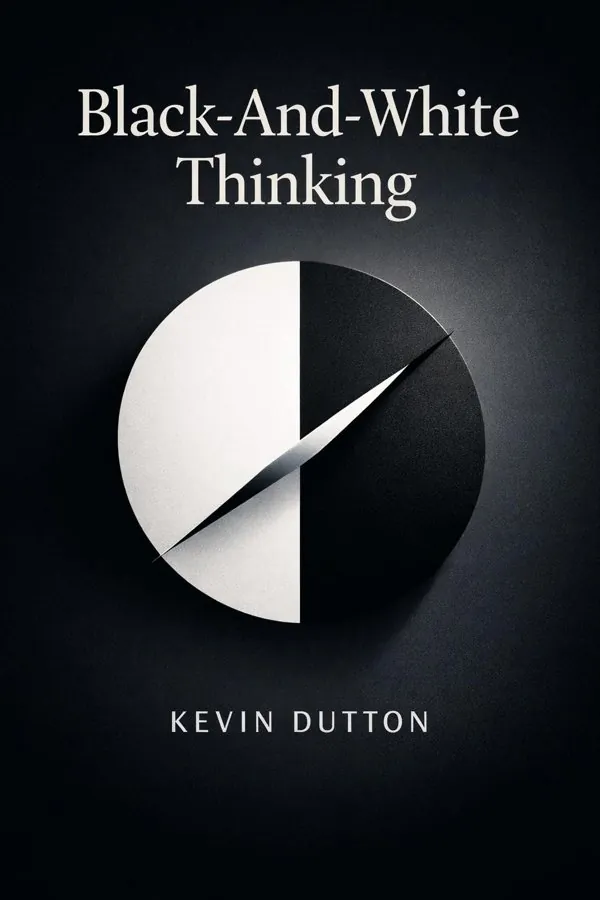
Black-And-White Thinking: The Burden of a Binary Brain in a Complex World: Summary & Key Insights
by Kevin Dutton
 10 min11 chaptersAudio available
What Is Black-And-White Thinking: The Burden of a Binary Brain in a Complex World About?
Black-And-White Thinking: The Burden of a Binary Brain in a Complex World by Kevin Dutton is a cognition book spanning 11 pages. In this book, psychologist Kevin Dutton explores how the human brain’s tendency to think in binary terms—good versus evil, right versus wrong, us versus them—shapes our perceptions, decisions, and social conflicts. Drawing on neuroscience, psychology, and real-world examples, Dutton reveals how this black-and-white thinking can both simplify and distort our understanding of complex issues, and offers insights into how we can cultivate more nuanced and flexible thought.
This FizzRead summary covers all 11 key chapters of Black-And-White Thinking: The Burden of a Binary Brain in a Complex World in approximately 10 minutes, distilling the most important ideas, arguments, and takeaways from Kevin Dutton's work. Also available as an audio summary and Key Quotes Podcast.
Black-And-White Thinking: The Burden of a Binary Brain in a Complex World
In this book, psychologist Kevin Dutton explores how the human brain’s tendency to think in binary terms—good versus evil, right versus wrong, us versus them—shapes our perceptions, decisions, and social conflicts. Drawing on neuroscience, psychology, and real-world examples, Dutton reveals how this black-and-white thinking can both simplify and distort our understanding of complex issues, and offers insights into how we can cultivate more nuanced and flexible thought.
Who Should Read Black-And-White Thinking: The Burden of a Binary Brain in a Complex World?
This book is perfect for anyone interested in cognition and looking to gain actionable insights in a short read. Whether you're a student, professional, or lifelong learner, the key ideas from Black-And-White Thinking: The Burden of a Binary Brain in a Complex World by Kevin Dutton will help you think differently.
- ✓Readers who enjoy cognition and want practical takeaways
- ✓Professionals looking to apply new ideas to their work and life
- ✓Anyone who wants the core insights of Black-And-White Thinking: The Burden of a Binary Brain in a Complex World in just 10 minutes
Want the full summary?
Get instant access to this book summary and 100K+ more with Fizz Moment.
Get Free SummaryAvailable on App Store • Free to download
Key Chapters
Our preference for binaries begins in the brain’s structure. The human mind, complex as it is, continually seeks efficiency. Every time we process sensory data or social signals, our neural circuits favor simplification, clustering details into opposing categories to find meaning faster. Research from cognitive neuroscience repeatedly shows that categorization is embedded in neural architecture—regions such as the amygdala, prefrontal cortex, and anterior cingulate cortex collaborate to assess threat, classify input, and initiate quick responses. This means that long before we consciously evaluate a situation, our brains have already made primitive decisions about whether it is good or bad, right or wrong.
This pattern recognition was crucial for survival. But here's the catch: modern contexts demand processing ambiguity rather than danger. Your amygdala’s alarm system doesn’t distinguish between a predator in the brush and a tweet that offends your beliefs—it treats both as signals to categorize: safe or threat, ally or enemy. This neurological shortcut creates moral, social, and political polarizations that often feel instinctive because, in a way, they are. Understanding that helps us pause the reflex, engage more deliberate reasoning, and appreciate that reality isn’t naturally divided into discrete boxes but rather flows across a continuum our brains struggle to represent.
Early humans operated under constant uncertainty. In the savannah, there wasn’t time to weigh gradations of intent in another tribe’s approach—you either fought or fled. So our cognitive evolution rewarded those who could decide quickly. Binary thinking therefore served as an adaptation: the faster the judgment, the higher the survival odds. I discuss how this ancestral coding became embedded in our perception. Even today, that ancient circuitry fires when we encounter unfamiliar people, strange ideas, or conflicting information.
The paradox is that the very mechanism that once saved lives now underlies many of our intellectual blind spots. We no longer live in small, homogenous bands but in vast societies shaped by nuance. Still, our brain defaults to that same ancestral strategy, pushing us toward overconfidence, stereotyping, and swift moral judgments. Seeing these instincts as evolutionary residue helps us treat them not as moral failings but as relics to be managed consciously. Evolution doesn't dictate destiny—it merely sets the starting conditions. Our challenge now is to evolve mentally beyond the reflexes that no longer serve us.
+ 9 more chapters — available in the FizzRead app
All Chapters in Black-And-White Thinking: The Burden of a Binary Brain in a Complex World
About the Author
Kevin Dutton is a British psychologist and writer known for his research on psychopathy and decision-making. He is affiliated with the University of Oxford and has authored several popular science books that bridge psychology and everyday life.
Get This Summary in Your Preferred Format
Read or listen to the Black-And-White Thinking: The Burden of a Binary Brain in a Complex World summary by Kevin Dutton anytime, anywhere. FizzRead offers multiple formats so you can learn on your terms — all free.
Available formats: App · Audio · PDF · EPUB — All included free with FizzRead
Download Black-And-White Thinking: The Burden of a Binary Brain in a Complex World PDF and EPUB Summary
Key Quotes from Black-And-White Thinking: The Burden of a Binary Brain in a Complex World
“Our preference for binaries begins in the brain’s structure.”
“Early humans operated under constant uncertainty.”
Frequently Asked Questions about Black-And-White Thinking: The Burden of a Binary Brain in a Complex World
Black-And-White Thinking: The Burden of a Binary Brain in a Complex World by Kevin Dutton is a cognition book that explores key ideas across 11 chapters. In this book, psychologist Kevin Dutton explores how the human brain’s tendency to think in binary terms—good versus evil, right versus wrong, us versus them—shapes our perceptions, decisions, and social conflicts. Drawing on neuroscience, psychology, and real-world examples, Dutton reveals how this black-and-white thinking can both simplify and distort our understanding of complex issues, and offers insights into how we can cultivate more nuanced and flexible thought.
More by Kevin Dutton

The Good Psychopath’s Guide to Success: How to Use Your Inner Psychopath to Get the Most Out of Life
Andy McNab and Kevin Dutton
10 min
The Wisdom of Psychopaths: What Saints, Spies, and Serial Killers Can Teach Us About Success
Kevin Dutton
10 min
Flipnosis: The Art of Split-Second Persuasion
Kevin Dutton
10 min
Split-Second Persuasion: The Ancient Art and New Science of Changing Minds
Kevin Dutton
10 minYou Might Also Like

A Field Guide to Lies: Critical Thinking in the Information Age
Daniel J. Levitin
10 min
A Theory of Cognitive Dissonance
Leon Festinger
10 min
Born Liars: Why We Can’t Live Without Deceit
Ian Leslie
10 min
Collective Illusions: Conformity, Complicity, and the Science of Why We Make Bad Decisions
Todd Rose
10 min
Concrete Mathematics: A Foundation for Computer Science
Ronald L. Graham, Donald E. Knuth, Oren Patashnik
10 min
Consciousness Explained
Daniel C. Dennett
10 minBrowse by Category
Ready to read Black-And-White Thinking: The Burden of a Binary Brain in a Complex World?
Get the full summary and 100K+ more books with Fizz Moment.