
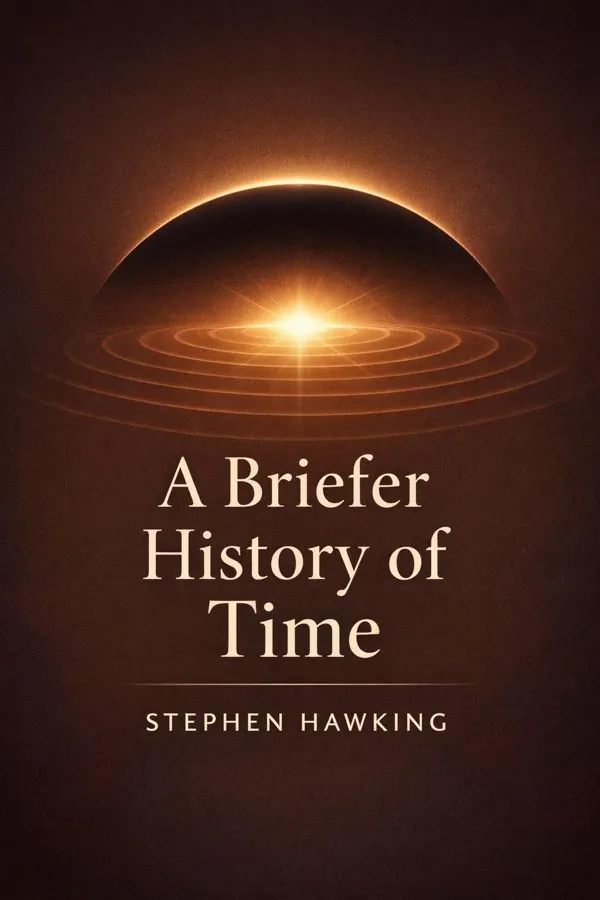
A Briefer History of Time: Summary & Key Insights
 10 min10 chaptersAudio available
What Is A Briefer History of Time About?
A Briefer History of Time by Stephen Hawking is a popular_sci book spanning 10 pages. A Briefer History of Time is a concise and updated version of Stephen Hawking’s classic work, co-authored with Leonard Mlodinow. It presents complex concepts in cosmology—such as the Big Bang, black holes, quantum mechanics, and the nature of time—in a more accessible and illustrated format for general readers. The book aims to explain the fundamental laws governing the universe and humanity’s place within it, using clear language and engaging examples.
This FizzRead summary covers all 10 key chapters of A Briefer History of Time in approximately 10 minutes, distilling the most important ideas, arguments, and takeaways from Stephen Hawking's work. Also available as an audio summary and Key Quotes Podcast.
A Briefer History of Time
A Briefer History of Time is a concise and updated version of Stephen Hawking’s classic work, co-authored with Leonard Mlodinow. It presents complex concepts in cosmology—such as the Big Bang, black holes, quantum mechanics, and the nature of time—in a more accessible and illustrated format for general readers. The book aims to explain the fundamental laws governing the universe and humanity’s place within it, using clear language and engaging examples.
Who Should Read A Briefer History of Time?
This book is perfect for anyone interested in popular_sci and looking to gain actionable insights in a short read. Whether you're a student, professional, or lifelong learner, the key ideas from A Briefer History of Time by Stephen Hawking will help you think differently.
- ✓Readers who enjoy popular_sci and want practical takeaways
- ✓Professionals looking to apply new ideas to their work and life
- ✓Anyone who wants the core insights of A Briefer History of Time in just 10 minutes
Want the full summary?
Get instant access to this book summary and 100K+ more with Fizz Moment.
Get Free SummaryAvailable on App Store • Free to download
Key Chapters
The story of cosmology begins long before telescopes or equations. For most of human history, we imagined ourselves at the center of everything. Ancient thinkers like Aristotle envisioned a universe built from concentric crystal spheres, revolving perfectly around Earth. The heavens seemed eternal, unchanging, and divinely ordained. This geocentric view resonated for centuries—it promised order in an otherwise mysterious world.
But progress in science is driven by the courage to ask whether what we see is truly what is. Copernicus dared to place the Sun at the center, and though his model still relied on circular orbits, it shifted the very frame of human perspective. Galileo’s telescope strengthened this revolution when he observed the moons of Jupiter, showing that not everything circled Earth. Isaac Newton then wove motion and gravitation into a single, universal law, explaining both falling apples and planetary orbits with the same mathematics. The cosmos, once ruled by divine perfection, now obeyed natural law.
Our intuition tells us that time ticks the same for all observers and that space exists independently of what moves through it. But Einstein showed otherwise. In his theory of special relativity, the speed of light remains constant regardless of an observer’s motion. This revelation forces time and space to bend together into a single fabric: spacetime. Events no longer share absolute order; simultaneity depends on the observer.
Later, Einstein extended these insights with general relativity, describing how mass and energy warp spacetime itself. Gravity is no longer an invisible force acting at a distance—it is the curvature of spacetime created by matter. The Sun doesn’t pull Earth; rather, Earth follows the curved geometry around the Sun. This idea predicts that massive objects bend light, clocks run differently in gravitational fields, and the universe itself can stretch or contract on cosmic scales.
With relativity, our concept of reality changed. Time and space became dynamic, flexible, and inseparable. We could imagine the universe as a vast landscape molded by energy, where geometry dictates destiny.
+ 8 more chapters — available in the FizzRead app
All Chapters in A Briefer History of Time
About the Author
Stephen Hawking (1942–2018) was a British theoretical physicist, cosmologist, and author, best known for his work on black holes and relativity. He served as the Lucasian Professor of Mathematics at the University of Cambridge and became one of the most recognized scientists of his time. Despite living with ALS for most of his life, Hawking made groundbreaking contributions to theoretical physics and popularized science through his books and lectures.
Get This Summary in Your Preferred Format
Read or listen to the A Briefer History of Time summary by Stephen Hawking anytime, anywhere. FizzRead offers multiple formats so you can learn on your terms — all free.
Available formats: App · Audio · PDF · EPUB — All included free with FizzRead
Download A Briefer History of Time PDF and EPUB Summary
Key Quotes from A Briefer History of Time
“The story of cosmology begins long before telescopes or equations.”
“Our intuition tells us that time ticks the same for all observers and that space exists independently of what moves through it.”
Frequently Asked Questions about A Briefer History of Time
A Briefer History of Time by Stephen Hawking is a popular_sci book that explores key ideas across 10 chapters. A Briefer History of Time is a concise and updated version of Stephen Hawking’s classic work, co-authored with Leonard Mlodinow. It presents complex concepts in cosmology—such as the Big Bang, black holes, quantum mechanics, and the nature of time—in a more accessible and illustrated format for general readers. The book aims to explain the fundamental laws governing the universe and humanity’s place within it, using clear language and engaging examples.
More by Stephen Hawking
You Might Also Like
Structures: Or Why Things Don"t Fall Down
J.E. Gordon
10 min
The Road to Wigan Pier
George Orwell
10 min
Bonk: The Curious Coupling of Science and Sex
Mary Roach
10 min
First Bite: How We Learn to Eat
Bee Wilson
10 min
In Pursuit Of The Unknown: 17 Equations That Changed The World
Ian Stewart
10 min
Napoleon's Buttons: 17 Molecules That Changed History
Penny Le Couteur and Jay Burreson
10 minFeatured In
Browse by Category
Ready to read A Briefer History of Time?
Get the full summary and 100K+ more books with Fizz Moment.