
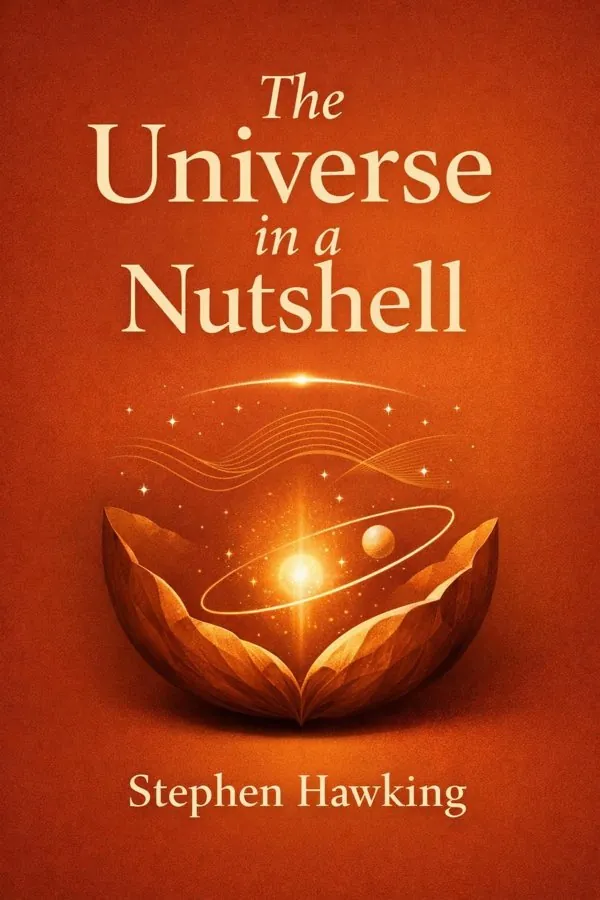
The Universe in a Nutshell: Summary & Key Insights
 10 min9 chaptersAudio available
Key Takeaways from The Universe in a Nutshell
Time is not a universal clock ticking the same for everyone, and space is not an empty stage on which matter simply moves.
The most astonishing fact about the cosmos may be that it had a history.
Black holes seem to promise absolute darkness, but Hawking’s work revealed something far stranger: even black holes are not completely black.
What if the information inside a volume of space could be fully described by what happens on its boundary?
If particles are not points but tiny vibrating strings, then the universe may be built more like music than matter.
What Is The Universe in a Nutshell About?
The Universe in a Nutshell by Stephen Hawking is a popular_sci book spanning 9 pages. Stephen Hawking’s The Universe in a Nutshell is a guided tour through some of the most ambitious ideas in modern physics: curved space-time, black holes, quantum uncertainty, superstrings, branes, and the search for a theory that unites everything. Written as a follow-up to A Brief History of Time, the book revisits the biggest cosmological questions with sharper focus and more up-to-date scientific developments. Hawking asks not only how the universe began and how it may end, but also whether the laws governing it can ever be fully understood. What makes this book matter is its rare combination of depth and accessibility. Hawking does not dilute the complexity of the science, yet he frames difficult concepts through vivid analogies, historical context, and a sense of intellectual adventure. He shows that physics is not just a collection of equations but a continuing effort to understand reality at its most fundamental level. Hawking’s authority is unmatched. As one of the most influential theoretical physicists of the modern era, he made foundational contributions to black hole physics, cosmology, and quantum gravity. This book captures both his scientific brilliance and his gift for making the universe feel astonishingly close.
This FizzRead summary covers all 9 key chapters of The Universe in a Nutshell in approximately 10 minutes, distilling the most important ideas, arguments, and takeaways from Stephen Hawking's work. Also available as an audio summary and Key Quotes Podcast.
The Universe in a Nutshell
Stephen Hawking’s The Universe in a Nutshell is a guided tour through some of the most ambitious ideas in modern physics: curved space-time, black holes, quantum uncertainty, superstrings, branes, and the search for a theory that unites everything. Written as a follow-up to A Brief History of Time, the book revisits the biggest cosmological questions with sharper focus and more up-to-date scientific developments. Hawking asks not only how the universe began and how it may end, but also whether the laws governing it can ever be fully understood.
What makes this book matter is its rare combination of depth and accessibility. Hawking does not dilute the complexity of the science, yet he frames difficult concepts through vivid analogies, historical context, and a sense of intellectual adventure. He shows that physics is not just a collection of equations but a continuing effort to understand reality at its most fundamental level.
Hawking’s authority is unmatched. As one of the most influential theoretical physicists of the modern era, he made foundational contributions to black hole physics, cosmology, and quantum gravity. This book captures both his scientific brilliance and his gift for making the universe feel astonishingly close.
Who Should Read The Universe in a Nutshell?
This book is perfect for anyone interested in popular_sci and looking to gain actionable insights in a short read. Whether you're a student, professional, or lifelong learner, the key ideas from The Universe in a Nutshell by Stephen Hawking will help you think differently.
- ✓Readers who enjoy popular_sci and want practical takeaways
- ✓Professionals looking to apply new ideas to their work and life
- ✓Anyone who wants the core insights of The Universe in a Nutshell in just 10 minutes
Want the full summary?
Get instant access to this book summary and 100K+ more with Fizz Moment.
Get Free SummaryAvailable on App Store • Free to download
Key Chapters
Time is not a universal clock ticking the same for everyone, and space is not an empty stage on which matter simply moves. One of Hawking’s central insights is that Einstein’s theory of general relativity changed the rules completely: matter and energy bend space-time, and that curvature tells objects how to move. Gravity, in this view, is not a mysterious force pulling things together from afar. It is the shape of the cosmic landscape itself.
This shift matters because it helps explain phenomena that Newtonian physics could only approximate. Planets orbit stars because they follow curved paths through warped space-time. Light bends around massive objects, allowing distant galaxies to act as gravitational lenses. Time itself runs differently depending on speed and gravity, which means clocks on satellites tick at different rates than clocks on Earth.
That may sound abstract, but it has practical consequences. GPS systems work only because engineers correct for relativistic effects. Without Einstein’s insights, navigation errors would quickly accumulate. Hawking uses examples like these to show that modern physics is not detached from daily life; it quietly powers many technologies we take for granted.
He also stresses that once space and time become dynamic, the universe can no longer be imagined as static and eternal in the old sense. It can expand, curve, and even contain regions where ordinary intuition breaks down. This opens the door to black holes, cosmic beginnings, and the possibility that the geometry of the universe determines its fate.
Actionable takeaway: When a scientific idea feels too strange, ask what problem it solves in the real world. Relativity becomes easier to grasp when you connect it to orbits, light, and everyday technologies like GPS.
The most astonishing fact about the cosmos may be that it had a history. Hawking explains that the universe is not a timeless backdrop but an evolving system that appears to have begun in an extremely hot, dense state and expanded over billions of years. The Big Bang is not simply an explosion in space; it is the rapid expansion of space itself.
In the earliest moments, the universe was radically different from the one we inhabit now. Temperatures were so high that the fundamental forces may have been unified. As the cosmos cooled, those forces separated, particles formed, and matter gradually assembled into stars, galaxies, and planets. Understanding this unfolding requires both general relativity, which describes the large-scale structure of the universe, and quantum theory, which governs the tiny, energetic world of the early cosmos.
Hawking also explores the future. Will the universe expand forever, slow to a halt, or collapse back in on itself? Modern cosmology suggests the answer depends on the total amount of matter and energy, the geometry of space, and mysterious components such as dark energy. Even if the book predates some later discoveries, its framework remains deeply valuable because it teaches readers how physicists think about cosmic destiny.
A practical application of this idea is intellectual rather than technological: it trains us to see large systems as dynamic and path-dependent. Economies, ecosystems, and societies also evolve from initial conditions and branching transitions. Hawking’s cosmic narrative reminds us that present complexity often emerges from simple beginnings governed by basic rules.
Actionable takeaway: Practice thinking historically about systems. Whether you are studying a business, a habit, or the cosmos, ask how it began, what forces shaped it, and what trajectories are still possible.
Black holes seem to promise absolute darkness, but Hawking’s work revealed something far stranger: even black holes are not completely black. By combining quantum theory with the physics of gravity, he showed that black holes can emit radiation and gradually lose mass. This insight, now called Hawking radiation, transformed black holes from cosmic prisons into thermodynamic objects with temperature and entropy.
Quantum theory says that empty space is never truly empty. Tiny fluctuations constantly create pairs of virtual particles. Near a black hole’s event horizon, one particle may fall in while the other escapes, making it appear as though the black hole is radiating. Over immense timescales, the black hole can shrink and eventually evaporate.
This idea matters because it exposes a deep tension between the two great pillars of modern physics. General relativity predicts black holes as regions where gravity becomes overwhelming. Quantum mechanics insists that information and uncertainty behave according to different rules. When Hawking asked what happens to information swallowed by a black hole, he helped launch one of the most important debates in theoretical physics.
The practical value here lies in learning how breakthroughs emerge at the boundaries between disciplines. Innovation often happens when two successful models collide and stop fitting together neatly. In medicine, technology, or social science, the biggest discoveries may appear where old frameworks contradict each other.
Hawking’s treatment of black holes also invites humility. Nature can violate common sense without violating logic. A black hole can be both a triumph of gravity and a quantum object with thermal properties.
Actionable takeaway: Pay close attention to contradictions in your own field. When two good explanations conflict, don’t ignore the tension; it may be pointing toward a deeper and more powerful understanding.
What if the information inside a volume of space could be fully described by what happens on its boundary? Hawking introduces the holographic principle as one of the most provocative ideas in theoretical physics. Inspired by black hole thermodynamics, it suggests that the maximum information contained in a region may scale not with its volume, but with its surface area.
The origin of this idea lies in black hole entropy. Physicists found that a black hole’s entropy is proportional to the area of its event horizon, not the volume of the space it encloses. That unexpected result led to a daring possibility: perhaps our usual picture of three-dimensional reality is not fundamental. Perhaps the deepest description of a region of space can be encoded on a lower-dimensional boundary, rather like a hologram storing a three-dimensional image on a two-dimensional surface.
Hawking uses this concept to push readers beyond comfortable intuition. The holographic principle does not mean reality is fake or illusory in a casual sense. It means that the mathematical structure of the universe may be more economical and surprising than it appears. The world we experience could emerge from information organized in ways we do not naturally perceive.
A practical analogy is data compression. A complex image or simulation can sometimes be represented more efficiently than expected if one finds the right encoding scheme. In the same spirit, modern physics searches for hidden simplicity beneath apparent complexity.
For readers outside physics, the principle offers a broader lesson: the visible form of a system may not reveal its true informational structure. Organizations, networks, and even personal habits may be governed by a few boundary conditions and rules rather than endless internal detail.
Actionable takeaway: Look for simpler descriptions behind complex systems. Ask what essential constraints or “boundary rules” shape the outcomes you see, rather than getting lost in every surface detail.
If particles are not points but tiny vibrating strings, then the universe may be built more like music than matter. Hawking explores superstring theory as an attempt to unify the known forces of nature by treating elementary particles as different vibrational modes of microscopic strings. In this picture, an electron, a quark, or a graviton is not made of different substances; each is a different pattern of vibration.
This approach is attractive because point-particle physics runs into severe mathematical difficulties when gravity is quantized. Strings soften those infinities by spreading interactions over a tiny length. Superstring theory also naturally includes a particle with the properties expected of the graviton, the hypothetical quantum carrier of gravity. That makes it a promising candidate for unifying general relativity with quantum mechanics.
Hawking also discusses p-branes, extended objects with more than one dimension. A string is a one-dimensional brane, but theory allows membranes and higher-dimensional analogues. These objects expanded the conceptual toolkit of theoretical physics and suggested that the universe may contain more dimensions than the familiar three of space and one of time.
Although these ideas remain difficult to test directly, their broader significance is important. They teach us that scientific progress sometimes requires radical changes in ontology: what we think the world is made of may need complete revision. In practical terms, this is a useful mindset in any domain undergoing disruption. When old assumptions stop working, the answer may not be a better patch but a deeper redefinition of the basic elements.
Actionable takeaway: When facing a stubborn problem, question the building blocks themselves. Sometimes progress comes not from refining old pieces, but from reimagining what the pieces really are.
The dream of a single elegant theory may lead not to one universe, but to many. Hawking presents M-theory as a framework that attempts to unify the various versions of string theory. Instead of one neat final equation, physicists found a family of related theories connected by deeper symmetries. M-theory suggests that these are different aspects of a larger structure, visible from different perspectives.
This development is philosophically striking. Rather than converging immediately on one simple model, physics discovered a web of possibilities. Different ways of compactifying extra dimensions could give rise to different effective laws of nature. This opens the door to multiverse thinking: perhaps our universe is one member of a broader ensemble, and some of the constants we observe are environmental rather than uniquely determined.
Hawking does not present this as science fiction but as a serious attempt to interpret mathematical implications. The multiverse idea is controversial, especially because direct testing is difficult. Still, it matters because it changes how physicists think about explanation. Some features of our universe may be derivable from first principles, while others may require selection effects, such as the anthropic principle: we observe a life-permitting universe because only such a universe allows observers to exist.
Outside cosmology, this has a useful application in decision-making and strategy. Not every outcome is the result of necessity; many arise from path dependence and conditions that happen to allow survival or success. Businesses, careers, and cultures may also be shaped partly by selection effects rather than by perfect design.
Actionable takeaway: Distinguish between what is fundamentally necessary and what is contingently successful. In your own life and work, ask which rules are universal and which are simply the conditions under which you happened to thrive.
We experience time as a steady flow from past to future, yet physics offers a much stranger story. Hawking examines the nature of time through relativity, thermodynamics, and quantum cosmology, showing that what feels obvious in daily life is remarkably difficult to define at a fundamental level. Time can stretch, slow, and intertwine with space. In some equations, it barely appears in the way we expect at all.
One of the book’s most important distinctions is between different “arrows” of time. There is the thermodynamic arrow, in which entropy increases and disorder tends to grow. There is the psychological arrow, through which we remember the past but not the future. And there is the cosmological arrow, tied to the expansion of the universe. Hawking explores why these arrows seem aligned and what that alignment tells us about the history of the cosmos.
He also introduces the idea of imaginary time, a mathematical tool that can smooth out singularities and make certain cosmological models more tractable. Though highly abstract, it reflects a deeper lesson: our ordinary categories may not be sufficient for describing extreme conditions such as the beginning of the universe.
A practical example comes from everyday planning. Human beings often treat time as an unlimited background resource, but entropy makes time directional: neglected systems decay, clutter accumulates, and opportunities close. The arrow of time means maintenance, preparation, and learning matter because processes are not automatically reversible.
Hawking’s treatment encourages readers to view time not merely as something they move through, but as a structure shaped by physical laws.
Actionable takeaway: Respect irreversibility. Use your best energy early on important relationships, health, and long-term projects, because many consequences of time cannot simply be undone later.
Science seeks laws that predict outcomes, but Hawking emphasizes that prediction is never unlimited. Even if the universe follows precise laws, our ability to forecast events is constrained by complexity, quantum uncertainty, and practical ignorance of initial conditions. This means determinism, where it exists, does not automatically grant perfect foresight.
At the quantum level, Heisenberg’s uncertainty principle imposes built-in limits on what can be known simultaneously. At larger scales, chaotic systems amplify tiny differences so dramatically that long-range prediction becomes unreliable. Weather is the classic example: the atmosphere obeys physical laws, yet small variations make exact forecasts impossible beyond a certain horizon. The same logic applies in many complex systems, from financial markets to ecological networks.
Hawking’s discussion shows why science is often probabilistic rather than prophetic. Physicists can predict statistical patterns, ranges of likely outcomes, and lawful constraints without claiming omniscience. This is not a weakness of science but one of its strengths. It replaces false certainty with disciplined, measurable confidence.
The practical application is immediate. In business, policy, and personal life, many errors come from overestimating one’s ability to foresee consequences. Good decisions often depend less on exact prediction than on building resilience, monitoring feedback, and adapting quickly when conditions change.
Hawking also underscores that our most powerful theories may explain broad structure while leaving many local details inherently uncertain. That insight encourages a more mature relationship with knowledge: understanding does not mean controlling everything.
Actionable takeaway: Plan probabilistically. Instead of demanding certainty before acting, identify likely scenarios, prepare for variance, and build systems flexible enough to absorb surprise.
The universe is not only a story of origins; it is also a story headed somewhere. Hawking considers the long-term future of cosmic evolution, asking what becomes of stars, galaxies, black holes, and matter itself over immense spans of time. Depending on the balance of energy and the rate of expansion, the universe may continue thinning into a cold, dilute future rather than ending in a dramatic collapse.
In such scenarios, stars eventually burn out, galaxies drift farther apart, and black holes become dominant relics before even they evaporate through Hawking radiation. The cosmos grows darker, quieter, and more entropic. This vision can feel bleak, but Hawking’s point is not pessimism. It is that the same laws that shaped the universe’s fiery beginning also govern its distant future with remarkable consistency.
Thinking on these scales alters our perspective on human life. Our concerns are local and brief, yet they unfold within a universe of extraordinary duration. That contrast can inspire humility, but also wonder. The fact that conscious beings can arise early enough in cosmic history to ask these questions is itself astonishing.
There is a practical lesson in long-horizon thinking. Individuals and institutions often focus on immediate gains while ignoring slow-moving but decisive trends. Cosmology trains the mind to consider delayed consequences, finite resources, and cumulative change. Even if we cannot influence the fate of the cosmos, we can improve how we reason about futures that unfold gradually.
Actionable takeaway: Develop long-term imagination. Regularly step back from short-term pressures and ask what your current choices imply over years or decades, not just days or quarters.
All Chapters in The Universe in a Nutshell
About the Author
Stephen Hawking (1942–2018) was a British theoretical physicist, cosmologist, and bestselling author whose work reshaped modern understanding of black holes and the origins of the universe. Educated at Oxford and Cambridge, he became one of the world’s leading scientists despite being diagnosed with ALS in his early twenties. Hawking held the prestigious Lucasian Professorship of Mathematics at the University of Cambridge, once occupied by Isaac Newton. His research on singularities, black hole thermodynamics, and Hawking radiation made him a central figure in efforts to unify relativity and quantum mechanics. Beyond academia, he became one of history’s most influential science communicators through books such as A Brief History of Time and The Universe in a Nutshell, bringing some of physics’ deepest ideas to a global audience.
Get This Summary in Your Preferred Format
Read or listen to the The Universe in a Nutshell summary by Stephen Hawking anytime, anywhere. FizzRead offers multiple formats so you can learn on your terms — all free.
Available formats: App · Audio · PDF · EPUB — All included free with FizzRead
Download The Universe in a Nutshell PDF and EPUB Summary
Key Quotes from The Universe in a Nutshell
“Time is not a universal clock ticking the same for everyone, and space is not an empty stage on which matter simply moves.”
“The most astonishing fact about the cosmos may be that it had a history.”
“Black holes seem to promise absolute darkness, but Hawking’s work revealed something far stranger: even black holes are not completely black.”
“What if the information inside a volume of space could be fully described by what happens on its boundary?”
“If particles are not points but tiny vibrating strings, then the universe may be built more like music than matter.”
Frequently Asked Questions about The Universe in a Nutshell
The Universe in a Nutshell by Stephen Hawking is a popular_sci book that explores key ideas across 9 chapters. Stephen Hawking’s The Universe in a Nutshell is a guided tour through some of the most ambitious ideas in modern physics: curved space-time, black holes, quantum uncertainty, superstrings, branes, and the search for a theory that unites everything. Written as a follow-up to A Brief History of Time, the book revisits the biggest cosmological questions with sharper focus and more up-to-date scientific developments. Hawking asks not only how the universe began and how it may end, but also whether the laws governing it can ever be fully understood. What makes this book matter is its rare combination of depth and accessibility. Hawking does not dilute the complexity of the science, yet he frames difficult concepts through vivid analogies, historical context, and a sense of intellectual adventure. He shows that physics is not just a collection of equations but a continuing effort to understand reality at its most fundamental level. Hawking’s authority is unmatched. As one of the most influential theoretical physicists of the modern era, he made foundational contributions to black hole physics, cosmology, and quantum gravity. This book captures both his scientific brilliance and his gift for making the universe feel astonishingly close.
More by Stephen Hawking
You Might Also Like

Structures: Or Why Things Don"t Fall Down
J.E. Gordon
10 min
The Road to Wigan Pier
George Orwell
10 min
Bonk: The Curious Coupling of Science and Sex
Mary Roach
10 min
First Bite: How We Learn to Eat
Bee Wilson
10 min
In Pursuit Of The Unknown: 17 Equations That Changed The World
Ian Stewart
10 min
Napoleon's Buttons: 17 Molecules That Changed History
Penny Le Couteur and Jay Burreson
10 minBrowse by Category
Ready to read The Universe in a Nutshell?
Get the full summary and 100K+ more books with Fizz Moment.