
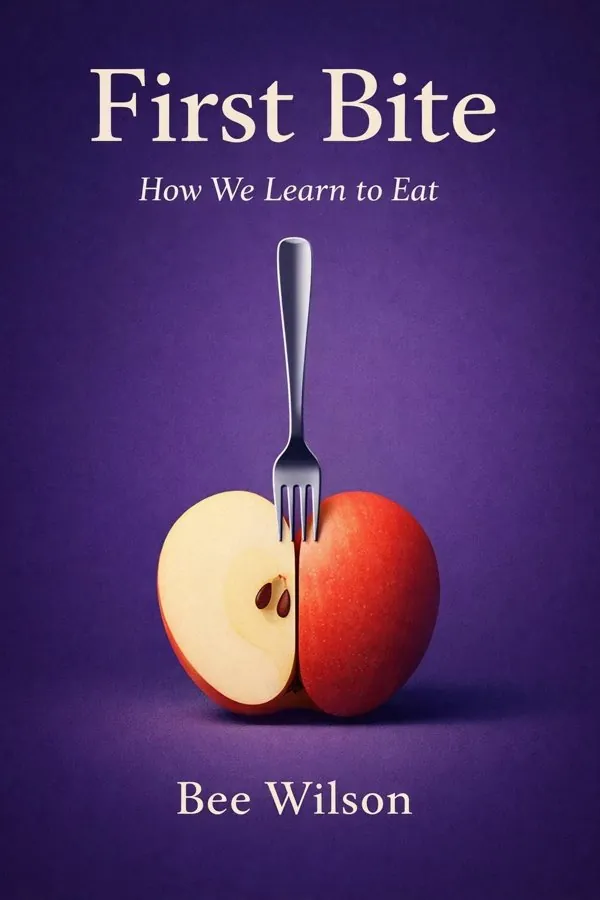
First Bite: How We Learn to Eat: Summary & Key Insights
by Bee Wilson
 10 min9 chaptersAudio available
Key Takeaways from First Bite: How We Learn to Eat
One of the book’s most liberating insights is that taste is not destiny.
The foods of childhood do not merely fill small stomachs; they help build the architecture of lifelong eating.
A common mistake in feeding children is assuming that resistance should be met with force, persuasion, or negotiation.
We often imagine appetite as an internal signal arising solely from hunger, but Wilson reveals how strongly context shapes desire.
One of Wilson’s most resonant arguments is that eating is deeply emotional, and these emotional layers are learned from early life onward.
What Is First Bite: How We Learn to Eat About?
First Bite: How We Learn to Eat by Bee Wilson is a popular_sci book. Why do some people crave bitter greens while others recoil from them? Why can one childhood meal shape a lifetime of comfort eating, while a single change in environment can transform a person’s entire diet? In First Bite, Bee Wilson explores a deceptively simple question: how do human beings learn to eat? Drawing on psychology, neuroscience, history, and personal experience, she argues that taste is far less fixed than we assume. Our food preferences are not simply inherited or biologically determined; they are formed through repetition, culture, parenting, advertising, memory, and emotion. This matters because modern societies often treat eating habits as personal failings or virtues, when in reality they are learned behaviors shaped by powerful external forces. Wilson shows that understanding this process can help us rethink childhood feeding, address unhealthy habits, and become more compassionate toward ourselves and others. A celebrated food writer and historian, Wilson brings intellectual rigor together with vivid storytelling, making complex research accessible and deeply relevant. First Bite is not just a book about food. It is a book about identity, habit, pleasure, and the possibility of change at any age.
This FizzRead summary covers all 9 key chapters of First Bite: How We Learn to Eat in approximately 10 minutes, distilling the most important ideas, arguments, and takeaways from Bee Wilson's work. Also available as an audio summary and Key Quotes Podcast.
First Bite: How We Learn to Eat
Why do some people crave bitter greens while others recoil from them? Why can one childhood meal shape a lifetime of comfort eating, while a single change in environment can transform a person’s entire diet? In First Bite, Bee Wilson explores a deceptively simple question: how do human beings learn to eat? Drawing on psychology, neuroscience, history, and personal experience, she argues that taste is far less fixed than we assume. Our food preferences are not simply inherited or biologically determined; they are formed through repetition, culture, parenting, advertising, memory, and emotion.
This matters because modern societies often treat eating habits as personal failings or virtues, when in reality they are learned behaviors shaped by powerful external forces. Wilson shows that understanding this process can help us rethink childhood feeding, address unhealthy habits, and become more compassionate toward ourselves and others. A celebrated food writer and historian, Wilson brings intellectual rigor together with vivid storytelling, making complex research accessible and deeply relevant. First Bite is not just a book about food. It is a book about identity, habit, pleasure, and the possibility of change at any age.
Who Should Read First Bite: How We Learn to Eat?
This book is perfect for anyone interested in popular_sci and looking to gain actionable insights in a short read. Whether you're a student, professional, or lifelong learner, the key ideas from First Bite: How We Learn to Eat by Bee Wilson will help you think differently.
- ✓Readers who enjoy popular_sci and want practical takeaways
- ✓Professionals looking to apply new ideas to their work and life
- ✓Anyone who wants the core insights of First Bite: How We Learn to Eat in just 10 minutes
Want the full summary?
Get instant access to this book summary and 100K+ more with Fizz Moment.
Get Free SummaryAvailable on App Store • Free to download
Key Chapters
One of the book’s most liberating insights is that taste is not destiny. Many people speak as if food preferences are permanent facts of personality: “I’m just not a vegetable person,” or “I’ve always hated fish.” Bee Wilson challenges this assumption by showing that likes and dislikes are built over time through exposure, familiarity, and emotional association. Biology matters, of course. Humans are born with some basic preferences, such as a liking for sweetness and a wariness of bitterness. But these starting points are only the beginning of a much larger learning process.
Wilson explains that what we come to enjoy depends heavily on the foods we encounter repeatedly, the social settings in which we meet them, and the meanings attached to them. A child raised with spicy food may find it comforting, while another may experience it as a shock. An adult who once hated olives can learn to appreciate them after repeated tasting in pleasurable contexts. The same principle applies to healthier foods: preferences for whole grains, vegetables, and less sugary meals can be cultivated, not merely wished for.
This idea has practical consequences. It means people are not trapped by current eating habits, and parents are not simply discovering what their child “is like.” They are helping shape a palate. It also means dietary change should focus less on willpower and more on repeated, low-pressure exposure. Instead of demanding instant transformation, Wilson suggests seeing taste as adaptable.
Actionable takeaway: Treat your food preferences as flexible. Choose one food you currently avoid and reintroduce it gently, multiple times, in appealing settings rather than assuming dislike is permanent.
The foods of childhood do not merely fill small stomachs; they help build the architecture of lifelong eating. Wilson shows that early experiences with flavor, texture, routine, and mealtime emotion leave a lasting imprint. From infancy onward, children are learning what food means. Is it comfort, conflict, boredom, celebration, pressure, pleasure, or connection? These lessons can endure far beyond childhood itself.
The book highlights that flavor learning begins astonishingly early. Babies are exposed to tastes through the womb and through breast milk, where flavors from the mother’s diet can appear. Later, repeated experiences with family meals, snacks, school food, and cultural rituals deepen these associations. A child repeatedly offered vegetables with patience and calm is more likely to accept them than a child pressured, bribed, or shamed. Likewise, if sweets are treated as highly charged rewards, they can gain emotional power that lasts for years.
Wilson does not argue that childhood determines everything forever. Rather, she emphasizes that early habits are powerful because they become normal. People often seek the foods that feel familiar and safe, especially under stress. This helps explain why changing diet in adulthood can feel like changing more than nutrition; it can feel like altering memory and identity.
For parents and caregivers, the implication is profound: feeding is education. For adults, the lesson is equally important: many food habits that feel deeply personal may actually be inherited from an environment that can be questioned and reshaped.
Actionable takeaway: Reflect on three foods or food rules from your childhood that still influence you today, and decide consciously whether each one still serves your health and happiness.
A common mistake in feeding children is assuming that resistance should be met with force, persuasion, or negotiation. Wilson shows that these tactics often backfire. The more adults pressure children to eat certain foods, the more those foods can become symbols of conflict and loss of control. A vegetable is no longer just a vegetable; it becomes the site of a power struggle.
Research discussed in the book suggests that repeated exposure is far more effective than coercion. Children often need to encounter a food many times before accepting it. This is not stubbornness in the moral sense; it is part of how humans learn safety and familiarity. A child may reject broccoli the first, fifth, or even tenth time, but calm, consistent reintroduction can gradually reduce suspicion. Crucially, this works best when the atmosphere is relaxed. If mealtime is charged with anxiety, lectures, or rewards, the learning becomes distorted.
Wilson also critiques the widespread habit of using dessert as a bargaining chip. When adults say, “Eat your vegetables and then you can have ice cream,” they unintentionally teach children that vegetables are chores and sweets are the true prize. This can increase preference for sugary foods and reduce intrinsic interest in healthier ones.
The practical application is not limited to parenting. Adults trying to change their own diets can also use exposure. Instead of attempting a perfect food overhaul, they can normalize healthier choices by making them frequent, visible, and easy. Familiarity slowly creates preference.
Actionable takeaway: Replace pressure with repetition. Offer disliked but nutritious foods regularly in small amounts, without lectures or bribes, and let familiarity do the work over time.
We often imagine appetite as an internal signal arising solely from hunger, but Wilson reveals how strongly context shapes desire. The room, the company, the packaging, the timing, and the emotional tone of eating all influence what tastes good to us. A food eaten joyfully among friends can become beloved; the same food consumed in stress or shame can become unappealing.
This insight helps explain why eating habits can shift dramatically across settings. Someone who hardly touches vegetables at home may enjoy them at a restaurant when they are presented beautifully and shared socially. A person who rarely snacks in structured environments may overeat while working alone at a laptop. Food companies understand this well and design products, environments, and cues to maximize repeated consumption. Bright wrappers, convenience, portion size, and strategic marketing all train appetite.
Wilson encourages readers to see eating behavior not as a simple matter of self-control but as a response to a learned environment. This perspective is useful because it opens new routes to change. Rather than only trying to resist cravings in the moment, we can redesign the context around us. If fruit is visible and ready to eat, we are more likely to choose it. If mindless snack foods are always within reach, we will consume them more often, regardless of our intentions.
Understanding context also encourages compassion. Many struggles with food are not signs of weakness but predictable results of modern environments engineered to shape preference and habit.
Actionable takeaway: Audit your eating environment for one week. Notice which places, moods, and cues drive your choices, then change one element, such as visibility, convenience, or routine, to support better eating.
Food is never just fuel. One of Wilson’s most resonant arguments is that eating is deeply emotional, and these emotional layers are learned from early life onward. Meals can signal love, scarcity, discipline, reward, comfort, or belonging. Over time, these associations become powerful enough to shape cravings that seem purely physical but are often emotional as well.
A person who was soothed with sweet foods as a child may instinctively reach for sugar during stress. Someone who grew up in a household where meals were tense may eat quickly, defensively, or in private. Another person may associate certain dishes with care and family, making those foods especially compelling in moments of loneliness. Wilson does not moralize these patterns. Instead, she helps readers understand that emotional eating is not evidence of broken character; it is often learned behavior rooted in memory and repetition.
This matters because people frequently try to solve emotional eating with nutritional rules alone. But if food has become linked to comfort, control, or relief, then information about calories or nutrients may not address the real issue. Change requires noticing the feeling beneath the behavior. It also requires creating new associations: comfort from rest, conversation, movement, ritual, or non-food pleasures.
Wilson’s approach is humane. She does not deny the pleasure of emotional eating altogether. Rather, she asks readers to become aware of when food is serving multiple roles and whether those roles are helping or harming them.
Actionable takeaway: The next time you crave a specific comfort food, pause and ask what emotion you are trying to manage. Name the feeling first, then decide consciously whether food is the best response.
What tastes natural in one culture can seem strange in another, and Wilson uses this fact to make a larger point: eating is shaped by collective learning. From meal timing to portion size, from acceptable textures to ideas about health, culture teaches us what counts as real food and what belongs at the table. These norms feel obvious only because we absorb them so thoroughly.
Wilson explores how children learn not just flavors but food rules. In some societies, bitter vegetables, fermented foods, or strong spices are ordinary from a young age. In others, children are surrounded by beige, sweet, highly processed foods that define comfort and convenience. Neither pattern is merely personal preference. Each reflects a social environment that teaches people what to expect and enjoy.
This cultural lens also exposes the limits of simplistic dietary advice. Telling people to “eat better” without acknowledging habit, family practice, class, and local norms misses the true complexity of change. People do not eat in isolation. They eat inside systems of belief, economics, tradition, and marketing. At the same time, culture is not static. Norms can shift, sometimes quickly, when households, schools, or societies make different foods visible and desirable.
For readers, this idea offers both perspective and possibility. If many of your preferences were socially taught, then alternative norms can also be learned. You can borrow from other food cultures, rethink inherited assumptions, and create a household culture with different defaults.
Actionable takeaway: Identify one food habit in your home that feels “normal” but may be culturally inherited rather than necessary, and experiment with replacing it with a healthier, equally satisfying norm.
Modern processed food does more than satisfy hunger; it trains the palate. Wilson pays close attention to how industrial food systems create preferences for intense sweetness, saltiness, softness, and instant gratification. When children and adults are repeatedly exposed to highly engineered foods, more subtle flavors can begin to seem dull or unsatisfying. This is not because natural foods lack value, but because the palate adapts to what it encounters most often.
Highly processed foods are often designed to be easy to chew, quick to consume, and immediately pleasurable. They remove many of the challenges that make eating more varied foods a learning experience, such as bitterness, mixed textures, or delayed appreciation. Over time, this can narrow dietary range. A child accustomed to sweet yogurts, sugary cereals, and salty snacks may struggle to enjoy plain foods not because they are impossible to like, but because their sensory baseline has shifted.
Wilson’s point is not nostalgic purism. She is interested in how environments shape preference, and industrial food is one of the strongest environments many people inhabit. The implication is that healthier eating requires more than information labels. It requires protecting and retraining the palate. Cooking, repeated exposure to whole foods, and reducing dependence on ultra-palatable products can widen taste again.
The hopeful message is that the palate remains trainable. Even after years of processed eating, many people find that sweetness becomes excessive and vegetables become more appealing once their diet changes.
Actionable takeaway: Pick one category of highly processed food you consume often, such as sweetened breakfast items or packaged snacks, and replace it consistently for two weeks with a simpler alternative to begin resetting your taste expectations.
Perhaps the most empowering idea in First Bite is that food learning does not end in childhood. Adults often assume that by the time they reach maturity, their preferences are settled. Wilson argues the opposite: while early habits are powerful, they are not final. Human beings continue learning through repetition, curiosity, social influence, and changing circumstances.
This matters because many people carry shame about their eating habits. They believe they should simply know how to eat well by now, and if they do not, they must lack discipline. Wilson reframes the problem. If your current diet is the result of years of learning in a particular environment, then improvement requires relearning, not self-criticism. That means building new routines, finding enjoyable forms of healthy food, and allowing preference to evolve gradually.
Examples of adult relearning include acquiring a taste for black coffee, spicy food, legumes, or raw vegetables through repeated exposure. Moving to a new country, cooking with a new partner, or joining a social group with different food habits can all reshape the palate. Even negative patterns can be disrupted when people become conscious of them and design alternatives.
Wilson’s realism is important here. Relearning is possible, but it is easier when supported by systems: meal planning, social encouragement, changed home environments, and patience. Sudden perfection rarely lasts. Slow normalization often does.
Actionable takeaway: Choose one eating habit you want to change and approach it as a learning project for the next month, focusing on repetition and curiosity rather than on instant results.
People often speak about eating in moral terms: good foods, bad foods, good eaters, weak eaters, disciplined bodies, failed diets. Wilson’s work pushes against this harsh language by showing that food behavior is learned, contextual, and emotionally saturated. Shame may create urgency, but it rarely creates sustainable change. More often, it deepens secrecy, defensiveness, and rebound eating.
By tracing how taste develops, Wilson invites a more compassionate understanding of ourselves and others. If a child rejects vegetables, the answer is not ridicule. If an adult overeats processed food, the explanation is not necessarily laziness. Feeding histories, stress, social pressure, marketing, income, and routine all play a role. This does not eliminate responsibility, but it changes its tone. We can take responsibility more effectively when we stop treating eating as a test of virtue.
Compassion also improves practical outcomes. Parents who stay calm at mealtimes create better learning conditions. Adults who drop all-or-nothing thinking are more likely to persist after setbacks. Someone who sees an unhealthy habit as learned can ask, “What trained me into this, and what can train me out of it?” That question is far more useful than, “What is wrong with me?”
Wilson’s broader contribution is to make food change feel humane rather than punitive. Pleasure, flexibility, and understanding are not luxuries; they are tools for lasting transformation.
Actionable takeaway: Replace one self-critical statement about your eating, such as “I have no willpower,” with a learning-based statement, such as “I’ve practiced this habit for years, and I can practice a new one.”
All Chapters in First Bite: How We Learn to Eat
About the Author
Bee Wilson is a British food writer, historian, and journalist known for her insightful work on how people cook, eat, and think about food. She has written several acclaimed books that blend cultural history, psychology, and everyday life, making complex subjects accessible to broad audiences. Wilson has contributed to major publications and built a reputation for exploring food not just as cuisine, but as behavior, identity, and social practice. Her writing is admired for being both intellectually rigorous and highly readable. In First Bite, she draws on research from neuroscience, child development, nutrition, and history to examine how taste is formed and how eating habits can change. Her work has made her one of the most respected contemporary voices in food writing.
Get This Summary in Your Preferred Format
Read or listen to the First Bite: How We Learn to Eat summary by Bee Wilson anytime, anywhere. FizzRead offers multiple formats so you can learn on your terms — all free.
Available formats: App · Audio · PDF · EPUB — All included free with FizzRead
Download First Bite: How We Learn to Eat PDF and EPUB Summary
Key Quotes from First Bite: How We Learn to Eat
“One of the book’s most liberating insights is that taste is not destiny.”
“The foods of childhood do not merely fill small stomachs; they help build the architecture of lifelong eating.”
“A common mistake in feeding children is assuming that resistance should be met with force, persuasion, or negotiation.”
“We often imagine appetite as an internal signal arising solely from hunger, but Wilson reveals how strongly context shapes desire.”
“One of Wilson’s most resonant arguments is that eating is deeply emotional, and these emotional layers are learned from early life onward.”
Frequently Asked Questions about First Bite: How We Learn to Eat
First Bite: How We Learn to Eat by Bee Wilson is a popular_sci book that explores key ideas across 9 chapters. Why do some people crave bitter greens while others recoil from them? Why can one childhood meal shape a lifetime of comfort eating, while a single change in environment can transform a person’s entire diet? In First Bite, Bee Wilson explores a deceptively simple question: how do human beings learn to eat? Drawing on psychology, neuroscience, history, and personal experience, she argues that taste is far less fixed than we assume. Our food preferences are not simply inherited or biologically determined; they are formed through repetition, culture, parenting, advertising, memory, and emotion. This matters because modern societies often treat eating habits as personal failings or virtues, when in reality they are learned behaviors shaped by powerful external forces. Wilson shows that understanding this process can help us rethink childhood feeding, address unhealthy habits, and become more compassionate toward ourselves and others. A celebrated food writer and historian, Wilson brings intellectual rigor together with vivid storytelling, making complex research accessible and deeply relevant. First Bite is not just a book about food. It is a book about identity, habit, pleasure, and the possibility of change at any age.
More by Bee Wilson
You Might Also Like

Structures: Or Why Things Don"t Fall Down
J.E. Gordon
10 min
The Road to Wigan Pier
George Orwell
10 min
Bonk: The Curious Coupling of Science and Sex
Mary Roach
10 min
In Pursuit Of The Unknown: 17 Equations That Changed The World
Ian Stewart
10 min
Napoleon's Buttons: 17 Molecules That Changed History
Penny Le Couteur and Jay Burreson
10 min
Natural History Museum Guide
Various
10 minBrowse by Category
Ready to read First Bite: How We Learn to Eat?
Get the full summary and 100K+ more books with Fizz Moment.