
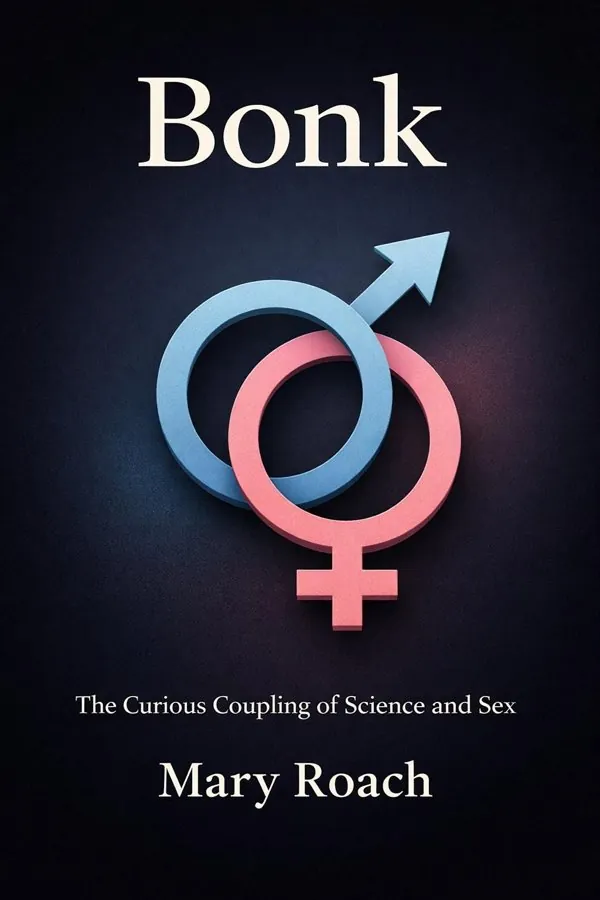
Bonk: The Curious Coupling of Science and Sex: Summary & Key Insights
by Mary Roach
 10 min8 chaptersAudio available
Key Takeaways from Bonk: The Curious Coupling of Science and Sex
The moment sex enters a laboratory, it stops being purely private and starts revealing how little we actually know.
Embarrassment is not proof that a subject is unworthy of study.
When people are reluctant to study something, mythology rushes in to fill the void.
Sexual response does not follow a neat universal script, no matter how often culture pretends it does.
Scientific inquiry does not happen in a vacuum; it reflects the moral climate of its time.
What Is Bonk: The Curious Coupling of Science and Sex About?
Bonk: The Curious Coupling of Science and Sex by Mary Roach is a popular_sci book. Bonk: The Curious Coupling of Science and Sex is Mary Roach’s witty, fearless exploration of what happens when one of humanity’s most private experiences becomes an object of scientific inquiry. Rather than treating sex as scandal, fantasy, or moral debate, Roach investigates it as a biological, psychological, and experimental subject. She follows researchers into laboratories, interviews sexologists, examines historical studies, and even participates in demonstrations to show how awkward, ingenious, and revealing the science of sex can be. The book matters because it strips away embarrassment and myth, replacing them with curiosity, evidence, and humor. In doing so, it helps readers see how much of what we believe about arousal, orgasm, desire, and sexual function rests on cultural assumption rather than tested fact. Roach is uniquely qualified for this task not because she is a clinician, but because she is a master investigative science writer who turns taboo subjects into accessible, intelligent stories. Her blend of rigorous reporting, comic timing, and human empathy makes Bonk both entertaining and genuinely illuminating.
This FizzRead summary covers all 8 key chapters of Bonk: The Curious Coupling of Science and Sex in approximately 10 minutes, distilling the most important ideas, arguments, and takeaways from Mary Roach's work. Also available as an audio summary and Key Quotes Podcast.
Bonk: The Curious Coupling of Science and Sex
Bonk: The Curious Coupling of Science and Sex is Mary Roach’s witty, fearless exploration of what happens when one of humanity’s most private experiences becomes an object of scientific inquiry. Rather than treating sex as scandal, fantasy, or moral debate, Roach investigates it as a biological, psychological, and experimental subject. She follows researchers into laboratories, interviews sexologists, examines historical studies, and even participates in demonstrations to show how awkward, ingenious, and revealing the science of sex can be. The book matters because it strips away embarrassment and myth, replacing them with curiosity, evidence, and humor. In doing so, it helps readers see how much of what we believe about arousal, orgasm, desire, and sexual function rests on cultural assumption rather than tested fact. Roach is uniquely qualified for this task not because she is a clinician, but because she is a master investigative science writer who turns taboo subjects into accessible, intelligent stories. Her blend of rigorous reporting, comic timing, and human empathy makes Bonk both entertaining and genuinely illuminating.
Who Should Read Bonk: The Curious Coupling of Science and Sex?
This book is perfect for anyone interested in popular_sci and looking to gain actionable insights in a short read. Whether you're a student, professional, or lifelong learner, the key ideas from Bonk: The Curious Coupling of Science and Sex by Mary Roach will help you think differently.
- ✓Readers who enjoy popular_sci and want practical takeaways
- ✓Professionals looking to apply new ideas to their work and life
- ✓Anyone who wants the core insights of Bonk: The Curious Coupling of Science and Sex in just 10 minutes
Want the full summary?
Get instant access to this book summary and 100K+ more with Fizz Moment.
Get Free SummaryAvailable on App Store • Free to download
Key Chapters
The moment sex enters a laboratory, it stops being purely private and starts revealing how little we actually know. One of Mary Roach’s central insights is that sex may be universal, but scientific knowledge about it is surprisingly patchy, often delayed by embarrassment, funding problems, and moral resistance. Researchers who study digestion, sleep, or balance can work openly. Researchers who study intercourse or orgasm have historically had to fight ridicule, censorship, and logistical absurdity just to gather data.
Roach shows that sexual science is not frivolous. It addresses real questions: What physically happens during arousal? How do blood flow, nerve signaling, and muscular contractions interact? Why do some people experience pain, dysfunction, or lack of desire? Why do assumptions about male and female sexuality persist even when evidence challenges them? Once framed this way, sex research looks less like curiosity and more like an overdue branch of human physiology.
A powerful aspect of the book is its attention to method. Measuring sexual response is difficult because observation changes behavior. Participants may feel self-conscious, researchers may interpret results through bias, and experiments are often constrained by what institutions permit. This means findings about sex require extra caution and humility.
In everyday life, this idea applies whenever people treat sexual beliefs as obvious truths. Advice from friends, media stereotypes, and cultural scripts may feel authoritative, but many claims about performance, frequency, satisfaction, or “normality” have weak foundations. A more scientific mindset asks: What is the evidence? How was it measured? Who was studied?
Actionable takeaway: Replace certainty with curiosity when thinking about sex. Before accepting common beliefs about sexual behavior or function, ask whether they are based on evidence, myth, or social expectation.
Embarrassment is not proof that a subject is unworthy of study. Roach repeatedly demonstrates that some of the most awkward experiments in science are also the most necessary. From devices designed to measure blood flow in genitals to observational studies of intercourse mechanics, sex research often sounds comical on paper. Yet beneath the absurdity lies a practical purpose: helping clinicians understand function, dysfunction, pleasure, pain, and anatomy more accurately.
One of the book’s great strengths is its insistence that humor and seriousness can coexist. Roach does not mock science; she uses comedy to illuminate the human challenge of performing rigor under absurd conditions. Participants must follow protocols while aroused. Researchers must record intimate physiological changes without losing scientific distance. Institutions must decide where decency rules end and medical necessity begins.
This matters because social discomfort often distorts priorities. Conditions such as erectile difficulties, painful intercourse, inability to orgasm, or lack of arousal are easy to dismiss or privatize. But when researchers persist through awkwardness, they produce findings that can improve diagnosis and treatment. Even failed studies are informative, showing where assumptions were flawed or methods inadequate.
There is also a broader lesson here about how innovation often looks ridiculous before it looks useful. Topics once dismissed as indecent or niche can eventually become recognized as major health concerns. Practical progress requires someone willing to ask awkward questions and withstand public discomfort.
In ordinary life, this idea encourages a healthier attitude toward difficult conversations with doctors or partners. If trained researchers can confront sexual realities directly, individuals can learn to discuss symptoms and concerns without shame.
Actionable takeaway: Do not let embarrassment prevent important inquiry. Whether in healthcare, relationships, or self-understanding, honest questions are often the first step toward meaningful solutions.
When people are reluctant to study something, mythology rushes in to fill the void. Roach highlights how sex has long been surrounded by confident claims that turned out to be untested, overstated, or simply wrong. Cultural narratives about desire, orgasm, frequency, anatomy, and sexual performance often sound ancient and authoritative, but many survive because no one examined them carefully enough.
This is especially clear in the history of sexology. Early researchers were often constrained by moral codes, poor tools, tiny sample sizes, and personal bias. Some projected gender stereotypes onto biology. Others made broad conclusions from anecdotal evidence. Once these claims entered popular culture, they hardened into “facts” repeated in magazines, education, therapy, and casual conversation.
Roach’s reporting invites readers to see sex not as a domain of timeless wisdom, but as one where scientific revision is constantly needed. What counts as normal varies widely. What counts as dysfunction often depends on context. Even experiences many assume are straightforward, such as orgasm or attraction, involve complex combinations of physiology, psychology, expectation, and environment.
A practical application is recognizing how harmful myths can be. Beliefs like “everyone should want sex the same amount,” “there is one correct way to respond,” or “certain experiences prove something is wrong with you” can create anxiety and miscommunication. Data does not eliminate uncertainty, but it can reduce unnecessary shame.
Roach also models a useful intellectual habit: laughing at bad assumptions without becoming cynical about knowledge itself. The point is not that all sexual science is unreliable, but that careful evidence is especially important in a field crowded with fantasy, moralism, and commercial claims.
Actionable takeaway: Challenge inherited sexual “truths.” When a belief creates pressure, shame, or unrealistic standards, ask whether it is scientifically grounded or merely culturally repeated.
Sexual response does not follow a neat universal script, no matter how often culture pretends it does. Roach explores the mechanics of arousal and orgasm in ways that reveal how variable human bodies really are. Rather than presenting sexuality as a simple sequence of desire, stimulation, climax, and resolution, she shows it to be a complicated interplay of circulation, nerves, muscles, hormones, sensation, emotion, and context.
This complexity matters because many people judge themselves against overly simplified models. They assume arousal should happen on cue, orgasms should occur predictably, and physical reactions should map neatly onto desire. But science suggests the body is more unruly. Physiological response may not perfectly mirror subjective experience. A person can feel mentally interested but physically unresponsive, or show physical signs without emotional readiness. Context, stress, medication, health conditions, age, and relationship dynamics all influence outcomes.
Roach’s treatment of these issues is useful precisely because it avoids turning complexity into pathology. Variation does not automatically mean dysfunction. At the same time, understanding the mechanics can help identify when support is needed. For clinicians, this means better diagnostics. For individuals, it means less self-blame and more informed communication.
In practical terms, this insight can improve relationships. Partners often rely on assumptions instead of observation and discussion. If bodies do not follow one standard pattern, then patience, feedback, and adaptability become more important than performance scripts. Sexual satisfaction is often better served by curiosity than by trying to imitate a formula.
The larger lesson extends beyond sex: human biology is rarely as linear as popular culture suggests. Any domain involving the body deserves nuance.
Actionable takeaway: Treat sexual response as individualized rather than scripted. Pay attention to your own patterns and communicate openly with partners instead of measuring experience against rigid expectations.
Scientific inquiry does not happen in a vacuum; it reflects the moral climate of its time. One of Roach’s most revealing contributions is her historical perspective on how social norms shaped what researchers were willing or allowed to investigate about sex. Questions that seem medically obvious today were once treated as indecent. Entire areas of anatomy and pleasure were ignored, distorted, or moralized because institutions found them embarrassing.
This means the history of sex research is also a history of omission. What was left out matters as much as what was studied. Female sexual response, nonreproductive pleasure, sexual pain, variation in desire, and the mechanics of intercourse all received uneven attention depending on era, ideology, and available technology. Some investigators were pioneers; others imported social prejudice into scientific language.
Roach’s storytelling makes this deeply relevant to present-day readers. It reminds us that medicine can inherit blind spots. If a topic is culturally awkward, underfunded, or politically charged, it may remain understudied even when it affects millions. The result is delayed treatment, poor education, and a false sense that silence means insignificance.
In practical terms, this helps readers become better consumers of health information. Lack of clear knowledge does not always mean a problem is rare or imagined. Sometimes it means the system did not prioritize it. Patients who understand this are often more empowered to seek second opinions, ask more precise questions, or advocate for better care.
Roach also offers a broader civic lesson: research priorities reflect values. What societies choose to fund and legitimize reveals what they consider worthy of understanding.
Actionable takeaway: Notice where silence exists in health and science. If a topic feels important but poorly explained, consider that historical neglect—not personal abnormality—may be part of the reason.
Laughter can open a door that shame keeps closed. Roach’s signature method is to approach an uncomfortable topic with enough wit to relax the reader, but not so much that the subject becomes trivial. In Bonk, humor is not decoration. It is a communication strategy that allows serious scientific material about sex to become approachable, memorable, and less threatening.
This matters because many people avoid sexual education not out of lack of interest, but out of discomfort. Technical language can feel clinical and alienating; moral language can feel judgmental; sensational language can feel exploitative. Roach finds a middle path. By acknowledging awkwardness directly, she lowers defensiveness and invites curiosity.
There is a practical lesson here for educators, clinicians, and even partners. Difficult topics are often easier to discuss when the tone is humane and lightly self-aware. A touch of humor can reduce tension, signal safety, and make honest conversation more likely. Of course, the humor must be respectful. The goal is not to mock vulnerability, but to normalize it.
This insight extends beyond sexual science. In many areas of life, from illness to aging to grief, people are more receptive when information is delivered with intelligence and warmth rather than solemnity alone. Humor can make complexity feel survivable.
For readers, Roach’s style also models emotional balance. It is possible to be amused and informed at the same time. One can recognize the absurdity of experimental setups while still appreciating the courage of participants and the significance of the findings.
Actionable takeaway: Use respectful humor to make difficult conversations easier. When discussing sensitive subjects, aim for a tone that reduces shame without undermining seriousness.
It is easy to assume that studying sex is merely interesting, but Roach shows it is also medically consequential. Beneath the bizarre instruments and memorable anecdotes lies a serious objective: understanding sexual function well enough to help people whose health, relationships, and quality of life are affected by sexual problems. Arousal disorders, pain disorders, erectile issues, orgasmic difficulties, and mismatches between mental and physical response are not trivial inconveniences. They can influence confidence, intimacy, fertility decisions, and emotional well-being.
By examining the science behind these issues, Roach reframes sexual difficulty as a legitimate area of health rather than a personal failing. This is an important shift. When sexual concerns are moralized or minimized, sufferers often remain silent. They may assume they are alone, defective, or beyond help. Research challenges that isolation by identifying mechanisms, patterns, and possible interventions.
The book also highlights the difficulty of translating laboratory findings into treatment. Bodies are variable, desire is contextual, and no single explanation works for everyone. Yet even imperfect knowledge is valuable if it leads to better questions, better diagnostics, and less shame.
In practical life, this encourages readers to treat sexual health as part of overall health. Persistent pain, distress, numbness, dysfunction, or unexplained changes deserve informed attention just like headaches or digestive issues. Partners can also benefit from this perspective by approaching problems collaboratively instead of assigning blame.
Roach’s reporting reminds us that medicine improves not only through breakthrough drugs, but through willingness to investigate neglected experiences with rigor.
Actionable takeaway: Treat sexual concerns as valid health concerns. If an issue is persistent or distressing, seek evidence-based medical guidance rather than dismissing it as something to endure in silence.
The deepest message of Bonk is that curiosity is more useful than embarrassment. Roach approaches sex not as a mystery to romanticize or a scandal to exploit, but as a human reality worth examining honestly. That attitude changes everything. Once curiosity takes the lead, shame loses some of its power, and simplistic narratives start to break apart.
This insight is larger than any individual experiment described in the book. It applies to how people learn, communicate, and make sense of their own bodies. Shame tends to produce secrecy, and secrecy invites misinformation. Curiosity, by contrast, asks better questions: What am I experiencing? What does science know? What remains uncertain? What assumptions am I carrying from culture, family, religion, media, or past relationships?
Roach also shows that curiosity is not cold or detached. It can be compassionate. To investigate sex scientifically is not to drain it of meaning, but to care enough about human experience to understand it more accurately. The result is a view of sexuality that is less moralistic, less performative, and more humane.
In practice, this can help readers adopt a healthier mindset toward themselves and others. Instead of sorting experiences into normal versus abnormal too quickly, they can investigate patterns, seek information, and have more nuanced conversations. This is especially helpful in long-term relationships, where assumptions can harden into misunderstandings unless partners remain curious about each other’s changing realities.
The book ultimately encourages intellectual humility. Human sexuality is complex, and certainty is often overstated. Curiosity does not promise all the answers, but it creates the conditions for better ones.
Actionable takeaway: When confronted with confusion or discomfort around sex, choose inquiry over judgment. Ask better questions, seek reliable information, and let curiosity guide understanding.
All Chapters in Bonk: The Curious Coupling of Science and Sex
About the Author
Mary Roach is a bestselling American science writer celebrated for making unusual, uncomfortable, and overlooked subjects both funny and intellectually engaging. She specializes in narrative nonfiction that blends immersive reporting, interviews, historical digging, and sharp observational humor. Roach first gained wide attention with Stiff, her book on the afterlife of human cadavers, and went on to write acclaimed works such as Spook, Bonk, Gulp, Packing for Mars, and Grunt. Her books often explore the spaces where science meets taboo, bureaucracy, or everyday curiosity. What distinguishes her writing is her ability to ask bold questions without losing rigor or humanity. In Bonk, she brings those strengths to the science of sex, turning a topic many treat with embarrassment into one of curiosity, clarity, and insight.
Get This Summary in Your Preferred Format
Read or listen to the Bonk: The Curious Coupling of Science and Sex summary by Mary Roach anytime, anywhere. FizzRead offers multiple formats so you can learn on your terms — all free.
Available formats: App · Audio · PDF · EPUB — All included free with FizzRead
Download Bonk: The Curious Coupling of Science and Sex PDF and EPUB Summary
Key Quotes from Bonk: The Curious Coupling of Science and Sex
“The moment sex enters a laboratory, it stops being purely private and starts revealing how little we actually know.”
“Embarrassment is not proof that a subject is unworthy of study.”
“When people are reluctant to study something, mythology rushes in to fill the void.”
“Sexual response does not follow a neat universal script, no matter how often culture pretends it does.”
“Scientific inquiry does not happen in a vacuum; it reflects the moral climate of its time.”
Frequently Asked Questions about Bonk: The Curious Coupling of Science and Sex
Bonk: The Curious Coupling of Science and Sex by Mary Roach is a popular_sci book that explores key ideas across 8 chapters. Bonk: The Curious Coupling of Science and Sex is Mary Roach’s witty, fearless exploration of what happens when one of humanity’s most private experiences becomes an object of scientific inquiry. Rather than treating sex as scandal, fantasy, or moral debate, Roach investigates it as a biological, psychological, and experimental subject. She follows researchers into laboratories, interviews sexologists, examines historical studies, and even participates in demonstrations to show how awkward, ingenious, and revealing the science of sex can be. The book matters because it strips away embarrassment and myth, replacing them with curiosity, evidence, and humor. In doing so, it helps readers see how much of what we believe about arousal, orgasm, desire, and sexual function rests on cultural assumption rather than tested fact. Roach is uniquely qualified for this task not because she is a clinician, but because she is a master investigative science writer who turns taboo subjects into accessible, intelligent stories. Her blend of rigorous reporting, comic timing, and human empathy makes Bonk both entertaining and genuinely illuminating.
More by Mary Roach




You Might Also Like

Structures: Or Why Things Don"t Fall Down
J.E. Gordon
10 min
The Road to Wigan Pier
George Orwell
10 min
First Bite: How We Learn to Eat
Bee Wilson
10 min
In Pursuit Of The Unknown: 17 Equations That Changed The World
Ian Stewart
10 min
Napoleon's Buttons: 17 Molecules That Changed History
Penny Le Couteur and Jay Burreson
10 min
Natural History Museum Guide
Various
10 minBrowse by Category
Ready to read Bonk: The Curious Coupling of Science and Sex?
Get the full summary and 100K+ more books with Fizz Moment.