
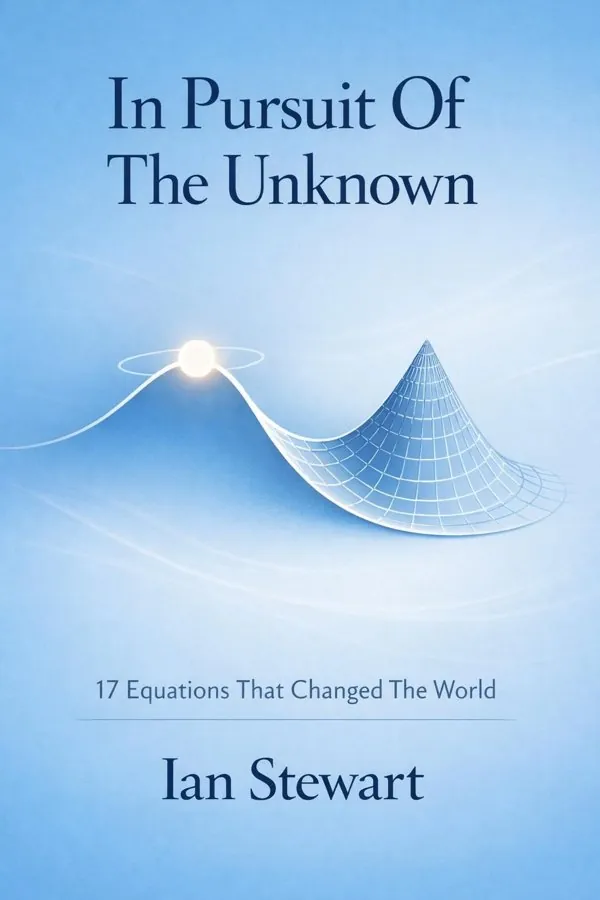
In Pursuit Of The Unknown: 17 Equations That Changed The World: Summary & Key Insights
by Ian Stewart
 10 min9 chaptersAudio available
Key Takeaways from In Pursuit Of The Unknown: 17 Equations That Changed The World
A short equation can contain centuries of thought, experimentation, and revolution.
Seeing a pattern is useful; predicting what comes next is transformative.
Some of the most astonishing discoveries in science began with the realization that nature follows surprisingly simple rules.
The ideas that seem most detached from everyday life often end up reshaping everyday life the most.
Every equation reveals something, but every equation also leaves something out.
What Is In Pursuit Of The Unknown: 17 Equations That Changed The World About?
In Pursuit Of The Unknown: 17 Equations That Changed The World by Ian Stewart is a popular_sci book. What if a handful of symbols could explain the motion of planets, the spread of disease, the growth of populations, the flow of information, and even the shape of reality itself? In In Pursuit Of The Unknown, celebrated mathematician Ian Stewart takes readers on a guided tour through 17 equations that transformed human thought and practical life. Rather than treating mathematics as a dry school subject, Stewart reveals it as one of civilization’s most powerful storytelling tools: a language that uncovers hidden order beneath chaos and turns abstract ideas into world-changing technologies. The book matters because most people live inside systems shaped by equations without realizing it. From GPS navigation and digital communication to finance, engineering, and medical modeling, the modern world runs on mathematical insights developed over centuries. Stewart, one of the most respected popularizers of mathematics, combines historical narrative, scientific explanation, and intellectual curiosity to show how these equations emerged, why they were controversial, and how they continue to shape our lives. This is not just a book about numbers. It is a book about human imagination, discovery, and the remarkable power of simple ideas to reshape the world.
This FizzRead summary covers all 9 key chapters of In Pursuit Of The Unknown: 17 Equations That Changed The World in approximately 10 minutes, distilling the most important ideas, arguments, and takeaways from Ian Stewart's work. Also available as an audio summary and Key Quotes Podcast.
In Pursuit Of The Unknown: 17 Equations That Changed The World
What if a handful of symbols could explain the motion of planets, the spread of disease, the growth of populations, the flow of information, and even the shape of reality itself? In In Pursuit Of The Unknown, celebrated mathematician Ian Stewart takes readers on a guided tour through 17 equations that transformed human thought and practical life. Rather than treating mathematics as a dry school subject, Stewart reveals it as one of civilization’s most powerful storytelling tools: a language that uncovers hidden order beneath chaos and turns abstract ideas into world-changing technologies.
The book matters because most people live inside systems shaped by equations without realizing it. From GPS navigation and digital communication to finance, engineering, and medical modeling, the modern world runs on mathematical insights developed over centuries. Stewart, one of the most respected popularizers of mathematics, combines historical narrative, scientific explanation, and intellectual curiosity to show how these equations emerged, why they were controversial, and how they continue to shape our lives. This is not just a book about numbers. It is a book about human imagination, discovery, and the remarkable power of simple ideas to reshape the world.
Who Should Read In Pursuit Of The Unknown: 17 Equations That Changed The World?
This book is perfect for anyone interested in popular_sci and looking to gain actionable insights in a short read. Whether you're a student, professional, or lifelong learner, the key ideas from In Pursuit Of The Unknown: 17 Equations That Changed The World by Ian Stewart will help you think differently.
- ✓Readers who enjoy popular_sci and want practical takeaways
- ✓Professionals looking to apply new ideas to their work and life
- ✓Anyone who wants the core insights of In Pursuit Of The Unknown: 17 Equations That Changed The World in just 10 minutes
Want the full summary?
Get instant access to this book summary and 100K+ more with Fizz Moment.
Get Free SummaryAvailable on App Store • Free to download
Key Chapters
A short equation can contain centuries of thought, experimentation, and revolution. One of Ian Stewart’s central insights is that equations are not mere strings of symbols for specialists; they are concentrated forms of understanding that let us describe patterns too subtle or vast for ordinary language. When you see an equation in the book, you are really looking at a breakthrough in how humanity learned to think.
Stewart shows that each famous equation marks a turning point. The Pythagorean theorem formalized geometric relationships. Newton’s law of gravitation connected falling apples and orbiting moons. Maxwell’s equations united electricity, magnetism, and light. Shannon’s information equation made the digital age possible. These formulas do not just solve textbook exercises. They create bridges between observation and prediction, turning scattered facts into systems.
The practical importance of this idea is enormous. Engineers use equations to design bridges that do not collapse. Epidemiologists use them to model outbreaks. Investors and economists use them, sometimes imperfectly, to estimate risks and growth. Smartphone maps depend on equations from relativity and geometry. Even weather forecasting, though imperfect, would be impossible without mathematical models translating data into predictions.
Stewart also emphasizes that beauty matters. Scientists and mathematicians often pursue elegant equations because simplicity can signal deep truth. A concise formula can unify previously separate phenomena, making the world feel more coherent. Yet equations are never final. They are tools that work within limits, and progress often comes from noticing when an equation no longer fits reality.
Actionable takeaway: the next time you encounter a formula, do not ask only, “How do I calculate this?” Ask, “What pattern of reality is this equation trying to capture?” That shift turns mathematics from memorization into meaning.
Seeing a pattern is useful; predicting what comes next is transformative. Stewart repeatedly demonstrates that the true power of equations lies in their ability to move from description to foresight. An equation tells us not only what is happening now, but what is likely to happen under given conditions. That is why equations have changed the world more profoundly than isolated facts ever could.
Take Newton’s second law, which links force, mass, and acceleration. It made mechanics predictive. Once the governing relationships were understood, engineers could calculate trajectories, build machines, and anticipate motion. Or consider the wave equation, which captures how vibrations and signals travel. Its applications extend from musical instruments to seismology to telecommunications. The same predictive logic appears in equations for population growth, fluid flow, and probability.
Stewart makes clear that prediction does not mean certainty in every case. Some systems are too sensitive, too complex, or too chaotic for perfect foresight. Even then, equations still improve our judgment. Weather models may not forecast every storm path precisely far in advance, but they dramatically outperform intuition. Disease models cannot tell us exactly who will get sick, yet they can estimate likely spread and help governments allocate resources.
In daily life, this lesson matters because we constantly make decisions under uncertainty. Mathematical thinking encourages us to identify variables, define relationships, and test assumptions. Businesses forecast demand. Hospitals predict patient loads. City planners estimate traffic. Families even use informal equations when balancing budgets, time, and trade-offs.
Stewart’s broader point is that equations sharpen human vision. They do not replace wisdom, but they discipline it. They make us confront how much we know, how much we only assume, and how changing one factor can reshape outcomes.
Actionable takeaway: whenever facing a complex decision, try to express the problem in terms of variables and relationships. Even a rough model can reveal hidden patterns and improve the quality of your predictions.
Some of the most astonishing discoveries in science began with the realization that nature follows surprisingly simple rules. Stewart highlights how equations such as the law of gravitation or the logarithmic relationship behind sound and perception show that complexity in the world often emerges from elegant underlying structures. This is one of the book’s deepest pleasures: seeing how a compact formula can illuminate phenomena on scales ranging from atoms to galaxies.
The law of gravitation is a classic example. It describes the attraction between masses and, in doing so, unifies the heavens and the earth. Before Newton, celestial motions and terrestrial events were often treated as separate realms. After Newton, the same mathematical law explained both a falling object and the orbit of a planet. That unification was intellectually radical. It suggested that the universe is not a patchwork of mysteries but a coherent system governed by discoverable rules.
Stewart traces similar leaps elsewhere. The heat equation explains how temperature spreads through matter, but it also influences finance and probability theory. The wave equation describes vibrating strings, yet also underpins optics and communications. The logistic equation, though simple, captures how growth is constrained by resources and becomes relevant in ecology, economics, and social systems.
In practical terms, simple laws are powerful because they are portable. Once understood, they can be applied to many domains. This is why mathematical literacy matters even for non-specialists. A person who grasps the logic of feedback, limits, and growth can better interpret news about inflation, climate trends, public health, or technology.
Stewart does not claim that all reality is simple. Rather, he shows that simple laws often provide the first reliable foothold in understanding complexity. They are starting points that can be refined as knowledge grows.
Actionable takeaway: look for the simplest governing principle behind any complicated issue. Often the clearest progress begins by identifying one basic law or constraint before adding layers of detail.
The ideas that seem most detached from everyday life often end up reshaping everyday life the most. Stewart makes a persuasive case that abstraction is not the enemy of usefulness; it is frequently the source of it. Many of the equations in the book began as intellectual curiosities, pursued for elegance or conceptual depth, only later becoming foundations for modern technologies.
Complex numbers offer a striking example. The square root of minus one once looked like a bizarre mathematical fiction. Yet the equation involving complex numbers became indispensable in electrical engineering, signal processing, quantum mechanics, and control systems. What first appeared unreal became essential for modeling very real phenomena. Similarly, Fourier analysis and wave-related mathematics were not merely abstract games. They became central to audio compression, imaging, communications, and data analysis.
Stewart uses these examples to challenge the common demand that knowledge must justify itself immediately through obvious utility. History shows the opposite: when thinkers explore patterns deeply and abstractly, society later gains tools no one could have fully anticipated. Pure mathematics often becomes applied mathematics after enough time has passed and the right problem emerges.
This lesson is relevant beyond science. In business, strategic frameworks can look abstract until they clarify decisions. In software, formal logic seems theoretical until it prevents catastrophic errors. In personal growth, abstract principles like incentives, feedback loops, or compounding can produce very practical improvements in habits and finances.
The book also warns against short-term thinking. Civilizations progress when they invest in understanding, not only in immediate outputs. Mathematical abstraction expands the range of what humanity can eventually build.
Actionable takeaway: do not dismiss an idea just because its usefulness is not obvious today. Ask instead whether it reveals a structure or relationship that could become valuable in a different context tomorrow.
Every equation reveals something, but every equation also leaves something out. Stewart is careful not to romanticize mathematics as a magical key that solves all problems. One of the book’s most important themes is that equations are powerful precisely because they simplify reality, and that simplification is both their strength and their danger.
The Black-Scholes equation is an especially vivid case. It revolutionized finance by providing a method to price options and manage risk. In many settings it was enormously useful. Yet its adoption also contributed to a culture of overconfidence in financial models. When users forget the assumptions built into an equation, they may trust the output more than the world deserves. Markets are not frictionless physical systems; they include fear, incentives, regulation, contagion, and irrational behavior.
The same caution applies elsewhere. A disease model may assume average contact rates while ignoring political behavior or misinformation. A climate model may capture long-term trends while remaining uncertain about local impacts. An economic equation may highlight incentives but miss culture or ethics. Models are not the territory. They are maps, and some maps are better than others depending on what you need to navigate.
Stewart’s balanced approach is refreshing because it respects mathematics without turning it into ideology. Equations should guide judgment, not replace it. Understanding their assumptions, domains, and blind spots is as important as admiring their elegance.
In practical life, this means being skeptical of numerical certainty. Dashboards, rankings, forecasts, and probability estimates can all be helpful, but only when interpreted with humility. The smartest users of equations know where the numbers come from and where they break down.
Actionable takeaway: whenever you rely on a model, ask three questions: what assumptions does it make, what factors does it ignore, and under what conditions might it fail?
Chance feels chaotic, but much of randomness follows patterns that mathematics can capture. Stewart explores this paradox through equations involving probability, normal distributions, and information. The insight is profound: uncertainty does not eliminate order. Instead, it often requires a different kind of order, one based on likelihoods rather than certainties.
The normal distribution, or bell curve, is a perfect example. Individual outcomes can vary unpredictably, yet large collections of outcomes often cluster in highly regular ways. Heights, measurement errors, test scores, and many natural variations approximate this pattern. Likewise, probability theory helps us understand everything from insurance and genetics to polling and machine reliability. These are not guesses in the casual sense; they are disciplined ways of reasoning under uncertainty.
Stewart also connects randomness to information. Claude Shannon’s work showed that communication can be understood mathematically, even when messages are subject to noise. This insight made possible efficient coding, error correction, and the digital infrastructure that supports modern communication. Without mathematical treatment of uncertainty, reliable phone calls, internet data transfer, and satellite communication would be far more difficult.
The practical implications are everywhere. Doctors interpret test results probabilistically. Businesses use risk analysis to plan investments. Governments estimate disaster scenarios. Individuals can use probabilistic thinking to avoid common mistakes such as assuming rare events are impossible or treating uncertain outcomes as guaranteed.
Stewart’s larger message is that mature thinking accepts uncertainty without surrendering to confusion. Equations of probability do not promise perfect knowledge, but they make uncertainty navigable. They help us act intelligently when certainty is unavailable, which is most of the time.
Actionable takeaway: replace yes-or-no thinking with probability thinking. Instead of asking, “Will this happen?” ask, “How likely is it, and what should I do given that level of risk?”
Most people notice technology but overlook the mathematics that makes it work. Stewart’s book is a reminder that equations form the invisible infrastructure of modern civilization. They govern not only dramatic scientific theories but also the hidden systems behind screens, transport networks, electricity grids, medical imaging, and digital communication.
Maxwell’s equations transformed our understanding of electromagnetism and led to radio, radar, wireless communication, and much of electrical engineering. The wave equation and Fourier-related ideas enable signal transmission and compression. Shannon’s information theory underlies coding, data storage, and error correction. Einstein’s relativity, once considered highly theoretical, is essential for GPS accuracy because satellite clocks behave differently under high speed and different gravitational conditions.
Stewart’s achievement is to connect these equations to everyday life without oversimplifying them. He shows that when you send a text, stream music, use Wi-Fi, or follow a navigation app, you are relying on centuries of mathematical discovery. This should change how we think about innovation. Breakthrough products often rest on deep intellectual foundations laid long before commercialization begins.
There is also a civic lesson here. Societies that support scientific research, mathematical education, and long-range inquiry build the groundwork for future prosperity. The visible gadget is the final layer; beneath it lies a pyramid of abstract understanding.
For individuals, recognizing this hidden structure builds intellectual humility and curiosity. It also suggests that learning foundational concepts can be more valuable than obsessing over surface trends. Tools change quickly. Underlying principles endure.
Actionable takeaway: when using a modern technology, pause to ask what invisible mathematical ideas make it possible. Training yourself to see foundations will deepen both your understanding and your ability to learn across domains.
Equations do not emerge from machines; they emerge from people struggling to make sense of the world. One of Stewart’s great strengths is his ability to present mathematics as a deeply human story filled with rivalry, imagination, confusion, persistence, and flashes of genius. The history behind these 17 equations is not a cold procession of facts but a record of human beings pushing against the boundaries of the known.
The Pythagoreans linked mathematics to cosmic harmony. Newton and Leibniz transformed motion and change through calculus while becoming entangled in bitter priority disputes. Maxwell synthesized decades of experimental and theoretical work into a new understanding of light and electromagnetism. Einstein reimagined space, time, and gravity by questioning assumptions most people never noticed. In each case, the equation is the visible tip of a much larger intellectual adventure.
Stewart uses these stories to show that discovery is rarely linear. Ideas evolve through errors, partial insights, and reinterpretation. A theorem may begin as geometry and later influence physics. A puzzle in one field may solve a problem in another. This reminds readers that knowledge is collaborative across generations. Even the most brilliant innovators build on inherited concepts.
That perspective is practical as well as inspiring. It encourages patience in learning. If world-changing ideas took decades or centuries to clarify, then our own confusion at first encounter is not failure. It is part of the process. Mastery grows through revisiting ideas, asking better questions, and staying curious long enough for patterns to click.
Stewart ultimately restores wonder to mathematics by reconnecting it to the people who created it and the problems they faced.
Actionable takeaway: when a concept feels intimidating, learn its story. Understanding who developed it, why they needed it, and what problem it solved can make even difficult ideas far more approachable.
The deepest gift of mathematics may not be any single equation, but the mental habits it cultivates. Stewart’s book suggests that engaging with equations changes how we reason about the world. Mathematics trains us to seek structure, define terms carefully, test assumptions, distinguish evidence from intuition, and remain open to surprising conclusions. These habits are valuable far beyond science.
Each equation in the book models a way of thinking. The Pythagorean theorem teaches that hidden relationships can be proven. Calculus shows that change can be analyzed systematically. Probability teaches disciplined humility in the face of uncertainty. Information theory demonstrates that even communication has measurable structure. Relativity reminds us that common sense is not always a reliable guide to reality.
In practical terms, mathematical thinking improves decision-making. It helps leaders ask better questions about trade-offs and constraints. It helps citizens evaluate statistics in media and politics. It helps professionals communicate clearly about systems and risks. Even in personal life, concepts like exponential growth, feedback loops, optimization, and expected value can sharpen choices about savings, habits, health, and time.
Stewart does not argue that everyone must become a mathematician. His point is more democratic and more important: mathematics is part of general intellectual culture. To ignore it is to cut yourself off from one of humanity’s best tools for understanding the world. You do not need to master every derivation to benefit. You need curiosity, patience, and willingness to think in patterns.
The book leaves readers with a renewed respect for equations not as barriers to understanding, but as doors into deeper perception.
Actionable takeaway: choose one mathematical idea you usually avoid—such as probability, growth rates, or basic geometry—and learn how it applies to a real decision in your life. Use mathematics as a thinking tool, not just a school subject.
All Chapters in In Pursuit Of The Unknown: 17 Equations That Changed The World
About the Author
Ian Stewart is a British mathematician, acclaimed science writer, and one of the most influential communicators of mathematics for general readers. He served as Professor of Mathematics at the University of Warwick and became widely known for making complex mathematical ideas accessible, engaging, and culturally relevant. Stewart has written numerous bestselling books on mathematics, chaos, symmetry, and scientific thought, as well as articles and columns that introduced broad audiences to advanced concepts without losing their depth. His work is admired for combining clarity, historical context, and a strong sense of wonder. In In Pursuit Of The Unknown, Stewart draws on decades of teaching, research, and public communication to show how equations have shaped science, technology, and human understanding itself.
Get This Summary in Your Preferred Format
Read or listen to the In Pursuit Of The Unknown: 17 Equations That Changed The World summary by Ian Stewart anytime, anywhere. FizzRead offers multiple formats so you can learn on your terms — all free.
Available formats: App · Audio · PDF · EPUB — All included free with FizzRead
Download In Pursuit Of The Unknown: 17 Equations That Changed The World PDF and EPUB Summary
Key Quotes from In Pursuit Of The Unknown: 17 Equations That Changed The World
“A short equation can contain centuries of thought, experimentation, and revolution.”
“Seeing a pattern is useful; predicting what comes next is transformative.”
“Some of the most astonishing discoveries in science began with the realization that nature follows surprisingly simple rules.”
“The ideas that seem most detached from everyday life often end up reshaping everyday life the most.”
“Every equation reveals something, but every equation also leaves something out.”
Frequently Asked Questions about In Pursuit Of The Unknown: 17 Equations That Changed The World
In Pursuit Of The Unknown: 17 Equations That Changed The World by Ian Stewart is a popular_sci book that explores key ideas across 9 chapters. What if a handful of symbols could explain the motion of planets, the spread of disease, the growth of populations, the flow of information, and even the shape of reality itself? In In Pursuit Of The Unknown, celebrated mathematician Ian Stewart takes readers on a guided tour through 17 equations that transformed human thought and practical life. Rather than treating mathematics as a dry school subject, Stewart reveals it as one of civilization’s most powerful storytelling tools: a language that uncovers hidden order beneath chaos and turns abstract ideas into world-changing technologies. The book matters because most people live inside systems shaped by equations without realizing it. From GPS navigation and digital communication to finance, engineering, and medical modeling, the modern world runs on mathematical insights developed over centuries. Stewart, one of the most respected popularizers of mathematics, combines historical narrative, scientific explanation, and intellectual curiosity to show how these equations emerged, why they were controversial, and how they continue to shape our lives. This is not just a book about numbers. It is a book about human imagination, discovery, and the remarkable power of simple ideas to reshape the world.
You Might Also Like

Structures: Or Why Things Don"t Fall Down
J.E. Gordon
10 min
The Road to Wigan Pier
George Orwell
10 min
Bonk: The Curious Coupling of Science and Sex
Mary Roach
10 min
First Bite: How We Learn to Eat
Bee Wilson
10 min
Napoleon's Buttons: 17 Molecules That Changed History
Penny Le Couteur and Jay Burreson
10 min
Natural History Museum Guide
Various
10 minBrowse by Category
Ready to read In Pursuit Of The Unknown: 17 Equations That Changed The World?
Get the full summary and 100K+ more books with Fizz Moment.