
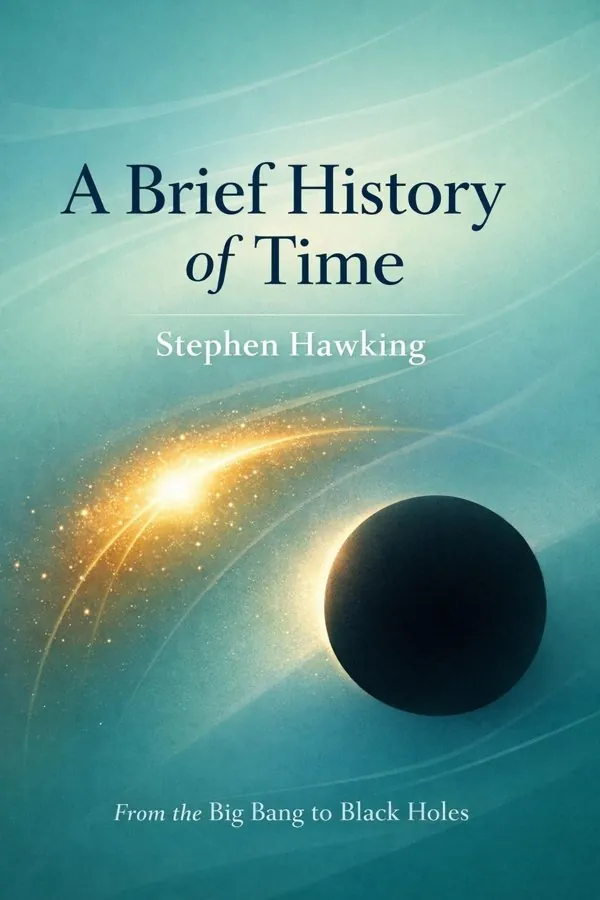
A Brief History of Time: Summary & Key Insights
 10 min10 chaptersAudio available
Key Takeaways from A Brief History of Time
Every age believes it finally understands the universe, until a better explanation arrives.
Time is not a universal clock ticking the same way for everyone.
The night sky looks eternal, but the universe is in motion on the largest possible scale.
At the smallest scales, nature does not behave like a precise machine.
The visible universe is astonishingly varied, but beneath that variety lies a small set of ingredients and interactions.
What Is A Brief History of Time About?
A Brief History of Time by Stephen Hawking is a science book published in 1988 spanning 10 pages. What if the biggest questions humanity has ever asked could be explored without a physics degree? In A Brief History of Time, Stephen Hawking takes readers to the edge of human understanding and asks how the universe began, what laws govern it, whether time had a starting point, and what may happen in the far future. Rather than treating cosmology as an abstract specialty, he presents it as a deeply human pursuit: our attempt to understand where we come from and how reality is structured. First published in 1988, the book became a landmark in popular science because it translated difficult ideas—relativity, quantum mechanics, black holes, entropy, and grand unified theories—into language accessible to curious general readers. Hawking does not oversimplify the science; instead, he guides readers carefully through the ideas that transformed modern physics. His authority is exceptional. As one of the world’s most influential theoretical physicists, Hawking made major contributions to black hole theory and the study of the early universe. This book matters because it shows that the deepest scientific questions are also philosophical ones, and that understanding the cosmos changes how we think about time, reality, and our place within it.
This FizzRead summary covers all 10 key chapters of A Brief History of Time in approximately 10 minutes, distilling the most important ideas, arguments, and takeaways from Stephen Hawking's work. Also available as an audio summary and Key Quotes Podcast.
A Brief History of Time
What if the biggest questions humanity has ever asked could be explored without a physics degree? In A Brief History of Time, Stephen Hawking takes readers to the edge of human understanding and asks how the universe began, what laws govern it, whether time had a starting point, and what may happen in the far future. Rather than treating cosmology as an abstract specialty, he presents it as a deeply human pursuit: our attempt to understand where we come from and how reality is structured.
First published in 1988, the book became a landmark in popular science because it translated difficult ideas—relativity, quantum mechanics, black holes, entropy, and grand unified theories—into language accessible to curious general readers. Hawking does not oversimplify the science; instead, he guides readers carefully through the ideas that transformed modern physics.
His authority is exceptional. As one of the world’s most influential theoretical physicists, Hawking made major contributions to black hole theory and the study of the early universe. This book matters because it shows that the deepest scientific questions are also philosophical ones, and that understanding the cosmos changes how we think about time, reality, and our place within it.
Who Should Read A Brief History of Time?
This book is perfect for anyone interested in science and looking to gain actionable insights in a short read. Whether you're a student, professional, or lifelong learner, the key ideas from A Brief History of Time by Stephen Hawking will help you think differently.
- ✓Readers who enjoy science and want practical takeaways
- ✓Professionals looking to apply new ideas to their work and life
- ✓Anyone who wants the core insights of A Brief History of Time in just 10 minutes
Want the full summary?
Get instant access to this book summary and 100K+ more with Fizz Moment.
Get Free SummaryAvailable on App Store • Free to download
Key Chapters
Every age believes it finally understands the universe, until a better explanation arrives. Hawking begins by showing that cosmology is not just a story about stars and galaxies, but about the changing models humans build to explain reality. Ancient thinkers such as Aristotle pictured a finite, ordered cosmos centered on Earth. Ptolemy refined that picture with complex systems of circles. Later, Copernicus displaced Earth from the center, Kepler described planetary motion more accurately, and Newton provided a mathematical framework that made the heavens intelligible through universal laws.
The key point is that scientific understanding progresses by replacing useful but limited pictures with better ones. A model is not reality itself; it is a tool for describing observations and making predictions. This matters because many debates about science become clearer once we accept that theories are judged by how well they explain evidence, not by whether they match common sense. Common sense once said the Earth stood still.
In everyday life, this model-based thinking has practical value. Weather forecasts, medical diagnoses, and even business planning all rely on imperfect models that improve with better data. We do not need certainty to make progress; we need testable explanations.
Hawking also reminds us that humility is built into real science. Theories are powerful precisely because they remain open to revision. That attitude helps readers see cosmology not as a set of final answers, but as a disciplined search for better questions.
Actionable takeaway: When evaluating any explanation—scientific, social, or personal—ask not whether it feels intuitive, but whether it fits the evidence and predicts what happens next.
Time is not a universal clock ticking the same way for everyone. One of the book’s most transformative ideas is that space and time are joined in a single framework: spacetime. Newton imagined space as a fixed stage and time as an independent stream flowing uniformly everywhere. Einstein overturned this picture by showing that measurements of distance and duration depend on motion and gravity.
Special relativity reveals that observers moving at different speeds can disagree about how much time has passed or how long an object is, and both can still be correct within their frame of reference. General relativity goes further, describing gravity not as an invisible force pulling objects together, but as the curvature of spacetime caused by mass and energy. Planets orbit stars because they follow curved paths in this geometry.
This idea can seem remote, yet modern technology depends on it. GPS satellites experience time slightly differently from clocks on Earth because of both their speed and weaker gravity. Without correcting for relativistic effects, navigation systems would quickly become inaccurate.
Hawking’s larger point is that reality is more subtle than our ordinary intuition suggests. Space and time are dynamic participants in the universe, not passive containers. Once readers absorb this, concepts like black holes and cosmic expansion become easier to understand.
Actionable takeaway: Use relativity as a mental reminder that perspective matters. In science and daily life, what seems fixed from one viewpoint may look very different from another, so always examine the frame from which a claim is made.
The night sky looks eternal, but the universe is in motion on the largest possible scale. Hawking explains one of the central discoveries of modern cosmology: distant galaxies are moving away from us, and the farther they are, the faster they recede. This was not just a curious observation; it implied that space itself is expanding.
That distinction matters. Galaxies are not simply flying through a preexisting void like sparks from an explosion. Instead, the fabric of space is stretching, increasing the distance between large structures over time. If we mentally reverse that expansion, we arrive at an earlier state in which the universe was denser and hotter. This leads directly to the Big Bang model.
A useful analogy is raisins in rising bread dough. As the dough expands, every raisin sees every other raisin moving away. No raisin sits at the center of the expansion, just as no special location appears to be the universal center. This helps correct a common misunderstanding.
The practical significance of cosmic expansion is philosophical as much as scientific. It tells us the universe has a history. It changes questions from “Why is the universe like this?” to “How did it become like this?” That shift opens the door to testable science.
The expanding universe also illustrates how evidence can force a dramatic revision of worldview. What once seemed static turned out to be evolving.
Actionable takeaway: When reality appears stable, look for deeper processes of change. In organizations, relationships, and ideas, what seems fixed may actually be unfolding over time according to patterns you can study.
At the smallest scales, nature does not behave like a precise machine. Hawking introduces Heisenberg’s uncertainty principle, which states that certain pairs of physical properties—such as a particle’s position and momentum—cannot both be known exactly at the same time. This is not a flaw in our instruments; it is a built-in feature of quantum reality.
The principle reshaped physics because it replaced the classical dream of perfect prediction with a probabilistic universe. In Newtonian mechanics, if one knew the position and motion of every particle, one could in principle forecast the future completely. Quantum mechanics says that at microscopic scales, such certainty is impossible.
This matters enormously for cosmology. If the early universe was tiny enough for quantum effects to dominate, then uncertainty is not a marginal detail but part of the foundation of cosmic structure. Hawking uses this insight to connect the behavior of particles with the fate and origin of the entire universe.
Readers can think of uncertainty less as randomness in the everyday sense and more as a limit to what reality allows us to pin down simultaneously. Modern technologies, including semiconductors and lasers, emerged from quantum theory despite its strangeness. Practical success does not require intuitive comfort.
On a personal level, the uncertainty principle can serve as a useful metaphor: some systems cannot be controlled with total precision, and trying to force certainty may misunderstand their nature.
Actionable takeaway: Replace the demand for absolute certainty with probabilistic thinking. Whether interpreting data, making decisions, or planning ahead, ask what outcomes are likely rather than insisting on perfect prediction.
The visible universe is astonishingly varied, but beneath that variety lies a small set of ingredients and interactions. Hawking outlines the world of elementary particles and the forces of nature to show that complexity emerges from simple rules. Matter consists of fundamental particles, while forces govern how those particles behave and combine.
He discusses the major interactions known to physics: gravity, electromagnetism, the strong nuclear force, and the weak nuclear force. Gravity shapes planets, stars, and galaxies. Electromagnetism governs atoms, chemistry, light, and much of ordinary experience. The strong force binds nuclei together, while the weak force plays a role in radioactive processes and stellar reactions.
The deeper ambition of physics is not merely to list these forces, but to understand whether they are different expressions of a more unified underlying law. This search for simplicity behind complexity is one of the book’s recurring themes. Hawking shows that science advances by uncovering connections that reduce apparent chaos to coherent structure.
A practical analogy comes from software or engineering: many visible features may arise from a smaller core architecture. In the same way, the universe may look diverse while operating through a limited set of rules.
For readers, this chapter develops a powerful intellectual habit: when confronted with complexity, look for underlying patterns rather than drowning in surface detail. Scientific explanation often means finding the hidden economy of nature.
Actionable takeaway: In any complex system, identify the smallest number of core variables driving outcomes. Simplifying to first principles often reveals more than piling on more details.
A black hole is where gravity becomes so extreme that our ordinary ideas about space, time, and escape begin to fail. Hawking explains black holes not as science fiction curiosities, but as serious predictions of general relativity. When a massive star collapses under its own gravity, it can compress matter so densely that a boundary forms—the event horizon—beyond which nothing, not even light, can return.
What makes black holes so important is that they test physics at its limits. Near them, spacetime becomes intensely curved, and familiar distinctions between space and time begin to blur. The existence of singularities, where equations seem to break down, suggests that our current theories are incomplete. Black holes therefore become laboratories for the deepest problems in science.
Hawking also helps readers distinguish between the black hole itself and our understanding of it. The event horizon is not a solid surface but a point of no return. Objects crossing it would not notice a dramatic wall, yet outside observers would describe events differently because time and light behave strangely in strong gravity.
In practical terms, black holes teach an important lesson about boundaries. There are thresholds in nature—and in life—where small differences in conditions lead to profoundly different outcomes. Systems can cross points beyond which return becomes difficult.
The chapter’s enduring value lies in making extreme physics conceptually accessible while showing why scientists care so much about these objects.
Actionable takeaway: Pay attention to critical thresholds. In finance, health, climate, or habits, identify points of no return early and act before crossing them.
The most surprising idea in the book may be that black holes are not entirely black. Hawking’s groundbreaking contribution combined quantum mechanics with black hole physics to show that black holes can emit radiation. This result, now called Hawking radiation, changed the scientific picture of black holes from perfectly absorbing objects to thermodynamic systems with temperature and entropy.
The basic intuition comes from quantum effects near the event horizon. Empty space is not truly empty; quantum theory allows fleeting particle-antiparticle pairs to appear. Under certain conditions near a black hole, one particle can fall inward while the other escapes, making it seem as though the black hole is radiating. Over immense spans of time, this means a black hole can lose mass and eventually evaporate.
This insight matters because it connects areas of physics once thought separate: gravity, quantum theory, and thermodynamics. It also creates a profound puzzle. If black holes can evaporate, what happens to the information about everything that fell into them? That question became one of the most important debates in theoretical physics.
For general readers, the broader lesson is that even the most absolute-seeming systems may leak, change, or transform when viewed at a deeper level. Reality often becomes more dynamic as our understanding improves.
Actionable takeaway: Reexamine assumptions that seem final or irreversible. In complex systems, hidden processes may be operating beneath the surface, slowly changing what appears fixed.
To ask where the universe came from is also to ask whether time itself had a starting point. Hawking explores the origin and fate of the universe through the Big Bang model and the role of gravity, density, and expansion. If the universe is expanding now, then in the past it must have been much hotter and denser. This idea suggests a cosmic beginning, though understanding that beginning requires physics beyond ordinary experience.
He considers whether the universe will expand forever, eventually slow down, or collapse back on itself. The answer depends on how much matter and energy the universe contains and how gravity competes with expansion. While later observations refined these details, the conceptual framework Hawking presents remains powerful: the universe is governed by laws that let us ask scientific questions about both its birth and long-term destiny.
This chapter matters because it moves cosmology beyond myth into testable inquiry. Background radiation, galaxy distribution, and large-scale structure become evidence in reconstructing cosmic history. The universe is not just there; it has a trajectory.
On a human level, questions of beginning and end are deeply resonant. Hawking’s achievement is to show that scientific investigation can address them without stripping them of wonder.
Actionable takeaway: Think historically about systems. To understand where something is going—an economy, institution, or personal life—study the conditions that shaped its beginning and the forces currently driving its trajectory.
We remember yesterday, not tomorrow, and broken cups do not spontaneously reassemble. Hawking tackles this familiar but profound mystery through the idea of the arrow of time. He distinguishes among several arrows: the thermodynamic arrow, in which entropy or disorder tends to increase; the psychological arrow, by which we experience time as moving from past to future; and the cosmological arrow, tied to the expansion of the universe.
The central insight is that the direction of time may not be a basic feature built into all laws of physics. Many fundamental equations work similarly forward and backward. Yet our lived experience is strongly directional because of statistical behavior in large systems: order tends to evolve into disorder because there are vastly more disordered states available.
This has practical relevance everywhere. Ice melts, memories are formed from records of lower-entropy past states, and machines wear down rather than improve spontaneously. The arrow of time explains why daily life feels irreversible even when many microscopic laws appear time-symmetric.
Hawking links this to cosmology by asking whether the universe’s expansion helps define why entropy increases. The issue is subtle, but the broader lesson is clear: our experience of time emerges from physical conditions, not just intuition.
Actionable takeaway: Respect irreversibility. In decisions, habits, and systems, some processes naturally drift toward disorder, so preserving order requires active energy, maintenance, and foresight.
The greatest scientific ambition in the book is breathtakingly simple: to find a single framework that explains the laws governing the universe. Hawking describes the long quest for unification, from Newton joining earthly and celestial mechanics to modern efforts to reconcile general relativity with quantum mechanics. These two pillars of physics are both enormously successful, yet they are difficult to combine under extreme conditions such as the Big Bang or inside black holes.
This tension is the heart of modern theoretical physics. General relativity describes the large-scale structure of spacetime and gravity. Quantum mechanics governs the microscopic world of particles and probabilities. Each works brilliantly in its own domain, but a complete account of reality likely requires a theory that includes both.
Hawking presents this search not as an abstract obsession, but as a natural continuation of science’s deepest pattern: finding unity beneath apparent fragmentation. A successful unified theory would not necessarily answer every question, but it would represent a major step toward understanding why the universe has the laws it does.
For readers, this final theme elevates the entire book. Cosmology is not just a catalog of discoveries; it is a coherent intellectual journey toward deeper simplicity. Even if the final theory remains incomplete, the search itself reveals how science advances.
Actionable takeaway: Look for integration, not isolated facts. In learning and problem-solving, the most powerful understanding often comes from connecting separate domains into one coherent picture.
All Chapters in A Brief History of Time
About the Author
Stephen Hawking (1942–2018) was a British theoretical physicist, cosmologist, and author whose work transformed public understanding of the universe. Educated at Oxford and Cambridge, he became one of the world’s leading experts on black holes, singularities, and the early cosmos. His research helped show that black holes are not entirely black but can emit what is now known as Hawking radiation, a landmark insight linking gravity, quantum theory, and thermodynamics. Hawking served as Lucasian Professor of Mathematics at the University of Cambridge, one of the most prestigious academic chairs in science. Beyond his technical contributions, he became a global cultural figure through his writing and public lectures, especially A Brief History of Time, which introduced millions of readers to cosmology. His life and work remain symbols of scientific brilliance, perseverance, and intellectual curiosity.
Get This Summary in Your Preferred Format
Read or listen to the A Brief History of Time summary by Stephen Hawking anytime, anywhere. FizzRead offers multiple formats so you can learn on your terms — all free.
Available formats: App · Audio · PDF · EPUB — All included free with FizzRead
Download A Brief History of Time PDF and EPUB Summary
Key Quotes from A Brief History of Time
“Every age believes it finally understands the universe, until a better explanation arrives.”
“Time is not a universal clock ticking the same way for everyone.”
“The night sky looks eternal, but the universe is in motion on the largest possible scale.”
“At the smallest scales, nature does not behave like a precise machine.”
“The visible universe is astonishingly varied, but beneath that variety lies a small set of ingredients and interactions.”
Frequently Asked Questions about A Brief History of Time
A Brief History of Time by Stephen Hawking is a science book that explores key ideas across 10 chapters. What if the biggest questions humanity has ever asked could be explored without a physics degree? In A Brief History of Time, Stephen Hawking takes readers to the edge of human understanding and asks how the universe began, what laws govern it, whether time had a starting point, and what may happen in the far future. Rather than treating cosmology as an abstract specialty, he presents it as a deeply human pursuit: our attempt to understand where we come from and how reality is structured. First published in 1988, the book became a landmark in popular science because it translated difficult ideas—relativity, quantum mechanics, black holes, entropy, and grand unified theories—into language accessible to curious general readers. Hawking does not oversimplify the science; instead, he guides readers carefully through the ideas that transformed modern physics. His authority is exceptional. As one of the world’s most influential theoretical physicists, Hawking made major contributions to black hole theory and the study of the early universe. This book matters because it shows that the deepest scientific questions are also philosophical ones, and that understanding the cosmos changes how we think about time, reality, and our place within it.
Compare A Brief History of Time
More by Stephen Hawking
You Might Also Like



Browse by Category
Ready to read A Brief History of Time?
Get the full summary and 100K+ more books with Fizz Moment.