
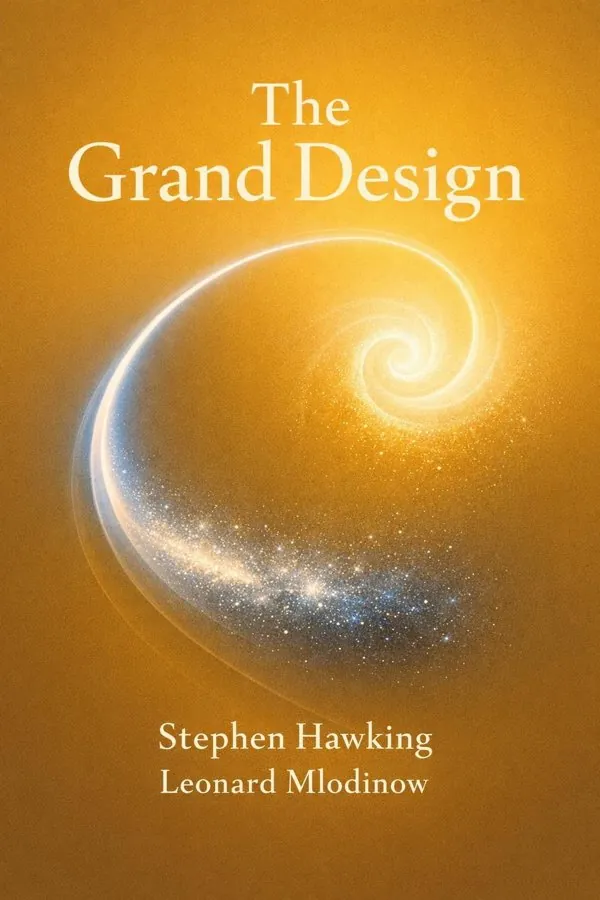
The Grand Design: Summary & Key Insights
by Stephen Hawking, Leonard Mlodinow
 10 min10 chaptersAudio available
Key Takeaways from The Grand Design
What if reality is not something we simply see, but something we interpret through mental and scientific frameworks?
Humanity has always searched for order in the heavens, but the way we explain that order has changed dramatically.
For centuries, science seemed to support a comforting idea: if we knew the position and motion of every particle, we could predict the future exactly.
We often imagine that the universe exists in a fully defined state whether or not anyone looks at it.
We tend to think of history as a single line: first this happened, then that, leading inevitably to the present.
What Is The Grand Design About?
The Grand Design by Stephen Hawking, Leonard Mlodinow is a popular_sci book spanning 10 pages. Why does the universe exist at all? Why do the laws of nature take the form they do, and do we need a creator to explain them? In The Grand Design, Stephen Hawking and Leonard Mlodinow tackle these immense questions with the tools of modern physics rather than theology or metaphysics. The book argues that recent advances in quantum theory, cosmology, and M-theory allow us to think about the origin of the universe in a radically new way: reality may be far stranger, more mathematical, and less intuitively “objective” than common sense suggests. At the heart of the book is a provocative idea called model-dependent realism, which claims that what we call reality is inseparable from the scientific models we use to describe it. From the collapse of classical determinism to the possibility of multiple universes, Hawking and Mlodinow guide readers through concepts that reshape how we think about existence itself. Their authority is unmatched: Hawking was one of the most influential theoretical physicists of the modern era, and Mlodinow is a gifted science communicator who makes difficult ideas understandable without draining them of depth.
This FizzRead summary covers all 10 key chapters of The Grand Design in approximately 10 minutes, distilling the most important ideas, arguments, and takeaways from Stephen Hawking, Leonard Mlodinow's work. Also available as an audio summary and Key Quotes Podcast.
The Grand Design
Why does the universe exist at all? Why do the laws of nature take the form they do, and do we need a creator to explain them? In The Grand Design, Stephen Hawking and Leonard Mlodinow tackle these immense questions with the tools of modern physics rather than theology or metaphysics. The book argues that recent advances in quantum theory, cosmology, and M-theory allow us to think about the origin of the universe in a radically new way: reality may be far stranger, more mathematical, and less intuitively “objective” than common sense suggests. At the heart of the book is a provocative idea called model-dependent realism, which claims that what we call reality is inseparable from the scientific models we use to describe it. From the collapse of classical determinism to the possibility of multiple universes, Hawking and Mlodinow guide readers through concepts that reshape how we think about existence itself. Their authority is unmatched: Hawking was one of the most influential theoretical physicists of the modern era, and Mlodinow is a gifted science communicator who makes difficult ideas understandable without draining them of depth.
Who Should Read The Grand Design?
This book is perfect for anyone interested in popular_sci and looking to gain actionable insights in a short read. Whether you're a student, professional, or lifelong learner, the key ideas from The Grand Design by Stephen Hawking, Leonard Mlodinow will help you think differently.
- ✓Readers who enjoy popular_sci and want practical takeaways
- ✓Professionals looking to apply new ideas to their work and life
- ✓Anyone who wants the core insights of The Grand Design in just 10 minutes
Want the full summary?
Get instant access to this book summary and 100K+ more with Fizz Moment.
Get Free SummaryAvailable on App Store • Free to download
Key Chapters
What if reality is not something we simply see, but something we interpret through mental and scientific frameworks? One of the book’s most important ideas is model-dependent realism, the claim that there is no single, direct, God’s-eye view of reality available to us. Instead, human beings understand the world through models, and those models are judged not by whether they perfectly mirror some hidden essence, but by whether they explain observations and make accurate predictions. This is a subtle but powerful shift. It means that two different theories can both be useful descriptions of the same phenomenon if each works within its domain.
Hawking and Mlodinow illustrate this with familiar examples. We say the sun “rises,” even though we know Earth rotates. Both the Earth-centered view and the sun-centered view can predict certain events, but one provides a broader and more elegant framework. In science, then, truth is often practical and model-based rather than absolute in the everyday philosophical sense.
This matters far beyond cosmology. In ordinary life, we also rely on models: economic forecasts, weather maps, medical diagnoses, and even personal beliefs about other people. None is perfect, but some are more useful, coherent, and predictive than others. The lesson is not that truth is meaningless, but that knowledge is always mediated.
Actionable takeaway: When evaluating any explanation, ask not “Is this the final truth?” but “How well does this model explain the evidence and help me predict what happens next?”
Humanity has always searched for order in the heavens, but the way we explain that order has changed dramatically. The book traces a sweeping intellectual arc from ancient myth and philosophy to the mathematical laws of modern physics. Early thinkers such as Aristotle imagined a cosmos governed by purpose and natural hierarchy, where Earth sat at the center and heavenly bodies moved in perfect circles. This worldview felt intuitive because it aligned with everyday experience. Yet intuition turned out to be a poor guide to the deeper structure of the universe.
The Scientific Revolution transformed the question. Copernicus displaced Earth from the center, Kepler replaced perfect circles with ellipses, Galileo emphasized observation, and Newton unified celestial and earthly motion under a single mathematical framework. Suddenly, the motions of planets and falling apples obeyed the same laws. This was not just a scientific breakthrough; it changed the human self-image. The universe no longer seemed built around us.
Hawking and Mlodinow use this history to show that scientific progress often comes from abandoning what feels obvious in favor of what explains more. The development of science is therefore not a straight accumulation of facts, but a series of conceptual revolutions. Today’s theories stand on that history while also challenging common sense in new ways.
In practical terms, this idea encourages intellectual humility. Many things that appear self-evident may be artifacts of limited perspective. Good inquiry requires curiosity, evidence, and the willingness to revise old assumptions.
Actionable takeaway: Treat your intuitions as starting points, not final authorities; the best explanations often emerge when evidence forces you beyond what feels obvious.
For centuries, science seemed to support a comforting idea: if we knew the position and motion of every particle, we could predict the future exactly. This classical determinism reached its clearest form in Newtonian physics and later in Laplace’s vision of a universe operating like a perfect clock. But quantum mechanics shattered that certainty. At the smallest scales, nature does not behave like a machine with perfectly knowable parts. Instead, outcomes are described in terms of probabilities, uncertainties, and superpositions.
Hawking and Mlodinow explain that this does not mean science has failed. Rather, it means the universe is built differently than classical physics assumed. Quantum theory is astonishingly successful at predicting experimental results, yet it forces us to abandon the idea that particles have definite properties independent of measurement in the way common sense suggests. We can predict distributions of outcomes with extraordinary accuracy, but not always a single predetermined event.
This shift has deep philosophical consequences. It limits the dream of total certainty and challenges the notion that the universe unfolds in one uniquely fixed way. It also opens the door to modern cosmological ideas about how the universe itself may have originated.
There is a practical lesson here too. In everyday decision-making, we often seek total control before acting. But much of life resembles quantum thinking more than classical certainty: we operate under incomplete information and must reason in probabilities. Investors diversify, doctors assess risks, and leaders prepare for multiple outcomes.
Actionable takeaway: Replace the demand for absolute certainty with probabilistic thinking; make better decisions by asking what is likely, not what is guaranteed.
We often imagine that the universe exists in a fully defined state whether or not anyone looks at it. Modern physics complicates that picture. In quantum mechanics, observation is not merely passive recording; it plays a role in determining which of many possible outcomes becomes actual in a specific event. Hawking and Mlodinow use this insight to challenge naive realism, the assumption that the world simply sits “out there” in a fixed, observer-independent form exactly as we perceive it.
This does not mean human consciousness magically creates reality. Rather, measurement is an interaction, and the result we observe depends on the setup, the questions asked, and the framework used. The famous double-slit experiment captures this beautifully: particles behave differently depending on whether we observe their paths. The world at the quantum level is not like a hidden billiard table waiting to be photographed. It is better understood as a set of possibilities constrained and revealed through interaction.
The broader significance is profound. Every instrument, language system, and conceptual scheme highlights some features while obscuring others. A microscope reveals one world, a telescope another. Economic data, psychological assessments, and legal categories also shape what becomes visible in human affairs.
This insight encourages care in interpretation. What we measure depends partly on how we measure. In business, education, and policy, metrics influence behavior. If a school measures only test scores, it may neglect curiosity and character. If a company measures only quarterly profit, it may undermine long-term health.
Actionable takeaway: Before trusting any result, examine the lens that produced it; better questions and better measurement tools often lead to better understanding.
We tend to think of history as a single line: first this happened, then that, leading inevitably to the present. Hawking and Mlodinow introduce a more radical perspective drawn from quantum cosmology. According to the idea of “top-down” cosmology, the universe may not have one unique past independent of observation. Instead, many possible histories contribute to the present state, and the one we describe depends partly on the conditions we observe now.
This is deeply counterintuitive because we are used to explaining the present by reconstructing a single past. But in quantum physics, systems are often described as sums over many possible paths. Applied to the universe as a whole, this suggests that the cosmos does not need one fixed, classical narrative from the beginning of time onward. The present selects, in a sense, the histories relevant to it.
This idea is not easy, but its importance lies in how it reframes explanation. Instead of asking for one neat story of cosmic origins, we may need to accept that the universe is fundamentally described by a range of possibilities. Scientific understanding becomes less like uncovering a single prewritten script and more like identifying which histories are consistent with current observations.
In everyday life, this offers a useful analogy. Human lives also contain many unrealized paths. Looking backward, we often invent a tidy story that makes our current situation seem inevitable. In truth, many possible routes could have led here.
Actionable takeaway: Be wary of overly simple origin stories, whether in science or personal life; often the present emerges from many possible paths, not one inevitable chain.
One of the boldest themes in The Grand Design is that the universe can be explained through laws of nature that operate consistently, without requiring supernatural intervention to fill the gaps. Hawking and Mlodinow do not argue that science has answered every question in complete detail. Rather, they argue that scientific laws increasingly account for phenomena once attributed to mystery, design, or divine action. Gravity, quantum mechanics, relativity, and thermodynamics together provide a framework in which cosmic evolution becomes intelligible.
This reflects a major transition in human thought. In earlier eras, unexplained events were often assigned to hidden purposes or gods. Thunder, disease, eclipses, and planetary motion all carried supernatural interpretations. As scientific understanding advanced, lawful explanations replaced many of these narratives. The authors extend this logic to the universe itself: if laws can explain how stars form and galaxies evolve, they may also explain how universes begin.
This perspective has practical importance because it promotes disciplined inquiry. If we assume an event is beyond explanation, investigation stops. If we assume there is an underlying lawful structure, curiosity continues. That mindset drives innovation in medicine, engineering, climate science, and technology.
At the same time, the book invites readers to distinguish between meaning and mechanism. Science may explain how things happen without necessarily resolving every existential or moral question humans care about. But when it comes to physical events, lawful explanation remains the most productive path.
Actionable takeaway: When faced with something mysterious, resist the temptation to stop at wonder alone; ask what underlying rules or mechanisms might make the phenomenon intelligible.
Perhaps the book’s most famous and controversial claim is that the universe can create itself from nothing, given the laws of physics. Hawking and Mlodinow argue that because there is a law like gravity, the universe can and will create itself from nothing. Here, “nothing” is not always the everyday idea of absolute emptiness, but a quantum vacuum or state in which spontaneous fluctuations are possible. In quantum theory, empty space is not truly empty; it is dynamic, active, and structured by physical laws.
The authors’ point is not casual atheism for shock value. Their larger argument is that the origin of the universe need not be explained by invoking a divine designer if the laws of physics already allow universes to emerge. Quantum cosmology offers models in which space and time themselves can arise under lawful conditions. This moves the creation question from theology toward physics.
Even readers who remain unconvinced must grapple with the intellectual challenge here: if science can provide a mechanism for cosmic origins, the explanatory role traditionally assigned to a creator changes. The debate shifts from “Who made the universe?” to “What laws permit a universe to exist?”
A practical analogy appears in other fields. We once sought external agents to explain disease, weather, or motion; later we found self-organizing mechanisms and natural laws. Complexity can emerge without central planning, from ecosystems to markets to neural networks.
Actionable takeaway: When considering origins, look first for generative processes built into the system itself; many complex outcomes arise naturally once the underlying rules are in place.
If the universe is governed by elegant laws, why do our best theories remain fragmented? The Grand Design presents M-theory as the leading candidate for a unified framework capable of combining different versions of string theory and potentially reconciling quantum mechanics with gravity. Rather than being one simple equation already completed, M-theory is more like a family of related models that describe reality from different angles. This fits neatly with the book’s theme of model-dependent realism: one complete description may require multiple overlapping perspectives.
In earlier physics, the dream was a single tidy theory of everything. Hawking and Mlodinow suggest the final picture may be less singular and more patchwork-like, similar to a map made of different charts. A flat city map, a subway map, and a topographical map all depict the same region but emphasize different features. None alone is sufficient for every purpose. In a similar way, M-theory may offer a set of complementary formulations that together describe the universe more fully than any one model can.
This idea is scientifically significant because it provides a possible way to integrate the large-scale structure of relativity with the probabilistic micro-world of quantum theory. It also explains why nature may appear mathematically rich rather than reducible to one familiar picture.
Outside physics, the lesson is valuable. Complex systems often require multiple valid models: businesses use financial, behavioral, and operational frameworks; health requires biological, psychological, and social perspectives.
Actionable takeaway: For difficult problems, don’t force one all-purpose explanation; use complementary models and let each illuminate a different dimension of reality.
The physical constants of our universe appear astonishingly precise. If gravity were slightly stronger or weaker, if the electromagnetic force differed, or if the cosmological constant were much larger, stars, chemistry, and life as we know it might never have formed. This apparent fine-tuning has often been used as evidence for design. Hawking and Mlodinow offer a different possibility: our universe may be just one among many, each with different laws or constants, and we observe this one precisely because it permits observers.
This is where the multiverse and the anthropic principle intersect. The anthropic principle does not claim that the universe was made for us. Rather, it states that any universe we can observe must be compatible with our existence. In a vast ensemble of possible universes, it is not surprising that at least some would allow life. We find ourselves in one of those not because it was chosen for us, but because universes hostile to life contain no one to ask the question.
The idea is controversial because direct evidence for other universes is difficult to obtain. Still, as a conceptual tool, it addresses one of cosmology’s deepest puzzles. It shifts the question from “Why was our universe designed this way?” to “Could many universes exist, with ours being one habitable case among them?”
In everyday reasoning, this reminds us to consider selection effects. Survivors of risky ventures often seem uniquely gifted, but we overlook the many unseen failures.
Actionable takeaway: When something looks extraordinarily tailored, ask whether selection bias may be at work before concluding intentional design.
Few ideas are more unsettling and liberating than the realization that the universe was not built around human intuition, comfort, or importance. Across the book, Hawking and Mlodinow show that each major scientific advance has displaced us from a privileged center. Earth is not the center of the cosmos. Classical certainty is not the final logic of nature. Reality is not simply what it appears to be. Even our universe may not be the only one. Yet this apparent demotion carries a profound gain: a more honest and expansive understanding of existence.
The main contribution of The Grand Design is not only its specific cosmological claims, but its philosophical posture. It argues that the deepest questions are not off-limits to science. We do not honor mystery by refusing to investigate it. We honor it by developing better models, testing them, and accepting conclusions that may challenge inherited assumptions.
For readers, this is both an intellectual and emotional invitation. The universe can feel colder when stripped of human-centered design, but it also becomes more wondrous. We are small, yet capable of understanding laws that govern galaxies and quantum fields. That is a remarkable achievement.
In practical life, the same mindset matters. Progress comes when we trade ego for inquiry, certainty for evidence, and comforting stories for better explanations. Whether in science, leadership, or personal growth, reality rewards those willing to revise their worldview.
Actionable takeaway: Let curiosity outrank comfort; the willingness to update your beliefs is one of the clearest signs of intellectual maturity.
All Chapters in The Grand Design
About the Authors
Stephen Hawking was a British theoretical physicist, cosmologist, and science writer whose work reshaped modern understanding of black holes, singularities, and the origins of the universe. Despite living for decades with ALS, he became one of the most influential scientific thinkers of the twentieth and twenty-first centuries, as well as a global symbol of intellectual courage. His bestselling A Brief History of Time brought cosmology to a mass audience. Leonard Mlodinow is an American physicist and acclaimed popular science author known for translating complex ideas into lucid, engaging prose. With a background in both physics and storytelling, he has written widely on science, probability, and human behavior. Together, Hawking and Mlodinow combined deep theoretical insight with exceptional clarity, making The Grand Design both rigorous and accessible.
Get This Summary in Your Preferred Format
Read or listen to the The Grand Design summary by Stephen Hawking, Leonard Mlodinow anytime, anywhere. FizzRead offers multiple formats so you can learn on your terms — all free.
Available formats: App · Audio · PDF · EPUB — All included free with FizzRead
Download The Grand Design PDF and EPUB Summary
Key Quotes from The Grand Design
“What if reality is not something we simply see, but something we interpret through mental and scientific frameworks?”
“Humanity has always searched for order in the heavens, but the way we explain that order has changed dramatically.”
“For centuries, science seemed to support a comforting idea: if we knew the position and motion of every particle, we could predict the future exactly.”
“We often imagine that the universe exists in a fully defined state whether or not anyone looks at it.”
“We tend to think of history as a single line: first this happened, then that, leading inevitably to the present.”
Frequently Asked Questions about The Grand Design
The Grand Design by Stephen Hawking, Leonard Mlodinow is a popular_sci book that explores key ideas across 10 chapters. Why does the universe exist at all? Why do the laws of nature take the form they do, and do we need a creator to explain them? In The Grand Design, Stephen Hawking and Leonard Mlodinow tackle these immense questions with the tools of modern physics rather than theology or metaphysics. The book argues that recent advances in quantum theory, cosmology, and M-theory allow us to think about the origin of the universe in a radically new way: reality may be far stranger, more mathematical, and less intuitively “objective” than common sense suggests. At the heart of the book is a provocative idea called model-dependent realism, which claims that what we call reality is inseparable from the scientific models we use to describe it. From the collapse of classical determinism to the possibility of multiple universes, Hawking and Mlodinow guide readers through concepts that reshape how we think about existence itself. Their authority is unmatched: Hawking was one of the most influential theoretical physicists of the modern era, and Mlodinow is a gifted science communicator who makes difficult ideas understandable without draining them of depth.
You Might Also Like

Structures: Or Why Things Don"t Fall Down
J.E. Gordon
10 min
The Road to Wigan Pier
George Orwell
10 min
Bonk: The Curious Coupling of Science and Sex
Mary Roach
10 min
First Bite: How We Learn to Eat
Bee Wilson
10 min
In Pursuit Of The Unknown: 17 Equations That Changed The World
Ian Stewart
10 min
Napoleon's Buttons: 17 Molecules That Changed History
Penny Le Couteur and Jay Burreson
10 minBrowse by Category
Ready to read The Grand Design?
Get the full summary and 100K+ more books with Fizz Moment.