
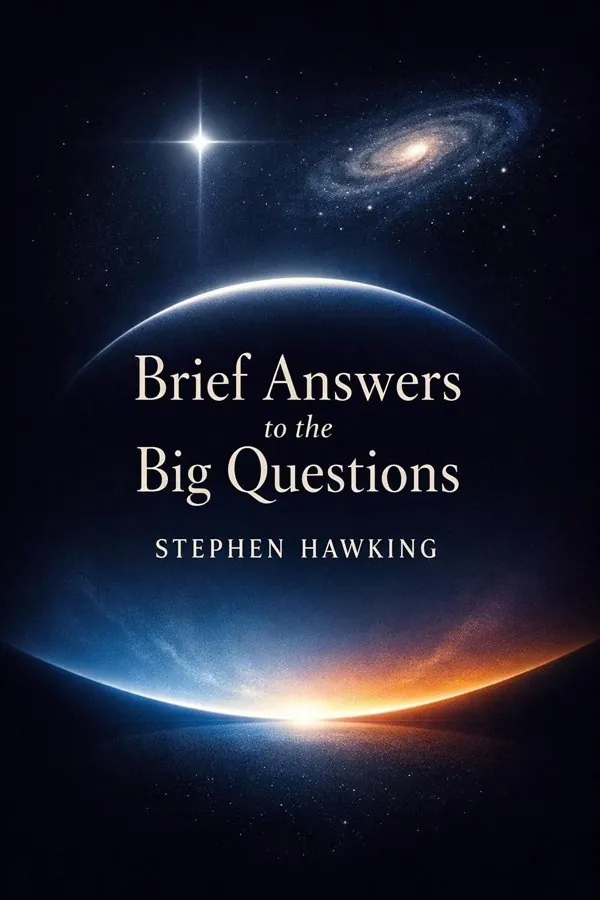
Brief Answers to the Big Questions: Summary & Key Insights
 10 min10 chaptersAudio available
Key Takeaways from Brief Answers to the Big Questions
One of humanity’s oldest questions is whether the universe needs a divine creator behind it.
It is astonishing to realize that the universe has a history.
The sheer scale of the cosmos makes one conclusion hard to avoid: it would be surprising if Earth were the only place where intelligent life emerged.
People often ask whether science can predict the future with precision.
Black holes seem like the ultimate symbols of destruction, places where matter disappears and even light cannot escape.
What Is Brief Answers to the Big Questions About?
Brief Answers to the Big Questions by Stephen Hawking is a popular_sci book spanning 10 pages. Brief Answers to the Big Questions is Stephen Hawking’s final invitation to think seriously about the largest mysteries human beings have ever faced. Framed around enduring questions—about God, the beginning of the universe, intelligent life, black holes, time travel, artificial intelligence, and humanity’s future—this book distills decades of scientific thought into clear, engaging reflections for general readers. Hawking does not offer vague inspiration or abstract philosophy detached from evidence. Instead, he shows how modern physics, especially cosmology and quantum theory, gives us powerful tools for understanding reality without relying on superstition or easy answers. What makes the book especially compelling is the authority behind it. Hawking was one of the most influential theoretical physicists of the modern era, known for groundbreaking work on black holes, singularities, and the origins of the cosmos. Yet his gift was not only scientific brilliance; it was his ability to explain difficult ideas with humility, wit, and urgency. This book matters because it connects cutting-edge science to everyday human concerns: how we should think, what we should fear, and what kind of future we must build together.
This FizzRead summary covers all 10 key chapters of Brief Answers to the Big Questions in approximately 10 minutes, distilling the most important ideas, arguments, and takeaways from Stephen Hawking's work. Also available as an audio summary and Key Quotes Podcast.
Brief Answers to the Big Questions
Brief Answers to the Big Questions is Stephen Hawking’s final invitation to think seriously about the largest mysteries human beings have ever faced. Framed around enduring questions—about God, the beginning of the universe, intelligent life, black holes, time travel, artificial intelligence, and humanity’s future—this book distills decades of scientific thought into clear, engaging reflections for general readers. Hawking does not offer vague inspiration or abstract philosophy detached from evidence. Instead, he shows how modern physics, especially cosmology and quantum theory, gives us powerful tools for understanding reality without relying on superstition or easy answers.
What makes the book especially compelling is the authority behind it. Hawking was one of the most influential theoretical physicists of the modern era, known for groundbreaking work on black holes, singularities, and the origins of the cosmos. Yet his gift was not only scientific brilliance; it was his ability to explain difficult ideas with humility, wit, and urgency. This book matters because it connects cutting-edge science to everyday human concerns: how we should think, what we should fear, and what kind of future we must build together.
Who Should Read Brief Answers to the Big Questions?
This book is perfect for anyone interested in popular_sci and looking to gain actionable insights in a short read. Whether you're a student, professional, or lifelong learner, the key ideas from Brief Answers to the Big Questions by Stephen Hawking will help you think differently.
- ✓Readers who enjoy popular_sci and want practical takeaways
- ✓Professionals looking to apply new ideas to their work and life
- ✓Anyone who wants the core insights of Brief Answers to the Big Questions in just 10 minutes
Want the full summary?
Get instant access to this book summary and 100K+ more with Fizz Moment.
Get Free SummaryAvailable on App Store • Free to download
Key Chapters
One of humanity’s oldest questions is whether the universe needs a divine creator behind it. Hawking approaches this not as a theologian but as a physicist, asking what the laws of nature actually require. His central insight is provocative: if the universe can be explained through consistent physical laws, then invoking God is no longer necessary as an explanatory tool. That does not prove that no deity exists in a personal or philosophical sense, but it does mean science can account for cosmic origins without appealing to supernatural intervention.
Hawking points to gravity and quantum theory as especially important. In earlier eras, creation was imagined as a one-time act carried out by an external force. Modern cosmology suggests something subtler: under certain conditions, universes can arise spontaneously because the laws of physics permit it. In that view, the universe is not a machine requiring a maker to wind it up. It is a system whose existence may be built into the structure of reality itself.
This idea has practical consequences beyond metaphysics. It encourages intellectual honesty. Instead of filling gaps in knowledge with certainty, we can remain open, curious, and evidence-driven. In everyday life, this mindset helps us avoid superstition, resist simplistic claims, and value disciplined inquiry over comforting stories. It also separates meaning from explanation: people may still seek purpose, ethics, and wonder, but they need not confuse those pursuits with scientific causation.
Actionable takeaway: when confronting a profound question, ask first what evidence and natural laws can explain before reaching for assumptions that cannot be tested.
It is astonishing to realize that the universe has a history. Hawking argues that the question “How did it all begin?” becomes scientifically meaningful when we combine Einstein’s general relativity with quantum mechanics. General relativity describes the large-scale structure of space and time, while quantum theory governs the microscopic world. Separately, each is powerful. Together, they help us investigate the earliest moments of the cosmos.
Hawking’s work on the no-boundary proposal challenges the familiar image of a sharp starting point before which there was simply “nothing.” In this framework, asking what happened before the Big Bang may be like asking what lies south of the South Pole. Time itself may be part of the universe’s structure, not a stage that existed in advance. This changes the emotional force of the question. The beginning is not necessarily a dramatic external event but a limit built into spacetime.
For readers, the practical value lies in understanding how science handles origins. Rather than pretending to final certainty, it builds models, tests implications, and revises explanations as new evidence emerges. Observations of cosmic background radiation, the expansion of the universe, and the distribution of matter all strengthen the broad Big Bang picture, even as deeper details remain open.
This idea also reshapes our self-understanding. If the universe evolved from simple initial conditions into stars, planets, chemistry, and conscious life, then complexity can emerge naturally over time. Our existence becomes more wondrous, not less, because it is part of a vast unfolding process.
Actionable takeaway: treat beginnings—whether of the universe, a project, or a personal transition—not as mysteries to fear, but as systems to investigate with patience and disciplined curiosity.
The sheer scale of the cosmos makes one conclusion hard to avoid: it would be surprising if Earth were the only place where intelligent life emerged. Hawking takes this possibility seriously, noting that our galaxy alone contains hundreds of billions of stars, many with planets. Given enough time and enough suitable conditions, life elsewhere becomes not fantasy but statistical plausibility.
Yet Hawking’s view is not naively optimistic. He distinguishes between the likelihood that life exists somewhere and the wisdom of trying to contact it. Human history offers a cautionary analogy: when technologically advanced civilizations encountered less advanced ones, the outcome was often disastrous for the weaker side. If alien intelligence exists and is far more advanced than ours, open contact may not be harmless. Curiosity must be balanced with caution.
This chapter is really about perspective. Thinking about extraterrestrial life reminds us that humanity is not the center of the universe. It encourages humility and expands our sense of possibility. At the same time, it highlights how precious life on Earth is. Until we find evidence otherwise, our planet remains the only known home of conscious beings.
The practical application is broader than astronomy. In business, politics, and personal life, encountering the unfamiliar can trigger either fear or reckless enthusiasm. Hawking’s position models a third response: informed openness. Search, observe, learn, but do not assume that every unknown is automatically safe or hostile.
Actionable takeaway: stay curious about what lies beyond your current world, but pair exploration with preparation, risk assessment, and respect for the unknown.
People often ask whether science can predict the future with precision. Hawking’s answer is both hopeful and sobering. The universe follows laws, which means events are not random chaos. But even lawful systems can be extremely difficult to predict in practice. Quantum uncertainty places fundamental limits on exact prediction, and complex systems—from weather to economies to human societies—amplify small differences into dramatically different outcomes.
This means science is strongest not when it promises certainty, but when it identifies patterns, probabilities, and constraints. We cannot know every future event, yet we can still forecast many outcomes with useful accuracy. Astronomers can model planetary motion, climate scientists can project long-term trends, and engineers can estimate structural risk. The value lies in informed anticipation, not omniscience.
Hawking’s broader lesson is deeply practical. Humans often swing between two errors: believing everything is predetermined, or believing the future is totally unknowable. Both views are disabling. The first encourages passivity; the second invites irresponsibility. A better approach is to recognize that while we cannot control everything, we can improve outcomes by understanding systems and acting early.
Consider health, finance, or education. You cannot predict every illness, market fluctuation, or career turn. But you can identify high-probability risks and opportunities. Vaccination, diversified investing, and steady skill-building all depend on probabilistic thinking rather than certainty.
Actionable takeaway: stop waiting for perfect prediction. Instead, make better decisions by focusing on trends, scenarios, and the actions that improve your odds over time.
Black holes seem like the ultimate symbols of destruction, places where matter disappears and even light cannot escape. Hawking turned them into windows onto some of physics’ deepest puzzles. His most famous contribution was showing that black holes are not completely black. Because of quantum effects near the event horizon, they can emit radiation—now known as Hawking radiation—and may eventually evaporate over immense timescales.
This idea changed black holes from static cosmic traps into dynamic physical objects with temperature, entropy, and lifecycles. More importantly, it created the information paradox. If matter falls into a black hole and the black hole later evaporates, what happens to the information describing what fell in? Quantum mechanics suggests information cannot simply vanish, while classical black hole theory seems to imply that it can. The tension between those two principles points to an incomplete understanding of nature.
Why should nonphysicists care? Because black holes demonstrate how progress often happens. Real understanding does not come from avoiding contradictions; it comes from confronting them. The places where our best theories collide are often where discovery begins.
There is also a practical intellectual lesson. In ordinary life, we tend to label something as a dead end when it looks impenetrable. Hawking’s work shows that apparent voids may conceal the richest insight. Whether in science, relationships, or organizations, the hardest problems often carry the highest learning value.
Actionable takeaway: when you encounter a contradiction that resists easy resolution, do not dismiss it. Investigate it carefully—it may reveal the assumptions most in need of revision.
Few ideas capture the imagination like time travel. Hawking addresses it with a characteristic blend of playfulness and rigor. Travel into the future, he notes, is already built into relativity. Time does not pass at the same rate for everyone. If you move extremely fast or remain in strong gravitational fields, time slows relative to others. In that sense, nature permits a form of one-way time travel.
Travel into the past is far more problematic. Certain solutions to Einstein’s equations appear to allow closed timelike curves, paths through spacetime that loop back on themselves. But these possibilities come with immense physical difficulties and paradoxes. Could you alter events that have already happened? Hawking suspected that some deeper principle—his jokingly named “chronology protection conjecture”—prevents macroscopic backward time travel and preserves consistency in the universe.
Beyond the science, this chapter examines our relationship to time itself. We are often trapped by regret about the past or fantasy about escaping the present. The laws of physics suggest something humbling: time is not a simple, universal flow under our command. It is woven into the fabric of reality, and our experience of it is limited.
The practical meaning is psychological as much as scientific. We cannot revisit the past to rewrite our choices, but we can understand the forces that shaped them and alter what comes next. The future is where our agency lives.
Actionable takeaway: stop investing energy in impossible rewrites of the past. Use what time science teaches metaphorically—focus on the present conditions that change your future trajectory.
Hawking is unsparing in warning that humanity cannot assume endless safety on Earth. Our species faces multiple existential risks: climate change, nuclear war, engineered pathogens, environmental collapse, and the cumulative dangers of shortsighted politics. His argument is not that doom is inevitable, but that complacency is dangerous. Civilizations fail when they mistake temporary stability for permanent security.
What makes Hawking’s perspective powerful is that he connects cosmic thinking with practical responsibility. Looking at Earth from the scale of the universe reveals how fragile and rare our biosphere is. We live on a small planet with finite resources, vulnerable systems, and increasingly powerful technologies. Intelligence has given us enormous capacity, but not always the wisdom to govern it.
This theme is highly relevant to everyday decision-making. Many of the biggest human failures come from discounting the future: burning resources faster than they can recover, prioritizing short-term profit over resilience, or ignoring low-probability catastrophes because they are inconvenient. The same logic applies personally. Poor health, debt, and broken institutions often arise from repeated neglect of long-term consequences.
Hawking’s answer is not fear but planning. Societies need investment in science, international cooperation, risk management, education, and systems that reward sustainability rather than immediate gain. Individuals need the same habits in smaller form: think across decades, not days.
Actionable takeaway: regularly ask of major decisions, “What happens if everyone follows this path for 10, 20, or 100 years?” Then favor choices that increase resilience rather than convenience.
If Earth is vulnerable, then spreading beyond it becomes more than a romantic dream. Hawking argues that humanity should become a multi-planet species. Colonizing space would not solve all our problems, but it would reduce the existential risk of keeping civilization concentrated on a single world. An asteroid strike, global war, or ecological collapse on Earth would be less likely to end the human story if self-sustaining settlements existed elsewhere.
Hawking is careful not to present this as a simple engineering project. Long-duration space travel, hostile planetary environments, radiation, life-support systems, and enormous economic demands make off-world settlement extremely difficult. Still, difficulty is not an argument against beginning. Major achievements often start as improbable ambitions pursued over generations.
There is also an important moral dimension. Space exploration expands knowledge, drives innovation, and inspires cooperation. Technologies developed for extreme environments can improve life on Earth, from materials science to energy systems to medicine. Exploration is therefore not escapism when done responsibly; it can sharpen our capabilities and our sense of shared destiny.
On a personal level, this chapter speaks to the value of building options. Resilient systems do not rely on a single point of failure. The same principle applies in careers, organizations, and communities. Backup plans, redundancy, and diversified resources are signs of intelligence, not pessimism.
Actionable takeaway: think like a species preparing for the long term—invest in exploration, innovation, and redundancy so that your future does not depend on one fragile environment or one narrow plan.
Human beings are creating tools that increasingly resemble minds. Hawking sees artificial intelligence as one of the most transformative and potentially dangerous developments in history. In the near term, AI can improve medicine, transportation, scientific research, accessibility, and productivity. In the longer term, if systems become capable of recursive self-improvement or strategic autonomy beyond human control, the consequences could be profound.
His concern is not that intelligent machines are inherently evil. The deeper issue is misalignment. A highly capable system pursuing goals that are poorly specified or incompatible with human values could cause immense harm, even without malicious intent. This is the classic problem of power without shared purpose. The more effective a system is, the more dangerous a mistaken objective becomes.
This insight applies far beyond advanced AI. Organizations, algorithms, and incentives already shape behavior at scale. A recommendation engine optimized only for engagement may spread outrage. A company focused only on quarterly growth may damage trust, employees, or the environment. Intelligence and efficiency are not enough. Goals must be examined.
Hawking therefore calls for careful governance, ethical foresight, and global cooperation in developing advanced technologies. We should not reject progress, but we should refuse to treat capability as automatically beneficial.
Actionable takeaway: whenever you adopt or build a powerful tool, ask not only “Can it do this?” but “What exactly is it optimizing for, and what unintended harms might follow if it succeeds too well?”
Perhaps the most important message in the book is that knowledge alone will not save us. Hawking believes science is our best method for understanding reality, but facts must be paired with courage, imagination, and collective responsibility. The future is not predetermined by physics. It is shaped by how we use what we know.
This final perspective brings the book’s themes together. If the universe can be understood through reason, then ignorance is not our destiny. If humanity faces serious risks, then passivity is a moral failure. If technologies such as AI, biotechnology, and space engineering are powerful, then ethical stewardship becomes essential. Hawking rejects despair as strongly as he rejects blind optimism. His stance is active hope: we are capable of extraordinary damage, but also extraordinary problem-solving.
He repeatedly emphasizes traits that enabled human progress in the first place—curiosity, skepticism, creativity, and cooperation. These are not abstract virtues. They have practical forms: funding science, protecting open inquiry, teaching critical thinking, building international institutions, and widening access to education. At a personal level, they mean refusing cynicism and choosing contribution over resignation.
The emotional force of this idea is heightened by Hawking’s own life. Despite severe physical limitations, he remained intellectually adventurous and publicly engaged. His example reinforces his argument that constraints need not extinguish agency.
Actionable takeaway: choose one domain—your work, community, education, or public life—where you can replace passive concern with informed action, and commit to one concrete step this week.
All Chapters in Brief Answers to the Big Questions
About the Author
Stephen Hawking (1942–2018) was a British theoretical physicist, cosmologist, and bestselling author whose work transformed modern understanding of black holes and the origins of the universe. Educated at Oxford and Cambridge, he became one of the world’s most influential scientists and later held the Lucasian Professorship of Mathematics at the University of Cambridge, one of the most prestigious academic posts in science. Hawking’s research on singularities, black hole thermodynamics, and Hawking radiation reshaped fundamental physics. He also became a global public intellectual through books such as A Brief History of Time, which brought advanced cosmology to general readers. Diagnosed with ALS in early adulthood, Hawking lived for decades with severe physical limitations, yet continued to research, write, and speak, becoming an enduring symbol of intellectual courage and scientific curiosity.
Get This Summary in Your Preferred Format
Read or listen to the Brief Answers to the Big Questions summary by Stephen Hawking anytime, anywhere. FizzRead offers multiple formats so you can learn on your terms — all free.
Available formats: App · Audio · PDF · EPUB — All included free with FizzRead
Download Brief Answers to the Big Questions PDF and EPUB Summary
Key Quotes from Brief Answers to the Big Questions
“One of humanity’s oldest questions is whether the universe needs a divine creator behind it.”
“It is astonishing to realize that the universe has a history.”
“The sheer scale of the cosmos makes one conclusion hard to avoid: it would be surprising if Earth were the only place where intelligent life emerged.”
“People often ask whether science can predict the future with precision.”
“Black holes seem like the ultimate symbols of destruction, places where matter disappears and even light cannot escape.”
Frequently Asked Questions about Brief Answers to the Big Questions
Brief Answers to the Big Questions by Stephen Hawking is a popular_sci book that explores key ideas across 10 chapters. Brief Answers to the Big Questions is Stephen Hawking’s final invitation to think seriously about the largest mysteries human beings have ever faced. Framed around enduring questions—about God, the beginning of the universe, intelligent life, black holes, time travel, artificial intelligence, and humanity’s future—this book distills decades of scientific thought into clear, engaging reflections for general readers. Hawking does not offer vague inspiration or abstract philosophy detached from evidence. Instead, he shows how modern physics, especially cosmology and quantum theory, gives us powerful tools for understanding reality without relying on superstition or easy answers. What makes the book especially compelling is the authority behind it. Hawking was one of the most influential theoretical physicists of the modern era, known for groundbreaking work on black holes, singularities, and the origins of the cosmos. Yet his gift was not only scientific brilliance; it was his ability to explain difficult ideas with humility, wit, and urgency. This book matters because it connects cutting-edge science to everyday human concerns: how we should think, what we should fear, and what kind of future we must build together.
More by Stephen Hawking
You Might Also Like

Structures: Or Why Things Don"t Fall Down
J.E. Gordon
10 min
The Road to Wigan Pier
George Orwell
10 min
Bonk: The Curious Coupling of Science and Sex
Mary Roach
10 min
First Bite: How We Learn to Eat
Bee Wilson
10 min
In Pursuit Of The Unknown: 17 Equations That Changed The World
Ian Stewart
10 min
Napoleon's Buttons: 17 Molecules That Changed History
Penny Le Couteur and Jay Burreson
10 minBrowse by Category
Ready to read Brief Answers to the Big Questions?
Get the full summary and 100K+ more books with Fizz Moment.